

Capital Pivot 2026: Why Energy Majors Are Exiting US Wind for LNG
Industry Risk Analysis: Policy and Costs Trigger Capital Flight from US Offshore Wind
A sharp reversal in U.S. energy policy, combined with persistent cost inflation, has fundamentally altered the risk-return calculation for energy majors, triggering a strategic retreat from capital-intensive U.S. offshore wind projects in favor of cash-generative Liquefied Natural Gas (LNG) assets. This pivot is not a gradual shift but a decisive reallocation of capital away from sectors with high policy and execution uncertainty toward those with proven profitability and established value chains.
- Between 2021 and 2024, European majors like Total Energies aggressively entered the U.S. offshore wind market, securing high-value leases with the expectation of strong government support and long-term growth. The company committed a combined $955 million for leases in the New York Bight and Carolina Long Bay, signaling a firm belief in the sector’s potential under the Biden administration’s 30 GW by 2030 goal.
- Starting in late 2024 and accelerating into 2026, this strategy unraveled due to a combination of rising project costs, which reached an estimated $4.2 million per megawatt, and a dramatic shift in federal policy. The new Trump administration facilitated a full exit for Total Energies, providing a nearly $1 billion reimbursement for its leases, an unprecedented move that transformed a potential stranded asset into liquid capital.
- In contrast, the global LNG market has benefited from sustained tailwinds, including heightened energy security concerns and favorable U.S. natural gas feedstock prices. This has solidified the business case for LNG export projects, making them a more reliable and immediately profitable destination for redeployed capital compared to the long-duration, high-risk profile of U.S. offshore wind.
Investment Pivot: Over $900 M Redirected from Wind Cancellations to LNG Expansion
The strategic pivot is quantified by Total Energies’ direct cancellation of over 4 GW of planned U.S. offshore wind capacity and the immediate redirection of the reimbursed $928 million into U.S. gas infrastructure. This financial maneuver demonstrates a disciplined capital allocation strategy that prioritizes near-term cash flow and return on capital by exiting a challenged market and reinforcing a core business segment.
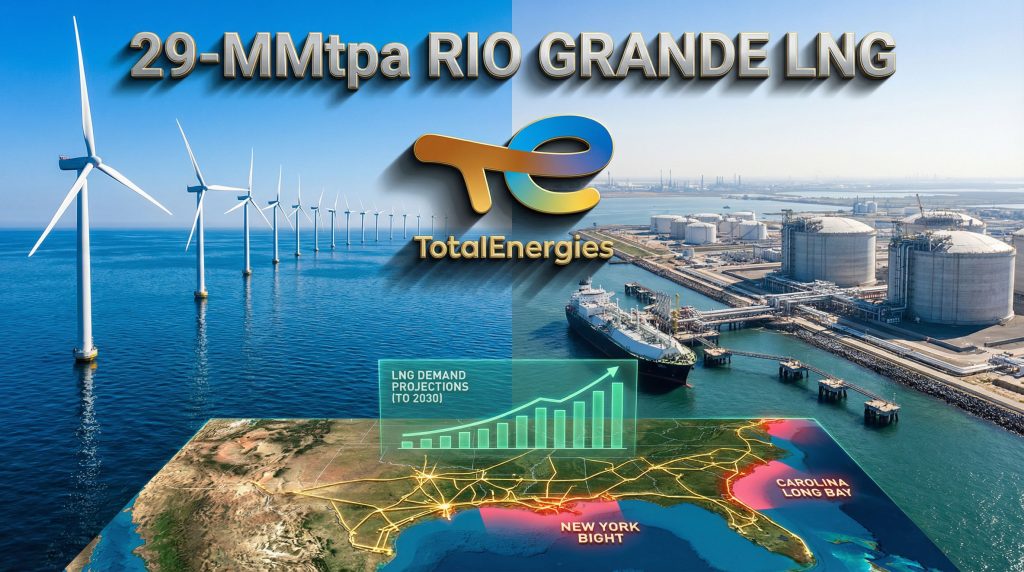
TotalEnergies Pivots From US Wind to LNG
This chart visualizes the specific investment pivot from canceled US offshore wind projects to the Rio Grande LNG facility, directly illustrating the capital redirection mentioned in the section.
(Source: Discovery Alert)
- The decision to abandon the U.S. offshore wind projects was cemented by a formal agreement with the U.S. Department of the Interior in March 2026. The deal not only allowed Total Energies to recover its initial lease payments but also included a pledge not to develop new offshore wind projects in the United States, marking a definitive strategic withdrawal.
- The primary beneficiary of this capital reallocation is the Rio Grande LNG export terminal in Brownsville, Texas, developed by Next Decade. The investment will accelerate the development of the facility’s first four liquefaction trains, deepening Total Energies’ already significant foothold in the U.S. LNG export market, where it accounted for 18% of total volume in 2025.
- A portion of the funds will also be channeled into expanding “upstream conventional oil and gas” production in the U.S., aligning with the company’s two-pillar strategy of using profits from its legacy fossil fuel business to fund its broader energy activities and shareholder returns.
Table: Total Energies’ Capital Reallocation from U.S. Wind to Gas
| Project & Sector | Time Frame | Details and Strategic Purpose | Source |
|---|---|---|---|
| Rio Grande LNG (Trains 1-4) & Upstream Gas | 2026 | Redirected $928 million from wind lease reimbursements to accelerate development of the Rio Grande LNG export facility with partner Next Decade and expand upstream oil and gas production. This move doubles down on a core, high-return business. | Reuters |
| New York Bight & Carolina Long Bay Offshore Wind Leases | March 2026 (Cancellation) | Formally relinquished two offshore wind leases with a combined potential capacity of over 4 GW in an agreement with the U.S. Department of the Interior. The move eliminated exposure to a market deemed “overly expensive” and “marginal.” | Total Energies |
| Attentive Energy Offshore Wind Project | November 2024 (Pause) | Paused development of the 3 GW Attentive Energy offshore wind project following the U.S. presidential election, citing policy uncertainty. This was the first major signal of a strategic retreat from the U.S. wind market. | Bloomberg |
Partnership Realignment: From Renewable JVs to LNG Development Alliances
The strategic shift is mirrored in Total Energies’ partnerships, with the dissolution of its U.S. offshore wind joint ventures and a deepening of its collaborations with LNG project developers. This realignment reflects a move away from partnerships designed for long-term renewable asset development toward alliances that support the expansion of its core, integrated gas value chain.
- The exit from the U.S. wind market resulted in the dissolution of the Attentive Energy joint venture with Corio Generation, which was formed to develop the 3 GW New York Bight project. This unwinds a key renewable partnership that was central to the company’s prior U.S. growth strategy.
- Conversely, Total Energies has strengthened its relationship with Next Decade, the developer of the Rio Grande LNG project. The new investment solidifies an existing partnership and accelerates a project critical to Total Energies’ goal of increasing its LNG sales by 70% by 2030.
- This trend is reinforced by other deals, such as a late 2025 agreement with Continental Resources for Oklahoma gas assets and a February 2026 preliminary agreement with Glenfarne Energy Transition for offtake from the Alaska LNG project, securing feedstock for its expanding global LNG portfolio.
Table: Key Partnerships in Total Energies’ Strategic Pivot
| Partner / Project | Time Frame | Details and Strategic Purpose | Source |
|---|---|---|---|
| Next Decade (Rio Grande LNG) | 2026 | Primary beneficiary of the redirected $928 million investment. The alliance supports the construction of a major U.S. LNG export facility, reinforcing Total Energies’ position as a leading global LNG player. | Houston Chronicle |
| Glenfarne Energy Transition (Alaska LNG) | February 2026 | Signed a preliminary agreement to purchase 2 Mtpa of LNG for 20 years, diversifying its U.S. supply sources beyond the Gulf Coast and strengthening its long-term LNG portfolio. | Total Energies |
| Attentive Energy (Corio Generation) | 2025-2026 (Dissolution) | The joint venture for the New York Bight wind project was effectively ended by Total Energies’ strategic exit. This marks the abandonment of a major renewable development partnership in the U.S. | AOWA |
| En BW (New York Bight Lease) | 2022-2024 | Partnered with German utility En BW to win the New York Bight lease for $795 million. This partnership was part of the initial, aggressive entry into U.S. offshore wind, which has now been reversed. | Natural Gas Intel |
Geographic Focus Shifts from US East Coast Wind to Gulf Coast LNG
The capital reallocation has triggered a distinct geographic pivot in Total Energies’ U.S. investment strategy, away from the nascent offshore wind hubs on the East Coast to the established and highly integrated oil and gas infrastructure of the Gulf Coast. This move concentrates capital in a region where the company possesses deep operational expertise and can leverage existing logistical networks to maximize returns.
- From 2022 to 2024, the company’s U.S. growth ambitions were geographically centered on the Atlantic coast, specifically offshore New York (New York Bight) and North Carolina (Carolina Long Bay). These locations were chosen for their proximity to major population centers and favorable wind resources, forming the basis of its U.S. renewables strategy.
- By 2026, the investment focus has decisively shifted to the U.S. Gulf Coast, particularly Brownsville, Texas, the site of the Rio Grande LNG project. This region offers access to low-cost natural gas from the Permian and Eagle Ford basins, extensive pipeline infrastructure, and a skilled workforce, creating a highly efficient and cost-competitive environment for LNG exports.
- This geographic concentration de-risks project execution by operating in a familiar industrial and regulatory environment, a stark contrast to the complexities of developing first-of-their-kind offshore wind projects in multiple states on the East Coast. The global energy crisis has reinforced the strategic importance of hubs like the Gulf Coast for Asia’s energy security and European supply.
Technology Maturity: A Flight from Nascent Wind Supply Chains to Proven LNG Tech
This strategic pivot is fundamentally a flight to technological and commercial maturity, reallocating capital from a U.S. offshore wind sector with a nascent and high-cost supply chain to a global LNG industry where technology is standardized and execution risk is well understood. Total Energies is leveraging its core competencies in managing complex gas projects rather than venturing into a less familiar and more volatile renewable technology segment in the U.S.
- Between 2021 and 2024, investing in U.S. offshore wind required navigating an immature supply chain, with a lack of domestic manufacturing for key components like turbines and foundations, leading to higher costs and project delays. The reliance on European technology and vessels added another layer of logistical complexity and cost uncertainty.
- By contrast, the technology for large-scale LNG liquefaction, storage, and shipping is highly mature and globally standardized. Total Energies’ investment in Rio Grande LNG utilizes proven liquefaction train designs and builds on decades of experience in constructing and operating such facilities worldwide, dramatically lowering technical and execution risk.
- The company’s CEO, Patrick Pouyanne, explicitly labeled U.S. offshore wind a “marginal technology” and “overly expensive, ” a verdict on its current commercial maturity in the U.S. market. This contrasts with LNG, which the company considers a vital and profitable technology for the energy transition, projecting a 70% increase in LNG cash flow by 2030.
SWOT Analysis: De-Risking the Portfolio by Reinforcing Core Strengths
The strategic pivot from U.S. offshore wind to LNG represents a classic SWOT-driven decision, where the company chose to mitigate external threats and internal weaknesses by capitalizing on core strengths and market opportunities. This analysis shows a clear shift from pursuing diversification to prioritizing profitability and execution certainty.
- The primary change is the transformation of a major threat (policy risk and cost inflation in U.S. wind) into an opportunity by securing a government-funded exit and redirecting the capital to a high-growth sector.
- This move addresses a key weakness, which was the company’s limited competitive advantage in the U.S. offshore wind construction and development market compared to more specialized players.
- By doubling down on LNG, Total Energies reinforces its primary strength as one of the world’s leading integrated gas players, leveraging its global trading and logistics capabilities to maximize value.
Table: SWOT Analysis of Total Energies’ U.S. Energy Strategy Pivot
| SWOT Category | 2021 – 2024 (Wind Focus) | 2025 – 2026 (LNG Focus) | What Changed / Resolved / Validated |
|---|---|---|---|
| Strength | Diversified energy portfolio with a strategic entry into the high-potential U.S. offshore wind market. | Capital discipline and agility to pivot quickly. Deep core competency and market leadership in the global LNG value chain. | The company validated that its core strength in LNG provides more reliable returns than venturing into a high-risk U.S. renewables market. |
| Weakness | High capital exposure ($955 M in leases) to a nascent U.S. wind market with an immature supply chain and long payback periods. | Increased carbon intensity of the investment portfolio and higher reputational risk from ESG-focused stakeholders. | The company resolved its exposure to U.S. wind project execution risk but amplified its exposure to commodity price volatility and ESG criticism. |
| Opportunity | Capitalize on strong U.S. federal support for renewables to build a significant zero-carbon power generation business. | Leverage favorable U.S. policy for fossil fuels to exit an unprofitable venture and reinvest in the highly profitable U.S. LNG export boom. | The change in U.S. administration created a unique opportunity to exit the wind leases at no financial loss, which was quickly seized. |
| Threat | Project returns threatened by severe cost inflation, supply chain bottlenecks, and potential for a U.S. policy shift away from renewables. | Long-term demand destruction for LNG if the global energy transition away from all fossil fuels accelerates faster than projected. Potential for a future U.S. administration to restrict LNG exports. | The primary threat of a stranded wind asset was neutralized. The new primary threat is the long-term viability of LNG as a transition fuel. |
Scenario Modelling: Precedent Set for Broader US Offshore Wind Exodus
If the U.S. political and regulatory environment continues to favor fossil fuels over large-scale renewables, the Total Energies buyout will serve as a precedent, potentially encouraging other European majors to seek similar exits from their U.S. offshore wind commitments. The critical signal to watch is whether the U.S. Department of the Interior offers comparable deals to other developers, which could trigger a wider capital flight from the sector and accelerate investment in U.S. LNG and gas infrastructure.
- Watch for public statements or strategic reviews from other major offshore wind leaseholders in the U.S., such as RWE and Shell. Shell already signaled a recalibration by exiting its Atlantic Shores joint venture in late 2025, and RWE may now see a financially attractive path to de-risk its U.S. portfolio.
- Monitor the progress of Final Investment Decisions (FIDs) for major U.S. LNG projects, including the next phases of Rio Grande LNG. An acceleration of these FIDs would confirm that capital is flowing from the uncertain renewables pipeline to the more certain gas export pipeline.
- The forward-looking outlook suggests a potential chilling effect on new private investment in U.S. offshore wind, as the risk of policy reversal is now a proven and material threat. Conversely, the U.S. is cementing its role as the world’s dominant LNG supplier, a trend directly accelerated by this strategic pivot. The reliability of global LNG supply chains now appears more robust than the development pathway for U.S. offshore wind.
Frequently Asked Questions
Why are energy majors like TotalEnergies pulling out of U.S. offshore wind?
Energy majors are exiting U.S. offshore wind due to a combination of factors, including a sharp reversal in U.S. federal energy policy, persistent cost inflation that drove project costs to an estimated $4.2 million per megawatt, and high execution uncertainty from an immature supply chain. They are pivoting to Liquefied Natural Gas (LNG) because it offers more reliable profitability, a mature value chain, and strong market demand.
Did TotalEnergies lose money on its canceled U.S. wind projects?
No. In an unprecedented move detailed in the report, the U.S. government facilitated TotalEnergies’ exit by providing a nearly $1 billion reimbursement for its lease payments. This allowed the company to fully recover its initial investment of $955 million, effectively turning a potential stranded asset into liquid capital.
Where is the money from the canceled wind projects being reinvested?
The reimbursed capital, totaling $928 million, is being immediately redirected into U.S. gas infrastructure. The primary beneficiary is the Rio Grande LNG export terminal in Brownsville, Texas, accelerating its development. A portion of the funds will also be used to expand the company’s upstream conventional oil and gas production.
What does this strategic shift mean for the future of U.S. offshore wind?
The analysis suggests this move could have a significant negative impact on U.S. offshore wind. The government-funded exit for TotalEnergies sets a precedent that might encourage other developers to seek similar deals, potentially triggering a wider capital flight from the sector. This creates a “chilling effect” on new private investment due to the proven risk of policy reversal.
Why is LNG considered a better investment than U.S. offshore wind right now?
LNG is seen as a better investment due to its technological and commercial maturity. Unlike U.S. offshore wind, which faces a nascent and high-cost supply chain, LNG technology is standardized and execution risk is well understood. Favorable U.S. natural gas prices and heightened global energy security concerns have solidified the business case for LNG, making it a more reliable and immediately profitable destination for capital.
Experience In-Depth, Real-Time Analysis
For just $200/year (not $200/hour). Stop wasting time with alternatives:
- Consultancies take weeks and cost thousands.
- ChatGPT and Perplexity lack depth.
- Googling wastes hours with scattered results.
Enki delivers fresh, evidence-based insights covering your market, your customers, and your competitors.
Trusted by Fortune 500 teams. Market-specific intelligence.
Explore Your Market →One-week free trial. Cancel anytime.
