

Global LNG Supply Chain Risk 2026: How the Qatar Crisis Exposed Systemic Failure
From Contractual Cracks to Catastrophic Failure: The New Reality of LNG Supply Risk
The global LNG market has fundamentally shifted from a system based on perceived reliability to one defined by acute vulnerability, a change catalyzed by a series of cascading force majeure events culminating in the near-total shutdown of Qatar’s export facilities in March 2026. While contractual disputes like the Venture Global case between 2021 and 2024 exposed weaknesses in legal frameworks, the subsequent physical disruption in Qatar demonstrated that geopolitical and concentration risks are no longer theoretical. This has forced a market-wide re-evaluation, where the security and diversification of supply now supersede marginal cost advantages.
- Between 2021-2024, the primary risk signal was contractual. Venture Global LNG‘s controversial force majeure at its Calcasieu Pass facility withheld contract volumes from partners like Shell while cargoes were sold on the spot market, highlighting the potential for commercial exploitation of legal clauses in a high-price environment.
- The 2026 crisis represents a far more severe escalation from contractual to physical risk. A geopolitical attack on Qatar’s Ras Laffan facility removed approximately 77 million metric tons per annum (mtpa) of capacity, or 20% of the global supply, from the market almost overnight, triggering a chain of force majeure declarations down the supply chain.
- The impact on Shell, the world’s largest LNG trader, illustrates the systemic nature of this new risk paradigm. The company’s inability to lift its contracted 6.8 mtpa from Qatar forced it to declare force majeure on its own downstream customers, propagating the supply shock globally.
- Before 2025, operational outages like those at Nigeria LNG in 2022 due to flooding were viewed as significant but manageable disruptions. The Qatar event created an LNG Supply Chain Risk 2026: Qatar Crisis Triggers Deficit of a different magnitude, with damage assessments suggesting a recovery timeline of three to five years, signaling a protracted period of market tightness.
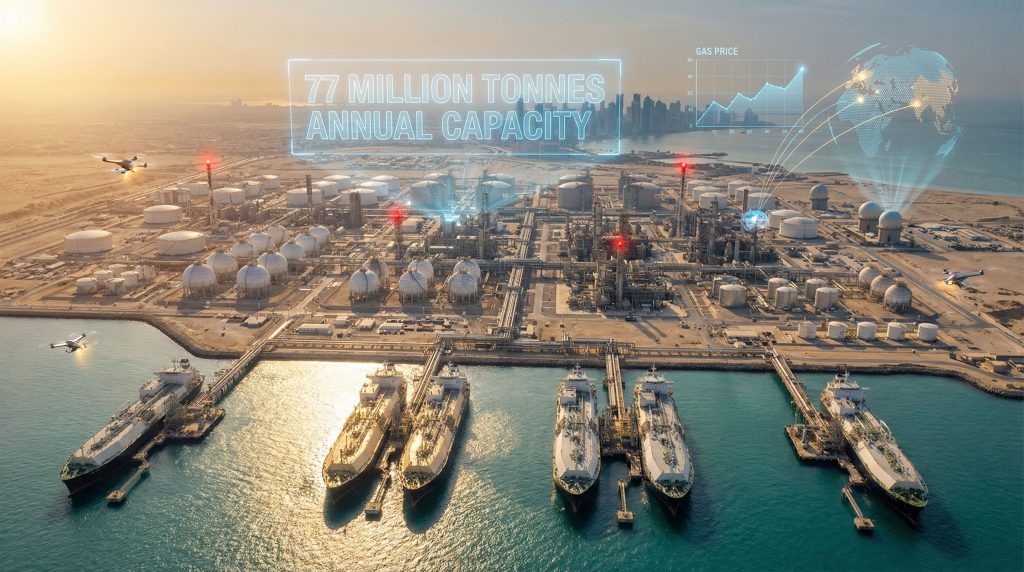
Qatar Disruption Triggers Global LNG Crisis
This image directly visualizes the catastrophic failure described in the section, showing the 77 mtpa facility at the center of the March 2026 crisis and symbolizing the attack that caused it.
(Source: Discovery Alert)
Partnerships Under Duress: Force Majeure Events Redefining Counterparty Risk
The stability of long-term LNG partnerships has been severely tested, with force majeure declarations evolving from a shield against unforeseen events into a source of major commercial disputes and supply chain breakdowns. The period since 2022 has seen a cascade of disruptions that have strained the foundational offtake agreements of major traders like Shell, exposing the fragility of the global LNG trading system when key production nodes fail.
Table: Key Force Majeure and Disruption Events Impacting Shell’s LNG Portfolio
| Partner / Project | Time Frame | Details and Strategic Purpose | Source |
|---|---|---|---|
| Qatar Energy (Ras Laffan) | March 2026 | Geopolitical attacks caused a near-total shutdown of the 77 mtpa facility. As the largest offtaker, Shell lost access to 6.8 mtpa, forcing it to declare force majeure downstream and halting its Pearl GTL plant. | The Globe and Mail |
| Venture Global LNG (Calcasieu Pass) | Ongoing from 2023 | Venture Global declared force majeure, citing equipment issues, but sold over 200 spot cargoes valued at $18 billion. Shell and other offtakers did not receive contracted volumes and initiated international arbitration. | Bloomberg |
| Nigeria LNG (NLNG) | October 2022 | NLNG, in which Shell holds a 25.6% stake, declared force majeure after widespread flooding disrupted gas feedstock supply, halting exports and forcing European customers to seek costly spot cargoes. | Bloomberg |
| Prelude FLNG | July 2022 | Production at Shell‘s 3.6 MTPA floating LNG facility in Australia was suspended due to a labor dispute, removing a significant volume of equity supply from its portfolio and impacting its trading commitments. | Anadolu Ajansı |
Geographic Realignment: The Pivot from Middle East Risk to US Supply Security
The crisis has exposed the untenable risk of concentrating 20% of the world’s LNG supply in a single geographic location, forcing a strategic realignment of global gas flows toward politically stable jurisdictions. Asian and European buyers, confronted with the long-term disruption of Qatari volumes, are now accelerating efforts to secure supply from North America and Australia, prioritizing reliability over the lowest possible cost.
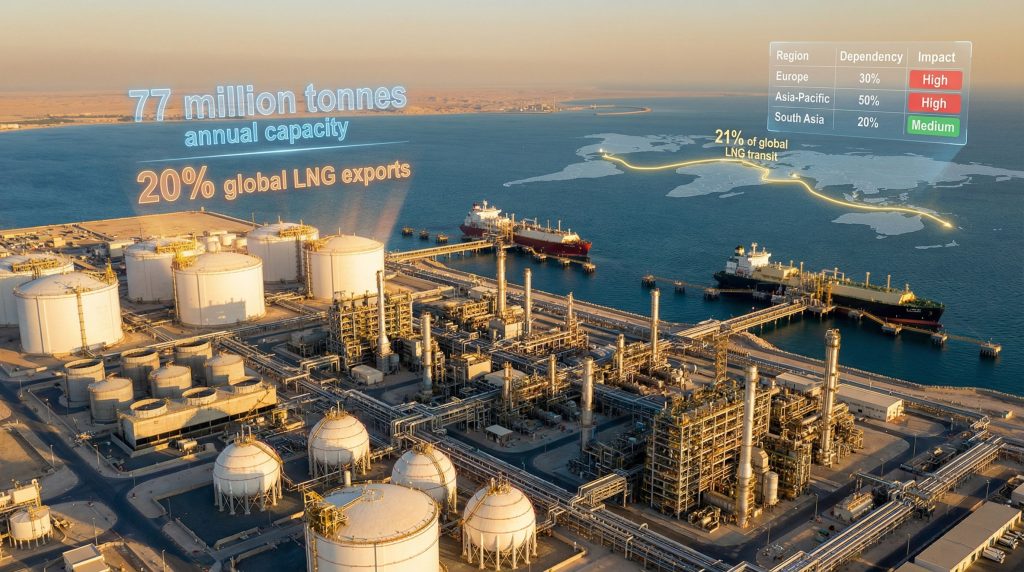
Qatar’s LNG Dominance Creates Systemic Risk
This chart perfectly illustrates the section’s core argument by quantifying Qatar’s 20% share of global exports and highlighting the high dependency of European and Asian buyers who are now seeking to realign their supply.
(Source: Discovery Alert)
- The shutdown of Qatar’s Ras Laffan facility has triggered a severe supply crunch across Asia. The resulting Asia’s Energy Security: 2026 War Triggers Supply Crisis is forcing nations to pay a premium for replacement cargoes and even revert to coal, undermining climate targets.
- This market shock is creating a clear divergence, where the US LNG vs Qatar LNG: 2026 Conflict Reveals Clear Winner is the United States. US projects are now viewed as the most viable alternative for buyers seeking to de-risk their portfolios from Middle Eastern instability, which is expected to drive a new wave of Final Investment Decisions (FIDs).
- Prior to 2025, diversification was a strategic goal; it has now become an urgent necessity. The crisis has validated the strategy of portfolio players with diversified sources, but even they are strained, demonstrating that no single company can fully insulate itself from a shock of this magnitude.
- The disruption is not isolated to the Middle East. Ongoing operational issues, such as the 2022 flooding that impacted Nigeria LNG, reinforce the market’s need for a broad portfolio of suppliers across multiple geographies to maintain system stability. The crisis has created a new urgency for projects like the US LNG Expansion 2026: Unlocking The Modular Boom.
Contractual Immaturity: Force Majeure Clauses Fail as a Market Stabilizer
The global LNG market’s contractual architecture has been proven immature and unable to withstand the dual pressures of extreme price volatility and geopolitical shocks. The period from 2021 to 2026 demonstrated that force majeure clauses, intended to be a mechanism for managing uncontrollable events, can be exploited in a seller’s market or are simply inadequate in the face of a systemic supply collapse, ultimately failing to protect downstream buyers.
- From 2021-2024, the Venture Global dispute showed that force majeure provisions could be strategically weaponized. By declaring a prolonged, yet contested, FM while selling cargoes on the spot market, the company prioritized windfall profits over long-term contractual obligations, undermining trust in the sanctity of Sales and Purchase Agreements (SPAs).
- The 2026 Qatar crisis exposed a different failure: the inability of contracts to function when an entire supply node disappears. Shell‘s downstream force majeure was not a strategic choice but a necessary reaction, demonstrating how a single upstream event cascades uncontrollably through a chain of interdependent legal agreements.
- The market is now reacting to this demonstrated immaturity. Future LNG SPAs will require far more stringent definitions of force majeure, explicit restrictions on spot market sales during an FM period, and clearer remedies for buyers to prevent a repeat of the Venture Global scenario.
- The scale of the Qatar disruption, with a potential multi-year recovery, moves beyond typical contractual remedies. It raises fundamental questions about counterparty risk and whether a portfolio player like Shell can realistically be expected to cover a 6.8 mtpa shortfall from the spot market without causing further price spirals and market destabilization.
SWOT Analysis: LNG Supply Chain Risk
The global LNG market has undergone a violent reassessment of risk, transforming its structural strengths into acute vulnerabilities. The shift from an abstract threat environment before 2024 to a realized catastrophic risk in 2026 has permanently altered the industry’s strategic priorities.

Visualizing the LNG Supply Chain
This chart serves as a perfect introduction to the SWOT analysis by providing a clear, high-level diagram of the entire LNG supply chain, the very system being analyzed for risks in the text.
(Source: Norton Rose Fulbright)
Table: SWOT Analysis for Global LNG Supply Chain Risk
| SWOT Category | 2021 – 2024 | 2025 – 2026 | What Changed / Validated |
|---|---|---|---|
| Strength | Large, flexible trading portfolios (e.g., Shell) optimized for arbitrage. Long-term contracts providing price stability. | Diversified portfolios help mitigate, but are insufficient for a 20% supply shock. Contract sanctity is questioned. | The strength of portfolio trading was validated as a mitigation tool but its limits were exposed. Contractual stability proved illusory. |
| Weakness | High geographic concentration of supply (Qatar). Loosely defined force majeure clauses in SPAs. | Geographic concentration in Qatar is realized as a catastrophic single point of failure. FM clauses are exploited or proven inadequate. | Theoretical weaknesses became realized vulnerabilities. The Venture Global case and the Qatar shutdown validated that both contractual and physical concentration risks were severely underestimated. |
| Opportunity | Growing Asian demand for LNG as a cleaner fuel. Favorable arbitrage between US gas and global LNG prices. | Accelerated FIDs for projects in politically stable regions (USA, Australia). Buyers willing to pay a “security premium” for reliable supply. | The market opportunity has shifted from cost-based arbitrage to security-based supply agreements. The US-Iran War 2026: Europe’s Shocking Energy Crisis and its impact on Qatar have cemented this trend. |
| Threat | Geopolitical tension in the Middle East. Price volatility and potential for supply disruptions. | Kinetic attacks on critical energy infrastructure (Ras Laffan). Protracted, multi-year supply outages and delayed expansion projects. | Abstract geopolitical threats materialized into a physical, multi-year supply deficit. The risk of supply chain collapse is no longer a tail risk but a central planning assumption. |
Scenario Model: A Two-Tiered Market Defined by Supply Security
If the market continues to prioritize supply security over marginal cost, then watch for a bifurcation of the global LNG trade. This will create a two-tiered system where buyers explicitly pay a premium for volumes from politically and operationally stable jurisdictions, fundamentally reshaping investment flows and contracting structures.
- Watch this signal: An acceleration of Final Investment Decisions (FIDs) and new long-term offtake agreements for LNG projects in the United States and Australia, even if their headline price is higher than competing offers from less stable regions.
- This could be happening: Asian buyers, particularly from Japan, South Korea, and Singapore, will lead this flight to quality. They will seek to renegotiate or supplement their portfolios with contracts that include more stringent security-of-supply clauses and reduced exposure to chokepoints like the Strait of Hormuz.
- This could also be happening: A temporary resurgence in coal-fired power generation in Asia becomes unavoidable to bridge the supply gap left by Qatar, representing a significant setback for regional and global decarbonization goals.
- The outcome: The definition of market leadership will evolve. While Shell‘s scale provides resilience, leadership will increasingly be defined by the perceived reliability of a supplier’s asset base. Producers in North America with uncontracted volumes or near-complete projects are positioned to capture significant market share and pricing power.
Frequently Asked Questions
What was the main difference between the Venture Global dispute and the 2026 Qatar crisis?
The Venture Global dispute between 2021-2024 represented a contractual risk, where the company declared a controversial force majeure while selling cargoes on the spot market. In contrast, the 2026 Qatar crisis was a far more severe physical risk, where a geopolitical attack on the Ras Laffan facility physically removed 77 mtpa (20% of global supply) from the market, causing a cascading, systemic supply chain failure.
How did the 2026 Qatar crisis specifically impact Shell?
The shutdown of Qatar’s Ras Laffan facility meant Shell, as the largest offtaker, lost access to its contracted 6.8 million metric tons per annum (mtpa) of LNG. This forced Shell to declare force majeure on its own downstream customers and halt operations at its Pearl GTL plant, illustrating how the supply shock propagated through the world’s largest LNG trader.
Why does the article claim the US is the ‘clear winner’ after the crisis?
The article argues that the US is the ‘clear winner’ because the crisis exposed the extreme risk of concentrating supply in a single, geopolitically vulnerable location like Qatar. Consequently, global buyers are now prioritizing supply security over cost. US projects, being in a politically stable jurisdiction, are now viewed as the most reliable alternative, which is expected to drive a new wave of investment and contracts for US LNG.
What failures in LNG contracts did the 2021-2026 period expose?
The period exposed that force majeure (FM) clauses were immature. The Venture Global case showed they could be exploited for commercial gain in a high-price environment, undermining trust. The Qatar crisis showed they were inadequate for a systemic shock, as a single upstream FM cascaded uncontrollably through the supply chain, demonstrating that legal agreements could not prevent a market collapse.
According to the SWOT analysis, what key weakness in the LNG market was validated by 2026?
The key weakness validated was the high geographic concentration of supply, specifically in Qatar. Before the crisis, this was seen as a theoretical weakness. The 2026 attack on Ras Laffan turned this into a realized, catastrophic single point of failure, proving that the market had severely underestimated the risk.
Experience In-Depth, Real-Time Analysis
For just $200/year (not $200/hour). Stop wasting time with alternatives:
- Consultancies take weeks and cost thousands.
- ChatGPT and Perplexity lack depth.
- Googling wastes hours with scattered results.
Enki delivers fresh, evidence-based insights covering your market, your customers, and your competitors.
Trusted by Fortune 500 teams. Market-specific intelligence.
Explore Your Market →One-week free trial. Cancel anytime.
