

BESS Tolling Agreements: ENGIE’s 625 MWh IGNIS Deal and the 4 Major Spanish Contracts De-risking Grid Storage (2026)
BESS Project Bankability, ENGIE’s 625 MWh Deal Signals Shift to Tolling
Long-term tolling agreements are rapidly becoming the dominant commercial model for de-risking grid-scale Battery Energy Storage System (BESS) projects in Spain, enabling developers to secure financing and accelerating deployment. This strategic shift away from speculative merchant models is exemplified by the July 2026 deal between ENGIE and IGNIS, which provides the revenue certainty required to build out Spain’s storage capacity in line with aggressive national targets.
- Before 2025, the Spanish BESS market was nascent, with projects largely dependent on volatile ancillary service markets and price arbitrage, making them high-risk and difficult to finance at scale. Installed capacity was just 60 MW in early 2025, reflecting investor caution.
- A significant grid failure in April 2025, which caused a peninsula-wide blackout, created the political impetus for rapid policy changes to support grid flexibility. This event catalyzed a fundamental shift in market structure and investor appetite.
- By 2026, the market had pivoted toward long-term contracts. The 10-year, 625 MWh tolling agreement between ENGIE and IGNIS, along with similar deals by Grenergy, provides developers with a stable revenue floor, enhancing the bankability of their project pipelines and unlocking the necessary capital for large-scale deployment.
- Under this model, a developer like IGNIS secures a predictable revenue stream by selling the battery’s flexibility to an offtaker like ENGIE. ENGIE, in turn, takes on the market optimization risk, using its trading expertise to capture value in the day-ahead electricity market. This separation of risks is critical for attracting project finance.
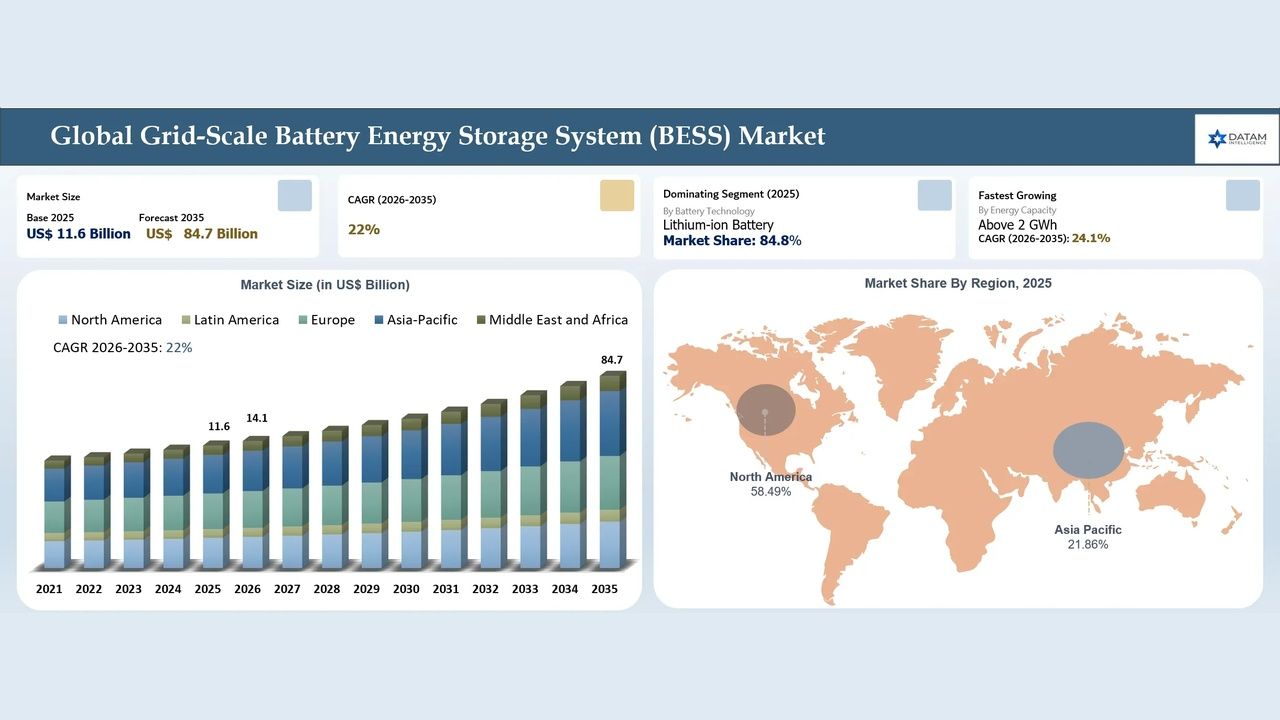
BESS Market Poised for 600%+ Growth to US$84.7B by 2035, Led by Li-ion Dominance
The Global Grid-Scale Battery Energy Storage System (BESS) market is set for exponential growth, projected to surge from US$11.6 billion in 2025 to US$84.7 billion by 2035, demonstrating a robust 22% CAGR. Lithium-ion batteries currently dominate this expansion with an 84.8% market share, solidifying their role as the primary technology for grid modernization.
Europe & Asia-Pacific Emerge as Key Growth Hubs for Large-Scale Grid Storage
While North America holds the largest BESS market share (58.49% in 2025), significant growth opportunities exist in Europe and Asia-Pacific, contributing to the global 22% CAGR from 2026-2035. The ‘Above 2 GWh” capacity segment is the fastest growing (24.1% CAGR), highlighting the increasing demand for large-scale grid storage solutions like the ENGIE IGNIS project in Spain.
(Source: ENGIE Energy Storage 2026, €240M Andalusia Acquisition)
ENGIE 2 Major Tolling Partnerships Solidify Spanish BESS Strategy (2026)
ENGIE has strategically utilized partnerships with Spanish developers to secure a significant BESS portfolio, leveraging tolling agreements to gain access to over 845 MWh of capacity in 2026 alone. This approach allows ENGIE to rapidly expand its footprint in a key European growth market while mitigating direct development and construction risks, which are retained by partners like IGNIS and Return.
Table: Major BESS Tolling Agreements in Spain (2026)
| Date | Developer | Offtaker | Capacity (MWh) | Duration (Years) | Details and Strategic Purpose | Source |
|---|---|---|---|---|---|---|
| Jul 21, 2026 | Return | ENGIE | 220 MWh | 10 | Full tolling agreement providing ENGIE with control over the assets for optimization, giving Return a bankable revenue stream to accelerate its 55 MW project pipeline. | Engie, Mas PV sign long-term BESS power agreements |
| Jul 2, 2026 | IGNIS | ENGIE | 625 MWh | 10 | Flexibility Purchase Agreement giving ENGIE access to a portfolio of BESS projects for day-ahead market optimization. Secures revenue for IGNIS to finance its development pipeline. | Engie gets access to 625-MWh Spanish battery portfolio |
| Apr 27, 2026 | Grenergy | Not specified | 680 MWh | 12 | Financial tolling agreement for a hybrid solar and storage project, de-risking the BESS component by securing long-term revenue. | Grenergy signs 12 year tolling deal |
| Feb 17, 2026 | Grenergy | Not specified | Not specified | 10 | Tolling agreement for what is slated to be Spain’s largest standalone battery project, establishing a precedent for financing large-scale assets. | Grenergy inks 10-year tolling deal |
Spain’s BESS Market, ENGIE and the Post-Blackout Policy Push
Spain has transformed into a premier European market for BESS investment, directly resulting from urgent policy interventions following a critical grid failure in 2025. This government-backed push created an ideal environment for strategic players like ENGIE to secure large-scale capacity through innovative commercial structures like tolling agreements.
- The catalyst for Spain’s market acceleration was a complete electrical blackout across the Iberian Peninsula on April 28, 2025. This event exposed the grid’s acute vulnerability to the high penetration of intermittent renewables and forced immediate political action to mandate and fund flexibility assets.
- In response, Spain’s government established one of Europe’s most ambitious storage targets under its National Integrated Energy and Climate Plan (PNIEC), mandating 22.5 GW of energy storage capacity by 2030.
- The policy push has been effective. Starting from a base of just 60 MW in early 2025, Spain’s installed BESS capacity grew by 589% in the year following the blackout. The development pipeline expanded dramatically, with 1.76 GW of new projects recorded in Q 2 2026 alone.
- This rapid, policy-driven market expansion created the conditions for the large-scale, long-term agreements signed by ENGIE and others, as developers rushed to bring bankable projects online to meet national targets.

Global BESS Market Set for 630% Surge by 2035, Driven by Li-ion Dominance
The Global Grid-Scale Battery Energy Storage System (BESS) Market is projected to grow from US$11.6 billion in 2025 to US$84.7 billion by 2035, exhibiting a robust 22% CAGR. Lithium-ion batteries dominate the technology segment with an 84.8% market share, underscoring its pivotal role in the industry’s expansion.
North America Leads BESS Market; Europe A Growing Hub for Grid Storage
North America holds a commanding 58.49% market share in BESS as of 2025, while Asia-Pacific follows at 21.86%. Europe, though not explicitly broken out in map percentage, represents a significant and growing segment within the global market size bar chart, indicating emerging opportunities for large-scale grid storage projects like ENGIE’s in Spain.
(Source: ENGIE Energy Storage 2026, €240M Andalusia Acquisition)
625 MWh, ENGIE’s Deal Shows BESS Commercial Model Maturation
The prevalence of multi-hundred MWh, decade-long tolling agreements in Spain signifies the commercial maturation of grid-scale BESS as an asset class. This evolution moves the technology beyond niche ancillary services and into a core component of the energy infrastructure, underpinned by financial structures that are palatable to institutional investors.
- In the market’s early phase (before 2025), BESS business cases were largely theoretical, relying on stacking revenues from volatile sources like frequency regulation and wholesale market arbitrage. This high-risk profile limited project sizes and access to capital.
- The commercial model validated in 2026 through deals like the ENGIE–IGNIS agreement institutionalizes BESS financing. By creating a predictable, long-term cash flow stream via a tolling fee, these contracts function similarly to Power Purchase Agreements (PPAs) for renewable generation, a model well understood by lenders.
- This new commercial standard allows for a clear division of labor and risk. Developers like IGNIS focus on securing land, permits, and grid connections. Specialized offtakers like ENGIE handle the complex task of market optimization. This specialization improves overall project efficiency and financial viability.
- The ability to secure 10– and 12-year contracts for standalone and hybrid BESS projects demonstrates that the market now views energy storage not just as a technology, but as a bankable infrastructure asset essential for grid stability.
Future Scenarios, ENGIE and the 625 MWh Tolling Model Expansion
The success of the tolling agreement model in de-risking large BESS portfolios in Spain positions it as a blueprint for other European markets that are grappling with grid instability from rising renewable energy penetration. The key signal to watch is the adoption rate of similar long-term flexibility contracts in markets like Italy and Germany.
- If this trend continues, watch for major European utilities to replicate ENGIE’s strategy by signing long-term tolling agreements to secure BESS capacity without taking on development risk. A key early indicator is the reported deal between En BW and Zelestra for a BESS tolling agreement in Italy, suggesting the model is already crossing borders.
- These events could trigger an increase in M&A activity, with utilities and infrastructure funds acquiring developers that possess mature pipelines of grid-connected BESS projects. ENGIE‘s own acquisition of 1.1 GWh of standalone BESS projects in Spain in April 2026 shows this consolidation is already underway.
- Further maturation could lead to the emergence of standardized financial products and insurance wraps specifically designed for BESS tolling agreements, which would further lower the cost of capital and accelerate deployment across the continent.
The questions your competitors are already asking
This report covers one angle of how grid-scale battery storage is becoming a bankable asset class. The questions that matter most depend on your work.
- Battery storage deals in Italy and Germany
- Major utility battery partnerships in Europe
- How do battery storage contracts work
- Grid instability risk in Europe
This report does not answer these. Enki Brief Pro does.
Your question, your angle, your framework. SWOT, PESTL, scenario modelling. The same niche depth, built around the decision your work actually depends on.
