

Flow Battery Grid Projects, Flex Base’s 2.1 GWh Invinity Design, and 1.6 GWh of Development in Switzerland (2021 to 2026)
BESS Adoption, Flex Base Shifts to GWh-Scale Flow Batteries for AI Data Centers
The grid-scale energy storage market is undergoing a strategic pivot from a dependency on general-purpose lithium-ion systems toward a diversified portfolio of specialized, long-duration technologies. This shift is driven by the dual pressures of managing renewable intermittency and satisfying the intense, constant power demands of new industrial loads like AI data centers, with projects like Flex Base Group’s Laufenburg facility serving as a key validator for commercializing alternative chemistries like Vanadium Flow Batteries (VFBs).
- In the 2021–2024 period, the prevailing model involved conceptual plans to co-locate battery energy storage systems, which were primarily assumed to be lithium-ion, with data centers. This approach, seen in the initial announcement of the Flex Base Technologiezentrum in 2023, focused on power reliability and participation in existing grid services.
- A definitive shift occurred in 2025–2026, when Flex Base Group moved from a general concept to a specific technology solution by selecting Invinity Energy Systems to design a GWh-scale VFB. This decision marks a deliberate move to adopt a technology explicitly suited for long-duration, high-throughput applications, signaling a maturation beyond the pilot stage for flow batteries.
- The catalyst for this change is the market’s recognition that standard 2-4 hour lithium-ion batteries are insufficient for two emerging needs: absorbing multi-day surpluses of renewable generation and providing the baseload-like, uninterruptible power required by AI computing infrastructure.
- The selection of VFB technology for a project with ambitions to scale to 2.1 GWh is a critical market signal. It confirms that developers are now tailoring technology selection to the specific use case, moving away from a one-size-fits-all approach and creating a distinct market segment for long-duration storage technologies.
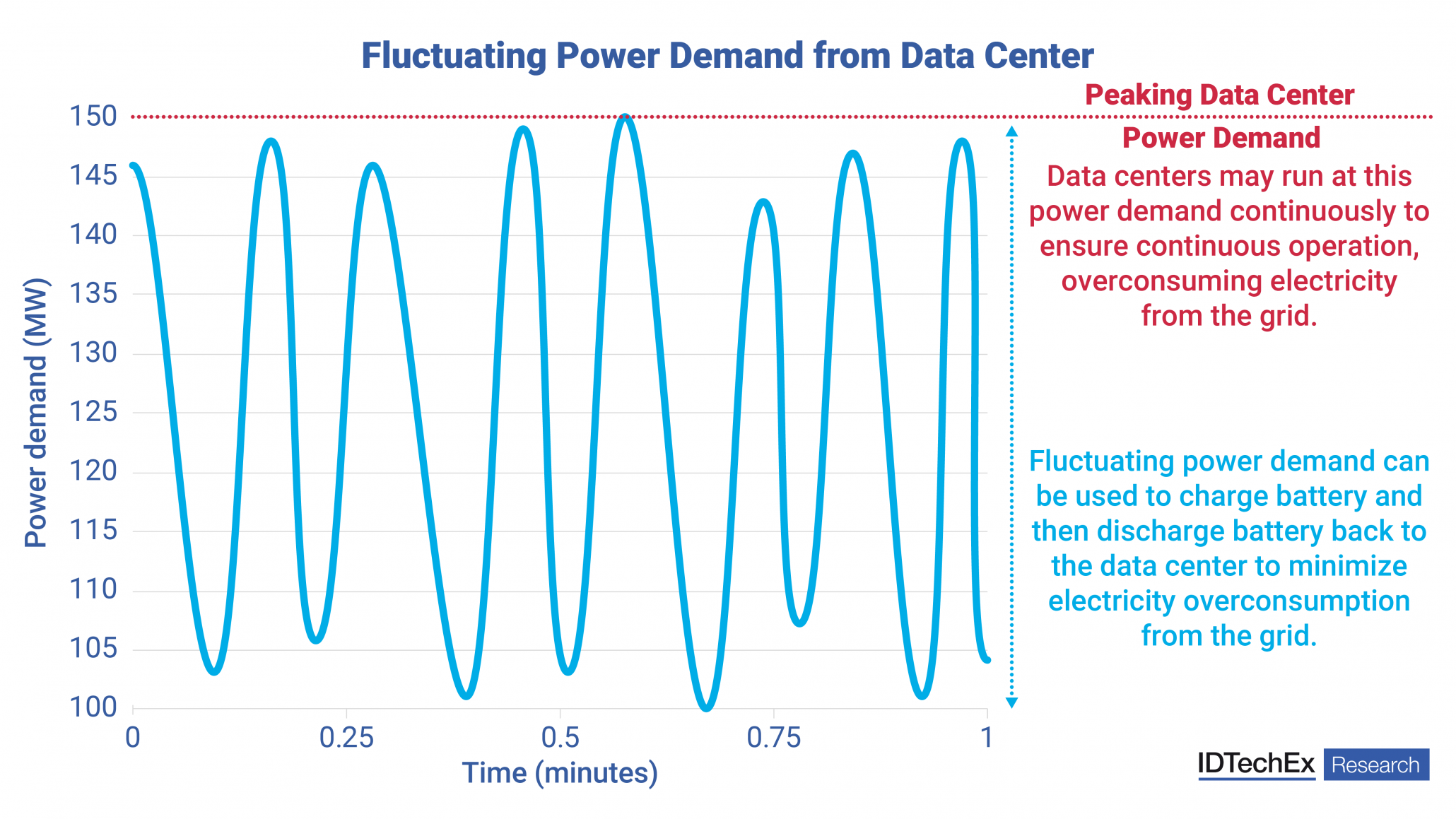
Data Centers Exhibit Volatile Power Demand
This chart illustrates the core challenge—the volatile and high power demand of AI data centers—that necessitates the shift to GWh-scale flow batteries, as discussed in this section.
(Source: IDTechEx)
Flex Base Group’s Key Partnerships for Swiss Grid Modernization (2023-2026)
To execute its integrated energy hub vision in Laufenburg, Flex Base Group has assembled a targeted set of strategic partnerships that combine development, construction, and specialized technology expertise. The evolution of these alliances from general contracting to advanced technology acquisition demonstrates a clear and maturing project strategy.
- The most consequential alliance is the strategic partnership announced in May 2026 with Invinity Energy Systems, a London-listed VFB manufacturer. This partnership moves the project into its next phase by bringing in a technology specialist to design the GWh-scale long-duration storage system, a core component of the facility’s business case.
- The foundational construction partnership with ERNE Gruppe, established in October 2023, secured the capability to build the physical technology center. Ground was broken in May 2025, establishing the site that will house both the battery system and the co-located AI data center.
- This progression in partnerships reflects a strategic refinement over time. The project moved from securing a general contractor for the physical build-out to later selecting a specialized technology provider for its most critical energy asset, indicating a two-phase approach to de-risking and developing the complex facility.
Table: Flex Base Group Strategic Alliances
| Partner | Time Frame | Details and Strategic Purpose | Source |
|---|---|---|---|
| Invinity Energy Systems | May 2026 | Selected as the technology partner to design the GWh-scale Vanadium Flow Battery (VFB) system. The purpose is to secure a proven, long-duration storage technology suitable for grid-scale and high-demand industrial applications. | Invinity Selected to Design GWh-Scale VFB System |
| ERNE Gruppe | October 2023 | Engaged as the general contractor for the construction of the Flex Base Technologiezentrum in Laufenburg. This partnership provides the construction and engineering capabilities to build the integrated data center and BESS facility. | Neubau Technologiezentrum Laufenburg für die Flex Base Group |
Switzerland as a Testbed, Flex Base Group’s Energy Hub Deployment
Switzerland is solidifying its position as a key European proving ground for advanced, grid-scale energy storage solutions. This is not by chance, but the result of a convergence of progressive energy policy, strategic geography, and specific industrial demand that makes it an ideal market to deploy and validate next-generation infrastructure like the Flex Base Group project.
- The country’s national energy policy, including the Energy Strategy 2050 and the recently approved 2024 Electricity Act, creates a powerful regulatory driver. These policies mandate an accelerated expansion of renewable energy, generating an urgent, state-backed requirement for large-scale storage to maintain grid stability.
- The project’s location in Laufenburg is strategic, situated in a region known as a hub for Swiss energy infrastructure. This allows the project to integrate directly into a critical part of the grid, positioning it to effectively provide balancing and ancillary services where they are most needed.
- The strong presence of high-tech industries in Switzerland creates a unique source of demand. The need for power-intensive AI data centers provides a bankable, private-sector offtaker for the storage facility, making the business case less reliant on fluctuating grid service revenues alone.
- Between 2021 and 2024, Switzerland was a destination for conceptual energy storage projects. However, the period from 2025 to 2026 has seen a clear transition to physical deployment, with Flex Base breaking ground and formalizing its GWh-scale technology choice, cementing the country’s role as a leader in implementing, not just planning, advanced energy systems.
GWh-Scale Validation, Flex Base Group’s Flow Battery Technology Selection
The decision by Flex Base Group to anchor its landmark project with Vanadium Flow Battery (VFB) technology represents a critical commercial validation for the long-duration energy storage sector. This moves VFBs from the category of promising but niche alternatives toward becoming a bankable, mainstream competitor to lithium-ion for large-scale grid applications.
- During the 2021-2024 period, flow batteries were largely in a pre-commercial or pilot phase for GWh-scale projects. While design agreements existed, the technology had not yet been selected for a project combining this scale with a concrete construction timeline, ceding the market to lithium-ion.
- The 2025-2026 announcements from Flex Base and Invinity mark a turning point. Committing to a design that could scale to 2.1 GWh demonstrates that sophisticated developers now view the technology as technically mature and financially viable enough for deployment in capital-intensive, critical infrastructure.
- This confidence is rooted in the VFB’s technical characteristics, which are purpose-built for grid-scale applications. These include a long operational life exceeding 20, 000 cycles with minimal degradation, the ability to decouple power and energy for cost-effective scaling, and an inherently non-flammable aqueous electrolyte that mitigates fire risk.
- The selection validates that VFBs are mature enough to fill a specific market gap that lithium-ion technology currently struggles to address: high-throughput, long-duration storage of 8-12 hours. This is vital for absorbing multi-day renewable generation and providing reliable power to industrial clients.
SWOT Analysis, Flex Base’s Project and the Long-Duration Storage Market
The Flex Base project highlights the powerful strategic advantages of integrating long-duration storage with high-value industrial demand. However, a broader analysis reveals that while opportunities are expanding, the market still faces weaknesses related to technology cost competition and systemic threats from infrastructure constraints.
- Strengths: The project’s most significant strength is the creation of a diversified business model that serves both the regulated grid services market and a private, high-value data center client, enhanced by VFB’s technical superiority for long-duration use.
- Weaknesses: A primary weakness for the flow battery market remains the higher upfront capital expenditure and lower volumetric energy density compared to mature LFP battery systems, which requires a larger physical footprint.
- Opportunities: The market opportunity is expanding rapidly, driven by the exponential power demand from the AI sector and new policy mandates across Europe that require multi-hour storage to stabilize grids with high renewable penetration.
- Threats: A major threat is the prevalence of grid connection delays, which can stall even the most well-funded projects. Additionally, continuous cost reductions in lithium-ion technology could make it a “good enough” solution for a wider range of storage durations, eroding the VFB value proposition.
Table: SWOT Analysis for Long-Duration Storage Projects like Flex Base
| SWOT Category | 2021 – 2024 | 2025 – 2026 | What Changed / Validated |
|---|---|---|---|
| Strengths | Conceptual model of co-locating BESS with high-demand industries for mutual benefit. | Selection of VFB technology, leveraging its superior cycle life (20, 000+ cycles), safety (non-flammable), and decoupled power/energy scaling. | The project’s strength was validated by moving from a generic BESS concept to selecting a specific, technologically superior solution for the intended long-duration use case. |
| Weaknesses | Higher perceived cost, lower technology readiness level, and larger footprint of flow batteries compared to dominant lithium-ion chemistry. | Lower volumetric energy density (25-50 Wh/L) remains a known trade-off, requiring more land. Upfront capex is still a key consideration for financiers. | While commercial validation has increased, the physical footprint and upfront cost relative to lithium-ion remain the primary competitive hurdles to overcome. |
| Opportunities | General market need for grid balancing and ancillary services driven by early-stage renewable energy integration. | Urgent, large-scale demand from the AI data center boom and policy-driven needs for long-duration storage (8+ hours) to resolve grid bottlenecks. | The market opportunity became significantly larger, more specific (AI, 8+ hour duration), and more urgent due to compounding industrial and policy drivers. |
| Threats | Direct competition from established and rapidly scaling lithium-ion BESS manufacturers. | Systemic grid connection delays have emerged as a primary barrier to deployment for all large-scale energy projects in Europe. | The key threat evolved from simple technology competition to systemic infrastructure constraints that affect all players, regardless of the chosen battery chemistry. |
Scenario Modelling, Flex Base’s Next Steps and VFB Market Acceleration
The most critical strategic milestone for the European long-duration storage sector in the next two years will be the successful financial close and initiation of procurement for the first GWh-scale phase of the Flex Base flow battery system. This event would serve as the definitive de-risking signal for the technology and its supply chain.
- If this happens: If Flex Base and Invinity finalize the system design and secure full project financing for the initial large-scale phase of the VFB by early 2027, it will trigger the next stage of market development.
- Watch this: The key leading indicators to watch for are public announcements of binding offtake agreements with the anchor AI data center tenant and long-term grid service contracts with the Swiss national grid operator. These commercial agreements are essential to prove the project’s bankability.
- These could be happening: A successful financial close would likely spur a rapid increase in developer-technology partnerships across Europe as other utilities and industrial players aim to replicate the Flex Base model. This would, in turn, drive significant new investment into the VFB supply chain to meet anticipated demand and would firmly establish flow batteries as the preferred technology for applications requiring over eight hours of storage, creating a clear market segmentation from lithium-ion.

Grid Storage Market Forecast Shows Flow Battery Growth
This forecast directly supports the section’s focus on VFB market acceleration, providing the quantitative data needed for the scenario modeling of Flex Base’s next strategic steps.
(Source: Global Market Insights)
The questions your competitors are already asking
This report covers one angle of grid-scale flow battery commercialization. The questions that matter most depend on your work.
- Flex Base Group activities in Switzerland. Is the Invinity partnership progressing from design to deployment?
- What is the outlook for Vanadium Flow Battery deployment in AI data centers by 2026?
- How do Vanadium Flow Batteries compare to lithium-ion systems for powering AI data centers?
This report does not answer these. Enki Brief Pro does.
Your question, your angle, your framework. SWOT, PESTL, scenario modelling. The same niche depth, built around the decision your work actually depends on.
