

Berkshire Hathaway BESS Grid Strategy, $12.3 B CAPEX, Google CTT Deal, 1, 736 MW Solar Pipeline (2025-2026)
Grid Stability Risk, Berkshire Hathaway Energy’s 1, 072 MW Battery Storage Plan
Berkshire Hathaway Energy’s (BHE) strategy in 2025-2026 pivots to a targeted focus on large-scale battery storage and transmission upgrades as the primary mechanism to manage grid instability. This approach addresses surging data center demand and the intermittency of renewables, moving beyond generalized renewable expansion. BHE is constructing a foundational grid infrastructure capable of supporting higher penetrations of distributed assets, rather than directly managing a fragmented portfolio of smaller resources.
- This strategy is a direct response to a market projecting 5.7% annual electricity demand growth over the next five years, driven primarily by data centers. These facilities require highly reliable power, making grid-scale battery storage and transmission reinforcement a prerequisite for service.
- BHE’s focus on proven, utility-owned assets provides a de-risked approach amidst significant market headwinds. In 2025, the broader clean energy sector saw over $14 billion in project cancellations due to policy uncertainty and financing challenges, validating BHE’s more conservative, capital-intensive model.
- The company’s plans are concrete and large-scale, highlighted by its subsidiary Pacifi Corp’s 2025 Integrated Resource Plan. The plan outlines the addition of 1, 736 MW of solar and 1, 072 MW of battery storage capacity between 2025 and 2026, confirming a strategic commitment to grid-balancing assets.
- Execution is already underway with the energization of the 75 MW / 150 MWh Glacier Battery System in Montana in January 2026. This project serves as a tangible example of BHE deploying commercial-scale batteries to enhance grid stability in its operational territories. As data centers look for 24/7 reliable power, some are also evaluating on-site solutions like those from Bloom Energy.
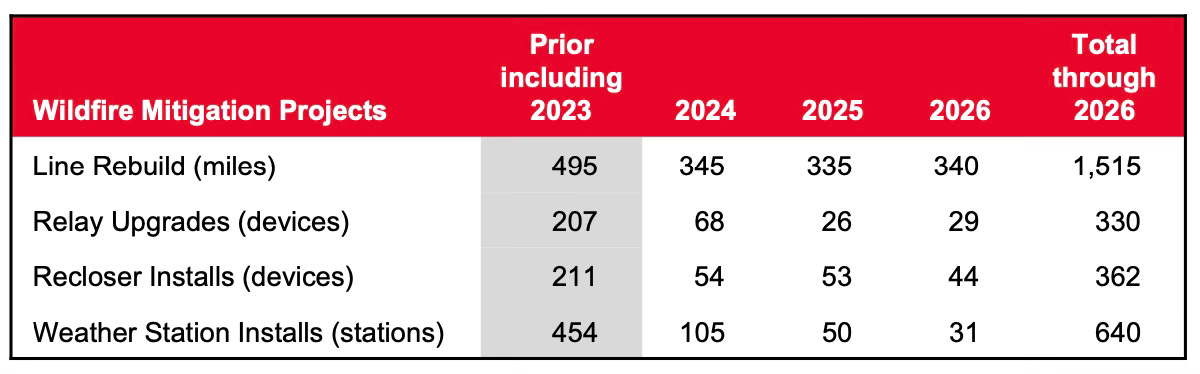
BHE Details Wildfire Mitigation Projects Through 2026
The section discusses grid stability risks, for which wildfire is a primary threat in BHE’s operating territories. The chart details BHE’s specific wildfire mitigation efforts, providing a concrete example of the company’s broader strategy to manage grid risks and improve stability.
(Source: The Rational Walk)
$12.3 Billion, Berkshire Hathaway Energy Capital Plan for Grid Modernization (2025-2027)
Berkshire Hathaway Energy is directing a $12.3 billion capital expenditure plan for 2025-2027 toward foundational assets, prioritizing utility-scale solar, battery storage, and transmission. This investment strategy is underscored by both the approval of major new projects and the calculated suspension of initiatives facing significant external risks. The focus remains on growing the regulated asset base with projects that ensure grid reliability and have a clear cost-recovery path.
- The investment plan directly funds the large-scale projects outlined in subsidiary resource plans. This includes Pacifi Corp’s plan to add 1, 736 MW of solar and 1, 072 MW of battery storage and Mid American Energy’s $3.9 billion investment in new Iowa-based renewable projects.
- In February 2025, BHE Renewables suspended three major geothermal and lithium extraction projects at California’s Salton Sea. The decision, driven by regulatory delays and transmission infrastructure challenges, validates the company’s core strategy of prioritizing investments in regions and technologies with clear and predictable development pathways.
- To meet near-term demand, Mid American Energy proposed new generation projects in February 2025 to address load growth projected for as soon as 2026. This includes a solar reliability project and a new natural-gas-fueled power plant, demonstrating a pragmatic approach that balances decarbonization with mandated reliability.
Table: Berkshire Hathaway Energy Strategic Investments and Cancellations (2025-2026)
| Partner / Project | Time Frame | Details and Strategic Purpose | Source |
|---|---|---|---|
| Capital Expenditure Plan | Nov 2025 (Plan for 2025-2027) | Allocated $12.3 billion for operating capital needs and funding future growth projects, focusing on regulated utility infrastructure and generation. | EEI Financial Conference |
| Mid American Renewable Projects | Oct 2025 | Committed $3.9 billion to expand wind and solar generation assets in Iowa, reinforcing its strategy of investing in states with favorable renewable resources. | The Invading Sea |
| Pacifi Corp Resource Additions | Mar 2025 (Plan for 2025-2026) | The 2025 Integrated Resource Plan details the addition of 1, 736 MW of new solar and 1, 072 MW of new battery storage to come online by the end of 2026. | Pacifi Corp |
| Geothermal and Lithium Project Suspension | Feb 2025 | BHE Renewables suspended three projects at the Salton Sea due to regulatory and transmission hurdles, avoiding further investment in high-risk, long-timeline developments. | GPS Business Insider |

US Wind Energy Market Projects Steady Growth
The section is a table detailing BHE’s strategic investments and cancellations. Given that wind power is a cornerstone of BHE’s portfolio, this chart showing the steady growth of the U.S. wind market provides the market rationale behind the company’s investment decisions.
(Source: Mordor Intelligence)
Berkshire Hathaway Energy Partnership with Google via NV Energy’s Clean Transition Tariff
BHE’s primary partnership model in 2026 centers on creating innovative commercial frameworks that enable large customers to directly fund new clean energy projects. This strategy was demonstrated by the agreement between Google and geothermal developer Ormat, facilitated by BHE subsidiary NV Energy through its novel Clean Transition Tariff (CTT). This positions BHE as an infrastructure enabler for corporate decarbonization rather than a direct equity partner in every project.
- The Clean Transition Tariff, pioneered by NV Energy and Google, acts as a new commercial product. It allows large energy users to procure energy from specific new clean energy projects, providing the financial backing needed for developers to secure financing and begin construction.
- The February 2026 agreement will supply Google’s Nevada data centers with 24/7 carbon-free geothermal power from new Ormat facilities. This structure serves as a blueprint for how utilities can help major tech companies meet their ambitious clean energy goals.
- This model contrasts with traditional power purchase agreements by creating a direct link between a large customer’s demand and the development of a new clean energy asset. It effectively creates a bespoke, distributed energy solution for a major industrial load, with the utility providing the critical tariff and grid infrastructure.

Renewable Energy Market Projected to Reach $8.25T
The section describes a major partnership between BHE and Google focused on clean energy. The chart contextualizes this deal by illustrating the massive scale and financial opportunity of the renewable energy market, which drives such large-scale corporate collaborations.
(Source: Precedence Research)
Table: Berkshire Hathaway Energy Strategic Partnerships
| Partner / Project | Time Frame | Details and Strategic Purpose | Source |
|---|---|---|---|
| Google and Ormat Technologies | Feb 2026 | BHE subsidiary NV Energy facilitated a geothermal energy deal using its Clean Transition Tariff (CTT). This allows Google to directly fund new geothermal capacity from Ormat to power its data centers with 24/7 carbon-free energy. | ESG Today |
| Fervo Energy | Jan 2026 | While not a direct partnership, BHE’s subsidiaries enable next-generation geothermal by signing long-term power purchase agreements (PPAs), providing the revenue certainty required for capital-intensive projects to secure financing. | Gates Notes |

Power Market to Near $7 Trillion by 2030
The section is a table listing BHE’s strategic partnerships. This chart provides the ultimate macro-level context, framing these partnerships as strategic maneuvers to compete and capture market share within a multi-trillion dollar global industry.
(Source: The Business Research Company)
Western US Focus, Berkshire Hathaway Energy’s Nevada, Montana, and Iowa Projects
BHE’s infrastructure investments are heavily concentrated in the Western U.S. and Midwest, targeting states where its regulated utilities operate and can grow their asset base. This geographic focus on areas like Nevada, Montana, Iowa, and the broader Pacifi Corp territory aligns investment with abundant renewable resources, growing industrial load from data centers, and established regulatory frameworks.
- Nevada: Through subsidiary NV Energy, BHE is directly serving massive data center growth. The development of new solar, storage, and the innovative Clean Transition Tariff for customers like Google makes Nevada a hub for BHE’s strategy of pairing large-scale renewables with large-scale demand.
- Montana: The successful energization of the 75 MW Glacier Battery System in January 2026 establishes a key BHE asset in the northern grid. This project enhances reliability and facilitates the integration of the region’s significant wind resources.
- Iowa: Subsidiary Mid American Energy continues to expand its significant wind portfolio with the Wind PRIME project, which will push its owned wind capacity past 9, 300 MW. A $3.9 billion investment in new renewables announced in October 2025 reinforces Iowa as a core growth market.
- Pacifi Corp Territory: The six-state Pacifi Corp service area in the West is guided by the 2025 Integrated Resource Plan, which methodically plans for large additions of solar (1, 736 MW) and battery storage (1, 072 MW) across its territory through 2026.

BHE Details Western Transmission Investment Plan
The section highlights BHE’s project focus in the Western US. The chart directly corresponds by detailing the company’s specific investment plan for transmission infrastructure in that exact geographical region, creating a perfect match.
(Source: The Rational Walk)
Commercial Scale BESS, Berkshire Hathaway Energy’s 75 MW Glacier System Energization
Berkshire Hathaway Energy is exclusively deploying commercially mature technologies, namely utility-scale lithium-ion battery energy storage systems (BESS) and conventional solar PV, to construct its grid backbone. This deliberate strategy avoids speculative ventures into nascent technologies, instead favoring proven, bankable assets that offer predictable performance and clear integration pathways into the regulated utility model.
- The successful energization of the 75 MW Glacier Battery System in Montana in January 2026 is a clear validation point. It demonstrates BHE’s ability to execute and commission large-scale BESS projects that provide immediate grid stability benefits.
- Pacifi Corp’s 2025 Integrated Resource Plan further codifies this focus on mature technology, calling for the addition of 1, 072 MW of battery storage by 2026. This signals a deep, systemic commitment to BESS as the primary tool for managing renewable intermittency.
- This commitment to mature technology is also evident in what BHE chooses not to pursue. The February 2025 suspension of geothermal-lithium projects in California, which faced both technological and transmission hurdles, reinforces the company’s risk-averse preference for deploying proven solutions at scale. The company’s focus is distinct from firms like Ceres Power which are targeting the data center market with emerging fuel cell technologies.

Smart Grid Market To Reach $400B by 2035
The section discusses a specific commercial-scale Battery Energy Storage System (BESS) project. BESS is a foundational technology for modern ‘smart grids’. The chart provides the market context, showing the large and growing smart grid market that this BESS project is a part of.
(Source: Transparency Market Research)
SWOT Analysis, Berkshire Hathaway Energy’s Grid-Building Strategy and Market Risks
An analysis of Berkshire Hathaway Energy’s strategy reveals that its primary strength lies in its massive balance sheet and regulated utility model, which enable the execution of large, long-term infrastructure projects. However, this conservative approach results in a slower deployment pace compared to agile competitors, presenting both opportunities to capture high-value customers and risks of being outmaneuvered in a rapidly evolving market.

BHE Power Mix: 47% Noncarbon, Led by Wind
The section is a SWOT analysis of BHE’s strategy. The chart perfectly illustrates a key ‘Strength’ and strategic pillar for the company: its significant power generation from non-carbon sources. This portfolio mix is a fundamental element of its competitive strategy.
(Source: The Rational Walk)
Table: SWOT Analysis for Berkshire Hathaway Energy’s Distributed Energy Infrastructure Strategy
| SWOT Category | Key Strengths & Weaknesses | Key Opportunities & Threats | Supporting Evidence |
|---|---|---|---|
| Strengths | Massive Balance Sheet and Regulated Model: Ability to fund and execute large-scale, capital-intensive projects with clear cost-recovery mechanisms. | The $12.3 billion CAPEX plan (2025-2027) and consistent growth of its regulated asset base through projects approved in IRPs. | |
| Weaknesses | Conservative Pace: Slower, more methodical deployment of renewables compared to more aggressive, specialized competitors. | BHE’s planned 500 MW of solar additions in 2025 is significantly less than competitors like AES, which targeted 3.2 GW for the same year. | |
| Opportunities | Surging Data Center Demand: Exponential load growth creates demand for the reliable, large-scale clean power BHE is positioned to provide. | The NV Energy CTT for Google and forecasts of 5.7% annual load growth driven by data centers. | |
| Threats | Policy and Regulatory Risk: Shifting federal energy policies, expiring tax credits, and local regulatory delays can impact project economics and timelines. | The suspension of the Salton Sea projects due to regulatory hurdles and an industry-wide wave of $14 B+ in cancellations in 2025. |

Insurance Market for Large Renewable Projects Expands
This section is a SWOT analysis table. A crucial part of any SWOT is assessing ‘Threats’ and risk mitigation. This chart, which shows an expanding insurance market for renewables, directly relates to the management of financial and operational risks for the distributed energy projects discussed in the strategy.
(Source: Market Research Future)
Data Center Demand, Berkshire Hathaway Energy’s Response to 5.7% Annual Load Growth
The most critical factor to watch for Berkshire Hathaway Energy is how it scales its infrastructure strategy to meet the exponential growth in electricity demand from data centers. The success of NV Energy’s Clean Transition Tariff serves as a key test case for future customer-driven clean energy procurement models, and BHE’s ability to execute its large-scale generation and storage plans will determine its success in this high-growth market.
- If the CTT model proves scalable and profitable, watch for BHE to roll out similar tariff structures across its other utility territories, such as Pacifi Corp and Mid American, to attract and retain more hyperscale customers seeking to decarbonize their operations.
- If BHE’s proposed generation projects, like those in Iowa, face significant regulatory delays, the utility could struggle to meet the 2026 load growth projections. This could create regional reliability risks or force a greater reliance on expensive, volatile wholesale power markets.
- If BHE successfully joins the Western Energy Imbalance Market in May 2026, this could signal an enhanced ability to optimize its large fleet of renewable and storage assets. This would improve the profitability of its existing investments and strengthen the business case for future large-scale projects.

BHE Plans $5.8B Renewable Investment Through 2025
The section identifies the challenge of rising electricity demand from data centers. The chart provides a direct illustration of BHE’s solution: investing billions in new renewable energy generation to meet this increased load growth.
(Source: The Rational Walk)
The questions your competitors are already asking
This report covers one angle of Berkshire Hathaway Energy’s large-scale grid infrastructure strategy for 2025. The questions that matter most depend on your work.
- Berkshire Hathaway Energy’s investments and funding. Is the 1,736 MW solar and 1,072 MW battery storage pipeline on track for its 2026 targets?
- What is the outlook for utility-scale battery storage deployment to support data center load growth by 2026?
- Berkshire Hathaway Energy’s activities with Google. Is the 24/7 carbon-free time-based energy (CTT) partnership progressing from pilot to large-scale deployment?
This report does not answer these. Enki Brief Pro does.
Your question, your angle, your framework. SWOT, PESTL, scenario modelling. The same niche depth, built around the decision your work actually depends on.
