

Microalgae DAC Policy Risk, $180/ton 45 Q Credit, $7.5 B in DOE Project Cancellations, and 2.35 Gt CO 2 Goal (2021-2026)
Microalgae-based Direct Air Capture (DAC) has validated its core economic advantage, with operational costs as low as $20-$40 per ton of CO₂, but its path to gigatonne-scale deployment is now constrained by significant policy and market risks, not scientific limitations. While the period from 2021 to 2024 focused on proving the technology’s high efficiency and low-cost potential in pilot settings, developments in 2025-2026 exposed the sector’s vulnerability to political shifts and the purchasing behavior of a few large corporate buyers. The cancellation of $7.5 billion in U.S. Department of Energy (DOE) projects and a temporary purchasing pause from Microsoft revealed that commercial and policy stability, rather than biological efficiency, are the primary hurdles to scaling toward the theoretical 2.35 gigatonnes per year potential.
Commercial Pilots and Scale-Up Challenges for Microalgae DAC
The commercial application of microalgae for carbon capture has progressed from laboratory validation to early commercial pilots, but now faces the difficult challenge of translating low-cost unit economics into large-scale, physically viable operations.
- From 2021 to 2024, focus remained on validating the core technology, with studies confirming high CO₂ absorption rates, such as 1.88 kg of CO₂ per kg of biomass for strains like *Chlorella vulgaris*. Pilot projects centered on urban applications like algae facades and photobioreactors, demonstrating localized air quality and biomass generation benefits.
- The period from 2025 to today shifted the focus to the practicalities of scaling. While the per-ton cost advantage over conventional DAC remains compelling, the physical footprint required for gigatonne-scale removal, estimated at 100, 000 km², has emerged as the most significant barrier, raising concerns about land use competition with agriculture and conservation.
- A 2026 technoeconomic assessment of a commercial demonstration plant, with a capital cost of £583, 905, showed that sales of algae alone were insufficient for profitability. This highlights the dependency on either carbon credit revenue or the production of high-value co-products like Omega-3 s and bioplastics to create a viable business model at scale.
- Harvesting the microscopic algae from large water volumes remains an energy-intensive process, potentially offsetting some of the low operational cost benefits. This technical bottleneck in dewatering and processing must be solved to make large-scale cultivation economically feasible.
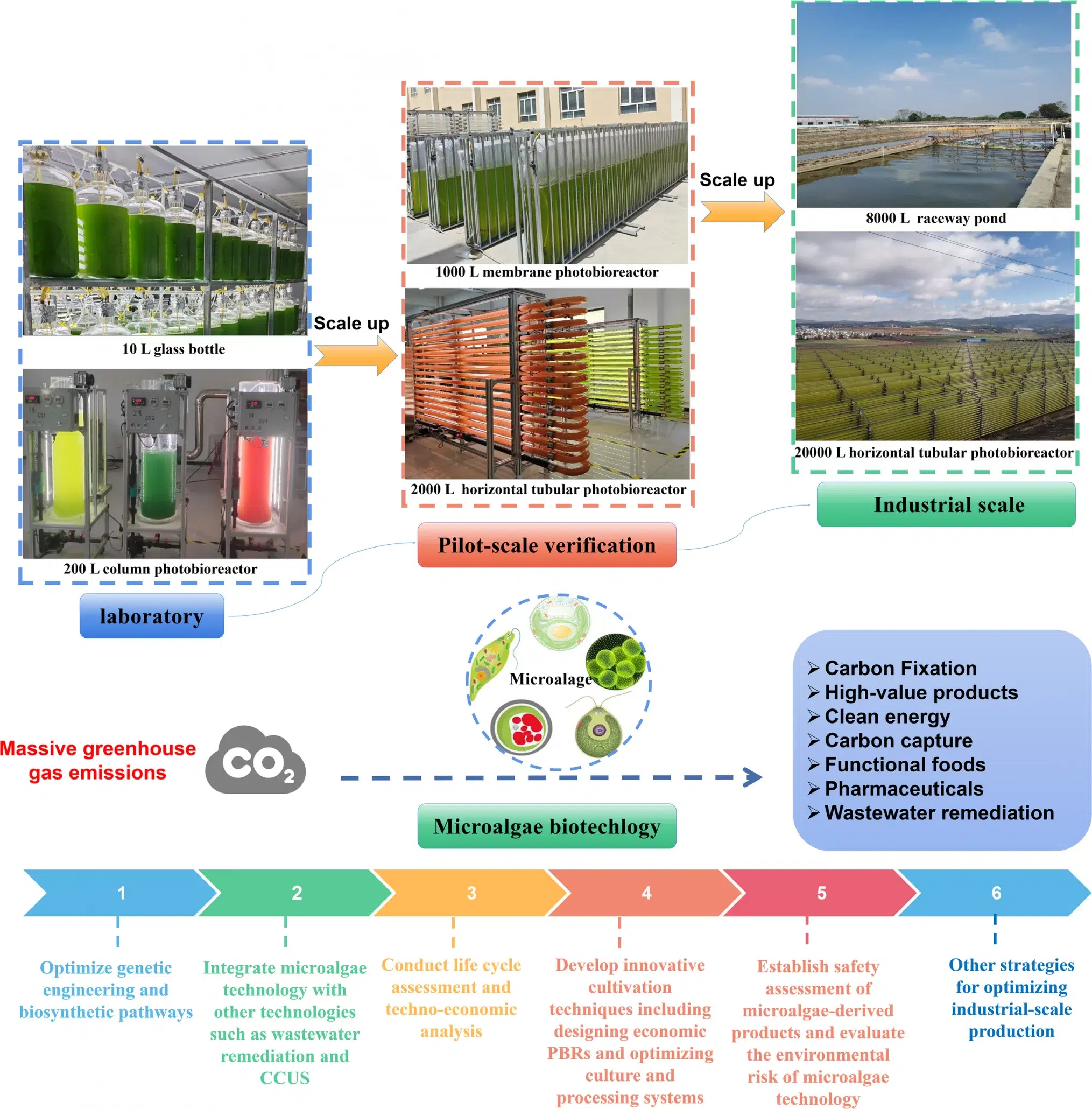
Microalgae DAC Scale-Up Process Visualized
The chart provides a visual representation of the technology’s scale-up pathway, which directly corresponds to the section’s focus on the journey from commercial pilots and the associated challenges.
(Source: Frontiers)
$7.5 B in Cancellations, Microalgae DAC Market Volatility
The nascent carbon removal market experienced significant turbulence in 2025-2026, as shifts in government funding and corporate procurement strategies created an unstable investment environment for capital-intensive projects.
- In 2025, the carbon removal market underwent a “reckoning” as investors and government bodies scrutinized project viability more closely. This culminated in the cancellation of $7.5 billion in DOE-awarded project funding, including for major carbon capture initiatives, highlighting the profound political risk tied to federal programs.
- The market’s reliance on a few large anchor customers was exposed in April 2026 when Microsoft, a leading buyer of carbon removal credits, announced a temporary pause on new purchases. While the company stated its program had not ended, the move sent a negative signal to project developers dependent on such offtake agreements for financing.
- Despite these headwinds, private sector demand continues to show promise. In December 2025, Frontier and Reverion signed a $41 million offtake agreement for bioenergy with carbon capture and storage (BECCS), demonstrating that demand for high-quality, durable carbon removal remains.
- A crucial market-enabling development occurred in October 2025 when the Puro.earth Advisory Board approved the Microalgae Carbon Fixation and Sinking (MCFS) methodology. This provides a certified, third-party-verified pathway for microalgae projects to generate tradable carbon credits, a vital step for accessing market-based finance.

Carbon Credit Issuance Declines After 2021 Peak
This chart’s data on declining carbon credit issuance is a direct indicator of the market volatility and financial setbacks mentioned in the section, which discusses significant cancellations.
(Source: ScienceDirect.com)
Key Commercial and Policy Setbacks
| Entity / Event | Time Frame | Details and Strategic Purpose | Source |
|---|---|---|---|
| Microsoft Purchasing Pause | April 2026 | Announced a temporary pause on new purchases of carbon removal credits, creating market uncertainty for project developers reliant on its offtake agreements. | indexbox.io |
| U.S. Department of Energy | May-June 2025 | Canceled 24 decarbonization project awards from the Office of Clean Energy Demonstrations, totaling $3.7 billion (part of the $7.5 B in total cancellations), halting development of major carbon capture projects. | Latitude Media |
| Carbon Removal Market “Reckoning” | 2025 | Investors shifted focus from speculative technologies to projects that could deliver verified tonnes, leading to increased scrutiny and financial risk across the sector. | Forbes |
US Policy Leadership, Microalgae DAC and the 45 Q Tax Credit
The United States remains the most critical geography for carbon capture deployment, with federal policy, particularly the Section 45 Q tax credit, serving as the primary financial driver for project development.
- Between 2021 and 2024, the Inflation Reduction Act established a strong baseline for 45 Q, but developers and investors sought higher credit values to de-risk first-of-a-kind projects, especially for DAC.
- The passage of the One Big Beautiful Bill Act (OBBBA) on July 4, 2025, marked a pivotal shift by significantly enhancing the 45 Q tax credit. This legislation is now the central market signal driving investment in U.S.-based carbon capture projects.
- For microalgae DAC, the most relevant provision is the increased credit for DAC with commercial utilization, which now stands at $180 per metric ton. This makes business models where captured CO₂ is converted into valuable products like biofuels or bioplastics highly attractive.
- In contrast, point-source capture from industrial facilities for either secure geologic storage or utilization (including enhanced oil recovery) now receives a credit of $85 per metric ton. The parity between storage and utilization was a key change in the OBBBA.
Microalgae DAC from Lab to Pilot, Cost vs. Scale Barriers (2021-2026)
Microalgae-based DAC has successfully transitioned from a laboratory concept to a pilot-stage technology with proven economic potential, though it has not yet achieved commercial scale due to significant physical and infrastructure-related constraints.
- The 2021-2024 period was characterized by academic and lab-scale validation. Research focused on optimizing algal strains, proving CO₂ uptake rates, and establishing the theoretical potential for low-cost capture compared to mechanical systems developed by firms like Climeworks and Carbon Engineering.
- From 2025 onward, the technology entered its pilot phase, with real-world deployments testing its performance. Data from these modern systems confirmed operational costs of $20-$40 per ton of CO₂, validating the economic models of the preceding period and confirming a profound cost advantage over conventional DAC’s $400-$1, 000 per ton.
- Despite the proven low operational cost, the technology’s maturity is limited by high initial capital expenditures for advanced photobioreactors and the immense land and water requirements needed for gigatonne-scale cultivation.
- The technology is currently most viable not for DAC at a global scale, but for capturing CO₂ from concentrated industrial flue gas to produce niche, high-value products where the final sale price, augmented by policy incentives, can justify the high initial investment.
SWOT Analysis, Microalgae DAC Strengths and Market Threats
The strategic position of microalgae DAC is defined by its superior unit economics, which are currently overshadowed by external market and policy risks that threaten its scalability.
- The technology’s primary strength is its low operational cost, which has been validated in pilot projects. However, its greatest weakness is the massive land and water footprint required for climate-relevant scale, a challenge that remains unresolved.
- A significant opportunity lies in the enhanced $180/ton 45 Q tax credit for DAC with utilization, which creates a strong financial incentive for projects that convert CO₂ into bioproducts.
- The main threat is policy and market instability. The cancellation of government funding and pauses in corporate purchasing create a high-risk environment that deters the long-term, large-scale private investment needed for infrastructure development.

Infographic Details Microalgae’s Carbon Capture Potential
The infographic details the fundamental capabilities of the technology, serving as a perfect illustration for the ‘Strengths’ component of the SWOT analysis discussed in this section.
(Source: Frontiers)
SWOT Analysis for Microalgae-Based Direct Air Capture
| SWOT Category | 2021 – 2024 | 2025 – 2026 | What Changed / Validated / Exposed |
|---|---|---|---|
| Strength | Theoretical low operational cost based on biological efficiency and low energy inputs. High CO₂ absorption rate (up to 1.88 kg CO₂ per kg biomass) demonstrated in labs. | Demonstrated operational costs of $20-$40 per ton in pilot-scale systems. Potential to create value-added products like biofuels and bioplastics. | The low operational cost was validated, moving from a theoretical advantage to a demonstrated one. This confirmed its economic superiority over conventional DAC on a per-ton basis. |
| Weakness | High initial CAPEX for photobioreactors. Energy-intensive harvesting and dewatering processes. Questions around nutrient supply for large-scale cultivation. | The immense land and water footprint (100, 000 km² for 2.35 Gt CO₂) emerged as the primary barrier to gigatonne-scale deployment. Poor economics if relying only on algae sales. | The focus shifted from technical process challenges to insurmountable physical constraints at scale. The bottleneck is no longer just the technology, but its massive resource intensity. |
| Opportunity | Growing global demand for carbon removal. Potential to leverage carbon credits and enter biofuel and nutraceutical markets. Initial 45 Q tax credit framework. | Enhanced Section 45 Q tax credit offers $180 per ton for DAC with utilization. Approval of Puro.earth methodology creates a path to monetize carbon credits. | Policy incentives became significantly more tangible and lucrative. The creation of a certified methodology provides a clear mechanism to access carbon market financing. |
| Threat | Competition from established mechanical DAC technologies. Regulatory uncertainty in classifying and permitting large-scale algae farms. | Policy instability evidenced by $7.5 B in DOE project cancellations. Market volatility shown by Microsoft’s purchasing pause. Backlash over 45 Q for enhanced oil recovery. | The primary risks were exposed as external, not internal. The technology’s success is now clearly tied to fragile political consensus and the purchasing habits of a few key corporate buyers. |
$180/ton Incentive, Microalgae DAC’s Path Forward
The most viable path to market for microalgae-based carbon capture in the near term is through niche, high-value applications funded by a combination of product sales and lucrative policy incentives, rather than aiming for immediate gigatonne-scale DAC.
- If stable, long-term offtake agreements for both carbon credits and algae-derived bioproducts materialize, watch for the first wave of commercial-scale projects to be financed. These will likely be facilities co-located with industrial CO₂ sources, not pure DAC.
- The signal to watch is whether project developers can secure financing based on the strength of the $180/ton 45 Q credit combined with revenue from products like sustainable aviation fuel, bioplastics, or nutraceuticals.
- If financing for these integrated biorefineries succeeds, it could validate a step-wise path to scale. This would involve building out infrastructure for profitable, smaller-scale utilization first, before attempting capital-intensive, pure-sequestration DAC projects.
The questions your competitors are already asking
This report covers one angle of the policy and market risks facing microalgae-based Direct Air Capture. The questions that matter most depend on your work.
- What is the status of the canceled $7.5 billion in U.S. Department of Energy projects for microalgae DAC?
- What is the outlook for microalgae DAC deployment toward the 2.35 Gt/year goal given recent policy setbacks?
- What is the status of the $180/ton 45Q tax credit? Does it still sufficiently de-risk investments in microalgae DAC scale-up?
- Microsoft’s carbon removal purchasing activities. Is the temporary pause on microalgae DAC purchases likely to become permanent?
This report does not answer these. Enki Brief Pro does.
Your question, your angle, your framework. SWOT, PESTL, scenario modelling. The same niche depth, built around the decision your work actually depends on.
