

COSCO Green Methanol Strategy, $1.75 B Ship Order, 500 Ton Dalian Bunkering, and 2 Retrofit Projects (2021 to 2025)
COSCO Green Methanol Adoption, 29 Ship Order, and 500 Ton Bunkering (2021 to 2025)
In 2025, COSCO Shipping Lines executed an aggressive hardware-first strategy to accelerate its green methanol adoption, fundamentally shifting from planning to large-scale deployment to create a demand-pull on the nascent fuel supply chain. This approach marks a significant change from the 2021-2024 period, which was characterized by strategic planning and initial project announcements, to a year of decisive capital commitment and operational firsts.
- Prior to 2025, COSCO’s green methanol strategy was largely defined by future commitments, including the announcement in late 2024 of a project to retrofit four vessels for the Shanghai-Los Angeles “Green Corridor.” This period focused on establishing goals and aligning with China’s broader ambition to secure a 50% market share in green-powered ships.
- The strategy materialized in 2025 with a landmark $1.75 billion investment for 29 new green-fueled vessels, signaling a massive scaling of its methanol-ready fleet. This order is a clear attempt to solve the “chicken-and-egg” dilemma by creating a substantial and visible source of future methanol demand.
- Operational validation occurred in June 2025 with the delivery of China’s first domestically built 16, 000 TEU methanol dual-fuel container ship. This was followed by the first bonded green methanol bunkering in Northern China in July 2025, where a COSCO vessel was supplied with 500 tons of domestically produced fuel at Dalian Port.
- Complementing newbuilds, COSCO officially launched its large container ship methanol dual-fuel retrofitting project in April 2025, demonstrating a dual approach to decarbonization that addresses both new and existing assets to expedite the fleet’s transition.
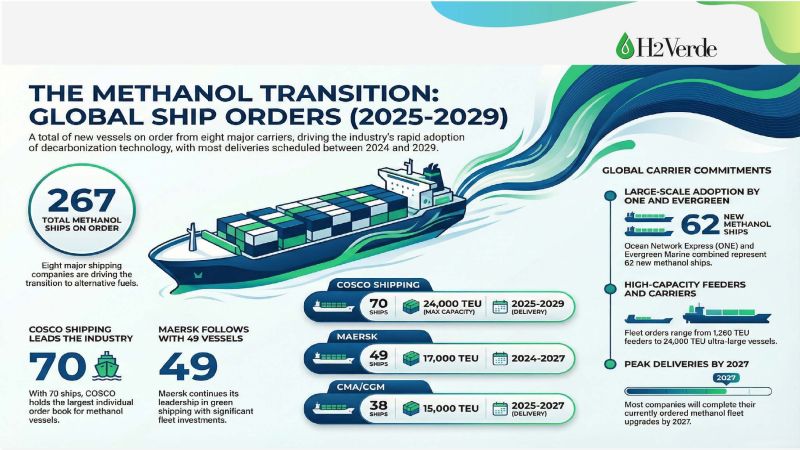
COSCO Leads Global Methanol Ship Orders
This chart directly visualizes COSCO’s leading position in methanol ship orders, which is the central theme of the section’s ’29 Ship Order’ topic.
(Source: LinkedIn)
$1.75 B Investment, COSCO Green Fleet Expansion
COSCO’s 2025 capital allocation was decisively concentrated on fleet expansion, committing $1.75 billion to newbuilds to establish a leadership position in methanol-powered shipping. This investment contrasts with broader market headwinds, including significant climate tech project cancellations in other sectors, highlighting COSCO’s focused commitment to a single alternative fuel pathway.
- The primary investment was the $1.75 billion commitment in October 2025 for 29 new vessels, which includes methanol dual-fuel ships and is intended to accelerate fleet renewal and meet decarbonization targets.
- This hardware investment is further defined by the ongoing construction of 12 methanol dual-fuel container ships of 24, 000 TEU capacity, which are projected to reduce CO₂ emissions by approximately 1.2 million tonnes annually upon delivery.
- This contrasts with the strategies of competitors like Maersk, which, through its C 2 X venture, is also investing upstream in fuel production. In April 2025, ENEOS announced a $100 million investment into C 2 X to advance green methanol production.
- The risk environment for such large-scale capital projects was underscored in Q 1 2025, when a reported $8 billion in U.S. climate tech projects were canceled or downsized, indicating significant execution and financing risks that COSCO’s strategy must navigate.

Methanol Ship Market Shifts to Commercial Scale
This chart provides context for COSCO’s ‘$1.75 B Investment’ by indicating the market is maturing to a ‘Commercial Scale,’ which justifies large-scale investment and ‘Green Fleet Expansion’.
(Source: MarketsandMarkets)
Table: COSCO Green Methanol Fleet Investment vs. Market Context (2025)
| Company / Entity | Time Frame | Details and Strategic Purpose | Source |
|---|---|---|---|
| COSCO Shipping Lines | Oct 31, 2025 | Committed $1.75 billion for 29 new vessels, including methanol-fueled ships, as part of a green fleet expansion to create demand-side scale. | Breakbulk News |
| COSCO Shipping Lines | Jul 15, 2025 | Advanced construction of 12 x 24, 000 TEU methanol dual-fuel vessels, aiming to create the world’s largest low-carbon container ships. | Xinde Marine News |
| ENEOS (for Maersk’s C 2 X JV) | Apr 2, 2025 | Invested $100 million in the C 2 X green methanol venture, demonstrating a strategy of vertical integration into fuel production. | ENEOS News Release |
| US Climate Tech Sector | Apr 21, 2025 | A record $8 billion worth of large-scale projects were canceled in Q 1 2025, highlighting broader investment and execution risks in the clean energy transition. | MIT Technology Review |

Green Methanol Ship Market Valued at $5.85B in 2025
This chart provides the specific market valuation data point (‘$5.85B’) for the target year (‘2025’) required by the section to compare COSCO’s investment against the broader ‘Market Context’.
(Source: Fortune Business Insights)
Supply Chain Risk, COSCO’s Hardware-First Strategy vs Maersk’s C 2 X Venture
COSCO’s 2025 strategy centers on building operational partnerships to support its hardware-first approach, focusing on creating a domestic bunkering ecosystem in China. This approach directly contrasts with competitors like Maersk that are forming joint ventures further upstream to secure fuel production, exposing COSCO to greater supply-side risks if the market fails to scale.
- In July 2025, COSCO partnered with Dalian Port to complete northern China’s first bonded green methanol bunkering, successfully supplying 500 tons of domestically produced fuel. This collaboration is designed to establish a critical refueling hub for its new fleet.
- The voyage of the “COSCO SHIPPING Yangpu” in September 2025 further validated this domestic ecosystem, with the vessel bunkering locally produced green methanol at Yangpu Port, proving the viability of the Chinese supply chain.
- This contrasts with Maersk’s strategy of being a founding partner in the green methanol production venture C 2 X. The April 2025 investment by ENEOS into C 2 X underscores a partnership model focused on securing the “egg” (fuel) before the “chicken” (ships) are fully scaled.
- COSCO’s reliance on the broader market is highlighted by developments like the November 2025 start of construction on a 150 MW green methanol plant in China for maritime exports. While COSCO is an expected offtaker, its success depends on such third-party projects delivering on time and at cost.

Green Methanol Market to Exceed $11B by 2030
This chart illustrates the rapidly growing green methanol fuel market, highlighting the ‘Supply Chain Risk’ central to COSCO’s ‘Hardware-First Strategy’ as it shows the scale of the fuel supply challenge.
(Source: MarketsandMarkets)
Table: COSCO Operational Projects vs. Supply-Side Developments (2025)
| Partner / Project | Time Frame | Details and Strategic Purpose | Source |
|---|---|---|---|
| Dalian Port | Jul 21, 2025 | First bonded green methanol bunkering in northern China, supplying 500 tons. Establishes a key node in COSCO’s planned operational network. | COSCO SHIPPING |
| Yangpu Port | Sep 23, 2025 | Maiden voyage and bunkering of “COSCO SHIPPING Yangpu” with domestic green methanol, demonstrating end-to-end operational readiness of the new fleet and local supply. | COSCO Interim Report |
| Chinese Shipbuilders | Jun 24, 2025 | Delivery of China’s first homegrown 16, 000 TEU methanol dual-fuel ship, a core collaboration to build domestic industrial capacity for green vessels. | COSCO SHIPPING |
| Chinese Green Methanol Plant | Nov 3, 2025 | Construction began on a 150 MW green methanol plant for maritime fuel. COSCO’s strategy is dependent on the success of such third-party supply projects. | Fuel Cells Works |

Green Methanol for Fuel Use Poised for Growth
This chart’s focus on the growth of ‘Fuel Use’ sets the stage for the section’s discussion on ‘Supply-Side Developments’, as it visualizes the demand that supply must meet.
(Source: MarketsandMarkets)
China vs Global, COSCO Green Methanol Geographic Focus
COSCO’s green methanol activities in 2025 were overwhelmingly concentrated within China, revealing a strategy to build a robust domestic ecosystem for fuel production, shipbuilding, and port infrastructure first. This contrasts with the 2021-2024 period, which included announcements for international routes like the Shanghai-Los Angeles “Green Corridor, ” suggesting a shift in 2025 to securing the domestic foundation before expanding globally.
- All major operational milestones in 2025 occurred in China. This includes the delivery of the first homegrown methanol-powered vessel, the retrofitting project launch, and the first bunkering operations at Dalian and Yangpu ports.
- This domestic focus is aligned with China’s national industrial strategy, detailed in a January 2025 USTR report, which aims for the country to capture a 50% international market share in green-powered ships. COSCO’s actions directly support this goal by creating a captive market for Chinese shipyards and fuel producers.
- While the “Green Corridor” to Los Angeles was part of its 2024 sustainability report, the tangible actions in 2025 were about proving the viability of the Chinese domestic supply chain, from shipyard to port.
- This geographic concentration creates a potential advantage, allowing COSCO to scale in a controlled, state-supported environment. However, it also presents a risk if bunkering infrastructure at key international ports like Singapore, Rotterdam, or Los Angeles fails to develop at a complementary pace.

Green Methanol Ship Market Growth in Asia
This chart’s focus on ‘Growth in Asia’ provides the ideal geographic data to support the section’s ‘China vs Global’ comparative analysis.
(Source: Fortune Business Insights)
COSCO Green Methanol Technology Readiness, 16, 000 TEU Ship Launch and Retrofits
In 2025, COSCO’s initiatives moved green methanol technology from the planning stage to proven, large-scale commercial application, validating the readiness of dual-fuel systems for large container ships. The period marked a transition from theoretical designs discussed in 2021-2024 to the deployment of physical assets with innovative engineering features and the launch of a formal retrofitting program to address the existing fleet.
- The delivery of the first homegrown 16, 000 TEU methanol dual-fuel container ship in June 2025 was the most significant validation point. The vessel featured new technologies, including a unique triangular-array methanol fuel tank design, demonstrating a focus on solving practical safety and storage challenges at scale.
- The initiation of a large-scale retrofitting project in April 2025 for its existing container ships signaled that the technology is considered mature enough for brownfield applications, not just newbuilds. This dual strategy accelerates the overall fleet transition.
- In contrast, the 2021-2024 period was defined by orders and announcements. The tangible launch of ships and bunkering operations in 2025 provides the first real-world data on performance, safety, and operational procedures for methanol as a marine fuel for COSCO.
- While the technology is now proven in application, the primary constraint on its maturity shifts from technical feasibility to economic viability, specifically the high cost of green methanol, which is reported to be 2-3 times more expensive than its fossil-based equivalent.

Container Ships Lead Green Methanol Fleet
This chart supports the section’s focus on ‘16,000 TEU Ship Launch’ by showing that container ships are the dominant segment of the green methanol fleet, confirming the relevance of COSCO’s technology focus.
(Source: Fortune Business Insights)
SWOT Analysis, COSCO Green Methanol Strategy and Market Execution
COSCO’s 2025 strategy leveraged its strengths in scale and state alignment to seize a leadership position, but in doing so, it exposed itself to significant new weaknesses and threats related to fuel supply and cost. The SWOT analysis reveals a company aggressively trading one set of risks for another in pursuit of decarbonization leadership.
- The company’s key strength is its ability to place massive, market-moving orders like the $1.75 billion fleet expansion, which creates a powerful demand signal.
- Its primary weakness is now its heavy dependence on the rapid and cost-effective scaling of a global green methanol production and bunkering infrastructure, which remains largely outside its direct control.
- The opportunity is to establish itself as the dominant carrier in the future green shipping market, leveraging a first-mover advantage with a modernized, compliant fleet.
- The main threat is that the green methanol supply chain fails to materialize at the required scale or price point, leaving COSCO with expensive, underutilized assets while more integrated competitors like Maersk secure their own fuel supplies.

Green Methanol Slashes Maritime Emissions
This chart quantifies the core environmental benefit of green methanol, providing a foundational ‘Strength’ and ‘Opportunity’ for the section’s ‘SWOT Analysis’.
(Source: Green Fuel Journal)
Table: SWOT Analysis for COSCO Green Methanol Initiatives for 2025: Key Projects, Strategies and Market Impact
| SWOT Category | 2021 – 2024 | 2025 – Today | What Changed / Validated |
|---|---|---|---|
| Strength | Strong balance sheet and market position in conventional shipping. Strategic alignment with Chinese state policy. | Demonstrated ability to execute large-scale domestic projects (ship delivery, bunkering). Aggressive capital deployment ($1.75 B order). | The company validated its ability to translate financial strength and state support into tangible, domestically-produced green shipping hardware and infrastructure. |
| Weakness | High carbon footprint from a large, fossil-fueled fleet. Lack of operational experience with alternative fuels. | High dependency on a nascent and expensive green methanol supply chain. Hardware-first strategy carries high fuel price and availability risk. | The core weakness shifted from an aging, non-compliant fleet to a strategic dependency on an immature external market for its new, compliant fleet. |
| Opportunity | Potential to lead in maritime decarbonization. Meet upcoming regulations like IMO 2030/2050. | Catalyze China’s domestic green methanol industry. Solidify a first-mover advantage in methanol-powered shipping routes. | The opportunity moved from theoretical leadership to a tangible chance to build and dominate a protected domestic green shipping ecosystem in China. |
| Threat | Regulatory uncertainty and risk of choosing the wrong future fuel. Competitors (e.g., Maersk) making early moves. | High green methanol costs ($450–$650/ton vs. <$250/ton for fossil). Slower-than-expected global bunkering network expansion. | The threat became less about choosing the wrong technology and more about the economic viability and supply-side execution risk of the chosen technology. |
COSCO Scenario Modeling, Offtake Agreements and Supply Chain Viability
The success of COSCO’s entire green methanol strategy now hinges on its ability to secure a stable, long-term supply of cost-effective green methanol. If COSCO announces large-scale offtake agreements in the near future, it will validate its demand-pull strategy and de-risk its massive hardware investments.
- Watch this: The announcement of multi-year, fixed-price or indexed-price offtake agreements for green methanol. Such deals are the most critical missing piece of COSCO’s strategy and the strongest signal that the supply “egg” is materializing to meet the hardware “chicken.”
- If this happens: Competitors and investors will see COSCO’s hardware-first approach as validated. It will likely trigger another round of vessel orders across the industry and accelerate investment in green methanol production, especially in and around China.
- These could be happening: Behind-the-scenes negotiations with new producers, like the entity building the 150 MW plant in China, are almost certainly underway. COSCO may also be exploring partnerships or direct investments in production, mirroring Maersk’s C 2 X strategy as a hedging mechanism.
- If no agreements emerge: If COSCO’s new fleet enters service without secured fuel contracts, the company will be exposed to extreme spot market price volatility for green methanol. This could render its new vessels uneconomical to operate on green fuel, forcing them to use conventional fuel and undermining the entire decarbonization effort.

Methanol Ship Market Forecasted for Strong Growth
This chart provides a strong growth forecast for the methanol ship market, which is a critical input for the ‘Scenario Modeling’ and ‘Supply Chain Viability’ analysis discussed in the section.
(Source: MarketsandMarkets)
The questions your competitors are already asking
This report covers one angle of COSCO’s ‘hardware-first’ strategy to accelerate the green methanol shipping market. The questions that matter most depend on your work.
- What is the status of COSCO’s Shanghai-Los Angeles ‘Green Corridor’ retrofit project since its 2024 announcement?
- Is COSCO’s $1.75 billion order for 29 methanol-fueled vessels on track to solve the fuel’s ‘chicken-and-egg’ supply problem?
- Who are the key suppliers of domestically produced green methanol for COSCO’s bunkering operations at Dalian Port?
This report does not answer these. Enki Brief Pro does.
Your question, your angle, your framework. SWOT, PESTL, scenario modelling. The same niche depth, built around the decision your work actually depends on.
