

Enel’s Onshore Pivot: Why the Energy Giant Is Avoiding Offshore Wind Risk in 2026
Risk Aversion in Renewables: Enel’s Strategic Retreat from Offshore Wind Projects
By 2026, Enel has solidified a corporate strategy of deliberate risk aversion, channeling capital into proven onshore renewables and grid infrastructure while consciously avoiding the high-cost, volatile offshore wind sector. This approach marks a significant strategic divergence from competitors, prioritizing financial stability and predictable returns over pioneering new, capital-intensive frontiers in marine energy.
- Between 2021 and 2024, Enel’s strategy was characterized by onshore expansion and exploratory R&D partnerships in marine energy, such as the EU-SCORES project, without committing to direct offshore wind farm development.
- From 2025 onwards, this strategy intensified with the announcement of a massive €53 billion investment plan for 2026-2028 that overwhelmingly favors grids and onshore projects, confirming offshore wind is not a near-term priority.
- In contrast, competitors like Iberdrola are actively developing large-scale offshore projects, such as the 806 MW Vineyard Wind 1 in the US, highlighting a fundamental split in industry risk appetite.
- Enel’s recent actions, including a ~$1 billion acquisition of an 830 MW US wind and solar portfolio and the start of construction on 110 MW of new onshore wind in Spain, reinforce a focus on immediate, value-accretive growth in mature technologies.
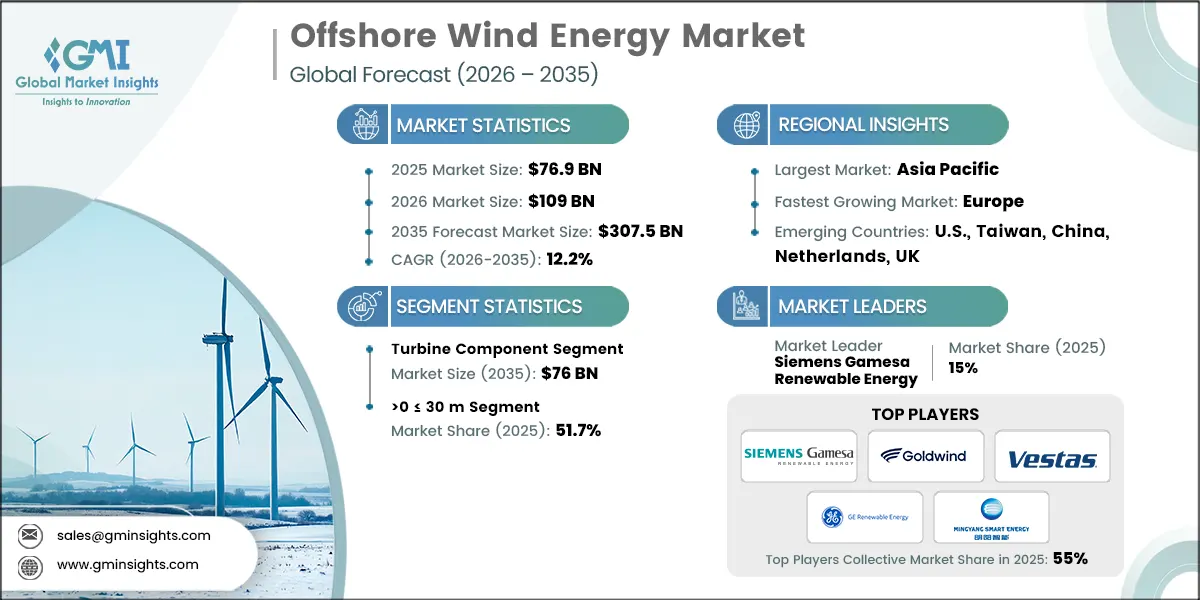
Offshore Wind Market to Exceed $300B
This chart highlights the massive potential value of the offshore wind market that Enel is strategically avoiding, contextualizing the scale of its risk-averse decision.
(Source: Global Market Insights)
Investment Analysis: A €53 Billion Plan Focused on Onshore and Grid Stability
Enel’s capital allocation for the 2026-2028 period confirms a clear financial directive to de-risk its portfolio by concentrating on its core competencies in onshore wind, solar, and grid modernization. While other energy majors like Repsol are simultaneously exploring digitalization through advanced AI projects to optimize operations, Enel’s financial strategy is centered on tangible asset growth in predictable markets.
- The 2026-2028 strategic plan allocates €53 billion in total investments, a significant increase designed to accelerate growth in stable markets like Europe and the US, with no major capital earmarked for new offshore wind development.
- Within this plan, renewables investment was increased to €20 billion, with approximately €10 billion specifically targeting the addition of 7 GW of new, primarily onshore, wind capacity by 2028.
- This selective investment approach stands in contrast to the period between 2021-2024, where plans like the €12.1 billion renewables CAPEX for 2024-2026 were also onshore-focused but part of a broader, less concentrated capital strategy.
Table: Strategic Investment Plans (2025-2028)
| Company | Time Frame | Details and Strategic Purpose | Source |
|---|---|---|---|
| Enel | 2026-2028 | Commits €53 billion total investment, with €20 billion for renewables. The plan prioritizes grid infrastructure and an additional 7 GW of onshore wind, indicating a strategy of risk mitigation and focus on proven technologies in stable markets. | re News |
| Iberdrola (Competitor) | 2026-2028 | Announces a €58 billion investment plan with a €21 billion focus on renewables. Unlike Enel, a significant portion is directed toward developing large-scale offshore wind megaprojects, demonstrating a higher-risk, higher-growth strategy. | Enlit World |
| Enel Americas | 2026-2028 | Plans to invest $7.9 billion with a focus on grid expansion in Brazil and renewable energy projects in Colombia. The goal is to reach 3.5 GW of wind power in its regional generation portfolio by 2028. | BNamericas |
Partnership Analysis: Alliances Bolster Onshore Supply Chains and R&D, Not Offshore Construction
Enel’s partnership ecosystem is structured to support its onshore-centric strategy by securing supply chains, financing, and corporate offtake, while only engaging with offshore technology at an exploratory R&D level. These collaborations are designed to optimize the execution of its current project pipeline rather than to build new capabilities in the offshore wind construction sector.
- In 2025-2026, key partnerships focused on execution, including a 636 MW turbine supply agreement with Vestas for US onshore projects and a major financing deal with Denmark’s EIFO tied to using Danish suppliers.
- This contrasts with the 2021-2024 period, where partnerships like the EU-SCORES project with EDP and Simply Blue Group were about exploring future hybrid offshore technologies, not immediate deployment.
- Corporate Power Purchase Agreements (PPAs) have become a central pillar of the strategy, with recent agreements like the one with Meta for the Rockhaven onshore wind farm de-risking new projects by guaranteeing revenue streams.
Table: Key Commercial Partnerships (2021-2026)
| Partner / Project | Time Frame | Details and Strategic Purpose | Source |
|---|---|---|---|
| Vestas | Jan 2026 | Agreement for up to 636 MW of turbines to supply Enel‘s US onshore wind development pipeline, securing critical components for its core growth area. | State of Green |
| Meta | Feb 2025 | PPA for a 115 MW portion of the Rockhaven onshore wind farm in Oklahoma. This secures a long-term offtaker and validates the financial model for new onshore developments. | POWER Magazine |
| EU-SCORES (with EDP, Simply Blue Group) | 2021-2025 | A €45 million R&D initiative to develop bankable hybrid offshore parks combining wind, wave, and solar. This allows Enel to monitor next-generation technology without direct capital exposure. | RWE |
| Ocean Power Technologies | Apr 2021 | Deployment of a PB 3 Power Buoy® to test wave energy conversion technology. This represents a low-risk exploration of alternative marine renewables. | Ocean Power Technologies |
Geography: Doubling Down on Onshore Wind Projects in the US, Spain, and Latin America
Enel’s geographic footprint for new energy generation is sharply focused on its core, stable markets of Europe and the Americas, where it can leverage existing infrastructure and regulatory familiarity to deploy onshore wind and solar projects efficiently. The post-2025 strategy shows a clear acceleration of project construction and acquisition in these key regions.

North American Offshore Market Booms
While Enel doubles down on US onshore projects, this chart shows the parallel offshore boom in North America, highlighting the specificity of Enel’s strategic choice within a key growth region.
(Source: Market Data Forecast)
- In the 2025-2026 period, Enel has concentrated its activities in the US, Spain, and Mexico. Major actions include starting construction on 110 MW of onshore wind in Zaragoza, Spain, and completing the 274 MW Dolores wind farm in Mexico.
- This represents a material acceleration from the 2021-2024 period, which saw foundational projects like the 180 MW Tico Wind farm in Spain come online but lacked the large-scale portfolio acquisitions seen recently.
- The US has become a primary target for inorganic growth, highlighted by the ~$1 billion acquisition of an 830 MW portfolio of operational wind and solar assets in February 2026.
- Latin America remains a strategic growth pillar, with a $7.9 billion investment plan for 2026-2028 focused on Brazil and Colombia, targeting 3.5 GW of total wind capacity in the region by 2028.
Technology Maturity: Deploying Proven Onshore Technology While Monitoring Future Offshore Innovations
Enel’s technology strategy is defined by a clear split: commercial-scale deployment is reserved for mature, cost-effective technologies like onshore wind and solar, while emerging technologies like floating offshore wind are kept in a low-cost, exploratory R&D phase. This approach insulates the company’s near-term financial performance from the risks of unproven or economically volatile technologies.

Floating Offshore Wind Market Surges
This chart quantifies the explosive growth of floating offshore wind, the exact technology the section identifies as an emerging innovation that Enel is monitoring from a distance.
(Source: Global Market Insights)
- From 2025 to today, all major project completions and construction starts, such as the Dolores wind farm in Mexico and the Zaragoza project in Spain, exclusively use latest-generation but commercially proven onshore wind turbines.
- While Enel‘s informational materials express interest in future technologies like floating offshore wind, there are no concrete investment announcements or project timelines for this segment in the 2025-2028 period.
- During the 2021-2024 timeframe, Enel engaged with emerging tech through partnerships, such as testing innovative fabric-based turbine blades with ACT Blade and wave energy buoys with Ocean Power Technologies, treating them as research initiatives, not commercial ventures.
SWOT Analysis: Enel’s Strategic Position in the Global Wind Market
Enel’s strategy of onshore prioritization creates a distinct profile of strengths and weaknesses, positioning it as a financially disciplined but potentially less growth-oriented player compared to its offshore-focused rivals. The key change from 2024 to 2025 is the formalization of this risk-averse stance through a massive, targeted investment plan.

Offshore Wind Market Reaching $151B
This forecast quantifies the scale of the global offshore market, directly illustrating the long-term growth opportunity that Enel risks missing, a key weakness noted in the SWOT analysis.
(Source: Market.us)
- Strengths: High financial discipline and focus on stable, predictable returns from proven technologies.
- Weaknesses: Potential to miss out on the exponential growth and market leadership opportunities in the burgeoning offshore wind sector.
- Opportunities: Ability to enter the offshore market at a later stage, potentially with more mature and cost-effective hybrid or floating technologies.
- Threats: Competitors could establish insurmountable leads in offshore supply chains, talent, and project sites, making future market entry more difficult and costly.
Table: SWOT Analysis for Enel’s Wind Energy Strategy
| SWOT Category | 2021 – 2024 | 2025 – 2026 | What Changed / Validated |
|---|---|---|---|
| Strengths | Focus on onshore wind, solar, and BESS. A “selective approach” to investment to maximize returns and reduce debt through a €21 billion asset disposal plan. | Implementation of a €53 billion investment plan heavily weighted to onshore renewables and grids. Strong focus on securing PPAs with corporate offtakers like Meta. | The strategy of financial discipline was validated and scaled up. The company proved it can secure long-term revenue for its onshore assets through corporate partnerships. |
| Weaknesses | Explicitly stated “no offshore wind capacity.” Strategy seen as conservative compared to peers like Ørsted and Iberdrola. | Described as “cautious” on offshore wind, with no capital allocated in the 2026-2028 plan. Appears to be ceding the offshore market to competitors. | The absence from offshore wind shifted from a passive state to an active strategic choice, confirmed by the new investment plan that doubles down on onshore. |
| Opportunities | Exploratory R&D in next-gen marine tech (EU-SCORES, wave energy) provided a low-cost window into future possibilities. | Maintains an “interest” in floating offshore wind. The cautious stance allows it to bypass current offshore supply chain bottlenecks and cost inflation. | The opportunity to be a “fast follower” rather than a “first mover” has been validated. Enel can let others bear the risk of maturing the offshore market. |
| Threats | Competitors like Iberdrola were advancing large-scale offshore wind projects, building expertise and securing supply chains. | Iberdrola is nearing completion of the 806 MW Vineyard Wind 1 project, a landmark achievement that Enel has no equivalent to. | The threat of being left behind in the offshore race has become more tangible as competitors deliver on their large-scale project pipelines. |
2026 Scenario: Watching for a Pivot While Executing on Onshore Dominance
For 2026, the primary expectation is that Enel will remain steadfast in its onshore-focused strategy, prioritizing the execution of its 7 GW new wind capacity target and grid investments. The company’s performance will be measured by its ability to deliver these projects on time and on budget, reinforcing its reputation for financial prudence.

Offshore Market Shows Concentrated Growth
This forecast illustrates near-term market concentration for 2025-2030, providing context for the section’s discussion on potential market volatility and the prudence of Enel’s strategy.
(Source: Investment Monitor)
- If the global offshore wind market continues to experience high volatility, supply chain disruptions, and project cancellations, Enel‘s risk-averse strategy will be hailed as a masterstroke of financial management.
- Watch for any minor, pilot-scale investment in floating offshore wind, particularly in its home market of Italy. Such a move would be the first concrete signal of a future strategic pivot and an acknowledgment that it cannot ignore the offshore market indefinitely.
- It could be happening that Enel is using the 2026-2028 period to strengthen its balance sheet and operational capabilities, positioning itself to acquire distressed offshore assets or smaller developers if the market experiences a downturn.
Frequently Asked Questions
Why is Enel avoiding offshore wind projects in its 2026 strategy?
Enel is avoiding the offshore wind sector due to its high costs, volatility, and associated risks. The company has adopted a strategy of deliberate risk aversion, choosing to prioritize financial stability and predictable returns by investing in proven onshore technologies like wind and solar, along with grid infrastructure.
What are the key details of Enel’s investment plan for 2026-2028?
Enel has announced a €53 billion investment plan for 2026-2028. Within this, €20 billion is allocated to renewables, specifically targeting the addition of 7 GW of new, primarily onshore, wind capacity. The plan confirms that no major capital is earmarked for new offshore wind development.
How does Enel’s strategy compare to its competitor, Iberdrola?
There is a clear strategic split. While Enel is focusing on onshore projects and grid stability to de-risk its portfolio, competitors like Iberdrola are pursuing a higher-risk, higher-growth strategy. Iberdrola is actively developing large-scale offshore wind projects, such as the 806 MW Vineyard Wind 1 in the US, a market segment Enel is currently avoiding.
Is Enel completely abandoning marine and offshore energy technologies?
Not entirely. While Enel is not committing direct capital to build offshore wind farms, it is monitoring the sector’s evolution through low-cost, exploratory R&D partnerships. Projects like EU-SCORES (for hybrid offshore parks) and collaborations with Ocean Power Technologies (for wave energy) allow Enel to explore next-generation technology without significant financial risk, positioning it as a potential ‘fast follower’ in the future.
Which geographic regions are the focus of Enel’s current onshore expansion?
Enel is doubling down on its core, stable markets. Its investment and project development activities are concentrated in the US, Spain, and Latin America. Key actions include acquiring an 830 MW US portfolio, building 110 MW of new wind in Spain, and a $7.9 billion investment plan for grid and renewables growth in Brazil and Colombia.
