

Electric Hydrogen Green Hydrogen Scale-Up, $1.6 B Funding, 100 MW PEM Plants, and 2 Giga-factories (2021 to 2026)
Green Hydrogen Adoption, Electric Hydrogen Drives Commercial Scale via Standardized Manufacturing
The industrialization of electrolyzer manufacturing is the primary mechanism driving green hydrogen toward commercial adoption and cost parity with grey hydrogen. Between 2021 and 2024, the market was defined by bespoke, megawatt-scale projects and R&D focused on catalyst breakthroughs. Since 2025, the focus has shifted decisively to commercializing these innovations through standardized, gigawatt-scale production, fundamentally changing the cost structure and accelerating deployment timelines for hard-to-abate sectors.
- In the 2021-2024 period, innovation was centered on lab-scale breakthroughs and pilots, such as the University of Wollongong’s capillary-fed electrolyzer cell and H 2 U Technologies’ partnership with So Cal Gas to test non-precious metal catalysts. These efforts established the technical feasibility of lower-cost components.
- The key strategic shift is exemplified by companies like Electric Hydrogen, which moved to standardize and mass-produce complete 100 MW PEM electrolyzer plants. This approach, validated by significant capital inflows in 2022, treats electrolyzers as a manufactured product rather than a construction project, directly attacking capital expenditure.
- Since 2025, this manufacturing-led strategy has gained commercial traction. Estonia-based Stargate Hydrogen raised €11 million in March 2025 to scale up its own precious metal-free electrolyzers, demonstrating that the market is now rewarding companies with a clear path to industrial production and significant CAPEX reduction.
- The result is an expanding application landscape. The promise of low-cost green hydrogen is enabling tangible projects in sectors like heavy transportation, including hydrogen trucks and maritime shipping, where cost-competitiveness is the main barrier to entry.
€200 M for Hy 2 gen AG, Green Hydrogen Investment Fuels Giga-factory Expansion
Capital deployment has pivoted from funding early-stage R&D to financing the physical infrastructure for mass manufacturing, signaling investor confidence in the technology’s commercial readiness. Early-stage funding between 2021 and 2023 validated novel catalyst and membrane technologies, while major rounds from 2024 onward are directed at building and equipping giga-factories, which is the critical step needed to realize economies of scale and drive down the per-kilowatt cost of electrolyzers.
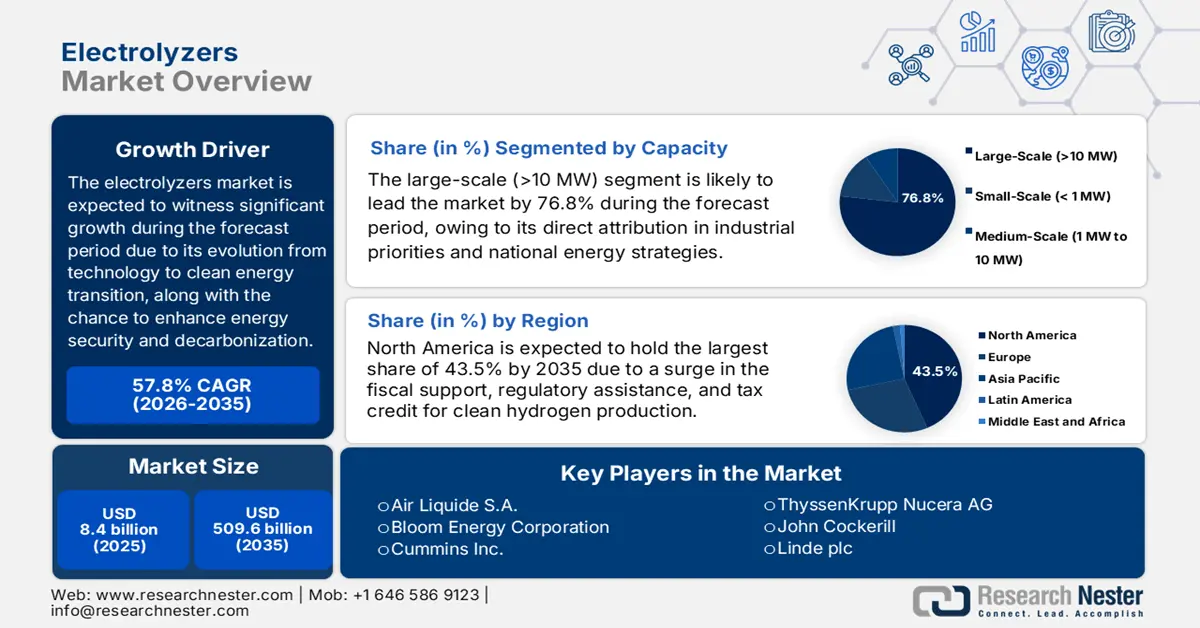
Global Electrolyzer Market Sees Explosive Growth
The chart’s forecast for a $509B market by 2035 reflects the massive capital deployment into giga-factories mentioned in the text. This signals the strong investor confidence required to finance commercial-scale infrastructure.
(Source: Research Nester)
- During the 2021-2023 period, investment focused on proving out next-generation technologies. For example, Sun Hydrogen focused on its nanoparticle-based direct solar-to-hydrogen technology with a target production cost of $2.50/kg.
- A major turning point was the surge in capital for production scale-up, which exceeded $1.6 billion in 2022 alone, with a significant portion directed toward companies like Electric Hydrogen focused on manufacturing.
- This trend accelerated into the 2025-2026 period, with large, targeted investments aimed at building production capacity. In February 2026, Hy 2 gen AG secured a €200 million investment specifically to develop facilities producing green hydrogen and its derivatives.
- Venture funding is also targeting regional manufacturing champions. In March 2026, Indian startup Newtrace raised $6.3 million to advance its climate-friendly hydrogen production technology, indicating that investment is diversifying geographically to support local manufacturing ecosystems.
Table: Strategic Investments in Green Hydrogen Manufacturing & Scale-Up
| Company / Project | Time Frame | Details and Strategic Purpose | Source |
|---|---|---|---|
| Newtrace | March 2026 | Raised $6.3 million in a funding round to advance its proprietary electrolyzer technology and support India’s domestic green hydrogen manufacturing goals. | India Tech Desk |
| Hy 2 gen AG | February 2026 | Secured a €200 million investment to develop facilities for producing green hydrogen-based e-fuels, signaling a shift toward funding downstream applications enabled by scaled production. | Hy 2 gen AG |
| Stargate Hydrogen | March 2025 | Raised €11 million in a Series A round to scale up production of its precious metal-free electrolyzers, directly addressing a key CAPEX driver for PEM technology. | Fuel Cells Works |
| U.S. Department of Energy (DOE) | December 2024 | Announced $750 million in funding as part of the Bipartisan Infrastructure Law to advance electrolysis technologies and reduce electrolyzer costs. | Hidrojen Teknolojileri Derneği |
US vs Europe, Global Race for Green Hydrogen Manufacturing Dominance
A global competition to establish regional green hydrogen manufacturing hubs is intensifying, driven by distinct policy mechanisms and resource advantages in the United States, Europe, and Asia. While Europe focused on foundational R&D and pilot projects from 2021-2024, the U.S. has leveraged powerful production incentives like the IRA Hydrogen Tax Credit 45 V to attract and anchor large-scale manufacturing. Since 2025, other regions, including India and the UK, have implemented their own support schemes to build domestic industrial capacity.

Europe Leads Global Hydrogen Manufacturing Race
This chart directly visualizes the global competition described in the section. It highlights Europe’s dominant growth in manufacturing capacity compared to the US and China, reinforcing the article’s theme.
(Source: IDTechEx)
- Between 2021 and 2024, Europe led in foundational research through initiatives like the ANIONE project, focused on developing next-generation AEM electrolyzers to avoid iridium dependence. This created a strong IP and technology base.
- The United States emerged as a primary destination for manufacturing investment, directly spurred by the Inflation Reduction Act (IRA). The IRA’s production tax credits created a bankable offtake market, incentivizing companies like Electric Hydrogen to establish giga-factories in the U.S.
- Since 2025, other governments have responded with their own industrial policies. The UK’s Hydrogen Allocation Rounds (HARs) provide a direct funding mechanism for low-carbon hydrogen projects, with construction on the Milford Haven plant set to begin in 2026.
- Asia is also becoming a key battleground. In February 2025, Tohoku University and in March 2025, Tokyo University of Science in Japan announced major catalyst breakthroughs, while India’s government support and venture funding for startups like Newtrace show a clear strategy to build a self-sufficient hydrogen economy.
PEM and AEM Maturity, How Manufacturing Scale Validates Electrolyzer Technology
The maturation of green hydrogen technology is now measured by its manufacturability at scale, not just its efficiency in the lab. The 2021-2024 period was characterized by a diverse range of competing electrolyzer designs, including Alkaline (AWE), PEM, AEM, and Solid Oxide (SOE), each with theoretical cost benefits. The period since 2025 shows that technologies best suited for standardized, automated production lines, particularly advanced PEM and emerging AEM systems, are attracting the most significant commercial investment and are on the clearest path to widespread deployment.

Comparing Core Water Electrolyzer Technologies
This diagram details the core electrolyzer technologies (AWE, PEM, AEM, SOE) that the section discusses. It provides crucial context for understanding which designs are best suited for mass production and standardization.
(Source: IDTechEx)
- Initially, the focus was on improving the core components of different technologies. For example, research into thinner membranes for advanced electrolyzers promised a 150% increase in hydrogen production or a 10% reduction in energy use.
- Anion Exchange Membrane (AEM) electrolysis was identified as a promising technology during 2021-2024, as it combines the PGM-free benefits of AWE with the performance of PEM. However, it remained largely in the R&D and pilot phase.
- The shift to industrialization since 2025 is forcing a convergence. Siemens Energy and other major players are now manufacturing electrolyzers specifically designed to be mass-produced, a clear signal that design-for-manufacturing is as important as raw performance.
- The commercial validation of this trend is evident in the funding for companies like Stargate Hydrogen, which is scaling up production of precious metal-free electrolyzers. This confirms that technologies enabling lower material costs and suitability for mass production are now considered mature enough for commercial scale-up.
SWOT Analysis, Electric Hydrogen and the Risks of Aggressive Manufacturing Scale-Up
The strategy of aggressive manufacturing scale-up presents a clear path to cost leadership for green hydrogen but also introduces new risks related to supply chains, market demand, and technology lock-in. While standardization and economies of scale offer a powerful advantage, the rapid build-out of giga-factories creates significant exposure to raw material price volatility and potential mismatches with the pace of offtake market development.
Table: SWOT Analysis for Green Hydrogen Manufacturing Scale-Up
| SWOT Category | 2021 – 2024 | 2025 – Today | What Changed / Resolved / Validated |
|---|---|---|---|
| Strengths | Technology leadership in R&D, particularly in catalyst and membrane innovation (e.g., AEM, PGM-free catalysts). | Mass production capability and standardized designs (e.g., Electric Hydrogen’s 100 MW plants) are driving down CAPEX. Electrolyzer efficiency is now commercially validated at 60-80%. | The theoretical cost benefits of R&D are now being realized through industrial-scale manufacturing, validating the business model. |
| Weaknesses | High CAPEX due to bespoke project designs and reliance on precious metals like iridium and platinum in PEM electrolyzers. | Supply chain vulnerabilities for key materials (even non-PGM ones) and the large upfront capital required for giga-factory construction. | The core weakness has shifted from technology cost to the industrial and financial challenge of scaling the supply chain to meet manufacturing targets. |
| Opportunities | Government R&D funding and long-term decarbonization targets (e.g., DOE’s “Hydrogen Shot”). | Direct production incentives like the U.S. IRA and UK’s HARs create bankable demand. Cost reductions are opening new markets in transport and industry. | Market creation has moved from policy ambition to tangible, government-backed financial incentives, de-risking offtake agreements. |
| Threats | Competition from established grey hydrogen and “blue” hydrogen with carbon capture. Slow development of offtake markets. | Intense global competition for manufacturing leadership, potential for technology obsolescence if a superior electrolyzer design emerges, and risk of carbon price volatility impacting grey hydrogen’s cost. | The primary threat is now commercial and geopolitical, centered on which region can build and sustain the most competitive manufacturing ecosystem. |
Scenario Modelling, Green Hydrogen’s Path to $2/kg Depends on Manufacturing Execution
The green hydrogen industry’s ability to achieve widespread cost parity with grey hydrogen before 2030 is now contingent on successful execution of its manufacturing scale-up strategy. If the current trajectory of factory construction and production standardization continues, the sub-$2/kg cost target is probable in favorable regions. However, any significant disruption to critical mineral supply chains or a slowdown in offtake commitments could delay this timeline. The most important signal to watch is the rate at which new, standardized electrolyzer capacity is not just announced, but successfully deployed and commissioned in commercial projects.

Green Hydrogen’s Path to Sub-$2/kg Goal
The chart reinforces the section’s focus on cost reduction by explicitly stating the industry’s target of reaching under $2/kg. This visualizes the key goal of achieving cost parity with grey hydrogen through manufacturing execution.
(Source: ScienceDirect.com)
- If this happens: Major electrolyzer manufacturers like Siemens Energy, Electric Hydrogen, and others successfully ramp up their giga-factories and meet production targets through 2026.
- Watch this: The Levelized Cost of Hydrogen (LCOH) from newly commissioned projects. Projections from multiple sources, including RMI and PMC, converge around a $2.00-$2.50/kg cost by 2030. Watch for early commercial projects in 2026-2027 to confirm if they are tracking toward this cost curve.
- These could be happening: A surge in Final Investment Decisions (FIDs) for large-scale green hydrogen projects that rely on these new, lower-cost electrolyzers. Additionally, watch for increased investment in the midstream supply chain for electrolyzer components and raw materials, which would signal confidence that the manufacturing ramp-up is sustainable.
The questions your competitors are already asking
This report covers one angle of the commercial scale-up of green hydrogen technology. The questions that matter most depend on your work.
- Which electrolyzer companies are gaining ground by shifting from R&D pilots to standardized giga-factory production?
- What is the outlook for green hydrogen achieving cost-parity with grey hydrogen based on current electrolyzer manufacturing scale-ups?
- How do innovations like precious metal-free catalysts impact the total capital cost of a 100 MW PEM plant?
This report does not answer these. Enki Brief Pro does.
Your question, your angle, your framework. SWOT, PESTL, scenario modelling. The same niche depth, built around the decision your work actually depends on.
Run your first brief in Enki Brief Pro
Experience In-Depth, Real-Time Analysis
For just $200/year (not $200/hour). Stop wasting time with alternatives:
- Consultancies take weeks and cost thousands.
- ChatGPT and Perplexity lack depth.
- Googling wastes hours with scattered results.
Enki delivers fresh, evidence-based insights covering your market, your customers, and your competitors.
Trusted by Fortune 500 teams. Market-specific intelligence.
Explore Your Market →One-week free trial. Cancel anytime.
