

Maersk’s 2026 LNG Fleet: How a $4.6 B Pivot is Reshaping Maritime Decarbonization
In a definitive strategic recalibration, A.P. Moller-Maersk has pivoted from its exclusive focus on methanol to aggressively embrace Liquefied Natural Gas (LNG) as a cornerstone of its decarbonization strategy for 2025 and 2026. This move, backed by billions in new vessel orders and strategic partnerships, repositions the shipping giant to navigate the uncertain future of green fuels. By adopting a dual-fuel approach, Maersk is mitigating risks associated with the slow scaling of green methanol while leveraging LNG’s mature infrastructure, with a clear path toward carbon-neutral bio-LNG.
Maersk’s LNG Commercial Scale Adoption Accelerates in 2025
Maersk executed a significant strategic shift away from a methanol-only pathway to a dual-fuel model, driven by the commercial and logistical realities of scaling new energy sources.
- Between 2021 and 2023, Maersk’s public strategy and commercial actions were centered exclusively on green methanol as its future fuel. The company pioneered this path by ordering the world’s first methanol-powered container vessels and establishing partnerships to secure methanol supply, while openly rejecting LNG as a viable long-term solution.
- A strategic inflection point occurred in late 2024 when, citing the “bumpy road” for green methanol supply, Maersk announced a massive fleet renewal plan for 50-60 new vessels that would include a substantial number of LNG dual-fuel ships.
- This pivot was solidified from 2025 to today, with Maersk placing firm multi-billion dollar orders for large LNG vessels with shipyards like New Times Shipbuilding. Critically, the company validated its green commitment by signing a framework agreement with Avenir Marine to procure liquified biomethane (bio-LNG), ensuring its new LNG fleet has a direct path to reducing GHG intensity.
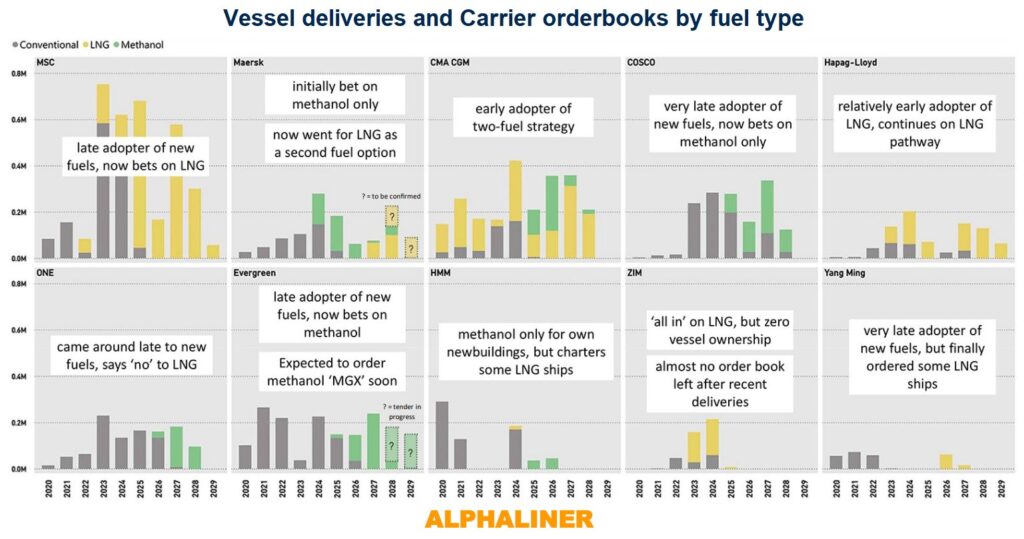
Maersk Adds LNG to Methanol Fleet
This chart perfectly visualizes the strategic shift to a dual-fuel model, showing how LNG-fueled vessels are added to the order book from 2026, complementing the earlier methanol-only strategy.
(Source: Global Maritime Hub)
Investment Data Reveals Maersk’s Multi-Billion Dollar LNG Commitment
Maersk’s capital allocation decisively shifted in late 2024 to fund a large-scale LNG fleet, with investments materializing in 2025 and 2026 through specific shipyard contracts and major port infrastructure projects.
- The company’s financial commitment was first signaled in October 2024 with the confirmation of contracts for up to 22 LNG dual-fuel container ships, valued at an estimated $4.6 billion.
- This plan translated into firm orders in late 2025, including a deal worth approximately $2.3 billion for up to 12 large 18, 000 TEU container ships from China’s New Times Shipbuilding.
- To support this new fleet, Maersk committed to significant infrastructure spending, announcing a joint investment of €1 billion with partner Eurogate in February 2026 to modernize their shared container terminal in Bremerhaven, Germany.
Table: Maersk’s Key LNG-Related Investments (2024-2026)
| Partner / Project | Time Frame | Details and Strategic Purpose | Source |
|---|---|---|---|
| Maersk / Eurogate | Feb 2026 | €1 billion joint investment to modernize the Bremerhaven container terminal. This is designed to enhance efficiency for Maersk’s entire fleet, including the new, large-capacity LNG vessels. | Riviera MM |
| New Times Shipbuilding | Nov 2025 | Order for up to 12 LNG dual-fuel container ships valued at approximately $2.3 billion. This contract represents Maersk’s single largest investment in LNG-powered vessels. | Trade Winds |
| Fleet Renewal Program | Oct 2024 | Confirmed finalization of contracts for up to 22 LNG dual-fuel container ship newbuilds with an estimated total value of $4.6 billion, marking the official start of the LNG investment pivot. | Trade Winds |
Partnership Strategy Shifts to Support Dual-Fuel Operations in 2025
Maersk’s partnership ecosystem evolved from a narrow focus on methanol R&D to a broad operational network designed to support a diversified dual-fuel fleet, with key alliances in 2025 for LNG supply and network efficiency.
- Between 2021 and 2024, Maersk’s primary collaborations, such as with CMA CGM and the Mærsk Mc-Kinney Møller Center for Zero Carbon Shipping, were aimed at establishing standards and accelerating R&D for green fuels, with a clear emphasis on methanol.
- A major operational shift occurred in 2025 with the launch of the Gemini Cooperation with Hapag-Lloyd. This long-term alliance creates a highly efficient network for integrating Maersk’s new large-capacity LNG and methanol vessels into global trade lanes.
- The most critical partnership validating the LNG strategy was the framework agreement signed in the second half of 2025 with Avenir Marine. This deal secures a future supply of bio-LNG starting in 2027, providing a direct pathway to decarbonize the new LNG vessel investment.
Table: Maersk’s Strategic Decarbonization Partnerships (2023-2026)
| Partner / Project | Time Frame | Details and Strategic Purpose | Source |
|---|---|---|---|
| Eurogate | Feb 2026 | Joint investment to modernize the Bremerhaven container terminal, creating a modern, efficient hub capable of servicing Maersk’s next-generation dual-fuel fleet. | Riviera MM |
| Avenir Marine Limited | H 2 2025 | Framework agreement for the supply of liquefied biomethane (bio-LNG). This secures a low-GHG fuel source for Maersk’s new LNG fleet, with deliveries timed to start in 2027. | Maersk |
| Hapag-Lloyd | Feb 2025 | Launch of the Gemini Cooperation, a long-term operational alliance. The goal is to create a more flexible and interconnected ocean network for integrating new large-capacity vessels, including LNG ships. | Offshore Energy |
| CMA CGM | Sep 2023 | Collaboration to jointly accelerate decarbonization by developing standards for new green fuels. This partnership aims to establish a common analysis framework to ensure fuels align with net-zero goals. | g Captain |
Maersk’s Geographic Focus Expands from Asia to Global Infrastructure
Maersk’s geographic strategy broadened from an initial focus on Asian methanol supply chains to a global infrastructure and shipbuilding program, with major port investments in Europe and a heavy concentration of newbuild orders in China from 2025.
- Between 2022 and 2023, activities were concentrated in Asia, highlighted by a Memorandum of Understanding with the Shanghai International Port Group for methanol bunkering infrastructure in China.
- From late 2024 onward, shipbuilding for the new fleet became almost exclusively centered in China, with Maersk placing its multi-billion dollar LNG vessel orders with yards like New Times Shipbuilding.
- Europe became a critical infrastructure hub starting in 2025, with the agreement with UK-based Avenir Marine for bio-LNG supply and the €1 billion investment in Germany’s Bremerhaven terminal announced in 2026.
- Maersk has also signaled a long-term commitment to expanding its footprint in India, with a potential $2 billion investment in port infrastructure and partnerships with local shipyards like Cochin Shipyard from 2025.

Maersk’s North Europe Capacity Soars in 2025
This chart provides specific data supporting the geographic expansion into Europe, showing Maersk’s capacity share in the region tripling and validating its investment in European port infrastructure.
(Source: Global Maritime Hub)
Maersk’s Technology Strategy: Mature LNG Complements Pioneering Methanol
Maersk’s technology strategy matured from pioneering methanol as a novel fuel to de-risking its decarbonization pathway by adopting commercially proven LNG dual-fuel technology, while creating a future-proof path with bio-LNG.
- In the 2021-2024 period, Maersk successfully advanced methanol technology from pilot to commercial scale. This was demonstrated by the launch of the world’s first methanol-powered feeder vessel, *Laura Maersk*, and the industry’s first large vessel methanol retrofit on the *Maersk Halifax* in November 2024.
- The pivot in late 2024 marked the adoption of mature and globally available LNG dual-fuel engine technology. This strategic choice was made to circumvent the slower-than-expected scaling of green methanol production and bunkering infrastructure.
- From 2025, the strategy advanced to include bio-LNG as a “drop-in” fuel for its new LNG vessels. This allows Maersk to achieve immediate greenhouse gas reductions without requiring further technological modifications, leveraging the existing LNG supply chain and de-risking the transition. The industry is also exploring other fuel options, such as those seen in the top green ammonia projects.

Analysis Shows LNG’s Long-Term Cost Advantage
This chart explains the rationale for adopting mature LNG technology by showing its projected long-term cost advantage, aligning with the strategy of de-risking the decarbonization pathway.
(Source: LinkedIn)
Maersk’s SWOT Analysis for LNG and Decarbonization
Maersk transitioned from a high-risk, single-fuel strategy to a more resilient dual-fuel model, mitigating methanol supply weaknesses but introducing new operational complexities and dependencies on bio-LNG development.
- Maersk’s strength as an industry leader allowed it to pioneer methanol, but this created a weakness of over-reliance on an unproven supply chain, which was validated in 2024.
- The opportunity to leverage mature LNG infrastructure was seized in late 2024, resolving the immediate fuel availability threat but creating a new challenge: managing methane slip from LNG engines.
- The strategic pivot creates a new opportunity to lead in the bio-LNG space, but its success is threatened by the pace of regulatory changes and the future cost-competitiveness of LNG versus other green fuels.

LNG Vessel Capacity Overtakes Methanol in 2024
This chart illustrates the market “Opportunity” described in the SWOT analysis, showing the industry-wide surge in LNG capacity that validated Maersk’s decision to leverage a mature technology.
(Source: gCaptain)
Table: SWOT Analysis for Maersk’s Fuel Strategy (2021-2025)
| SWOT Category | 2021 – 2024 | 2025 – Today | What Changed / Resolved / Validated |
|---|---|---|---|
| Strengths | Industry leadership in pioneering methanol technology (e.g., *Laura Maersk* launch, methanol retrofit). | Operational scale and flexibility through the Gemini Cooperation. Diversified, de-risked dual-fuel fleet. | Shifted from R&D leadership to practical operational resilience. The Gemini Cooperation provides the network to efficiently deploy a mixed-fuel fleet. |
| Weaknesses | Over-reliance on a single, unproven green methanol supply chain. | Management of methane slip from new LNG engines. Complexity of managing dual-fuel logistics for both LNG and methanol. | The “bumpy road” for methanol supply, as cited by Maersk, was validated. The pivot resolved the single-fuel weakness but introduced new technical and operational challenges. |
| Opportunities | First-mover advantage in the green methanol market and establishment of related green corridors. | Leverage mature global LNG bunkering infrastructure for immediate operational viability. Secure a leading position in the emerging bio-LNG market through the Avenir Marine partnership. | The company moved from creating a new market (methanol) to capturing value from an existing one (LNG) while positioning for its green evolution (bio-LNG). |
| Threats | Significant risk of green methanol production failing to scale in time and cost. | Unfavorable regulatory changes from the IMO or EU ETS regarding methane slip, potentially undermining LNG’s cost-competitiveness. | The initial methanol supply threat materialized, forcing the strategic pivot. The new threat is regulatory, which could impact the long-term viability of the multi-billion-dollar LNG investment. |
Forward-Looking Insights: Bio-LNG Supply is Maersk’s Next Hurdle
The success of Maersk’s multi-billion-dollar pivot to LNG now hinges on its ability to secure a scalable and cost-effective supply of bio-LNG to meet its 2040 net-zero target.
- The first deliveries of bio-LNG from Avenir Marine, scheduled for 2027, represent a critical milestone. This event will be the first major test of the commercial viability of Maersk’s green gas strategy.
- The deployment of the new 18, 000 TEU LNG dual-fuel vessels into the Gemini Cooperation network post-2026 will reveal the real-world operational efficiencies and challenges of managing a large-scale, mixed-fuel fleet.
- Future policy decisions from the International Maritime Organization (IMO) and the expansion of the EU’s Emissions Trading System (ETS) will be pivotal. These regulations will directly influence the cost-competitiveness of fossil LNG, bio-LNG, and methanol, ultimately determining the long-term financial outcome of Maersk’s dual-fuel strategy.
Frequently Asked Questions
Why did Maersk pivot to an LNG fuel strategy after focusing only on methanol?
Maersk adopted a dual-fuel strategy including LNG due to the slow and “bumpy road” in scaling the global supply of green methanol. This pivot allows Maersk to leverage LNG’s mature and available bunkering infrastructure, mitigating the risks of relying on a single, less developed fuel source for its immediate decarbonization needs.
How much has Maersk committed to its new LNG fleet?
Maersk has committed an estimated $4.6 billion for a fleet renewal program that includes up to 22 LNG dual-fuel container ships. A significant part of this is a firm order worth approximately $2.3 billion with New Times Shipbuilding for up to 12 large 18,000 TEU vessels.
How does using LNG, a fossil fuel, align with Maersk’s decarbonization goals?
Maersk’s strategy is to use LNG dual-fuel vessels with a clear pathway to using carbon-neutral liquified biomethane (bio-LNG). The company has secured a framework agreement with Avenir Marine for a future supply of bio-LNG, which can be used as a “drop-in” fuel in its LNG ships to significantly reduce greenhouse gas intensity and progress toward its net-zero targets.
Who are Maersk’s key partners in executing its LNG strategy?
Maersk’s key partners include shipyards like New Times Shipbuilding for constructing the vessels, Avenir Marine for securing a future supply of bio-LNG, Hapag-Lloyd through the ‘Gemini Cooperation’ to create an efficient operational network, and Eurogate for a €1 billion joint investment to modernize the Bremerhaven container terminal to handle the new fleet.
What is the biggest future challenge for Maersk’s LNG strategy?
According to the analysis, the success of Maersk’s multi-billion-dollar pivot now hinges on its ability to secure a scalable and cost-effective supply of bio-LNG. The first deliveries scheduled for 2027 will be a critical test, and the long-term viability also depends on future regulations from bodies like the IMO and EU concerning methane slip and overall fuel competitiveness.
