

US LNG Expansion 2026: How Modular Construction De-Risks FIDs and Accelerates Capacity Growth
LNG Project Adoption 2026: Modular Construction Shifts from Niche to Industry Standard
Modular LNG construction, once a disruptive model, has become the proven template for rapid capacity deployment in a volatile market, enabling developers to meet urgent geopolitical demand and secure financing for mega-projects. This shift is best exemplified by the March 2026 Final Investment Decision (FID) for Venture Global LNG’s CP 2 Phase 2, which proceeded in a record timeframe by leveraging a manufacturing-style approach to liquefaction.
- Between 2021 and 2024, modular construction was in an early validation phase. While Venture Global was pioneering the concept with its initial projects, the broader industry remained cautious, largely adhering to traditional, large-scale “stick-built” construction methods that carried longer timelines and higher capital risks.
- The period from 2025 to 2026 marked a critical inflection point. Venture Global’s ability to reach FID on CP 2 Phase 1 in July 2025 and Phase 2 less than a year later in March 2026 proved the model’s repeatability and scalability. This rapid execution became a significant commercial advantage, attracting offtakers and financiers seeking speed-to-market.
- The success of this model has forced a strategic re-evaluation across the sector. Competitors are now compelled to adopt similar standardized, factory-built approaches to remain competitive on both cost and project delivery schedules in a market that prioritizes supply availability.
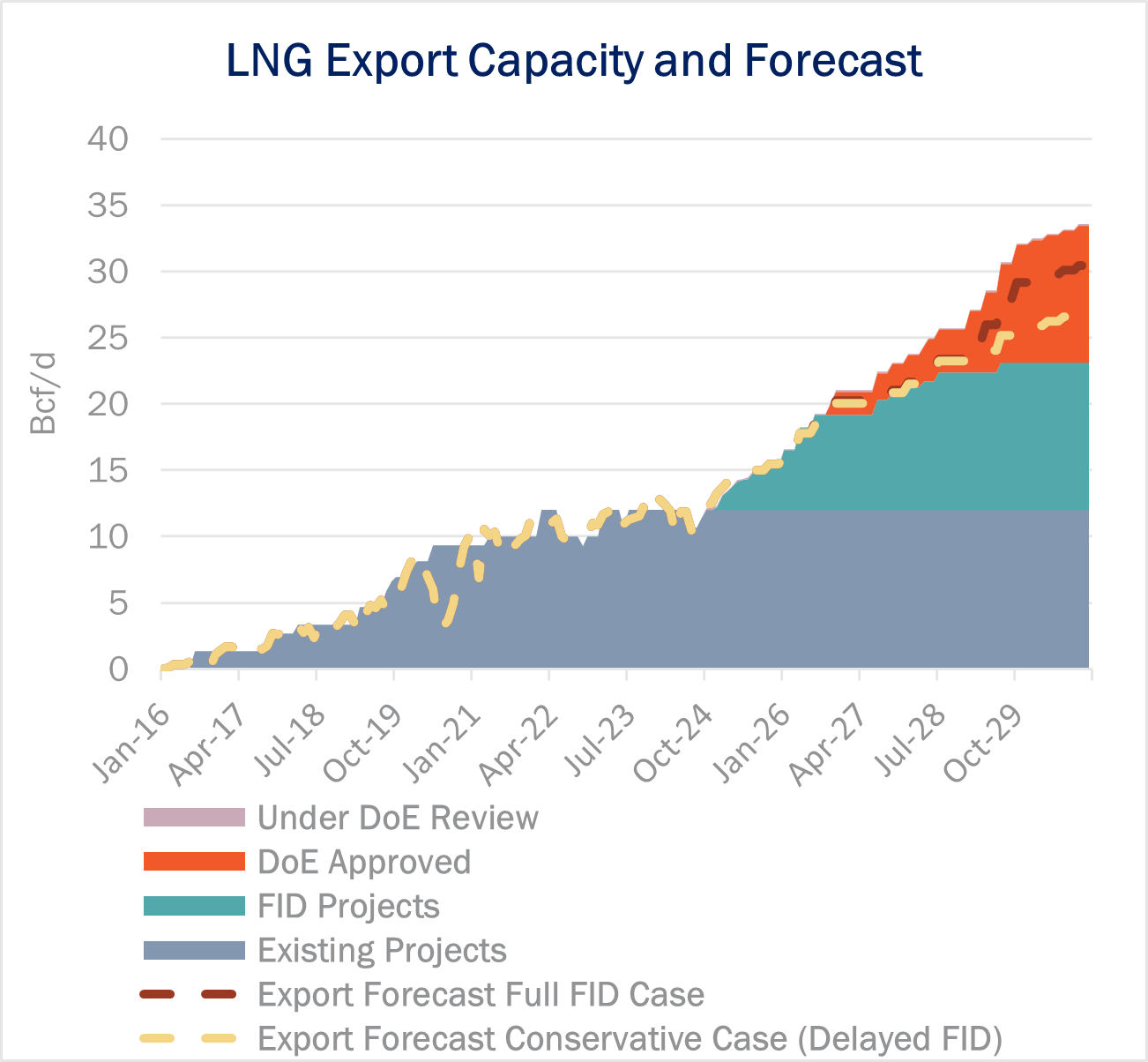
US LNG Capacity Set to Surge Post-2025
This chart illustrates the outcome of modular project adoption, showing the significant ramp-up in US export capacity expected after 2025 as new FID-approved projects come online.
(Source: East Daley Analytics)
LNG Investment Analysis: How Modular Projects Attract Billions in Project Financing
The de-risking effect of accelerated construction timelines and lower capital intensity, both hallmarks of the modular approach, has unlocked unprecedented levels of project financing for US LNG projects. Investor appetite has surged for developers who can demonstrate a clear, repeatable path from FID to first cargo, as confirmed by the heavily oversubscribed financing for the CP 2 project.
- The $8.6 billion project financing package for CP 2 Phase 2, announced on March 13, 2026, stands as one of the largest of its kind. The deal was dramatically oversubscribed, with banks indicating interest totaling approximately $19 billion, signaling deep confidence from the financial community in the modular development model.
- This funding brought the total capital raised for the entire 20 MTPA CP 2 project to $20.7 billion within a 12-month period, following the $15.1 billion FID for Phase 1 in July 2025. This rapid, large-scale capitalization is a direct result of the perceived lower risk and faster revenue generation of the modular approach.
- Market reaction validated this investor confidence. Following the announcement of the Phase 2 financing, Venture Global’s stock (VG) increased by 14.5%, reflecting shareholder optimism regarding the company’s de-risked growth trajectory and future revenue streams.
Table: Key Financial Milestones for CP 2 LNG Project
| Partner / Project | Time Frame | Details and Strategic Purpose | Source |
|---|---|---|---|
| CP 2 LNG (Phase 2) | March 2026 | Secured $8.6 billion in project financing to greenlight construction of an additional 12 bcm/yr of capacity. Lead arrangers included BBVA and MUFG. | Reuters |
| CP 2 LNG (Phase 1) | July 2025 | Reached FID with a $15.1 billion financing package, initiating the first stage of the project’s construction. | Upstream |
Strategic LNG Partnerships: Securing Offtake with Speed-to-Market Guarantees
Long-term offtake agreements are now intrinsically linked to a developer’s ability to provide a rapid and reliable construction timeline, giving modular developers like Venture Global a distinct commercial advantage in negotiations. The CP 2 project’s success was built on a foundation of strong engineering and commercial partnerships that provided the certainty needed to secure financing.
- The selection of Worley Field Services Inc. as the Engineering, Procurement, and Construction (EPC) contractor for Phase 2 in January 2026 was a critical milestone. This partnership provided offtakers and lenders with tangible proof of a de-risked and executable construction plan ahead of the final investment decision.
- The project’s commercial viability was anchored by long-term, 20-year sales and purchase agreements (SPAs) with major global players. Key contracts include a 2 MTPA agreement with Italy’s Eni and a 1 MTPA deal with Malaysia’s Petronas, which were essential for underwriting the massive financing rounds.
- This sequence of securing EPC contracts and offtake agreements *before* seeking final financing has become the new blueprint for successful LNG project development. It demonstrates a commercially mature and de-risked project, making it highly attractive to capital markets.
Table: Key Commercial and Construction Partnerships for CP 2 LNG
| Partner / Project | Time Frame | Details and Strategic Purpose | Source |
|---|---|---|---|
| Worley Field Services Inc. | March 2026 | Received full notice to proceed with the EPC contract for CP 2 Phase 2, officially beginning the construction phase following FID. | Tip Ranks |
| Worley Field Services Inc. | January 2026 | Signed the formal EPC contract for Phase 2, a key step that moved the project toward its final investment decision by solidifying construction costs and timelines. | The Globe and Mail |
| Eni | July 2025 | Signed a 20-year SPA for 2 MTPA of LNG from the CP 2 facility, providing a foundational revenue stream that supported the Phase 1 FID. | Eni |
| Petronas | January 2026 (reported) | Secured a 1 MTPA offtake agreement, further diversifying the project’s customer base and enhancing its commercial stability ahead of the Phase 2 FID. | NGS INDIA |
US Gulf Coast Ascendancy: Why Louisiana Is the Global Epicenter for Modular LNG
The US Gulf Coast, particularly Louisiana, has cemented its role as the dominant global hub for new LNG capacity, driven by a confluence of extensive pipeline infrastructure, a skilled workforce, and the successful at-scale deployment of modular liquefaction technology. This geographic concentration has become a pillar of global energy security, offering reliable supply insulated from chokepoints in other regions.

Map Shows US Gulf Coast LNG Epicenter
This map perfectly illustrates the section’s focus on the US Gulf Coast as an “epicenter” by showing the geographic concentration of LNG projects, including the CP2 facility in Louisiana.
(Source: American Security Project)
- While the US Gulf Coast was an established LNG hub between 2021 and 2024, project development was characterized by slower, more traditional construction cycles. The region served as the initial proving ground for modular concepts, but adoption was not yet widespread.
- By 2026, Louisiana has become the definitive showcase for accelerated, modular build-outs. Venture Global’s cluster of projects, including Calcasieu Pass, Plaquemines, and now the massive CP 2 facility, forms a super-complex that demonstrates the power of co-locating standardized projects.
- The strategic value of this concentrated US supply was amplified by geopolitical events in early 2026, such as the closure of the Strait of Hormuz. This event triggered a shock to the global energy transition and reinforced the premium on secure supply chains, enhancing Asia’s energy security concerns and highlighting the strategic advantage of the US LNG vs Qatar LNG competition based on speed and reliability.
Modular LNG Technology: From Disruptive Concept to Commercial-Scale Reality
Modular liquefaction technology has definitively transitioned from a promising but unproven concept to a fully mature, commercially scalable solution, fundamentally altering the economics and timelines of LNG project development. The successful financing and rapid sanctioning of the CP 2 project serves as the final validation point for this technology at mega-project scale.
- In the 2021-2024 period, modular systems were in early adoption. Investors and competitors watched Venture Global’s initial projects with interest, weighing the theoretical benefits of speed against the perceived execution risks of a novel, manufacturing-based approach to a complex industrial process.
- The events of 2025-2026 resolved this debate. The ability to secure over $20 billion and sanction both phases of a 20 MTPA project in under a year provided undeniable proof that the modular model is de-risked, bankable, and repeatable.
- This maturity is rooted in the standardization of designs and a factory-like fabrication process. This approach removes many of the construction variables and bottlenecks associated with traditional on-site builds, leading to more predictable schedules and costs, which are highly valued by capital markets.
Forward Outlook: Navigating the Post-2026 LNG Supply Wave
With the success of the modular model validated by the CP 2 FID, the strategic focus for LNG developers now shifts from sanctioning projects to flawless execution and cost control in what is expected to become an oversupplied market. The very speed that made these projects attractive now creates a new competitive dynamic centered on operational efficiency.
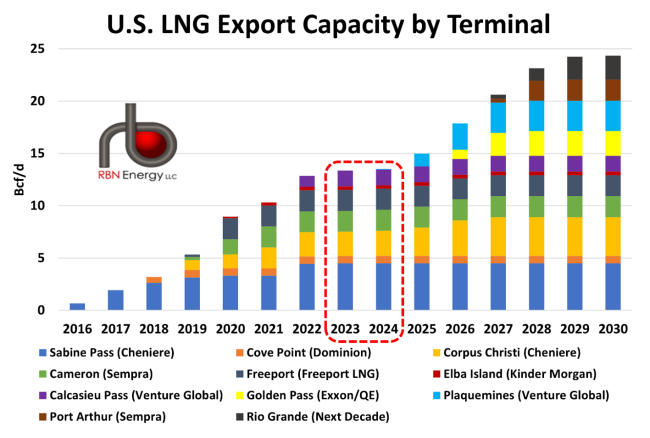
US LNG Export Capacity Projected to Surge
This forecast directly visualizes the “post-2026 LNG supply wave” described in the section, projecting a significant surge in US export capacity driven by new terminals.
(Source: RBN Energy)
- If this happens: More developers and EPC firms successfully replicate the modular, rapid-FID model, leading to a sustained wave of new US LNG capacity announcements through 2027.
- Watch this: The time between FID and first cargo for CP 2 Phase 1 (expected 2027) and Phase 2. Any significant delays could indicate that scaling this model presents unforeseen operational challenges. Also, monitor LNG spot prices for signs of a price war as new US and Qatari volumes enter the market simultaneously.
- These could be happening: Legacy producers will be forced to acquire modular technology expertise or form new strategic partnerships to shorten their own development cycles. The market may bifurcate between low-cost, fast-moving producers and higher-cost, slower projects that struggle to secure financing without firm, high-priced offtake agreements. This impending supply glut could challenge the narrative of LNG as a reliable transition fuel by introducing significant price volatility.
Frequently Asked Questions
Why is modular construction becoming the standard for new US LNG projects?
Modular construction has become the industry standard because it provides a proven template for rapid capacity deployment. This approach de-risks projects by offering accelerated construction timelines and lower capital intensity, which attracts investors and offtakers. The success of Venture Global’s CP2 project, which sanctioned two large phases in less than a year, proved the model’s repeatability and scalability, compelling competitors to adopt similar methods to stay competitive on cost and delivery schedules.
How was the 20 MTPA Venture Global CP2 project financed?
The CP2 project was financed in two stages, raising a total of $20.7 billion within a 12-month period. Phase 1 reached a Final Investment Decision (FID) in July 2025 with a $15.1 billion financing package. Phase 2 followed in March 2026, securing an additional $8.6 billion. The financing for Phase 2 was heavily oversubscribed, demonstrating strong confidence from the financial community in the lower-risk, faster-revenue modular development model.
What is the new blueprint for getting an LNG project approved and financed?
The new blueprint involves de-risking the project commercially before seeking a final investment decision. This means first securing a formal Engineering, Procurement, and Construction (EPC) contract to solidify costs and timelines, as Venture Global did with Worley. Then, the developer secures long-term sales and purchase agreements (SPAs) with offtakers, like the deals with Eni and Petronas, to guarantee future revenue. Presenting a project with both construction and commercial contracts already in place makes it highly attractive to capital markets.
Why is the US Gulf Coast, particularly Louisiana, the center of this LNG expansion?
Louisiana has become the global epicenter for modular LNG build-outs due to a combination of factors. It possesses extensive existing pipeline infrastructure, a skilled workforce, and is the region where the at-scale deployment of modular liquefaction technology has been successfully proven. The clustering of Venture Global’s projects (Calcasieu Pass, Plaquemines, and CP2) has created a super-complex that demonstrates the power of this model, cementing the region’s role as a pillar of global energy security.
What challenges does the success of modular construction create for the LNG market after 2026?
The very speed that makes modular construction attractive is expected to lead to a new set of challenges. The article’s outlook suggests that a sustained wave of new US LNG capacity could create an oversupplied market. This shifts the competitive focus from getting projects sanctioned to flawless operational execution and cost control. Developers will need to watch for potential price wars as new US and Qatari volumes enter the market, which could challenge the stability of LNG prices.
Experience In-Depth, Real-Time Analysis
For just $200/year (not $200/hour). Stop wasting time with alternatives:
- Consultancies take weeks and cost thousands.
- ChatGPT and Perplexity lack depth.
- Googling wastes hours with scattered results.
Enki delivers fresh, evidence-based insights covering your market, your customers, and your competitors.
Trusted by Fortune 500 teams. Market-specific intelligence.
Explore Your Market →One-week free trial. Cancel anytime.
