

US LNG Export Saturation, 28.7 Bcf/d Capacity, European Contract Reluctance, and 170 MTPA Global Supply Glut (2021 to 2026)
US LNG Export Risks: European Saturation and New Project Viability
U.S. Liquefied Natural Gas (LNG) exporters, after a period of rapid expansion driven by European demand post-2022, now confront a significant market saturation risk as Europe’s long-term contract appetite wanes, supply growth outpaces demand, and regulatory headwinds intensify.
- Between 2021 and 2024, the primary market signal was Europe’s urgent need to replace Russian gas, which catalyzed a surge in U.S. LNG imports and a wave of Final Investment Decisions (FIDs) for new American export capacity, greenlit on the expectation of sustained high demand.
- Beginning in 2025, the dynamic has shifted decisively. Europe, having refilled its storage and accelerated its renewable transition, is exhibiting significant reluctance to sign the long-term (15-20 year) offtake agreements that are necessary to underwrite the next wave of multi-billion-dollar U.S. LNG projects.
- A massive wave of new LNG supply, primarily from the U.S. and Qatar, is set to flood the market, with North American capacity projected to more than double from 11.4 billion cubic feet per day (Bcf/d) in early 2024 to 28.7 Bcf/d by 2029, creating a global supply glut widely expected to begin in 2026.
- This impending oversupply is forecast to compress prices, with analysts projecting Asian spot prices (JKM) to drop to an average of $10/MMBtu in 2026 and as low as $8.30/MMBtu by 2028, severely squeezing the profitability margins for U.S. exporters and challenging the economics of new, uncontracted projects.
- The EU’s Methane Regulation, which imposes stringent monitoring, reporting, and verification (MRV) requirements on importers starting January 1, 2027, adds a critical regulatory risk that could disadvantage U.S. supplies, which are widely considered to have a higher methane emissions intensity.
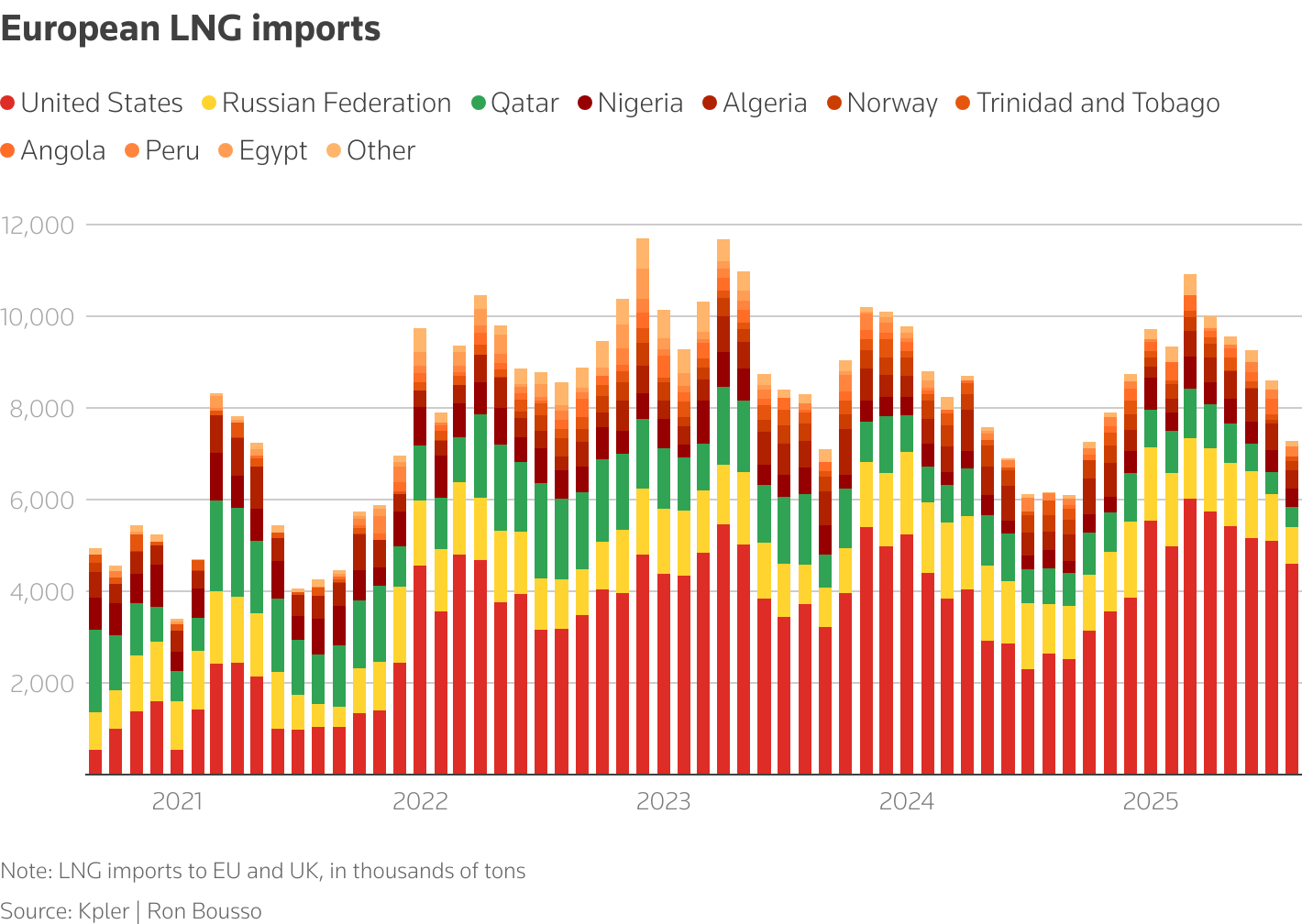
US LNG Surges to Dominate European Imports
This chart directly illustrates the massive increase of US LNG into Europe, which is the primary driver of the ‘European Saturation’ risk mentioned in the section heading.
(Source: EnergyNow.com)
$5.3 B Cancellation, Energy Transfer Halts Lake Charles LNG Project
The growing misalignment between U.S. supply growth and European demand outlook is already resulting in tangible project cancellations, signaling that financing for the next wave of LNG terminals is becoming increasingly difficult to secure without the anchor of long-term offtake agreements.
- The most significant signal of these market headwinds was the cancellation of Energy Transfer’s $5.3 billion, 16.5 mtpa Lake Charles LNG project in late 2025, a decision attributed directly to the failure to secure sufficient long-term commercial commitments.
- While established players like Cheniere Energy secured a positive FID for its Corpus Christi expansion in mid-2025, the broader momentum for new FIDs slowed considerably as market saturation risks became more apparent through 2025 and into 2026.
- The struggle for uncontracted projects is further evidenced by Commonwealth LNG, which was forced to push its FID target from 2025 into 2026, highlighting the challenges in finalizing the necessary commercial backing in a tightening, buyer-centric market.

Europe Becomes Top Destination for US LNG
The cancellation of a major project like Lake Charles can be seen as a consequence of market saturation. This chart establishes Europe as the top destination, providing context for why the market may not be able to absorb significant new capacity, making new projects commercially risky.
(Source: EnergyNow.com)
Table: Key U.S. LNG Project Decisions and Cancellations
| Partner / Project | Time Frame | Details and Strategic Purpose | Source |
|---|---|---|---|
| Energy Transfer / Lake Charles LNG | Jan 14, 2026 | Project with 16.5 mtpa capacity was scrapped at the end of 2025, citing an inability to secure long-term buyers. This was a major signal of market saturation and financing difficulties. | Argus Media |
| Commonwealth LNG | Jan 7, 2026 | The developer pushed its target for a Final Investment Decision from 2025 to 2026, indicating challenges in finalizing sufficient long-term offtake agreements in a competitive market. | Natural Gas Intel |
| Venture Global / CP 2 Project | Nov 10, 2025 | Received its final Department of Energy authorization for exports to non-free trade agreement nations, a key regulatory milestone before a potential FID, but still faces the market challenge of signing buyers. | Venture Global |
| Cheniere Energy / Corpus Christi LNG | Jul 9, 2025 | Announced a positive Final Investment Decision (FID) for its Stage 3 expansion on June 24, 2025, locking in one of the last major FIDs before market sentiment toward new long-term contracts began to sour. | Greenpeace |

US LNG Liquefaction Capacity to Quadruple by 2030
This chart provides the high-level summary of the individual ‘Project Decisions’ that would be detailed in the table, aggregating them to show the expected massive growth in total US capacity.
(Source: Bloomberg.com)
Europe vs. Asia: A Tectonic Shift in US LNG’s Geographic Focus
While Europe was the indispensable growth driver for U.S. LNG from 2022 to 2025, its maturing demand profile and climate-driven policy shifts are forcing a necessary strategic reorientation for new and uncontracted U.S. supply toward more price-sensitive Asian markets, where competition with lower-cost producers will define the next decade.
- Between 2021 and 2024, U.S. LNG exports were increasingly directed toward Europe, which rapidly became the dominant destination by absorbing over 60% of U.S. volumes to displace Russian gas, establishing a strong, geopolitically crucial transatlantic energy partnership.
- From 2025 onwards, clear evidence shows Europe’s import demand is plateauing. European utilities are securing their baseload needs but are explicitly avoiding new long-term contracts that would lock in fossil fuel consumption past their 2030 and 2050 climate targets.
- This forces new U.S. LNG projects to pivot their marketing efforts toward Asia, including China, India, and Southeast Asia, which remains the world’s primary demand growth center for natural gas driven by economic expansion and coal-to-gas switching.
- The primary challenge in Asia is price sensitivity. Chinese buyers, for instance, are reportedly willing to increase gas consumption at prices around $8/MMBtu, a level that significantly compresses margins for U.S. exporters after accounting for liquefaction fees ($2.50-$3.00/MMBtu) and shipping costs.

US LNG Exports Pivoted to Europe Post-2021
The chart’s headline and theme are a perfect match for the section’s title, directly illustrating the ‘tectonic shift’ and ‘pivot’ of US LNG export flows towards Europe and away from other markets like Asia.
(Source: American Security Project)
LNG Decarbonization: The Next Competitive Hurdle for US Exporters
While LNG liquefaction is a mature technology, the next competitive frontier is the integration of emissions abatement technologies like Carbon Capture, Utilization, and Storage (CCUS) and methane reduction systems, which are becoming necessary to meet new European regulations but add significant cost and complexity to U.S. projects.
- From 2021 to 2024, the primary focus for U.S. LNG was on speed and volume, leveraging proven liquefaction technology (TRL 9) to meet urgent European demand. Emissions profiles, while discussed, were a secondary concern to energy security.
- From 2025 onwards, with the EU’s Methane Regulation set to take full effect for importers in January 2027, the technological focus must shift to emissions monitoring and abatement. This presents a significant commercial challenge, as U.S. natural gas supply chains are widely considered to have a higher methane intensity than competitors like Qatar.
- To remain competitive in Europe, U.S. producers must invest in methane abatement technologies across the value chain and potentially integrate costly CCUS at liquefaction plants. Indicating this trend, projects like the proposed Alaska LNG are now including carbon capture facilities to market a lower-carbon LNG product.
- The technology for methane monitoring and large-scale CCUS is less mature and more expensive than liquefaction itself, creating a technological and financial hurdle that new U.S. projects must overcome to secure long-term European contracts or justify a green premium.
- Adjacent opportunities in the growing market for LNG as a marine fuel, served by companies like Hapag-Lloyd, also increasingly demand lower-carbon fuel options, reinforcing the need for decarbonization technology investment.
SWOT Analysis for US LNG: From Supply Boom to Market Glut
The U.S. LNG industry’s primary strength, its vast and scalable gas resource, is now contributing to a potential market glut, while its dependency on European buyers has become a key vulnerability as regulatory and climate policies create long-term demand uncertainty.

US to Solidify Dominance in Global LNG Capacity
This chart perfectly illustrates the ‘Supply Boom’ aspect of the section’s sub-heading and represents a key ‘Strength’ in a SWOT analysis, highlighting the massive build-out of US infrastructure.
(Source: LinkedIn)
Table: SWOT Analysis for the U.S. LNG Export Market
| SWOT Category | 2021 – 2023 | 2024 – 2025 | What Changed / Resolved / Validated |
|---|---|---|---|
| Strengths | Abundant, low-cost natural gas feedstock (Henry Hub); Large-scale, modular liquefaction technology. | Established as the world’s largest LNG exporter; Deep commercial relationships with European buyers. | The strength in supply volume is now a potential weakness, contributing directly to a forecasted global glut and price depression. |
| Weaknesses | Long project development timelines and high CAPEX requirements. | Higher production cost structure compared to Qatar; Higher methane intensity of the U.S. gas supply chain; High dependence on the European market. | Methane intensity has shifted from a reputational issue to a direct commercial threat due to the EU Methane Regulation’s enforcement in 2027. |
| Opportunities | Filling the massive supply gap in Europe created by the reduction of Russian pipeline gas. | Pivot to growing, albeit more price-sensitive, Asian markets; Develop lower-carbon LNG with CCUS to meet new regulations; Expand into the LNG bunkering market. | The “infinite” European demand opportunity has been proven finite, forcing a strategic pivot to a more competitive and fragmented Asian market. |
| Threats | Geopolitical instability impacting shipping; Construction cost inflation for new projects. | Global supply glut from 2026 onwards; EU Methane Regulation and potential CBAM; Lack of European long-term contracts; Intense price competition from low-cost Qatari expansion. | The primary threat has shifted from project execution risk to market saturation risk, where even completed projects may struggle with profitability. |

US Becomes Top LNG Exporter with 25% Market Share
This chart quantifies a primary ‘Strength’ that would be central to the SWOT analysis detailed in the table, showing the current market leadership of the U.S.
(Source: EnergyNow.com)
US LNG 2026 Outlook: Watching for Cargo Cancellations
The most critical signal to monitor for the health of the U.S. LNG market in 2026 will be the frequency of cargo cancellations, as this will serve as the first tangible evidence of the supply glut overwhelming demand and forcing exporters with spot exposure to shut in production.
- If the forecasted supply wave from the U.S. and Qatar materializes as expected through 2026, and if Asian demand does not accelerate significantly to absorb the surplus, a price collapse is the most probable outcome.
- The key indicator to watch will be a sustained drop in European (TTF) and Asian (JKM) spot prices toward the U.S. “cash cost” floor, estimated at approximately $4.50-$5.50/MMBtu (Henry Hub price + liquefaction opex + shipping).
- Should this price compression occur, U.S. exporters with volumes not tied to long-term contracts may find it more profitable to cancel cargoes and pay a contractual penalty rather than ship LNG at a loss. Some analysts predict around 100 U.S. cargo cancellations in the 2029-2030 timeframe, but this could begin as early as 2026-2027.
- A rising number of cancellations would validate the market saturation thesis and signal severe financial distress for projects without long-term offtake agreements, potentially triggering a wave of financial restructuring, asset sales, or consolidation among U.S. exporters like Sempra Infrastructure and Venture Global.

US Gas Exports to Europe Quadrupled by 2025
The forward-looking nature of this chart, forecasting a massive increase in volume by 2025, sets the essential context for the ‘2026 Outlook.’ This rapid growth is precisely why watching for potential ‘Cargo Cancellations’ becomes a critical market indicator.
(Source: EnergyNow.com)
The questions your competitors are already asking
This report covers one angle of the commercial risks facing the next wave of US LNG export projects. The questions that matter most depend on your work.
- Which US LNG project sponsors are gaining or losing ground in securing the long-term contracts required for a Final Investment Decision (FID)?
- What is the outlook for the profitability of uncontracted US LNG projects with Asian spot prices (JKM) forecast to drop below $10/MMBtu by 2026?
- What are the commercial opportunities for US LNG exporters in Asian markets to absorb the incoming supply glut as European demand saturates?
- Is the next wave of US LNG export capacity (post-2026) still bankable without traditional 15-20 year European offtake agreements?
This report does not answer these. Enki Brief Pro does.
Your question, your angle, your framework. SWOT, PESTL, scenario modelling. The same niche depth, built around the decision your work actually depends on.
