

Next Era BESS for Data Centers, 2.5 GW Meta PPA, 4.5 GW Entergy JV, and 11 Storage Agreements (2024-2026)
Data Center Demand, Next Era Energy’s 2.5 GW Meta Agreement
Surging electricity demand from data centers and AI is the primary commercial driver accelerating large-scale battery storage deployments, shifting utility strategy from grid-wide planning to securing dedicated, long-term corporate offtake agreements. This pivot allows developers like Next Era Energy to de-risk massive capital investments required to meet the 24/7 power needs of technology giants.
- Between 2021 and 2024, BESS projects were primarily driven by grid ancillary services and renewable-shifting for utilities. The period from 2025 to 2026 marks a structural change where direct corporate PPAs, particularly from the tech sector, became a dominant force in new project origination.
- The landmark agreement between Next Era Energy and Meta exemplifies this trend, encompassing 11 Power Purchase Agreements (PPAs) and two Energy Storage Agreements (ESAs) for a total of 2.5 GW of capacity to support Meta‘s U.S. operations.
- This strategic shift directly addresses the exponential growth in power consumption from the digital economy. The rise of AI and data centers is projected to increase U.S. electricity demand by 150-250 TWh between 2024 and 2030, creating a substantial and reliable source of demand for new renewable and storage projects.
- The commercial application has broadened from simply storing excess solar and wind to providing firm, round-the-clock clean energy. This enables corporate customers to meet their 100% renewable energy goals on an hourly basis, a service that intermittent generation alone cannot provide.
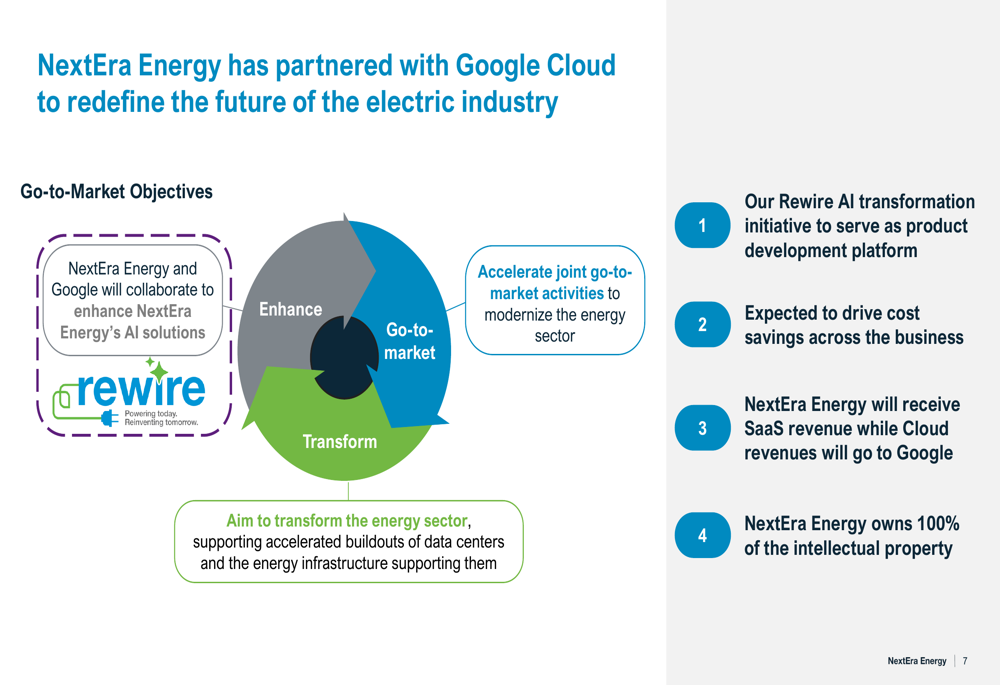
NextEra Energy and Google Cloud Partner on AI
This chart is relevant as it highlights NextEra’s strategic partnerships with major technology companies like Google. This aligns with the section’s focus on the Meta agreement and the growing demand for energy from data centers, which are heavily driven by AI development.
(Source: Investing.com)
$5.5 Billion Investment, Next Era Energy’s 4.3 GW BESS Expansion
Next Era Energy is executing a multi-billion dollar capital plan to expand its battery storage portfolio, targeting specific high-growth regions and de-risking investments through long-term contracts tied to both utility and corporate demand.
- Next Era Energy Resources (NEER) allocated approximately $5.5 billion for the 2025-2029 period to develop and construct an additional 4, 265 MW of new energy storage projects, cementing its commitment to the sector.
- The company’s project pipeline shows accelerating origination, with a record of approximately 4 GW of new renewables and storage projects added to its backlog in Q 1 2026 alone, reflecting a strong market pull.
- This investment builds on an aggressive growth trajectory, with projections showing Next Era reaching an operational battery storage capacity of approximately 5, 177 MW by the end of 2025.
- The business case for these investments is strengthened by improving project economics, as BESS capital costs are projected to fall from $320/k Wh in 2025 to $157/k Wh by 2050, increasing the return on investment for large-scale deployments.

New Investments Drive NextEra EPS Growth
The chart directly connects new investments to EPS growth, providing a financial rationale for the $5.5 billion investment in BESS expansion discussed in the section. It illustrates the expected positive financial impact of such large-scale capital deployment.
(Source: Investing.com)
Table: Next Era Energy BESS Investment and Development Plan
| Project / Plan | Time Frame | Details and Strategic Purpose | Source |
|---|---|---|---|
| Multi-year Storage Expansion | 2025-2029 | Invest approximately $5.5 billion to develop and construct 4, 265 MW of new energy storage projects, signaling a long-term strategic focus on market leadership. | Yahoo Finance |
| Renewable and Storage Pipeline | 2024-2027 | Target to build between 36.5 GW and 46.5 GW of new wind, solar, and battery storage projects, representing one of the industry’s largest development pipelines. | [PDF] Next Era Energy Investor Relations |
| Q 1 2026 Backlog Additions | Q 1 2026 | Added a record of approximately 4 GW of new renewables and storage projects to its backlog, indicating accelerating demand and successful project origination efforts. | pv-magazine-usa |
| Utah BESS Project | Approved Aug 2025 | Received approval for a 200 MW battery energy storage system in Utah, with a supply agreement from CATL, to enhance regional grid stability. | Energy Storage News |
Next Era Energy’s 4.5 GW Entergy JV and 2.5 GW Meta PPA (2024-2026)
Next Era’s partnership strategy centers on joint developments with utilities and securing massive offtake agreements with technology companies to underwrite its project pipeline and establish predictable, long-term revenue streams.
- In June 2024, Next Era Energy Resources and Entergy formed a joint development agreement to accelerate up to 4.5 GW of new solar generation and energy storage projects, a move designed to modernize the grid across Entergy’s southern U.S. service territory.
- The partnership with Meta, which reached a 2.5 GW milestone in December 2025, provides the financial certainty needed to construct new renewable and storage facilities by guaranteeing a long-term buyer for the generated power and storage capacity.
- Beyond offtake, Next Era is forming technology partnerships, including a collaboration with Google Cloud announced in June 2026, to leverage AI and data analytics for optimizing grid management, asset performance, and energy trading.
- The company also maintains critical supply chain relationships, such as its agreement with CATL to supply 2, 400 MWh of BESS for the 200 MW Utah project, securing the necessary hardware for its large-scale deployments.

NextEra Energy Q3 Earnings Rise Significantly
This chart, showing a significant rise in recent earnings, provides immediate financial context for the major joint ventures and PPAs mentioned in the section. It suggests that NextEra’s strategy, including these large-scale partnerships, is contributing to strong financial performance.
(Source: Investing.com)
Table: Next Era Energy Strategic Partnerships (2024-2026)
| Partner / Project | Time Frame | Details and Strategic Purpose | Source |
|---|---|---|---|
| Google Cloud | Announced Jun 2026 | Strategic partnership to combine Next Era’s energy expertise with Google Cloud’s AI and data analytics, aiming to optimize grid management and energy trading. | Energy Choice Matters.com |
| Dominion Energy | Rumored Jun 2026 | Reports indicate Next Era is exploring an acquisition of Dominion Energy, a move that would create the largest utility in the U.S. and massively expand its asset base. | Latitude Media |
| Meta | Announced Dec 2025 | Reached a 2.5 GW milestone through 11 PPAs and 2 ESAs, providing long-term revenue certainty to support Meta’s operations with 100% renewable energy. | Next Era Energy Investor Relations |
| Entergy | Announced Jun 2024 | Jointly developing up to 4.5 GW of new solar and storage projects across Entergy’s service territory (AR, LA, MS, TX) to accelerate clean energy adoption. | ess-news.com |
US South & West, Next Era Energy’s Geographic BESS Focus
Next Era’s battery storage deployment is geographically concentrated in high-growth regions like the U.S. South and West, driven by supportive regulatory environments, abundant solar resources, and proximity to new data center hubs.
- While the 2021-2024 period saw broad renewable expansion across the U.S., the 2025-2026 timeframe is characterized by a more targeted deployment of large-scale BESS in specific states.
- Florida remains a core market through its regulated utility, Florida Power & Light (FPL), which plans to build 7 GW of battery storage as part of its long-term generation strategy.
- Activity is accelerating in the West, with the approval of a 200 MW battery project in Utah and a flexible offtake agreement for a 115 MW BESS with a California utility.
- The U.S. South is a key growth area, evidenced by the 4.5 GW joint development with Entergy across its territory (Arkansas, Louisiana, Mississippi, Texas) and a proposed 300 MW project in Missouri. This aligns with the rapid development of data centers in these regions.

North America BESS Market to Exceed $50B by 2031
The chart quantifies the significant market opportunity in North America for Battery Energy Storage Systems (BESS). This provides a strong macro-level justification for NextEra’s strategic geographic focus on the US South and West, as discussed in the section.
(Source: Mordor Intelligence)
BESS Commercial Scale, Next Era Energy Co-locates with Solar
Battery energy storage systems have matured to a commercially viable, utility-scale technology, with the primary strategic challenge shifting from technical feasibility to economic optimization and rapid deployment through solar co-location.
- The 2021-2024 timeframe saw pilot programs and early GW-scale projects that validated the technical performance of BESS. Since 2025, the focus has shifted to mass deployment and integration.
- The industry standard is now large-scale, co-located solar-plus-storage projects, which maximize asset returns by capturing federal incentives like the Investment Tax Credit (ITC) and providing dispatchable power.
- System durations are increasing to meet grid needs. The 200 MW Utah project, paired with 2, 400 MWh of batteries from CATL, signals a move toward longer-duration storage (12 hours) capable of providing firm capacity over extended periods.
- Next Era leverages proprietary software across its 58 GW renewable portfolio to optimize BESS asset dispatch for grid services and energy arbitrage, providing a data-driven advantage over competitors.

US Energy Storage Market Forecasts Strong Growth
This chart illustrates the strong growth trajectory of the US energy storage market. This overall market expansion provides the essential context for why NextEra is pursuing commercial-scale BESS projects and co-locating them with solar, as it validates the long-term viability and profitability of such strategies.
(Source: Dimension Market Research)
SWOT Analysis, Next Era Energy BESS Strengths and Risks
Next Era’s market leadership in BESS is built on its immense scale and development expertise, but it faces external risks from policy uncertainty and grid infrastructure constraints that could temper its aggressive growth targets.
- Next Era’s primary strength is its ability to translate its development pipeline into operational assets, leveraging its scale to secure favorable supply agreements and long-term offtake contracts.
- The main opportunity remains the explosive growth in electricity demand from data centers, which provides a durable, high-volume customer base for new renewable and storage assets.
- A key weakness is the capital-intensive nature of its business, which creates a dependency on stable federal tax policies like the IRA that are now subject to political risk.
- The most significant external threat is regulatory and infrastructure friction, including grid interconnection backlogs and potential changes to federal energy policy, which could delay projects and alter financial models.

Battery Prices Forecast to Continue Falling
Falling battery prices are a critical external factor in a SWOT analysis for a BESS developer. This chart directly illustrates a key ‘Opportunity’ that lowers project costs and improves economic viability, while also mitigating risks associated with high capital expenditure, making it a perfect fit for this section.
(Source: LinkedIn)
Table: SWOT Analysis for Next Era Energy BESS Initiatives
| SWOT Category | 2021 – 2023 | 2024 – 2025 | What Changed / Resolved / Validated |
|---|---|---|---|
| Strength | Leading renewable developer with a large project pipeline and strong balance sheet. | Dominant operator of battery storage with 4, 141 MW online as of Q 2 2025 and proprietary software for asset optimization. | Scale was validated as a decisive competitive advantage, enabling the company to secure GW-scale corporate deals like the 2.5 GW agreement with Meta. |
| Weakness | High capital expenditure requirements for growth; projects sensitive to interest rates and commodity costs. | Increased reliance on federal tax credits (IRA) to support project economics, creating exposure to policy changes. | The “One Big Beautiful Bill” of 2025 validated this weakness by directly targeting IRA tax credits, introducing significant uncertainty into long-term financial projections. |
| Opportunity | Growing demand for renewable energy from utilities and corporations to meet decarbonization goals. | Explosive electricity demand from AI and data centers creates a massive new market for 24/7 clean power. | The opportunity shifted from a general decarbonization trend to a specific, urgent demand driver, as evidenced by large-scale partnerships with Meta and Google. |
| Threat | Grid interconnection queues and permitting delays; general policy uncertainty. | Specific legislative proposals to repeal or curtail IRA tax credits; supply chain bottlenecks for transformers and switchgear. | Threats became more concrete. The interconnection backlog grew to nearly 2, 600 GW, and specific legislation like the “One Big Beautiful Bill Act” emerged as a direct risk to project financing. |
Next Era Energy’s 2026 Outlook, 4.3 GW Storage Pipeline Execution
The central question for 2026 is whether Next Era can execute its massive BESS pipeline on schedule, as this will serve as the primary indicator of the industry’s ability to overcome grid interconnection and supply chain constraints while navigating an uncertain policy environment.
- If federal tax policy for energy storage remains stable despite changes for other renewables, watch for an acceleration of final investment decisions on standalone battery projects within Next Era’s 4, 265 MW pipeline.
- The conversion rate of projects from the backlog to operational status is the key metric. A slowdown in this rate would signal that grid interconnection queues and equipment supply chain issues are becoming binding constraints on growth.
- The potential acquisition of Dominion Energy remains a major wildcard. If it proceeds, it would fundamentally reshape Next Era’s growth trajectory and the U.S. utility sector, likely accelerating storage deployment within a larger regulated asset base.
- Continued success in signing large-scale corporate PPAs for combined solar-plus-storage offtake will be critical to de-risking the 36.5 GW to 46.5 GW development pipeline targeted for completion by 2027.

NextEra Projects 6-8% Annual EPS Growth
This chart provides the company’s official long-term financial growth target. It directly aligns with the section’s focus on the 2026 outlook and the execution of its project pipeline, as achieving this EPS growth is contingent on successfully developing projects like the 4.3 GW storage pipeline.
(Source: Investing.com)
The questions your competitors are already asking
This report covers one angle of NextEra Energy’s battery storage commercialization strategy. The questions that matter most depend on your work.
- What is actually happening with the 4.5 GW NextEra-Entergy joint venture since the announcement?
- What is the outlook for utility-scale BESS deployment for AI data centers by 2026?
- Which data center operators, besides Meta, are adopting utility-scale battery storage solutions?
- Which companies are gaining or losing ground in the utility-scale battery storage market for data centers?
This report does not answer these. Enki Brief Pro does.
Your question, your angle, your framework. SWOT, PESTL, scenario modelling. The same niche depth, built around the decision your work actually depends on.
