

Petrobras CCUS Strategy, $16.3 B Low-Carbon Plan, Hitachi Energy Partnership, and 33 Projects (2025 to 2026)
Petrobras Low-Carbon Projects Pivot to Operational Decarbonization
Petrobras’s energy transition strategy in 2025 shifted from broad exploration to a focused execution on decarbonizing its core, profitable oil and gas assets, using its low-carbon budget to reduce emissions intensity rather than directly competing in the consumer distributed generation market.
- Between 2021 and 2024, the company’s efforts were concentrated on strategic planning and setting emissions targets, with large-scale low-carbon project execution remaining limited outside of its primary exploration and production activities.
- From 2025 to 2026, tangible projects were initiated with an internal focus. The July 2025 partnership with Hitachi Energy to evaluate the electrification of offshore platforms exemplifies this approach, applying low-carbon technology to enhance operational efficiency rather than to sell power to the grid.
- The commissioning of a 48 MW solar plant in 2025 represents Petrobras’s most direct distributed generation project. However, its scale is minimal when compared to Brazil’s approximately 46 GW distributed generation market and the company’s own extensive oil and gas investments.
- The successful bid for 2.6 GW of thermal capacity contracts in May 2026 reinforces an indirect strategy. This capacity provides the firm power needed to stabilize a grid increasingly dependent on intermittent renewables, thereby enabling the broader distributed generation market without directly participating in it.
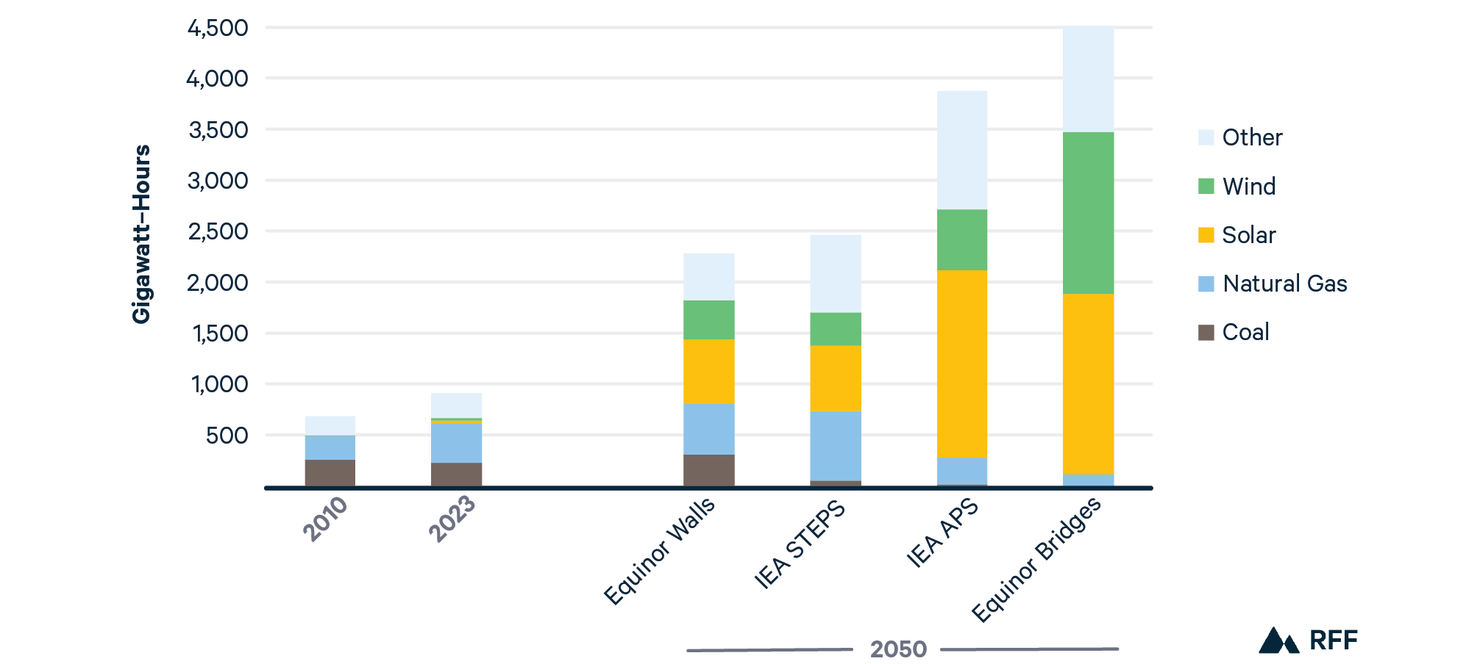
Global Energy Mix Shifts Towards Renewables by 2050
This chart illustrates the global energy transition, providing the high-level strategic context for why Petrobras is pivoting its projects toward operational decarbonization.
(Source: RFF.org)
$16.3 B Investment, Petrobras Low-Carbon CAPEX Focus (2025 to 2029)
Petrobras’s 2025-2029 business plan commits a landmark $16.3 billion to low-carbon initiatives, a 42% increase from its previous plan, yet this capital is primarily allocated to bioproducts, operational decarbonization, and foundational large-scale renewables, not distributed generation.
- The $16.3 billion fund is strategically divided among operational decarbonization ($5.3 billion), low-carbon energies such as wind and solar ($5.7 billion), and bioproducts ($4.3 billion), signaling a diversified but targeted approach.
- A considerable portion of this investment is directed at internal efficiency projects, including the $1 billion Ref Top program to upgrade refineries and feasibility studies for electrifying offshore assets.
- The total capital expenditure of $111 billion for the period underscores that low-carbon initiatives, while growing, constitute approximately 14.7% of total investment, with exploration and production remaining the dominant focus.
- Major investments such as the $7.3 billion plan for Sao Paulo’s energy infrastructure are designed to ensure large-scale grid reliability, which is an essential prerequisite for integrating a higher volume of distributed energy resources.

Petrobras Details $111B Investment Plan for 2025-2029
The chart provides the total investment plan ($111B) for the same period as the section’s focus, showing how the $16.3B in low-carbon CAPEX is part of a larger corporate financial strategy.
(Source: Agência Petrobras)
Table: Petrobras Strategic Energy Investments (2024-2026)
| Partner / Project | Time Frame | Details and Strategic Purpose | Source |
|---|---|---|---|
| Sao Paulo Energy Infrastructure | Announced May 2026 | Investment of R$37 billion (approx. $7.3 billion) to strengthen energy infrastructure in Brazil’s most populous state, enhancing grid reliability to support industrial demand and renewable integration. | Industrial Info |
| Gas Transport Capacity Expansion | Announced Jan 2026 | Contracts worth $521 million for 25 new vessels to enhance liquefied petroleum gas (LPG) logistics, supporting the company’s core refining and natural gas operations that fund the energy transition. | Yahoo Finance |
| Business Plan Low-Carbon Initiatives | 2025-2029 | A $16.3 billion allocation, representing a 42% increase, for investments in biofuels, wind, solar, hydrogen, and CCUS, forming the financial backbone of the company’s decarbonization strategy. | Petrobras Agency |
| Business Plan Total CAPEX | 2025-2029 | Total planned investment of $111 billion, with the majority dedicated to maintaining and expanding upstream oil and gas production, which provides the cash flow for low-carbon projects. | BNamericas |

Global Energy Mix Projections to 2050
The chart projects the long-term evolution of the energy market, offering the strategic rationale behind the specific energy investments Petrobras is making from 2024-2026, as detailed in the table.
(Source: RFF.org)
Petrobras 2 Key Alliances, Hitachi Energy and Shell Brazil (2025)
In 2025, Petrobras forged strategic partnerships not to enter the distributed energy market directly, but to acquire technical capabilities for decarbonizing its core operations and shaping future carbon markets.
- The collaboration with Hitachi Energy is a critical step toward reducing Scope 1 emissions, focusing on the complex engineering challenge of developing a subsea solution to electrify offshore oil and gas platforms.
- The “Carbon Countdown” project with Shell Brazil, launched in December 2025, is a foundational initiative. It aims to build a reliable carbon stock inventory to support Brazil’s emerging carbon credit market, a necessary component for the economic viability of future large-scale CCUS projects.
- A long-term, 15-year LNG supply agreement with Centrica, while related to the core fossil fuel business, is instrumental in securing stable cash flow required to fund the capital-intensive energy transition strategy.
- The integrated services contract awarded to SLB in late 2024 for all offshore fields ensures the operational efficiency needed to maintain production levels and generate the revenue that underpins the $16.3 billion low-carbon investment plan.

Global Grid Investment to Surpass $470B in 2025
The section discusses an alliance with Hitachi Energy, a major player in grid solutions. The chart quantifies the massive market opportunity in grid investment that this partnership is positioned to address.
(Source: BloombergNEF – BNEF)
Table: Petrobras Strategic Partnerships
| Partner / Project | Time Frame | Details and Strategic Purpose | Source |
|---|---|---|---|
| Shell Brazil | Announced Dec 2025 | Launched the “Carbon Countdown” project, the largest carbon stock inventory in Brazil, to develop a robust carbon credit market and inform nature-based climate solution investments. | Brazil Energy Insight |
| Hitachi Energy | Announced Jul 2025 | Engaged for technical evaluation studies on developing subsea electrification for offshore platforms, a key step in decarbonizing core production assets by connecting them to low-carbon energy sources. | Hitachi Energy |
| SLB | Announced Dec 2024 | Awarded a major integrated services contract for all of Petrobras’s offshore fields in Brazil, ensuring operational efficiency and cash flow to fund the company’s large-scale energy transition investments. | SLB |

Electrification to Drive Global Power Demand Growth
This chart shows the core market driver—electrification—that necessitates the formation of the strategic partnerships detailed in the corresponding table.
(Source: BloombergNEF – BNEF)
Brazil-Centric Strategy, Petrobras Focuses on Offshore and Industrial Hubs
Petrobras’s low-carbon activities in 2025 remained geographically concentrated in Brazil, leveraging its deep incumbency in offshore regions and proximity to major industrial centers like Sao Paulo for its decarbonization efforts.
- From 2021 to 2024, the company’s geographic focus was almost exclusively on pre-salt offshore exploration and production, with its low-carbon strategy remaining largely theoretical and in the planning stages.
- Beginning in 2025, this strategy materialized with projects physically tied to existing assets. The offshore platform electrification study with Hitachi Energy directly targets the pre-salt basins, where Petrobras has decades of operational experience.
- The $7.3 billion infrastructure investment announced for the state of Sao Paulo demonstrates a clear focus on bolstering the energy grid in Brazil’s industrial heartland, which is a prime future market for industrial hydrogen and advanced biofuels.
- Nature-based initiatives, such as the forest conservation programs and the “Carbon Countdown” project with Shell, are uniquely Brazilian, leveraging the country’s vast natural resources to generate carbon credits and offset operational emissions.

North America to Dominate Renewable Energy Market
This chart provides a global market benchmark, offering a point of comparison or contrast to Petrobras’s Brazil-centric strategy for offshore and industrial hub development.
(Source: Market Research Future)
CCUS Pilot Phase, Petrobras Pursues Operational Decarbonization Tech
In 2025, Petrobras’s distributed energy and low-carbon technology portfolio is in a pilot and foundational stage, focused on adapting existing technologies like solar and electrification for industrial use rather than commercializing new distributed generation products.
- Between 2021 and 2024, the technological focus was on improving exploration and production efficiency, with low-carbon technologies largely confined to research and development departments or strategic plans.
- In 2025, the commissioning of the 48 MW solar plant marks the operational debut of a mature technology within the company’s portfolio. It serves as a crucial, albeit modest, first step in building internal expertise in renewable project execution.
- Technologies such as subsea electrification for offshore platforms, explored with Hitachi Energy, are in the technical evaluation stage and have not yet reached a final investment decision, indicating a deliberate progression from R&D to piloting.
- The company is actively developing its capabilities in Carbon Capture, Utilization, and Storage (CCUS), which is central to its strategy of mitigating emissions from its extensive and profitable fossil fuel operations.

Global Landscape of National Climate Pledges
The pursuit of CCUS technology by Petrobras is a direct response to the policy pressures and goals outlined in national climate pledges, as depicted in the chart.
(Source: REN21)
SWOT Analysis of Petrobras’s Cautious Distributed Energy Strategy
Petrobras’s SWOT profile in 2025 reflects its strength as a capitalized incumbent with deep engineering expertise, but also a weakness in its slow, cautious entry into the fast-moving distributed generation market, creating an opportunity for more agile competitors.

Solar Power Market to Exceed $650B by 2035
The chart’s projection of a massive solar market represents a key ‘Opportunity’ that is central to the SWOT analysis of Petrobras’s distributed energy strategy.
(Source: Market Research Future)
Table: SWOT Analysis for Petrobras Distributed Energy Initiatives
| SWOT Category | 2021 – 2024 | 2025 – 2026 | What Changed / Validated |
|---|---|---|---|
| Strengths | Dominant market position in Brazilian E&P; strong balance sheet and cash flow from pre-salt assets. | Leveraged engineering expertise for offshore electrification studies (Hitachi Energy); deployed significant capital ($16.3 B low-carbon fund) for transition projects. | Validated its ability to fund a large-scale transition using profits from its core business, leveraging existing engineering strengths for decarbonization. |
| Weaknesses | Lack of experience in renewable project development; strategy heavily influenced by government priorities. | Slow to enter the consumer-facing distributed generation market, focusing instead on industrial-scale projects. The 48 MW solar plant is small relative to the market. | Confirmed a strategic preference for large, centralized projects over the fragmented and fast-moving distributed energy sector, potentially missing market share. |
| Opportunities | Massive potential in Brazil’s growing renewable energy market, particularly offshore wind and solar. | Began building a foundation for future carbon markets (“Carbon Countdown” with Shell); positioned to be a key player in offshore wind due to offshore expertise. | The opportunity to become a leader in Brazil’s offshore wind and CCUS sectors is now more concrete, with foundational projects and partnerships initiated. |
| Threats | Competition from agile, pure-play renewable companies; regulatory uncertainty in the energy sector. | Pure-play renewable firms continue to dominate Brazil’s ~46 GW DG market; cancellation of the 2025 backup capacity tender highlights regulatory volatility. | The threat from specialized renewable companies was validated as they continue to capture market share while Petrobras focuses on its internal transition. |

Solar Market to Exceed $522B by 2035
The SWOT analysis table for distributed energy initiatives is informed by market data. This chart provides a quantitative basis for the ‘Opportunities’ related to the growing solar market.
(Source: Precedence Research)
Petrobras 2026: Watch for Offshore Wind JVs from its $16.3 B Fund
The key signal to watch in the next 12-18 months is how Petrobras allocates its $16.3 billion low-carbon fund, specifically whether it forms joint ventures with experienced developers to enter Brazil’s nascent offshore wind market.
- If Petrobras announces a major joint venture for an offshore wind project, then watch for a signal of a true strategic pivot to becoming a large-scale renewable power generator, directly leveraging its decades of offshore engineering and operational expertise.
- Watch for the results of the Hitachi Energy study on offshore platform electrification. A positive final investment decision would validate its industrial decarbonization strategy and lock in significant capital expenditure for this purpose.
- If new project announcements from the fund are primarily directed toward refinery upgrades, biofuels, and small-scale CCUS pilots, then these could be happening: it would indicate the company is committing to a fossil fuel-centric strategy with a decarbonization overlay, rather than a fundamental energy transition.

Hydrogen Generation Market to Reach $226B by 2030
While the section mentions offshore wind, Petrobras’s low-carbon fund is versatile. The chart highlights the booming hydrogen market, a likely target for JVs and a sector often synergistic with offshore wind.
(Source: MarketsandMarkets)
The questions your competitors are already asking
This report covers one angle of Petrobras’s low-carbon investment strategy. The questions that matter most depend on your work.
- Petrobras activities in offshore decarbonization. Is the partnership with Hitachi Energy progressing from evaluation to deployment?
- Petrobras investments and funding. Is the $16.3 B low-carbon plan on track to meet operational decarbonization targets?
- What are the opportunities for distributed generation developers created by Petrobras’s 2.6 GW of new thermal capacity contracts?
This report does not answer these. Enki Brief Pro does.
Your question, your angle, your framework. SWOT, PESTL, scenario modelling. The same niche depth, built around the decision your work actually depends on.
