

Phillips 66 Green Hydrogen: $2.4 B CAPEX Plan, VPI Humber Project, and an Offtaker Strategy (2025-2026)
Green Hydrogen Offtake, Phillips 66 Adopts a Demand-Side Strategy
Phillips 66 is deliberately positioning itself as a primary industrial offtaker for low-carbon hydrogen, a strategy that mitigates exposure to production risks while enabling the decarbonization of its core refining assets.
- In 2025, the company’s main hydrogen initiative was the proposed offtake agreement to supply its Humber Refinery in the UK with low-carbon hydrogen from a new facility developed by VPI at the adjacent Killingholme Power Station.
- This demand-side approach contrasts with the period from 2021-2024, where public announcements were sparse, indicating a “wait-and-see” posture while the market for green hydrogen production and policy frameworks like the 45 V tax credit matured.
- The company’s focus in 2025 remained on converting existing infrastructure, exemplified by the fully operational Rodeo Refinery producing 800 million gallons per year of renewable fuels, using hydrogen as a processing input rather than a primary product for sale.
- This strategy creates a demand anchor for hydrogen producers, helping de-risk large-scale production projects without Phillips 66 bearing the direct capital cost, which can exceed $5 billion for a new 200, 000 tonnes per annum plant.
$2.4 B CAPEX, Phillips 66 Prioritizes Refining and Midstream Growth
The company’s capital allocation for 2026, announced in December 2025, confirms its strategy to reinvest in its profitable core businesses, with no major carve-outs for direct investment in green hydrogen production facilities.
- The $2.4 billion capital budget for 2026 allocates $1.1 billion to Refining and $1.1 billion to Midstream, demonstrating a continued focus on its traditional segments.
- Within the Refining budget, $520 million is designated for growth projects, which are aimed at high-return opportunities and operational decarbonization rather than new-build green hydrogen production.
- This disciplined spending contrasts sharply with the green hydrogen production market, which requires massive upfront capital for electrolyzers, with system costs ranging from $306/k W to $4, 748/k W in 2025.
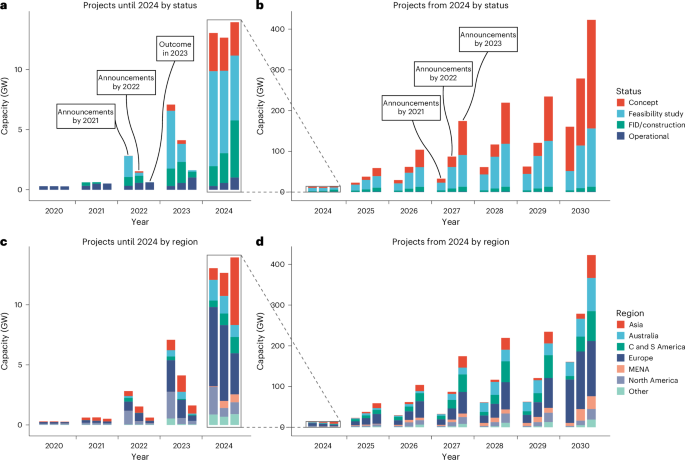
Green Hydrogen Pipeline Shows Significant ‘Implementation Gap’
This section explains that Phillips 66 is prioritizing its core business CAPEX over green hydrogen production. The chart, which shows a significant gap between announced and operational green hydrogen projects, justifies this cautious financial strategy. The ‘implementation gap’ highlights the high risk and uncertainty in the green hydrogen supply sector, making a focus on established, profitable business units a logical move.
(Source: Nature)
Table: Phillips 66 Capital Allocation vs. Green Hydrogen Project Costs (2025)
| Investment Area | Time Frame | Details and Strategic Purpose | Source |
|---|---|---|---|
| Phillips 66 2026 Capital Budget | 2026 | $2.4 billion allocated to enhance midstream NGL infrastructure and high-return refining projects, not direct green hydrogen production. | Reuters |
| Phillips 66 Refining Growth | 2026 | $520 million designated for growth projects within the refining segment, prioritizing operational efficiency and decarbonization. | Phillips 66 |
| Typical Green Hydrogen Project | 2025 | Estimated cost for a new 200, 000 tonnes per annum green hydrogen plant is approximately $5 billion, highlighting the capital intensity Phillips 66 is avoiding. | [PDF] Clifford Chance |

Green Hydrogen Faces Massive Implementation Gap
The section is a table comparing Phillips 66’s capital allocation against the high cost of green hydrogen projects. The chart’s headline of a ‘Massive Implementation Gap’ visually reinforces the central theme of this comparison: the enormous scale of investment and risk required for green hydrogen projects, which must be carefully weighed against a company’s available capital.
(Source: Nature)
Phillips 66 VPI Partnership to Decarbonize UK Humber Refinery
Phillips 66‘s partnership strategy in 2025 centered on securing low-carbon feedstocks for its existing operations, with the proposed VPI collaboration for the Humber Refinery serving as a key example.
- The most significant partnership activity in 2025 was the proposal for VPI to produce and supply low-carbon hydrogen to the Phillips 66 Humber Refinery from its Killingholme site in the UK.
- This agreement would position Phillips 66 as a foundational customer, providing the demand certainty needed for VPI to proceed with a major hydrogen production investment.
- The company also maintained its long-term supply and offtake agreement with Sustainable Aviation Fuel (SAF) producer XCF Global, reinforcing its role as a market-maker and distributor for low-carbon fuels rather than a primary producer of the core molecules.

Fossil Fuels Dominate Global Hydrogen Production
This section details a specific partnership to decarbonize the Humber Refinery. The chart provides essential context by showing that current hydrogen production is dominated by fossil fuels (i.e., ‘grey’ hydrogen). This illustrates the status quo and underscores the necessity of the partnership’s goal: to replace carbon-intensive hydrogen with a green alternative.
(Source: Springer Nature)
Table: Phillips 66 Low-Carbon Partnerships (2025)
| Partner / Project | Time Frame | Details and Strategic Purpose | Source |
|---|---|---|---|
| VPI / Humber Hydrogen Supply | Oct 2025 | Proposed offtake agreement for low-carbon hydrogen from a new production plant at Killingholme to decarbonize the Phillips 66 Humber Refinery. | Grimsby Telegraph |
| XCF Global / SAF Supply | Jun 2025 | Long-term supply and offtake agreement for Sustainable Aviation Fuel, demonstrating Phillips 66‘s role as a downstream partner for clean energy producers. | Green Air News |

Green Hydrogen Project Pipeline Grows, Ambition Gap Persists
This section is a table of Phillips 66’s low-carbon partnerships. The chart complements this by showing a market where the project pipeline is growing, but an ‘ambition gap’ remains. Partnerships, as listed in the table, are a primary business strategy to de-risk projects from this pipeline and help close the gap between ambition and reality.
(Source: Nature)
UK Focus, Phillips 66 Humber Project Signals European Strategy
In 2025, the United Kingdom emerged as the clear geographic focal point for Phillips 66‘s hydrogen activities, driven by the decarbonization needs of its Humber Refinery and the development of regional industrial clusters.
- The proposed low-carbon hydrogen supply project for the Humber Refinery in North Lincolnshire, UK, was the company’s most significant geographic and strategic move in the hydrogen space during 2025.
- This UK-centric approach is influenced by supportive regional policy and the existence of industrial clusters like the Humber, which are actively pursuing hydrogen and carbon capture infrastructure.
- In the US, the company’s activities remained focused on its renewable fuels conversion at the Rodeo Refinery in California and strengthening its NGL midstream assets, without a comparable hydrogen-specific project announcement in 2025.
Hydrogen Integration, Phillips 66 Focuses on Application not Production
Phillips 66 is treating low-carbon hydrogen as a mature, commercially available input for decarbonizing its existing refining processes, rather than a novel technology requiring internal research and development on production methods like electrolysis.
- The company’s actions in 2025 show it views water electrolysis (TRL 9) as a technology to be procured from specialist partners like VPI, not developed in-house, allowing it to bypass the risks associated with high electrolyzer costs and evolving performance standards.
- This approach allows Phillips 66 to focus on the complex integration challenge: retrofitting its refineries to use low-carbon hydrogen, optimizing processes, and managing the new feedstock supply chain.
- While the company acknowledged exploring electrolytic hydrogen production via wind power in 2025, this appears to be a research-level activity to build institutional knowledge, not a commitment to become a technology developer or operator of electrolysis plants.
SWOT Analysis, Phillips 66 Offtaker Strategy Risks and Rewards
The SWOT analysis reveals a strategy that prioritizes financial discipline and shareholder returns by leveraging existing assets, but potentially misses the high-growth upside of the hydrogen production market while remaining exposed to policy shifts and feedstock price volatility.

Green Hydrogen Market Drivers and Restraints Analyzed
This section provides a SWOT (Strengths, Weaknesses, Opportunities, Threats) analysis of Phillips 66’s offtaker strategy. A chart analyzing market ‘Drivers and Restraints’ is a perfect match, as these external factors directly translate into the Opportunities/Threats portion of the SWOT analysis, providing a macro-level context for the company-specific risks and rewards.
(Source: Coherent Market Insights)
Table: SWOT Analysis for Phillips 66 Green Hydrogen Offtaker Strategy
| SWOT Category | 2021 – 2024 | 2025 | What Changed / Validated |
|---|---|---|---|
| Strengths | Large-scale refining and midstream infrastructure. Expertise in handling hydrogen as a processing chemical. Strong balance sheet. | Leveraged refining assets for renewable fuels (Rodeo). Used its status as a large industrial user to anchor a major hydrogen project (Humber). | Validated that existing assets and market position can be used to decarbonize operations without taking on early-stage production risk. |
| Weaknesses | Limited public engagement or investment in the emerging green hydrogen production market. Perceived as a slow mover in the energy transition. | Did not allocate major CAPEX to green hydrogen production, forgoing potential high-growth returns in a market projected to grow at over 45% CAGR. | Confirmed its position as a hydrogen consumer, not a producer, ceding the high-growth production segment to other players. |
| Opportunities | Decarbonize refining operations to meet emissions targets and produce lower-carbon fuels. Act as a demand aggregator for hydrogen hubs. | Humber project proposal materializes the opportunity to use offtake agreements to secure low-carbon feedstock. Finalized 45 V rules create a pathway for similar US projects. | The viability of the “offtaker as enabler” model was demonstrated, creating a repeatable template for its other global assets. |
| Threats | Uncertainty around hydrogen policies (e.g., 45 V tax credit). High cost and volatility of green hydrogen feedstock. | Policy uncertainty remains a threat, with potential legislative changes to the 45 V credit. Dependence on third-party producers creates feedstock price risk. | The risk shifted from technological to commercial and political; the strategy is now dependent on the reliability of partners and the stability of government incentives. |

Green Hydrogen Faces Major Ambition-Implementation Gap
This section is a table version of a SWOT analysis. The chart, which highlights the ‘Major Ambition-Implementation Gap’ in the green hydrogen market, provides the central external context for the table. This gap represents both a primary threat (supply unreliability) and a key opportunity (securing scarce supply) that would be foundational to any SWOT analysis of an offtaker strategy.
(Source: Nature)
Phillips 66 2026, Watch the Humber FID and 45 V Influence
Looking to 2026, the critical variable for Phillips 66‘s hydrogen strategy is whether it proceeds to a Final Investment Decision on the Humber offtake agreement and how the finalized 45 V tax credit rules in the US influence future North American supply partnerships.
- If the Humber project with VPI reaches FID, it will validate the offtaker model and likely serve as a blueprint for decarbonizing other Phillips 66 refineries in Europe and North America.
- Watch for the allocation of the $520 million in refining growth capital; any portion dedicated to hydrogen-ready infrastructure would signal a more concrete commitment to integrating hydrogen across its portfolio.
- Conversely, if the Humber project stalls or if Phillips 66 does not announce any US-based hydrogen offtake agreements by late 2026 despite the 45 V incentive, it could indicate that the economics of low-carbon hydrogen remain unfavorable even for industrial users.

E-Fuels Market to Reach $66.3B by 2030
This section looks forward to 2026, focusing on the Humber project’s final investment decision (FID) and the influence of incentives like the 45V tax credit. The chart on the growing E-Fuels market provides a compelling long-term strategic rationale for these investments. E-fuels are a high-value downstream product made from hydrogen, and the projected market growth shown in the chart justifies near-term investment decisions in hydrogen infrastructure.
(Source: MarketsandMarkets)
The questions your competitors are already asking
This report covers one angle of Phillips 66’s hydrogen offtaker strategy. The questions that matter most depend on your work.
- What is the status of the VPI Humber project to supply Phillips 66’s refinery with low-carbon hydrogen?
- Which other oil refiners are adopting a demand-side hydrogen offtaker strategy?
- What opportunities does Phillips 66’s offtaker strategy create for large-scale hydrogen producers?
- What does Phillips 66’s $2.4B CAPEX plan for 2026 reveal about its outlook for direct investment in hydrogen production?
This report does not answer these. Enki Brief Pro does.
Your question, your angle, your framework. SWOT, PESTL, scenario modelling. The same niche depth, built around the decision your work actually depends on.
