

Hydrogen’s Chicken-and-Egg Problem: RWE’s 2026 Blueprint for Building a Bankable Ecosystem
From Pilot Projects to Integrated Ecosystems: RWE’s Hydrogen Adoption Strategy
RWE has transitioned from developing isolated pilot projects to engineering a fully integrated hydrogen ecosystem, a strategic shift designed to solve the industry’s “chicken-and-egg” dilemma by simultaneously creating large-scale supply, demand, and midstream infrastructure.
- Between 2021 and 2024, the company’s focus was on foundational activities, including feasibility studies for projects like Pembroke Green Hydrogen in the UK, operating pilot plants such as the 14 MW facility in Lingen, and announcing ambitious but separate large-scale plans like the GET H 2 Nukleus and H 2 ercules projects.
- The strategy materialized in 2025 with a pivot toward tangible integration, highlighted by the plan to build an 850 MW hydrogen-ready power plant in Voerde, Germany. This project creates a dedicated, large-scale offtaker for RWE’s own hydrogen production, directly connecting supply with demand.
- In March 2025, RWE secured a landmark 15-year offtake agreement with Total Energies to supply 30, 000 metric tons of green hydrogen annually. This move provides the long-term revenue certainty required to secure financing and underwrite the bankability of its production assets.
- The focus on infrastructure was solidified in September 2025 through a joint venture with Apollo Global Management concerning RWE’s stake in grid operator Amprion. This partnership is aimed at financing grid development, demonstrating a commitment to building the underlying transport infrastructure, not just production assets.
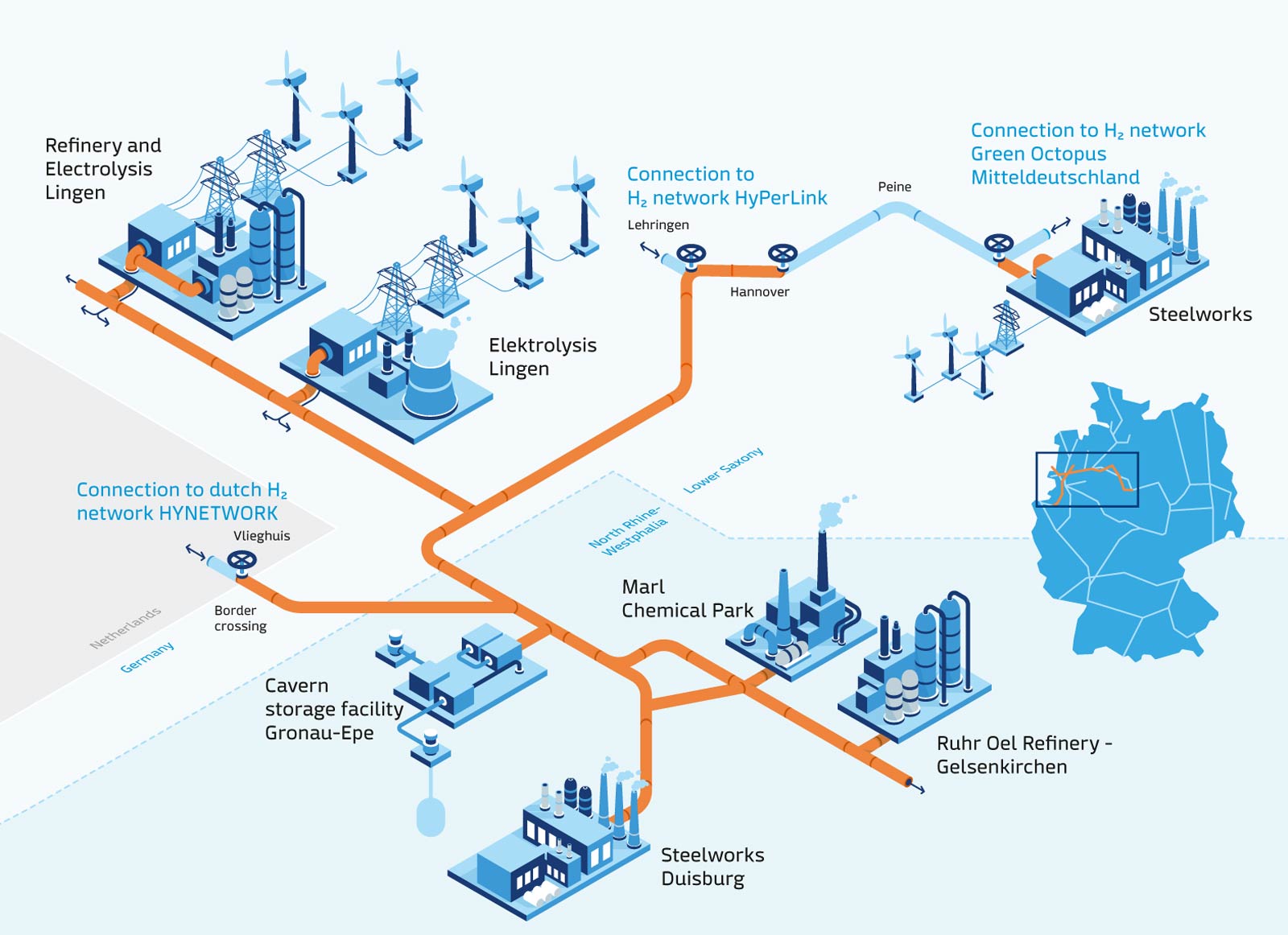
RWE’s Integrated Hydrogen Ecosystem Strategy
This diagram of the ‘GET H2 Nukleus’ project directly visualizes the integrated hydrogen ecosystem strategy discussed, connecting production in Lingen to industrial users.
(Source: RWE)
Strategic Capital Allocation: Why RWE Pivoted From the US to Double Down on Europe
In 2025, RWE executed a significant strategic pivot, slashing investments in the uncertain U.S. market to de-risk its portfolio and concentrate capital on Europe’s more supportive regulatory and financial environment, where it can more predictably build its integrated hydrogen model.
- Before 2025, RWE’s “Growing Green” strategy was globally expansive, with a planned €55 billion investment across worldwide markets, including a significant focus on the United States.
- A strategic reversal occurred in March 2025, when RWE announced a €10 billion reduction in its overall green spending and cut planned U.S. investments by 25% through 2030, citing regulatory uncertainties and supply chain constraints while halting work on U.S. offshore wind projects.
- This European focus was validated in September 2025 when RWE secured a €551 million grant from the Netherlands for its 100 MW green hydrogen plant in Eemshaven, confirming the viability of its strategy to leverage European public-private funding mechanisms.
- Further bolstering its European focus, the company issued a €1 billion hybrid bond in September 2025. Strong demand for the bond confirmed investor confidence in its refocused, Europe-centric energy transition strategy.
Table: RWE Strategic Investment and Divestment Actions
| Partner / Project | Time Frame | Details and Strategic Purpose | Source |
|---|---|---|---|
| Hybrid Bond Issuance | 2025-09-26 | Raised €1 Billion to finance its European energy transition and net-zero strategy, including hydrogen projects, following its U.S. pivot. | Nat West |
| Eemshaven Government Grant | 2025-09-01 | Awarded a €551 Million grant by the Netherlands for a 100 MW green hydrogen plant, de-risking the project and validating its European focus. | Fuel Cells Works |
| U.S. Investment Reduction | 2025-03-20 | Cut overall green spending by €10 Billion and U.S. investments by 25% through 2030 to de-risk from regulatory uncertainty. | Energy Connects |
| GET H 2 Nukleus | 2024-09-11 | Made a final investment decision on its flagship 300 MW project in Lingen by ordering the final 100 MW of electrolysers. | Hydrogen Insight |
| Growing Green Strategy | 2023-12-01 | Announced a gross investment plan of €55 Billion between 2024 and 2030 for global renewables and hydrogen projects, predating the 2025 strategic pivot. | Masdar |
Building the Value Chain: RWE’s Hydrogen Partnerships from Technology to Offtake
RWE’s partnership strategy evolved from primarily technology-focused collaborations between 2021-2024 to a comprehensive ecosystem-building approach in 2025, creating a network that spans the entire value chain from financing and grid access to securing long-term customers.

RWE Secures Value Chain with Offtake Deal
This infographic details a long-term offtake agreement with TotalEnergies, perfectly illustrating the section’s focus on building partnerships across the entire value chain.
(Source: RWE)
- In the period leading up to 2025, partnerships were concentrated on project execution, such as collaborating with Linde Engineering for electrolyser technology at the Lingen pilot and contracting with Técnicas Reunidas and Ansaldo Energia for the hydrogen-ready power plant in Werne.
- The partnership model broadened significantly in 2025 to address systemic needs. The joint venture with Apollo for the Amprion stake secures financing for critical grid infrastructure, a key enabler for connecting production and demand centers.
- The consortium with GE Vernova and Técnicas Reunidas for the 850 MW Voerde H 2-ready plant demonstrates a focus on building out the demand side of the ecosystem with proven industrial partners.
- Locking in a 15-year offtake agreement with Total Energies in 2025 represents the crucial final piece of the puzzle. This partnership with a major industrial consumer creates a bankable end-market that validates the commercial viability of RWE’s production projects.
Table: RWE Hydrogen and Energy Transition Partnerships
| Partner / Project | Time Frame | Details and Strategic Purpose | Source |
|---|---|---|---|
| Técnicas Reunidas, GE Vernova | 2025-10-28 | Selected to develop the 850 MW hydrogen-ready CCGT plant in Voerde, Germany, creating a large-scale demand center for hydrogen. | Técnicas Reunidas |
| Apollo Global Management | 2025-09-08 | Formed a JV over RWE’s stake in grid operator Amprion to secure financing for critical transmission infrastructure needed for renewables and hydrogen. | RWE |
| Total Energies | 2025-03-31 | Signed a 15-year offtake agreement to supply 30, 000 metric tons/year of green hydrogen, providing long-term revenue certainty for production projects. | RWE |
| Linde Engineering | 2024-08-19 | Collaborated on the GET H 2 project, with Linde providing the electrolysis plant technology that serves as the foundation for the 300 MW site. | Linde Engineering |
| Equinor | 2023-08-07 | Partnered to develop a blue hydrogen supply chain, with Equinor to produce up to 2 GW of blue hydrogen in Norway for import into Germany. | RWE |
| OGE | 2022-03-24 | Launched the “H 2 ercules” concept to create a national hydrogen pipeline network in Germany, connecting production with industrial demand. | OGE |
Geographic Consolidation: RWE’s Strategic Retreat to a German-Dutch Hydrogen Fortress
In 2025, RWE executed a decisive geographic consolidation, pulling back from the uncertain U.S. market to concentrate its formidable capital and expertise on a core European hub across Germany and the Netherlands, where it can leverage existing assets and strong policy alignment.

RWE’s European Hydrogen Cluster Strategy
This map visualizes RWE’s plan for a cross-border hydrogen cluster in Europe, directly illustrating the section’s theme of geographic consolidation.
(Source: RWE)
- Between 2021 and 2024, RWE’s hydrogen activities were geographically dispersed, with development projects and feasibility studies in Germany, the Netherlands, and the UK, alongside significant investment plans for the U.S. market.
- The strategic shift in 2025 was marked by an explicit 25% reduction in planned U.S. investments and the halting of related offshore wind projects, a direct response to what the company perceived as a high-risk regulatory environment.
- Germany is now cemented as RWE’s ecosystem core, hosting flagship production projects like GET H 2 Nukleus (Lingen), major infrastructure initiatives like H 2 ercules, and critical demand-side assets such as the hydrogen-ready power plants in Werne and Voerde.
- The Netherlands serves as a vital production hub, anchored by the Eemshaven and Eemshydrogen projects. The award of a €551 million government grant for the Eemshaven plant underscores the benefits of focusing on regions with strong public-private support.
From Pilot to Commercial Scale: RWE’s Hydrogen Technology Moves into Execution
RWE’s technology strategy has progressed from testing and pilot-scale deployments before 2025 to executing commercially-sized projects and integrating critical enabling technologies, such as long-duration energy storage and hydrogen-ready power turbines, to support its integrated ecosystem.
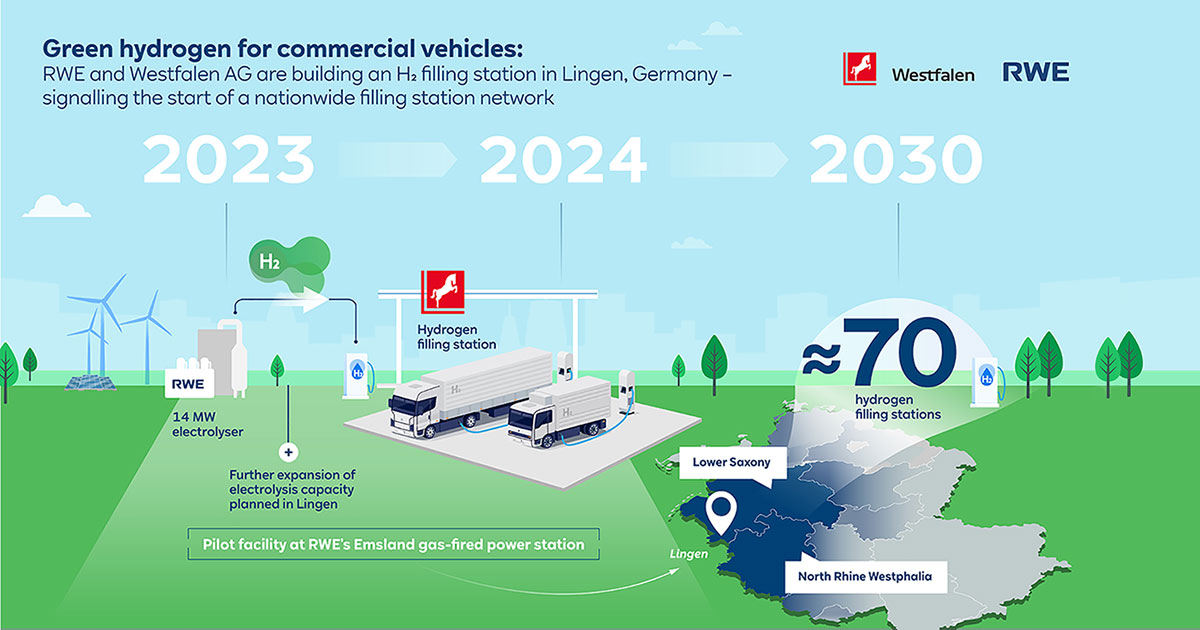
RWE Scales From Pilot to Commercial Network
This chart shows a commercial plan for 70 filling stations originating from the Lingen pilot plant mentioned in the text, perfectly illustrating the ‘pilot to commercial’ theme.
(Source: RWE)
- Before 2025, RWE’s efforts were centered on proving technological concepts. This included operating the 14 MW pilot electrolysis plant in Lingen and conducting feasibility studies for initial 100 MW-scale electrolyzers, as seen with the Pembroke project.
- In 2025, the company moved firmly into commercial-scale execution. It advanced its 300 MW GET H 2 project by ordering the final components and secured a major grant for a new 100 MW plant in Eemshaven, scaling up its production capabilities significantly.
- On the demand side, the plan for an 850 MW hydrogen-ready power plant in Voerde capable of using 50% hydrogen at launch represents a commitment to deploying commercially available, large-scale consumption technology.
- RWE also prioritized enabling technologies critical for a hydrogen economy. In 2025, it registered Australia’s first eight-hour battery storage system and began operating an inertia-ready BESS in the Netherlands, technologies essential for stabilizing the grid to accommodate large, power-intensive electrolyzers.
SWOT Analysis: RWE’s Hydrogen Strategy Pivot in 2025
RWE’s 2025 strategic pivot leveraged its deep-rooted strengths in European energy markets to mitigate emerging threats from U.S. regulatory uncertainty, allowing it to seize opportunities in public funding and integrated project development while exposing a potential weakness in geographic over-concentration.

RWE Positioned as Market Execution Leader
This chart categorizes the competitive landscape, positioning RWE as a major industrial player, which visually supports the strengths and market position discussed in the SWOT analysis.
(Source: LinkedIn)
- The company’s strengths, including its extensive European asset base and engineering expertise, were validated by its ability to secure a major grant in the Netherlands and advance complex projects in Germany.
- Its primary weakness, a high dependence on predictable policy and subsidies, was exposed by the U.S. market volatility, prompting a strategic retreat.
- Opportunities in European industrial decarbonization and public funding were aggressively pursued, as seen with the Total Energies offtake deal and the €551 million Eemshaven grant.
- The main threat of unclear policy frameworks, which materialized in the U.S., was effectively managed by reallocating capital to the more stable and supportive regulatory environments of its home markets.
Table: SWOT Analysis for RWE’s Hydrogen Strategy
| SWOT Category | 2021 – 2024 | 2025 – Today | What Changed / Resolved / Validated |
|---|---|---|---|
| Strengths | Existing power generation assets in Europe, strong balance sheet for investment, early-mover in pilot projects (e.g., Lingen). | Leveraged existing sites for new projects (Voerde, Werne). Used financial strength to issue €1 B bond. Deep relationships helped secure €551 M Dutch grant. | The 2025 pivot validated that RWE’s core strength lies in its ability to execute complex, large-scale projects within the familiar European regulatory and political system. |
| Weaknesses | Geographically diverse ambitions (US, UK, EU) created exposure to multiple regulatory risks. High capital intensity for unproven large-scale H 2 projects. | Dependence on supportive policy became a liability in the U.S. The company’s strategy became less diversified, concentrating risk in the EU market. | The U.S. retreat confirmed the weakness of depending on nascent and shifting policy frameworks. The company chose to manage this by retreating to its area of strength. |
| Opportunities | Announced broad goals to tap into the growing hydrogen market (e.g., 10 GW pipeline). Explored partnerships for blue and green H 2 (Equinor, OGE). | Capitalized on specific, tangible opportunities: a €551 M government grant (Eemshaven) and a major 15-year offtake deal (Total Energies). | RWE shifted from pursuing a general market opportunity to securing specific, bankable projects and revenue streams, successfully converting ambition into commercial reality. |
| Threats | Regulatory uncertainty in key markets. “Chicken-and-egg” problem of securing offtake for large-scale production. Supply chain constraints for key equipment. | The threat of U.S. regulatory uncertainty materialized, forcing a €10 B spending cut. RWE directly addressed the offtake problem by signing the Total Energies deal. | RWE actively mitigated the two greatest threats. It exited the uncertain U.S. market and created its own offtake solution through H 2-ready plants and long-term contracts. |
2026 Outlook: Will RWE’s Integrated Hydrogen Ecosystem Become the Industry Standard?
The single most critical signal to watch in 2026 is whether RWE reaches Final Investment Decisions (FIDs) on its cornerstone projects like the Eemshaven electrolyzer and the Voerde power plant. Positive FIDs would validate its integrated ecosystem strategy as a bankable and replicable model for the global hydrogen industry.

Electrolyzer Market Growth Underpins 2026 Outlook
This forecast of explosive growth in the European electrolyzer market provides critical financial context for the 2026 outlook, which hinges on the success of new electrolyzer projects.
(Source: Persistence Market Research)
- If FIDs are announced for Eemshaven and Voerde, it will confirm that the combination of securing large-scale industrial demand and leveraging government grants is a successful formula for de-risking multi-billion-euro hydrogen investments.
- Watch for the announcement of additional long-term offtake agreements similar to the landmark Total Energies deal. Such contracts remain the primary mechanism for proving project bankability to investors and lenders.
- Monitor the physical progress of infrastructure projects like the H 2 ercules pipeline and the Amprion grid expansion. Any delays in this midstream segment could create a critical bottleneck, stalling the entire ecosystem regardless of production capacity.
- The initial operational data from the first commercial phases of the GET H 2 Nukleus project will be scrutinized. These figures will provide the first real-world data on the Levelized Cost of Hydrogen (LCOH) from a large-scale European facility, heavily influencing the financial models for all future projects.
Frequently Asked Questions
What is the ‘chicken-and-egg’ problem in the hydrogen industry, and how is RWE’s strategy trying to solve it?
The ‘chicken-and-egg’ problem refers to the challenge where large-scale hydrogen supply won’t be built without guaranteed demand, and large-scale demand won’t emerge without a reliable supply. RWE is solving this by simultaneously developing all parts of the value chain: building large-scale production (like GET H2 Nukleus), creating its own dedicated demand (like the 850 MW Voerde power plant), and investing in the midstream infrastructure (like the Amprion grid partnership) to connect them.
Why did RWE significantly reduce its investments in the U.S. in 2025?
RWE reduced its planned U.S. investments by 25% through 2030 and cut its overall green spending by €10 billion due to what it perceived as ‘regulatory uncertainties and supply chain constraints’ in the U.S. market. The move was a strategic pivot to de-risk its portfolio and concentrate capital on Europe’s more supportive and predictable regulatory and financial environment.
How is RWE making its large-scale hydrogen projects ‘bankable’ or financially viable?
RWE is making its projects bankable in three key ways. First, by securing long-term revenue certainty through offtake agreements, such as the 15-year deal with TotalEnergies. Second, by de-risking capital costs by securing significant public funding, like the €551 million grant from the Netherlands for its Eemshaven plant. Third, by demonstrating investor confidence and raising capital through financial instruments like its successful €1 billion hybrid bond issuance.
What are the core components of RWE’s hydrogen ecosystem in its ‘German-Dutch fortress’?
RWE’s European ecosystem is built on three pillars: 1) Production hubs in Germany (Lingen’s GET H2 Nukleus) and the Netherlands (Eemshaven project). 2) Demand centers, including its own hydrogen-ready power plants in Voerde and Werne, Germany. 3) Infrastructure, supported by its H2ercules pipeline concept and a joint venture with Apollo to finance the Amprion electricity grid.
According to the outlook, what is the most critical milestone to watch for in 2026 to see if RWE’s strategy is successful?
The single most critical signal to watch for in 2026 is whether RWE reaches Final Investment Decisions (FIDs) on its cornerstone projects, particularly the Eemshaven electrolyzer and the Voerde hydrogen-ready power plant. Positive FIDs would confirm that its integrated strategy of combining government grants with secured industrial demand is a bankable and replicable model.
