

2026 Energy Investment: Why Battery Storage at $78/MWh Beats Offshore Wind’s $100/MWh Price Tag
Project Viability in 2026: Battery Storage Rises as Offshore Wind Stalls on Cost
A fundamental economic divergence now defines the clean energy sector, creating distinct risk profiles for capital-intensive projects. While the levelized cost of battery energy storage has collapsed, making it a prime investment for displacing fossil fuels, the economics for offshore wind have deteriorated due to inflation and supply chain constraints, forcing project cancellations and threatening development pipelines without significant subsidies.
- Between 2021 and 2024, both battery storage and offshore wind were viewed as key growth technologies, with offshore wind in particular benefiting from projections of falling costs. Lithium-ion battery pack prices even saw a temporary increase in 2022 to $151/k Wh due to raw material costs.
- The market shifted decisively in 2025 and early 2026. The global benchmark Levelized Cost of Storage (LCOS) for a four-hour battery system plummeted 27% year-over-year to a record low of $78/MWh. This was driven by lower material costs and manufacturing oversupply, which improved the economic case for large-scale projects in the U.S. and Europe.
- In contrast, the Levelized Cost of Energy (LCOE) for new offshore wind projects stabilized at a much higher plateau of approximately $100/MWh, with some analyses showing the average cost for U.S. projects effectively doubling from a baseline of $80/MWh. This has rendered many previously signed Power Purchase Agreements (PPAs) unviable.
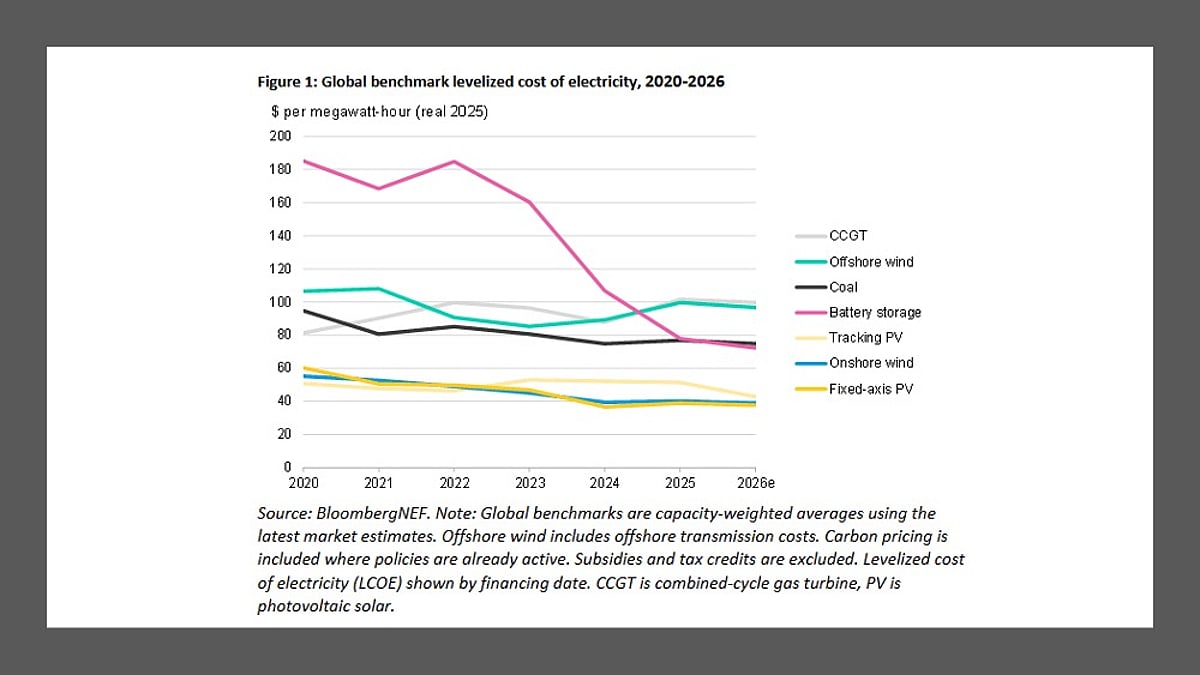
Battery Storage LCOE Plummets Below Wind
This chart directly illustrates the section’s core theme: the economic divergence where battery storage costs have fallen dramatically, undercutting offshore wind by 2026.
(Source: TaiyangNews)
Investment and Cancellations: A Tale of Two Trajectories
Financial decisions in the energy sector now reflect this cost divergence, with capital flowing toward the superior economics of battery storage while high-profile offshore wind projects are delayed or cancelled. The investment risk for offshore wind has increased substantially, making projects highly dependent on government subsidies and long-term, high-priced offtake agreements to reach a final investment decision.
- The business case for battery storage is now stronger than that for new gas peaker plants, whose LCOE rose 16% to $102/MWh. The $78/MWh LCOS for batteries creates a clear economic incentive for deployment, further supported by policies like the U.S. Inflation Reduction Act’s 30% tax credit.
- The most compelling case is for hybrid solar-plus-storage systems, which achieve a combined LCOE of just $57/MWh, making them the lowest-cost dispatchable power option.
- Offshore wind developers have been forced to cancel or renegotiate projects due to rising costs. The sector now faces a significantly higher cost of capital as investors reassess the risks associated with supply chain volatility and inflation.
Table: Energy Project Economic Viability Shifts (2025-2026)
| Project Type / Sector | Time Frame | Details and Strategic Purpose | Source |
|---|---|---|---|
| Battery Storage (4-hour) | 2025 | Global benchmark LCOS fell 27% to a record low of $78/MWh, making it more cost-effective than new gas peaker plants. | Saur Energy |
| Combined-Cycle Gas (Peaker) | 2025 | LCOE increased by 16% year-over-year to $102/MWh, losing its economic advantage against battery storage for firming capacity. | Next GPower |
| U.S. Offshore Wind Projects | July 2025 | Analysis indicated the average LCOE for U.S. projects effectively doubled from a baseline of $80/MWh due to inflation and supply chain issues, leading to project cancellations. | [PDF] White Strand LLC |
| Coastal Virginia Offshore Wind (CVOW) | June 2025 | Dominion Energy’s project, with a Q 4 2026 Commercial Operation Date, has a projected LCOE of $91/MWh in 2027 dollars, reflecting the higher cost environment for new builds. | [PDF] Lazard |
Geography: China Drives BESS Cost Down, U.S. Offshore Wind Costs Rise
The geographic concentration of manufacturing and deployment reveals different regional dynamics shaping project economics. While scaled manufacturing in China is a primary driver of falling battery costs globally, nascent offshore wind markets like the U.S. are experiencing acute cost inflation due to undeveloped supply chains and infrastructure.

Renewables Achieve Cost Competitiveness in 2024
This chart provides a 2024 comparison of the Levelized Cost of Electricity for the exact technologies discussed, visually supporting the economic viability shifts detailed in the table.
(Source: Evwind)
- From 2021 to 2024, Europe was a leader in offshore wind deployment, benefiting from established supply chains. The U.S. market was emerging, with ambitious targets but limited operational capacity.
- By 2025, the impact of China’s massive scale in battery production became a dominant factor in global cost reduction. BNEF reported that the LCOS for a four-hour system is now below $100/MWh in at least six distinct markets, indicating widespread economic viability.
- Conversely, the U.S. offshore wind market has struggled with persistent cost pressures. Lazard’s June 2025 analysis places the unsubsidized LCOE for offshore wind in a wide range of $70/MWh to $157/MWh, reflecting the high costs and risks associated with developing projects in the region.
Technology Maturity: Battery Storage Reaches Economic Tipping Point
The commercial status of these technologies has decisively shifted, with battery storage proving its economic maturity as a mainstream grid asset while the economic model for offshore wind is being stress-tested. The year 2026 marks an economic and technical tipping point where BESS surpasses gas peaker plants in cost-effectiveness for providing grid flexibility and firming capacity.

Battery Storage Reaches Economic Tipping Point
This chart perfectly visualizes the ‘economic tipping point’ mentioned in the text, showing the moment battery storage costs fall below those of gas peaker plants.
(Source: EnkiAI)
- Prior to 2025, utility-scale storage was often considered an ancillary service provider or a peaker plant alternative in high-value markets. Its economic viability was not yet universal.
- The 27% year-over-year cost decline to $78/MWh in 2025 validated battery storage as a fully commercial and economically superior technology for many grid applications. Advances in battery technology and manufacturing economies of scale are now fully realized in project costs.
- Offshore wind technology itself is mature, particularly fixed-bottom designs. However, its economic model has proven fragile in the face of macroeconomic shocks, with its LCOE surging to over $100/MWh. This indicates that while technically ready, its financial viability is not assured without external support mechanisms.
SWOT Analysis: Diverging Fortunes in Clean Energy
The strategic outlook for battery storage and offshore wind is now sharply defined by their opposing cost trajectories. Battery storage strengths are directly aligned with market needs for low-cost, dispatchable power, while offshore wind’s weaknesses create significant project development and investment hurdles.

Cost Trajectories for Battery and Wind Diverge
This chart’s comparison of declining battery storage costs against higher offshore wind costs directly visualizes the ‘diverging fortunes’ described in the SWOT analysis.
(Source: EnkiAI)
- Strengths: Battery storage benefits from a rapidly declining LCOS, making it and hybrid solar+storage systems the most economically attractive clean energy investments.
- Weaknesses: Offshore wind suffers from high capital costs, supply chain bottlenecks, and sensitivity to inflation, which have pushed its LCOE above competitive alternatives.
- Opportunities: Battery storage is positioned to capture a significant market share from retiring fossil fuel peaker plants and enable higher penetration of intermittent renewables like solar.
- Threats: The primary threat to offshore wind is economic non-competitiveness, leading to project cancellations and a potential shift of investment capital toward lower-cost technologies.
Table: SWOT Analysis of Battery Storage vs. Offshore Wind (2024-2026)
| SWOT Category | 2021 – 2024 | 2025 – 2026 | What Changed / Validated |
|---|---|---|---|
| Strengths | Both technologies showed declining cost curves and strong policy support. Offshore wind had a high capacity factor. | BESS LCOS dropped 27% to $78/MWh. Solar+storage LCOE is now $57/MWh, the cheapest dispatchable power. | The economic competitiveness of BESS and hybrid systems was validated, surpassing earlier forecasts. |
| Weaknesses | BESS faced raw material price volatility (e.g., lithium). Offshore wind had high initial CAPEX and long development cycles. | Offshore wind LCOE surged to $100/MWh+ due to inflation and supply chain issues. BESS supply chains face geographic concentration risk. | Offshore wind’s vulnerability to macroeconomic factors became a critical weakness, while BESS costs proved resilient and continued to fall. |
| Opportunities | BESS could provide grid services and firm renewables. Offshore wind could provide large-scale, carbon-free power to coastal centers. | BESS is now economically superior to new gas peakers ($102/MWh), opening a massive market for displacement. | The market opportunity for BESS as a direct replacement for fossil fuel capacity was confirmed by its cost advantage. |
| Threats | Permitting delays and grid interconnection queues were common threats. Competition from natural gas was a factor. | Offshore wind faces project cancellations and PPA renegotiations. It is losing competitiveness against solar+storage. | The primary threat shifted from policy uncertainty to fundamental economic non-viability for offshore wind projects without new subsidies. |
2026 Outlook: Capital Favors Storage as Wind Seeks a Lifeline
The most critical strategic action for energy investors in 2026 is to reallocate capital toward utility-scale solar and battery storage projects, which offer superior risk-adjusted returns. If interest rates remain elevated and offshore wind supply chains do not expand rapidly, the development pipeline for offshore wind will continue to face significant friction, making it a strategic, long-term play dependent on policy support rather than near-term market economics.

Offshore Wind Costs Stall After Decade-Long Decline
This chart specifically illustrates the ‘Weaknesses’ point in the SWOT table, showing that the long-term cost reduction for offshore wind has plateaued and is reversing.
(Source: AleaSoft)
- Watch for a pivot to hybrid systems: The $57/MWh LCOE of solar-plus-storage is a definitive market signal. Expect an acceleration of project announcements and financing for these hybrid assets as they represent the lowest-cost path to new, dispatchable clean energy.
- Monitor offshore wind subsidy enhancements: For the offshore wind sector to maintain momentum, governments will need to increase subsidies, offer inflation-indexed contracts, or provide other de-risking mechanisms. The economic gap is now too large to ignore.
- Expect storage to drive decarbonization: With a clear cost advantage over gas peakers, battery storage is no longer a niche technology but a central pillar of grid decarbonization. Its deployment will be the leading indicator of progress in phasing out fossil fuel firming capacity.
Frequently Asked Questions
Why is battery storage considered a better investment than offshore wind in 2026?
The primary reason is the sharp divergence in cost. The levelized cost of battery storage (LCOS) has dropped to a record low of $78/MWh, while the levelized cost of energy (LCOE) for new offshore wind projects has risen to approximately $100/MWh. This significant cost difference makes battery storage a more economically competitive and lower-risk investment for providing dispatchable power.
What factors are causing the cost of offshore wind projects to increase?
Offshore wind costs are rising due to a combination of high inflation, global supply chain constraints, and undeveloped local supply chains in emerging markets like the U.S. According to the analysis, these factors have caused the average cost for U.S. projects to effectively double, leading to project cancellations and making them highly dependent on government subsidies.
How does the cost of battery storage compare to a new natural gas peaker plant?
Battery storage is now more cost-effective. The analysis shows that the LCOS for a four-hour battery system is $78/MWh, while the LCOE for a new gas peaker plant has risen by 16% to $102/MWh. This gives battery storage a clear economic advantage for providing grid flexibility and firming capacity.
What is the cheapest form of dispatchable (on-demand) clean energy mentioned in the article?
The most cost-effective option identified is a hybrid solar-plus-storage system. The article states that these combined systems can achieve a Levelized Cost of Energy (LCOE) of just $57/MWh, making them the lowest-cost dispatchable power option and a prime investment.
Why did the cost of battery storage drop so significantly after prices actually increased in 2022?
While battery pack prices saw a temporary spike in 2022 due to raw material costs, the market shifted decisively by 2025. The significant 27% year-over-year cost reduction was driven by a combination of falling material costs and a massive increase in global manufacturing scale (described as manufacturing oversupply), particularly from China.
