

Google’s Long-Duration Storage Strategy for Data Centers in 2025-2026: The Shift to 24/7 Power
Google is fundamentally re-architecting its energy procurement model, moving beyond standard renewable energy credits and Power Purchase Agreements (PPAs) to directly integrate long-duration energy storage (LDES) into its infrastructure. This strategic pivot is driven by the urgent need to provide reliable, 24/7 carbon-free energy (CFE) to its power-intensive AI data centers. The company is now acting as a prime mover in commercializing novel LDES technologies, using its immense capital and project pipeline to solve the intermittency of solar and wind power at a grid-scale.
Google’s Commercial Scale LDES Projects Signal a New Era for Data Center Power 2026
Google’s adoption of long-duration energy storage has decisively shifted from theoretical exploration between 2021 and 2024 to a core pillar of its infrastructure deployment strategy from 2025 onward.
- In the 2021-2024 period, Google’s strategy focused on establishing its 24/7 CFE goal and forming exploratory partnerships, such as the October 2021 alliance with AES to innovate on clean energy solutions. These early moves laid the groundwork but did not involve direct, large-scale LDES asset deployment.
- The period from 2025 to today marks a radical acceleration into commercial-scale projects. The centerpiece is the February 2026 commitment to deploy a 300 MW / 30 GWh iron-air battery system from Form Energy, a project with an unprecedented 100-hour duration designed to back a new data center in Minnesota.
- This is complemented by a July 2025 strategic agreement with Energy Dome to deploy its CO₂ Battery technology globally. This signals a portfolio approach, validating multiple LDES pathways to secure firm power.
- This transition from high-level goals to deploying physical, first-of-their-kind storage assets demonstrates that LDES is no longer a conceptual solution but an essential component required to power the AI revolution sustainably.
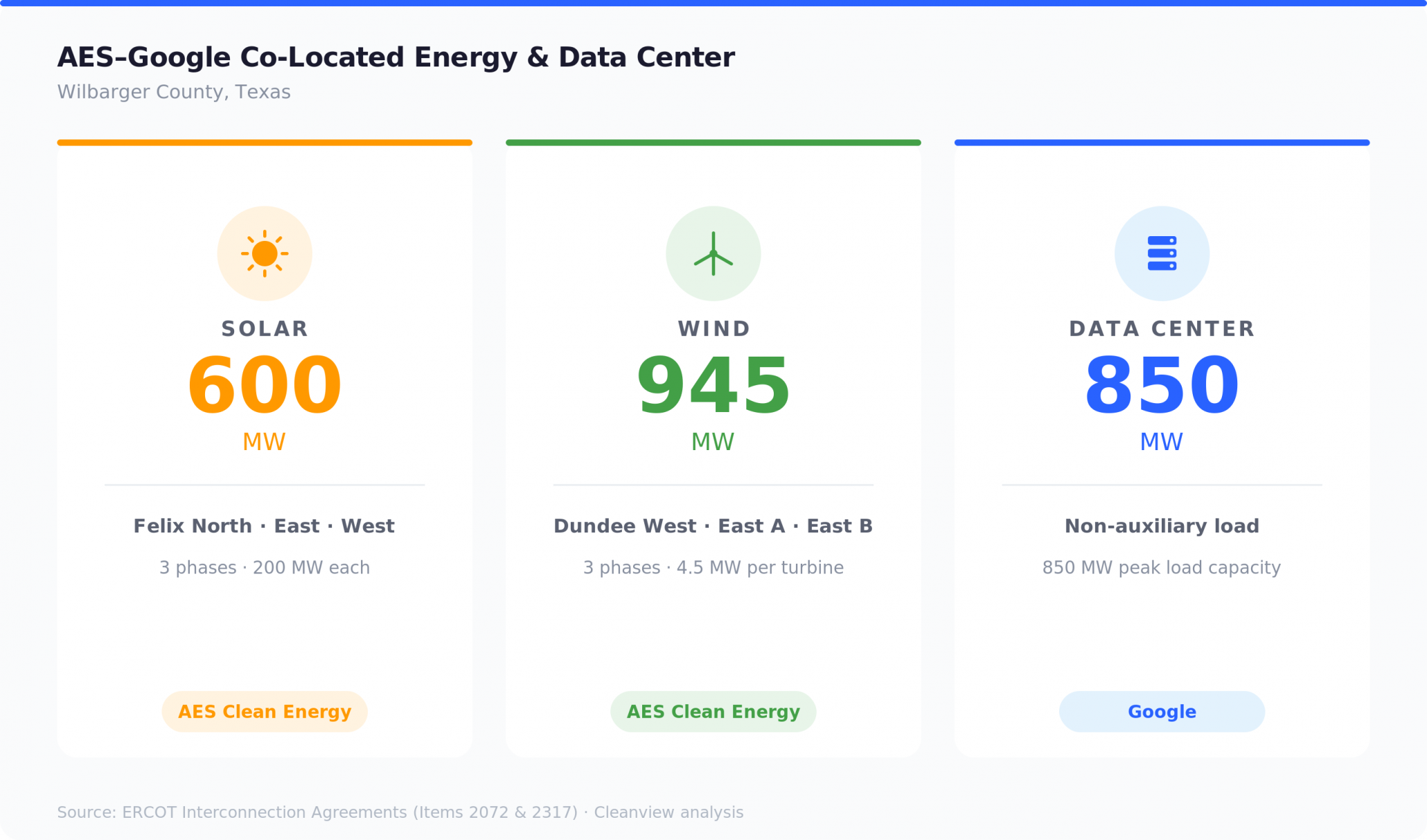
Google & AES Partner on Gigawatt-Scale Project
This infographic illustrates Google’s early exploratory partnerships, such as the alliance with AES mentioned in the text, which laid the groundwork for its current LDES strategy.
(Source: Distilled)
Google Investment Data: From Venture Funding to Billion-Dollar Infrastructure
Google’s financial strategy for long-duration storage has matured from participating in venture rounds to direct, billion-dollar procurement of physical assets, underpinning its “power-first” data center development model.
- The most significant financial commitment is the approximately $1 billion Google will pay for the Form Energy 100-hour battery system in Minnesota, announced in February 2026. This is not an equity investment in the company but a direct procurement of a critical infrastructure asset.
- In January 2026, Google participated in a $425 million funding round for Redwood Materials, a strategic investment timed with Redwood’s pivot toward developing energy storage solutions specifically for the data center market.
- These LDES investments are a key component of Google’s massive infrastructure spending, which includes a planned capital expenditure of up to $185 billion for new data centers and the energy systems required to power them.
Table: Google’s Strategic Investments in Long-Duration Storage and Related Technologies
| Partner / Project | Time Frame | Details and Strategic Purpose | Source |
|---|---|---|---|
| Form Energy Battery System | February 2026 | Directly procured a 300 MW / 30 GWh iron-air battery system for an estimated $1 billion to provide 100-hour storage for its Minnesota data center, ensuring 24/7 CFE supply. | mlq.ai |
| Redwood Materials Investment | January 2026 | Participated in a $425 million funding round as Redwood Materials shifted its focus to developing energy storage systems tailored for the data center market, securing a position in the battery supply chain. | Latitude Media |
Google Partnership Data: Building an Ecosystem for 24/7 Carbon-Free Energy
Google has architected a focused partnership ecosystem to de-risk its LDES strategy, combining utility-scale collaboration for deployment, technology-specific agreements for innovation, and vertical integration for control.
- The partnership with utility Xcel Energy, announced in February 2026, is the critical enabler for the Form Energy deployment in Minnesota. It provides the regulatory and grid framework to integrate the massive battery system alongside 1, 600 MW of new wind and solar generation.
- The global commercial agreement with Energy Dome from July 2025 diversifies Google’s technology risk, providing a scalable and geographically independent LDES solution based on a CO₂ thermodynamic cycle.
- Google’s January 2026 acquisition of developer Intersect Power for $4.75 billion provides the vertical integration necessary to build and control its own generation and storage assets, allowing it to co-locate these resources directly with new data centers.

Chart Shows Gaps in Carbon-Free Energy Supply
This chart visualizes the core challenge of achieving 24/7 carbon-free energy by showing the gaps between renewable supply and constant demand, explaining the need for the partnership ecosystem.
(Source: EEPower)
Table: Google’s Key Partnerships for Long-Duration Energy Storage
| Partner / Project | Time Frame | Details and Strategic Purpose | Source |
|---|---|---|---|
| Xcel Energy & Form Energy | February 2026 | A three-way collaboration to add 1.9 GW of clean energy and storage to the Minnesota grid. Xcel Energy provides the utility integration for the 300 MW / 30 GWh Form Energy battery procured by Google. | Reuters |
| Energy Dome | July 2025 | A strategic commercial agreement to deploy Energy Dome’s CO₂ Battery long-duration storage technology at a global scale, providing a geographically flexible option to support 24/7 CFE for data centers. | Energy Dome |
| Intersect Power Acquisition | January 2026 | Google’s parent company, Alphabet, acquired the energy developer for $4.75 billion to vertically integrate the development of power generation and storage, accelerating its “power-first” data center strategy. | Power Mag |
Geography: Concentrating LDES Deployments in US Data Center Hubs
Google’s long-duration storage deployments are strategically concentrated in key U.S. data center growth regions, directly connecting next-generation energy infrastructure with its expanding computational footprint.
- The state of Minnesota has become the epicenter of Google’s LDES strategy, selected as the site for its new Pine Island data center and the co-located Form Energy iron-air battery. This project serves as the primary blueprint for integrating LDES with a major data center load.
- While earlier efforts between 2021 and 2024 involved broad, non-specific commitments, the 2025-2026 period shows a clear geographic focus. The projects in Minnesota are physical, large-scale deployments tied to specific data center energy needs.
- The agreement with Energy Dome for “worldwide” commercial deployments indicates a future global ambition, but the initial, capital-intensive projects are firmly rooted in the U.S. to solve immediate power constraints for its most critical data center expansion zones.
Technology Maturity: Accelerating LDES from Pilot to Commercial Validation
Google is acting as a powerful catalyst, accelerating novel long-duration storage technologies from the pilot and venture stages directly to first-of-a-kind commercial scale to meet its urgent operational needs.
- Between 2021 and 2024, LDES technologies were largely considered pre-commercial, with hyperscalers engaging in smaller pilot projects or making venture investments. The focus was on learning and exploration rather than solving immediate power deficits.
- The 2025-2026 period marks a definitive shift to commercial validation. The 300 MW / 30 GWh Form Energy project in Minnesota is not an R&D pilot; it is a grid-scale infrastructure asset being deployed to provide a firm commercial power solution for a gigawatt-scale data center.
- Similarly, the commercial agreement with Energy Dome in July 2025 moves its CO₂ Battery technology from demonstration to a scalable, commercially deployable solution backed by a major offtaker. Google’s backing provides the market signal and financial security needed to prove these technologies at scale.

US Data Center Power Use Forecasted to Surge
This forecast highlights the surging US energy demand that creates the “urgent operational needs” for Google to accelerate new LDES technologies from pilot to commercial scale.
(Source: Carbon Credits)
SWOT Analysis: Evaluating Google’s LDES Strategy for Data Centers
Google’s aggressive LDES strategy provides a powerful solution to achieve its 24/7 CFE goals but introduces significant execution risks and capital demands, while its market-leading position creates unique opportunities to shape grid policy.
Table: SWOT Analysis for Google’s Data Center LDES Strategy
| SWOT Category | 2021 – 2024 | 2025 – 2026 | What Changed / Validated |
|---|---|---|---|
| Strengths | Established ambitious 24/7 CFE goal; strong balance sheet for R&D; leadership in renewable PPA procurement. | Direct control over power supply via Intersect Power acquisition; first-mover advantage on 100-hour storage (Form Energy); pioneering new tariff models (CTT). | The strategy evolved from being an energy buyer to an integrated energy infrastructure developer, providing greater control and de-risking supply. |
| Weaknesses | Stagnant 24/7 CFE score (64%); heavy reliance on intermittent solar and wind; rising absolute emissions from AI growth. | Extreme capital intensity ($1 B+ per major LDES project); high execution risk on novel technologies (iron-air, CO₂ batteries); long project development timelines. | Financial and operational risk has increased substantially with the shift from offtake agreements to direct ownership and deployment of unproven-at-scale technologies. |
| Opportunities | Leverage purchasing power to influence renewable energy markets; aggregate demand with other large buyers. | Set the industry standard for 24/7 data center power; replicate innovative tariff models globally; secure power and land ahead of competitors facing grid constraints. | The opportunity has expanded from influencing markets to physically shaping the grid and pioneering regulatory frameworks that benefit its business model. |
| Threats | Grid congestion and interconnection queues; volatile energy prices; AI energy demand growing faster than clean energy supply. | Permitting and construction delays for complex, integrated projects; supply chain bottlenecks for LDES components; technology underperformance at scale. | Threats have become more operational and project-specific. The success or failure of the first major LDES projects now carries significant strategic weight. |
Forward-Looking Insights and Summary
The operational performance of the Form Energy battery system in Minnesota will be the most critical validation point for Google’s entire LDES-centric energy strategy and its ability to achieve its 2030 goals.
- Success of the 100-hour iron-air battery will serve as a powerful, replicable blueprint for powering data centers globally and will likely trigger a wave of similar deployments by competitors like Microsoft and Amazon.
- Expect Google to announce further partnerships in other LDES technologies, such as advanced thermal storage or flow batteries, to build a resilient and diversified portfolio that is not reliant on a single chemistry.
- The market will closely watch how the integration of Intersect Power translates into the rapid, parallel development of co-located solar, wind, and storage assets. The speed of this execution will determine if Google can stay ahead of its explosive AI-driven energy demand.
- Monitor for efforts to export the Clean Transition Tariff (CTT) model pioneered with NV Energy to other key data center regions like Virginia, Ohio, and Texas, as this regulatory innovation is key to unlocking utility-scale investments in firm clean power.
