

Meta’s US Energy Blueprint 2025-2026: Securing Gigawatts of Solar and Baseload Power for AI Data Centers
Meta Platforms is executing a two-pronged energy strategy to power its massive artificial intelligence (AI) data center expansion across the United States. The company continues its aggressive procurement of multi-gigawatt solar energy through Power Purchase Agreements (PPAs) to meet its public sustainability goals. Concurrently, it is making a strategic and necessary pivot to secure firm, 24/7 carbon-free power sources, including nuclear and geothermal energy, to address the critical reliability demands of its AI infrastructure.
Meta’s Commercial-Scale Renewable Projects Signal Major Shift for Data Center Power 2026
Meta has evolved its energy procurement from a strategy dominated by solar PPAs between 2021 and 2024 to a dual approach in 2025 and 2026 that now includes commercial agreements for firm, 24/7 clean power. This shift is a direct response to the non-stop, high-intensity energy requirements of its AI data centers, which intermittent solar power alone cannot satisfy.
- The 2021-2024 period was defined by Meta’s successful push to match 100% of its operational electricity use with renewables, primarily through large-scale solar PPAs with partners like RWE, Ørsted, and Silicon Ranch, establishing it as a leader in corporate renewable procurement.
- In 2025-2026, Meta dramatically increased the scale of its solar procurement with massive deals, including a 2.1 GW PPA with Next Era Energy Resources and a 600 MW agreement with Enbridge, to support a new wave of data center construction.
- The most significant strategic change is the company’s move into baseload power, evidenced by a January 2026 commitment to procure 6.6 GW of nuclear energy by 2035 and a June 2025 partnership with XGS Energy to develop 150 MW of waterless geothermal power.
- This pivot acknowledges a critical reality: despite massive solar investments, new data centers in locations like Louisiana and El Paso, Texas, still require new natural gas power plants for grid reliability, highlighting a gap that next-generation clean technologies are intended to fill.
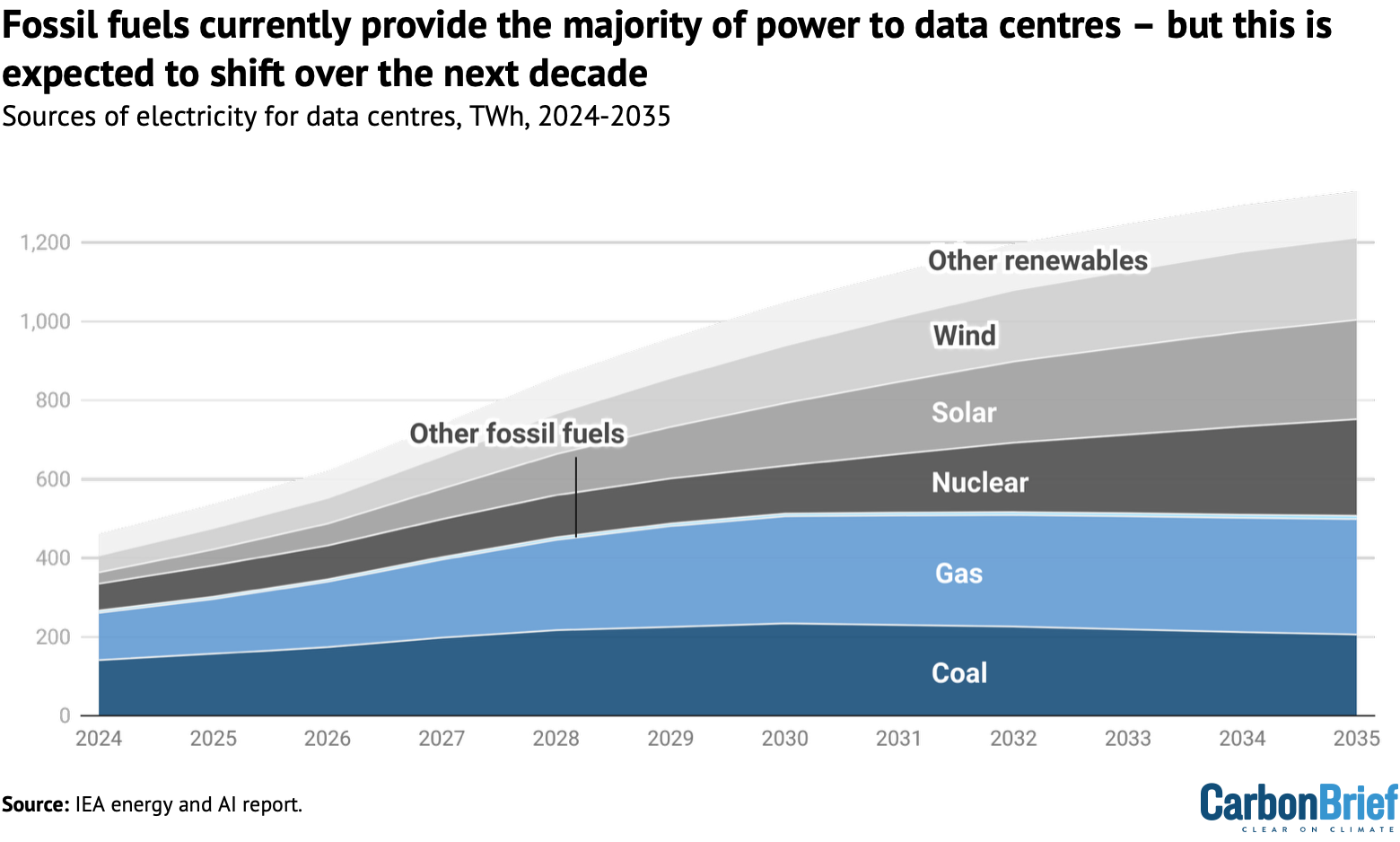
Data Center Power Shifting to Nuclear, Renewables
This chart shows the forecast power mix for data centers shifting toward renewables and nuclear. This directly illustrates the section’s point about Meta’s strategic move to 24/7 clean power sources beyond intermittent solar.
(Source: Carbon Brief)
Meta’s Multi-Billion Dollar Data Center Investments Drive Energy Market Transformation
Meta is committing tens of billions in capital to build new AI-optimized data centers, and each new facility serves as a powerful catalyst for the development of new, large-scale energy generation projects. This direct link between data center investment and energy infrastructure development is reshaping regional power markets.
- Meta’s planned capital expenditures, including a $60 billion budget for 2025, are overwhelmingly directed toward data center infrastructure, creating an immense and predictable source of demand for clean energy developers.
- The company’s investment strategy directly couples new data centers with new renewable projects. For example, the $800 million AI data center announced in South Carolina in August 2025 is being built in tandem with a $100 million, 100 MW solar farm developed by partner Silicon Ranch.
- The announcement of the colossal $10 billion Hyperion data center in Louisiana in June 2025 immediately triggered plans for new power generation, including both natural gas turbines for reliability and a strategic move to incorporate nuclear power through its partnership with utility Entergy.
- Meta’s role as a guaranteed offtaker de-risks major energy investments for its partners, as seen with Enbridge’s decision to invest $900 million in the 600 MW Clear Fork solar project in Texas, which was developed specifically to fulfill its PPA with Meta.

Hyperscalers Like Meta Drive Power Demand Surge
The chart projects that the hyperscaler segment, which includes Meta, is the main driver of data center power demand growth. This supports the section’s core argument that Meta’s massive investments are transforming energy markets.
(Source: Boston Consulting Group)
Table: Meta’s Data Center and Supporting Energy Investments (2025)
| Partner / Project | Time Frame | Details and Strategic Purpose | Source |
|---|---|---|---|
| Hyperion Data Center | June 2025 | A $10 billion investment in Louisiana for what will be the largest data center in the Western Hemisphere. The project’s immense energy needs are driving Meta’s strategy to procure baseload power, including nuclear. | CNBC |
| Enbridge / Clear Fork Solar Project | July 2025 | A $900 million investment by Enbridge to build a 600 MW solar facility in Texas. Meta is the sole offtaker, demonstrating how its PPAs directly finance and enable new renewable energy infrastructure. | Utility Dive |
| South Carolina AI Data Center | August 2025 | An $800 million investment for Meta’s first data center in the state. This project is directly tied to a new 100 MW solar farm being built by Silicon Ranch to supply the facility. | Latitude Media |
| Texas Data Center | October 2025 | A $1.5 billion investment to build a new renewables-powered hyperscale data center in Texas, further concentrating Meta’s energy demand in the ERCOT market. | Renewables Now |
Meta’s Strategic Energy Partnerships Build a Multi-Gigawatt Clean Power Pipeline
Meta has assembled a broad network of energy partners to construct its clean power portfolio, evolving from a roster of primarily solar and wind developers between 2021-2024 to one that now includes next-generation geothermal and nuclear firms in 2025-2026 to secure a reliable, carbon-free energy supply.
- The 2025-2026 period is marked by an acceleration in PPA volume with established renewable developers. Key partnerships include a 2.1 GW deal with Next Era, a 791 MW agreement with Invenergy, and a 600 MW PPA with Enbridge, primarily for new solar capacity.
- This builds upon a strong foundation of partnerships from 2021-2024 with developers like RWE, Ørsted, and Silicon Ranch, though the scale and concentration of deals have increased significantly to meet AI-driven demand.
- A strategic expansion of Meta’s partnership ecosystem now includes specialists in firm power. The agreement with XGS Energy for geothermal and the engagement with three unnamed nuclear firms for its 6.6 GW procurement plan represent a critical diversification beyond intermittent renewables.
- Meta is also forging deeper ties with traditional utilities that are committed to clean energy transition, such as its collaboration with Entergy in Louisiana to source a mix of renewables and nuclear power for the Hyperion data center.

Meta’s Renewable Energy Portfolio Reaches 8.6 GW
This chart quantifies the scale of Meta’s contracted renewable energy capacity by 2024. It provides a concrete data point for the “multi-gigawatt clean power pipeline” described in the section.
(Source: Meta Sustainability)
Table: Meta’s Key Energy Partnerships (2025-2026)
| Partner / Project | Time Frame | Details and Strategic Purpose | Source |
|---|---|---|---|
| MN 8 Energy / Walker Solar | February 2026 | A long-term PPA for 100% of the offtake from an 80 MW solar project in Pennsylvania, supporting Meta’s data center operations in the PJM market. | Business Wire |
| Nuclear Energy Firms | January 2026 | Agreements with three nuclear companies to procure 6.6 GW of nuclear power by 2035. This is a landmark move to secure 24/7 carbon-free baseload energy for its US data centers. | Data Centre Magazine |
| Next Era Energy Resources | December 2025 | A massive agreement for 2.1 GW of solar capacity from nine new projects across the US. This partnership is a cornerstone of Meta’s strategy to add new renewable capacity to the grid. | Next Era Energy |
| Enbridge / Clear Fork Solar | July 2025 | A long-term PPA for 100% of the power from Enbridge’s 600 MW solar project in Texas, designed specifically to support Meta’s regional data center operations. | Utility Dive |
| XGS Energy | June 2025 | A partnership to develop 150 MW of waterless geothermal energy in New Mexico, providing round-the-clock renewable power and diversifying Meta’s portfolio with a key baseload technology. | Supply Chain Digital |
Meta’s Data Center Expansion Concentrates Energy Demand in Texas, Midwest, and Southeast USA
While Meta’s renewable energy procurement portfolio is geographically diverse, its recent multi-billion-dollar investments in new data center campuses are creating concentrated zones of extreme energy demand. These hubs are emerging primarily in Texas and the U.S. Southeast, forcing the development of new, dedicated power infrastructure in those regions.
- Between 2021 and 2024, Meta expanded its footprint in established data center markets like Arizona (Mesa), while procuring renewables in regions with high generation potential like Georgia and Tennessee through its partnership with Silicon Ranch.
- The period from 2025 to 2026 has seen a clear geographic focus for new builds in the U.S. Southeast and Texas. Major projects include a $1.5 billion data center in Texas, an $800 million facility in South Carolina, and the $10 billion Hyperion campus in Louisiana.
- This geographic strategy directly influences the type of energy procured. Texas, with its favorable solar conditions and competitive ERCOT market, has become the epicenter of Meta’s largest solar PPAs, including deals with Enbridge, ENGIE, and Pine Gate Renewables.
- In contrast, the selection of Louisiana for the Hyperion data center is driving a different energy solution, leveraging the state’s existing nuclear capacity and regulatory environment to support a massive baseload power demand, supplemented by new natural gas and solar projects.

US Data Center Demand Concentrates in Texas
This forecast shows a surge in US data center power demand, with Texas emerging as a dominant state. This directly visualizes the geographic concentration of energy demand discussed in the section.
(Source: Rystad Energy)
Meta’s Strategy Validates Commercial Scale Solar While Pioneering Geothermal and Nuclear for Data Centers
Meta’s energy strategy confirms that utility-scale solar is a fully mature and commercially viable solution for meeting daytime data center power needs. Simultaneously, its groundbreaking 2025-2026 investments are forging the first commercial pathways for next-generation geothermal and direct corporate nuclear procurement to solve the critical 24/7 power challenge posed by AI.
- Throughout the 2021-2024 period, utility-scale solar PPAs were the core, fully commercialized technology in Meta’s portfolio. The addition of battery storage, seen in the 2023 partnership with Ørsted in Arizona for a 300 MW solar plus 1, 200 MWh storage project, marked an emerging commercial strategy to mitigate intermittency.
- In 2025-2026, solar PPAs remain the commercial workhorse, with multi-gigawatt deals from partners like Next Era demonstrating bankability at an unprecedented scale. However, solar is now positioned as one component of a broader strategy rather than the sole solution.
- The June 2025 agreement with XGS Energy for 150 MW of geothermal power represents a major technology validation step, moving next-generation geothermal from a pilot-phase technology to a commercial-scale demonstration project for data center power.
- Meta’s January 2026 commitment to procure 6.6 GW of nuclear power is a powerful market-making signal. It is pulling nuclear energy, a technologically mature but commercially novel option for corporate procurement, directly into the portfolio of solutions for hyperscale data centers.
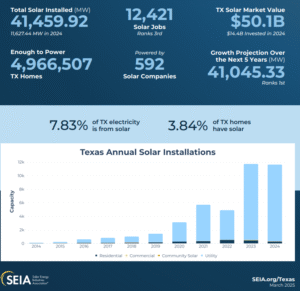
Texas Solar Market Soars in Capacity and Value
The chart details the massive scale and value of the Texas solar market. This validates the section’s claim that utility-scale solar is a mature and commercially viable solution for data centers.
(Source: CarbonCredits.com)
SWOT Analysis: Meta’s Data Center Energy Strategy
Meta’s primary strength lies in its financial capacity to underwrite gigawatts of new renewable projects. However, it faces a fundamental weakness in the intermittency of its solar-heavy portfolio, creating a strategic opportunity to pioneer the market for firm clean power while navigating the threat of grid constraints and complex regulatory environments.
- Strengths: Unmatched financial power and PPA execution capability.
- Weaknesses: Operational reliability gap from intermittent renewables.
- Opportunities: Pioneer new commercial models for nuclear and geothermal procurement.
- Threats: Regulatory delays and grid instability from massive load growth.

AI Drives Explosive Growth in Power Demand
This forecast shows AI workloads driving a massive increase in global data center power demand by 2030. This highlights the immense challenge that forms the strategic context for Meta’s SWOT analysis.
(Source: CarbonCredits.com)
Table: SWOT Analysis for Meta’s Energy Strategy
| SWOT Category | 2021 – 2024 | 2025 – 2026 | What Changed / Validated |
|---|---|---|---|
| Strengths | Achieved 100% renewable energy match for operations through effective PPA execution with partners like RWE and Ørsted. | Ability to finance multi-billion-dollar data centers and underwrite gigawatt-scale PPAs (e.g., 2.1 GW with Next Era). Diversifying into firm power (nuclear, geothermal). | The strategy shifted from meeting a sustainability metric to actively shaping future grid infrastructure with a mix of energy technologies, validating its market-making power. |
| Weaknesses | Portfolio heavily reliant on intermittent solar and wind, creating a mismatch with 24/7 data center operational needs. | The “reliability gap” is now an explicit operational challenge, requiring reliance on new natural gas plants in Louisiana and El Paso, which complicates the net-zero narrative. | The weakness of intermittency became an acknowledged strategic driver, forcing the company to publicly pursue and invest in baseload power solutions. |
| Opportunities | Leverage procurement scale to drive down costs for solar and wind energy and solidify sustainability leadership. | Pioneer commercial models for corporate nuclear (6.6 GW commitment) and geothermal (150 MW XGS Energy deal) procurement. Gain market control via an electricity trading license. | The opportunity evolved from optimizing existing renewable markets to creating entirely new corporate procurement markets for firm, carbon-free power. |
| Threats | Grid congestion, interconnection delays, and renewable energy supply chain constraints. | Acute risk of regulatory delays for new power plants (nuclear, gas). Increased competition from other hyperscalers for limited grid capacity and PPA opportunities. Public and political opposition to large-scale energy projects. | Threats intensified from general market risks to acute project-level risks tied to the unprecedented scale and speed of AI-driven data center expansion. |
Future Outlook: Meta’s Execution of Nuclear and Geothermal Strategy Will Define the Next Era of Data Center Power
The long-term success of Meta’s energy strategy will be defined not by the volume of solar PPAs it signs, but by its ability to successfully execute its pioneering procurement of nuclear and geothermal power. This execution will determine if the company can sustainably meet the relentless 24/7 energy demands of AI at a global scale.
- The most critical development to monitor is the execution of Meta’s 6.6 GW nuclear energy procurement plan. The announcement of specific partners, timelines, and reactor technologies will signal a definitive shift in how the technology industry powers its core infrastructure.
- The outcome of Meta’s federal application for an electricity trading license is a key milestone. If approved, it would grant the company more direct control over energy markets, enabling it to better manage costs and accelerate the development of its complex portfolio of energy assets.
- Watch for evidence that Meta’s investments in firm clean power are beginning to displace the need for fossil fuel backstops. A key indicator will be whether future data center announcements in regions like the Southeast still require new natural gas plants or can rely on a combination of renewables, storage, geothermal, and nuclear.
- The successful commissioning of large-scale solar projects currently under contract, such as Enbridge’s 600 MW Clear Fork project scheduled for 2027, remains essential. These projects must come online as planned to meet the immediate, escalating power needs of data centers already under construction.

AI Power Demand Forecasted to Skyrocket by 2030
The chart’s projections of exponential growth in electricity demand from AI highlight the future challenge Meta faces. This visualizes the “relentless 24/7 energy demands” that Meta’s future strategy must address.
(Source: Carbon Credits)
Frequently Asked Questions
Why is Meta shifting its energy strategy to include nuclear and geothermal power?
Meta is shifting its strategy because its new AI data centers have non-stop, high-intensity energy requirements that intermittent renewable sources like solar cannot satisfy alone. The company needs firm, 24/7 carbon-free power sources like nuclear and geothermal to address the critical reliability demands of its AI infrastructure and close the ‘reliability gap’.
Is Meta stopping its investment in solar energy?
No, Meta is not stopping its investment in solar energy. The text describes its new strategy as a ‘dual approach’ where solar PPAs remain the ‘commercial workhorse.’ In 2025-2026, Meta dramatically increased its solar procurement with massive deals, including a 2.1 GW PPA with Next Era Energy Resources and a 600 MW agreement with Enbridge, to run in parallel with its new investments in baseload power.
How does Meta’s investment in a new data center lead to new energy projects?
Meta’s role as a guaranteed buyer (or ‘offtaker’) for the immense amount of power its data centers need de-risks major energy investments for its partners. For example, Enbridge invested $900 million in a 600 MW solar project specifically to fulfill its PPA with Meta, and the $10 billion Hyperion data center in Louisiana immediately triggered plans for new power generation in the region.
What is the significance of Meta’s 6.6 GW nuclear power commitment?
This commitment is described as a ‘landmark move’ and a ‘powerful market-making signal.’ It represents one of the first major direct corporate procurement efforts for nuclear energy to power data centers. By doing this, Meta is helping to create a commercial pathway for nuclear power to become a viable solution for the 24/7 energy challenge faced by the entire hyperscale data center industry.
What are the main risks or threats to Meta’s energy strategy?
According to the SWOT analysis, the primary threats include regulatory delays and public opposition to new large-scale energy projects (especially nuclear), grid instability caused by the massive new load from data centers, and increased competition from other hyperscale companies for limited grid capacity and clean power agreements.
