

MODEC SOFC Deployment, 120 k W Eld Energy Pilot, 1 FPSO Project, and 3 Partner Agreements (2021 to 2026)
SOFC Commercial Pilots, MODEC Moves to At-Sea Validation from R&D
In 2026, the maritime industry’s adoption of Solid Oxide Fuel Cells (SOFCs) shifted from broad, land-based research to focused, commercially-driven at-sea pilots in high-value niche sectors. This pivot is defined by the move to validate the technology’s operational durability and economic case in demanding marine environments, a necessary step before mainstream adoption is feasible.
- Prior to 2025, activity centered on laboratory development and component-level advancements. From 2025 to today, the market focus has narrowed to small-scale, integrated system deployments, exemplified by the offshore energy sector.
- The most significant signal of this shift is the consortium of MODEC, Delta, and Eld Energy launching a pilot to deploy a 120 k W SOFC system on a Floating Production Storage and Offloading (FPSO) unit by 2027. This trial aims to de-risk the technology for continuous, harsh-environment operations.
- While specialized sectors advance, the mainstream cargo industry, including major container lines like Hapag-Lloyd, remains in an observational phase. These operators are hindered by the high capital costs and the lack of megawatt-scale SOFC systems required for large vessel propulsion.
- Other decarbonization pathways are being chosen now, creating competitive pressure. For example, Skarv Shipping Solutions is deploying a vessel with an ammonia-powered engine from Wärtsilä, highlighting that operators are not waiting for SOFCs to mature before making fleet decisions.
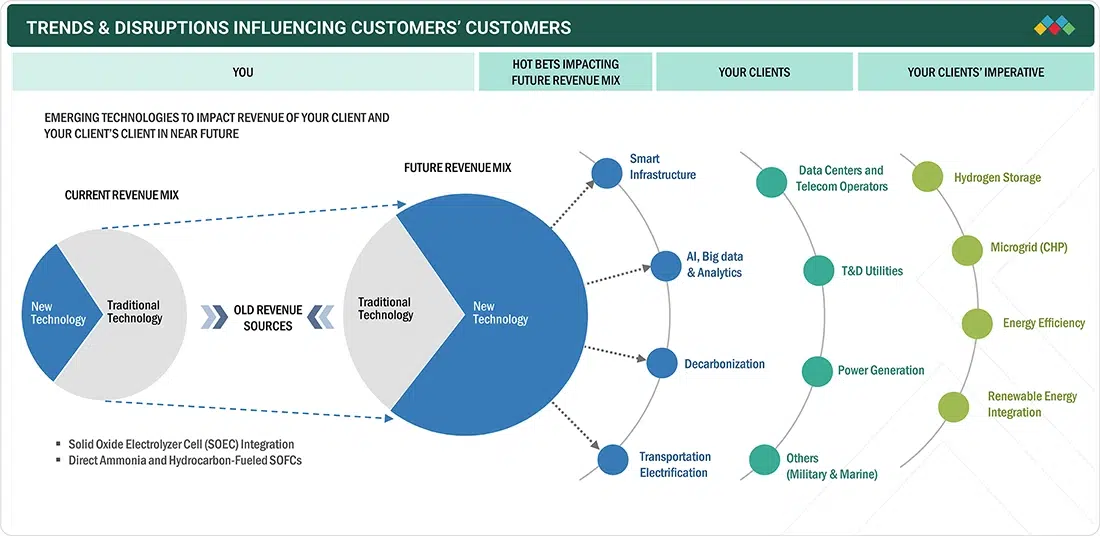
SOFCs Poised to Disrupt Marine Sector
This chart shows the strategic shift of SOFCs into key future applications, including the marine sector. This aligns with the section’s focus on the move from R&D to at-sea pilots.
(Source: MarketsandMarkets)
$3.59 Billion Market, SOFC Growth Signals Investor Confidence for Maritime
The Solid Oxide Fuel Cell market’s projected growth in 2026 provides a strong financial tailwind for its expansion into the maritime sector, as increasing scale in stationary applications promises to drive down costs. Projections from multiple independent market analyses confirm strong investor confidence and a clear growth trajectory, underpinning the business case for capital-intensive marine pilot projects.

SOFC Market Reaches $2.89B in 2026
This chart directly validates the market size of $2.89 billion for 2026 mentioned in the text. It underscores the investor confidence driving maritime expansion.
(Source: Mordor Intelligence)
- The overall SOFC market is valued between $2.89 billion and $3.59 billion for 2026, with compound annual growth rates projected as high as 41.73% through 2031, indicating rapid technology adoption across industries.
- This growth is driven by the technology’s core advantage of high electrical efficiency, which reaches over 60%. This figure is significantly higher than traditional marine engines and is a key value proposition for operators focused on fuel savings.
- EU-level funding instruments, such as the HORIZON-JU-CLEANH 2-2026 call, provide critical non-dilutive capital. This funding is designed to bridge the gap from lab-validated components (TRL 4) to system prototype demonstrations in relevant environments (TRL 6).
SOFC Market Growth Forecasts (2026-2040)
| Forecast Source | Time Frame | Details and Strategic Purpose | Source |
|---|---|---|---|
| Research And Markets | 2026 – 2030 | Projects market growth from $3.59 billion to $9.30 billion, a 26.90% CAGR, signaling sustained commercial expansion. | Solid Oxide Fuel Cell Market Report 2026 |
| Mordor Intelligence | 2026 – 2031 | Forecasts market growth from $2.89 billion to $16.53 billion, an aggressive 41.73% CAGR, indicating strong belief in rapid adoption. | Solid Oxide Fuel Cells Market – Size, Share & Growth Analysis |
| Roots Analysis | 2026 – 2040 | Projects a long-term expansion from $3.19 billion to $143.66 billion, reflecting a 31.25% CAGR driven by decarbonization mandates. | Solid Oxide Fuel Cell Market – Roots Analysis |
Doosan 3 Partner SOFC Alliance with Shell and KSOE (2026)
Strategic partnerships that integrate the full value chain, from technology development to fuel supply and vessel integration, have become the primary mechanism for de-risking maritime SOFC deployment in 2026. These collaborations are essential for overcoming the complex engineering and commercial hurdles that no single company can solve alone.

Key Players Like Doosan Drive SOFC Growth
This chart reinforces the importance of key players like Doosan Fuel Cell, a central partner in the alliance discussed in this section. It connects the partnership’s activities to the broader market growth trend.
(Source: Research Nester)
- The alliance between Shell, Doosan Fuel Cell, and Korea Shipbuilding & Offshore Engineering (KSOE) represents a complete ecosystem approach. It combines a fuel supplier, a stack manufacturer, and a major shipbuilder to create a direct path to commercialization, aligning with a national strategy where industrial giants like Samsung also advance marine technologies.
- A Joint Development Project (JDP) between shipbuilder HD Hyundai, classification society DNV, and cruise operator TUI Cruises focuses on the high-power cruise segment. This effort contrasts with the strategies of other lines like MSC Cruises, which have focused heavily on LNG as a transition fuel.
- The partnership between MODEC, Eld Energy, and Delta is purely execution-focused. It leverages Delta’s durable steel-supported SOFC stack and Eld Energy’s integration expertise for MODEC’s specific FPSO application.
- European public-private partnerships are also accelerating development. The EU-funded HELENUS project, led by Genevos, aims to develop a modular, drop-in SOFC solution for commercial and cruise ships.
MODEC and Key SOFC Maritime Partnerships
| Partner / Project | Time Frame | Details and Strategic Purpose | Source |
|---|---|---|---|
| MODEC, Eld Energy, & Delta | Jan 2026 | Announced intent to develop and trial a 120 k W SOFC system on an FPSO by 2027. The project validates SOFCs for decarbonizing offshore power generation. | Eld Energy, MODEC and Delta Join Forces |
| Doosan Fuel Cell, Shell, & KSOE | Mar 2026 | Partnership to develop marine SOFC systems using Doosan’s low-temperature SOFC technology. Creates a full value chain from fuel to ship integration. | Doosan Fuel Cell partners with Shell and KSOE |
| Genevos (HELENUS Project) | Feb 2026 | Launched the EU-funded HELENUS project to develop a next-generation, modular SOFC for commercial shipping and cruise sectors, creating a drop-in solution. | Genevos to Develop Solid Oxide Fuel Cells |
| Wärtsilä & Alma Clean Power | Feb 2026 | Wärtsilä and its partner continue to test and scale direct ammonia-fed SOFC technology, pursuing a key alternative fuel pathway for the maritime sector. | Wartsila – Ammonia Energy Association |
Europe vs. Asia, MODEC SOFC Pilots Signal Regional Competition
Deployment activity for maritime SOFCs is concentrated in Europe and Asia, driven by strong industrial policy, established maritime technology clusters, and targeted public funding. North America leads in overall market size forecasts but lags in publicly announced, at-sea SOFC pilot projects in 2026.

Europe Leads Marine Fuel Cell Market
This chart supports the section’s regional analysis by identifying Europe as the largest market for marine fuel cells. It provides context for the discussion of regional competition with Asia.
(Source: TechSci Research)
- Europe is leading technology development and standardization through government-backed initiatives. The EU’s HORIZON-JU-CLEANH 2-2026 program and projects like HELENUS (France) and Mi Na Mi (multi-country) provide critical R&D funding to advance SOFC and PEM systems toward commercial readiness at French shipyards like Chantiers de l’Atlantique.
- Asia, particularly South Korea, is emerging as a center for commercial integration and manufacturing scale-up. The partnership between Doosan Fuel Cell and KSOE leverages the nation’s shipbuilding dominance to create a direct path from SOFC production to vessel installation.
- North America is projected to be the largest market for marine fuel cells, valued at over $1.09 billion between 2025-2035. However, this appears driven by stationary-to-marine applications and PEM technology, with fewer specific SOFC at-sea pilots announced in 2026 compared to Europe and Asia.
SWOT Analysis, MODEC Highlights SOFC Strengths and Market Risks
The strategic landscape for maritime SOFCs in 2026 is defined by the technology’s inherent efficiency advantages and fuel flexibility, which are now being tested against persistent economic and infrastructural barriers. The shift from 2021-2024 to the present has seen theoretical strengths and weaknesses become decisive factors in real-world pilot projects.

SOFC Energy Density Competes with Other Fuels
This chart visualizes a key strength mentioned in the SWOT analysis by comparing the energy density of an ammonia-powered SOFC. It shows its viability against other maritime fuel options.
(Source: IDTechEx)
- Strengths: The primary strength remains high electrical efficiency (over 60%), a crucial factor for reducing operational costs. This has transitioned from a lab-proven metric to a key objective of commercial pilots like the MODEC project.
- Weaknesses: High capital expenditure and the absence of proven, megawatt-scale systems remain the most significant weaknesses. This factor continues to sideline mainstream cargo operators, whose strategies, like Maersk’s focus on methanol, prioritize more mature technologies.
- Opportunities: Increasingly stringent IMO decarbonization targets are the primary market driver. The establishment of “Green Shipping Corridors” creates protected niches for early adopters to deploy and test new technologies with reduced competitive pressure.
- Threats: The biggest threat comes from competing decarbonization technologies, such as ammonia-powered internal combustion engines. Additionally, regulatory fragmentation, evidenced by Norway’s delayed adoption of Fuel EU Maritime, creates uncertainty for shipowners and stalls investment decisions.
SWOT Analysis for Maritime SOFC Deployment (2021-2026)
| SWOT Category | 2021 – 2024 | 2025 – 2026 | What Changed / Validated |
|---|---|---|---|
| Strengths | Theoretical high efficiency (>60%) and fuel flexibility (LNG, ammonia, H 2) were key selling points in research papers. | High efficiency is a primary goal of at-sea pilots (e.g., MODEC). Multi-fuel capability is now a central requirement in EU funding calls (HORIZON-JU-CLEANH 2). | The industry shifted from discussing theoretical benefits to actively trying to validate them in real-world, commercially-driven projects. |
| Weaknesses | High capital cost and lack of large-scale systems were identified as major barriers to adoption for large vessels. | These remain the primary reasons mainstream cargo carriers are stalling. The lack of MW-scale systems is being addressed by R&D projects (e.g., Mi Na Mi for PEM). | The weakness was validated as niche players (offshore) moved forward while mass-market players (container ships) waited for scale and cost reductions. |
| Opportunities | Future IMO 2030/2050 targets and the concept of green corridors were seen as long-term drivers. | These drivers are now fueling concrete action, with JDPs (TUI Cruises) and pilots (MODEC) directly targeting decarbonization goals within these frameworks. | Long-term regulatory pressure has been translated into near-term commercial and R&D activity, creating tangible market demand. |
| Threats | Alternative technologies like battery-hybrids and hydrogen combustion engines were considered potential competitors. | Ammonia-powered engines (Wärtsilä) are being commercially deployed now, presenting a direct and immediate competitive threat to the SOFC business case. | The competitive threat is no longer theoretical. Shipowners are making investment decisions today, and SOFCs must compete with more mature engine technologies. |
Scenario Modeling: MODEC FPSO Pilot Is the Critical Inflection Point
The most critical strategic event for the maritime SOFC market in the near term is the successful execution of the MODEC, Delta, and Eld Energy 120 k W FPSO pilot by its 2027 target. This project’s outcome will serve as the key validation signal for investors and the wider shipping industry.

Marine Fuel Cell Market Forecast to Grow
This chart illustrates the potential future described in the scenario model. It shows significant growth in the marine fuel cell market, representing the outcome of a successful pilot project.
(Source: Verified Market Research)
- If this happens: A successful pilot will validate the durability and reliability of SOFCs in a harsh, 24/7 operational environment, de-risking the technology significantly. Watch this: Expect a subsequent wave of investment into SOFC system integrators and new, larger-scale pilot announcements (250 k W-1 MW), likely targeting other specialized vessels like cruise ships or offshore construction vessels.
- If this stalls or fails: A failure would reinforce perceptions of SOFCs as a technologically immature solution for maritime use. Watch this: Investment would likely pivot toward more mature, competing technologies like direct ammonia engines and advanced PEM fuel cells. Major shipowners would further delay any consideration of SOFCs, awaiting next-generation stack technology.
- What is happening now: The market is bifurcated. Niche, high-value sectors are assuming the technology risk through focused pilots, while the mainstream market remains stalled due to scale and cost barriers. The success or failure of these early projects will determine whether SOFC adoption accelerates or stagnates post-2027.
The questions your competitors are already asking
This report covers one angle of SOFC deployment in the maritime sector, focusing on which companies are moving forward with at-sea pilots versus who is stalling. The questions that matter most depend on your work.
- What is the status of the MODEC-led SOFC pilot on its FPSO, and is the project on track for 2027?
- Which shipping segments are actively adopting SOFCs, and why are mainstream container lines stalling?
- How do SOFCs compare to ammonia engines from companies like Wärtsilä for decarbonizing mainstream cargo vessels?
- What is the outlook for megawatt-scale SOFC deployment in the cargo industry by 2030?
This report does not answer these. Enki Brief Pro does.
Your question, your angle, your framework. SWOT, PESTL, scenario modelling. The same niche depth, built around the decision your work actually depends on.
