

BESS Execution Risks: 266 GW Canceled, $920 M Arevon Financing, and Major Project Delays (2024-2026)
Project Execution Risks: BESS Deployment Delays Despite Falling Costs
The primary barrier to Battery Energy Storage System (BESS) deployment has decisively shifted from high capital costs to non-cost execution challenges, primarily grid interconnection delays and complex permitting processes. While equipment prices have plummeted to historic lows, with turnkey systems reaching $117/k Wh in 2025, developers now face significant uncertainty in bringing projects online, fundamentally altering the risk profile of the storage market.
- Before 2024, the market was focused on technology cost reduction. Now, the most significant barrier to deployment is the time and uncertainty associated with navigating grid interconnection queues. According to industry experts, these delays can stall projects for months or even years, creating substantial risk for developers.
- The problem is so acute that it is altering development strategies. For example, power-hungry data centers, a new demand source for BESS, are increasingly turning to co-located solar and storage to bypass grid bottlenecks entirely. This includes projects being developed by firms like Ameresco.
- These execution hurdles have led to real-world project failures. In January 2025, the Central Electricity Regulatory Commission of India was forced to cancel a major 500 MW/1, 000 MWh standalone BESS tender due to prolonged delays in finalizing project agreements.
- In the U.S., the scale of this issue is substantial, with an estimated 266 GW of solar and storage projects canceled in the ERCOT and CAISO markets due to a combination of interconnection challenges and other development hurdles, highlighting a systemic constraint on growth.
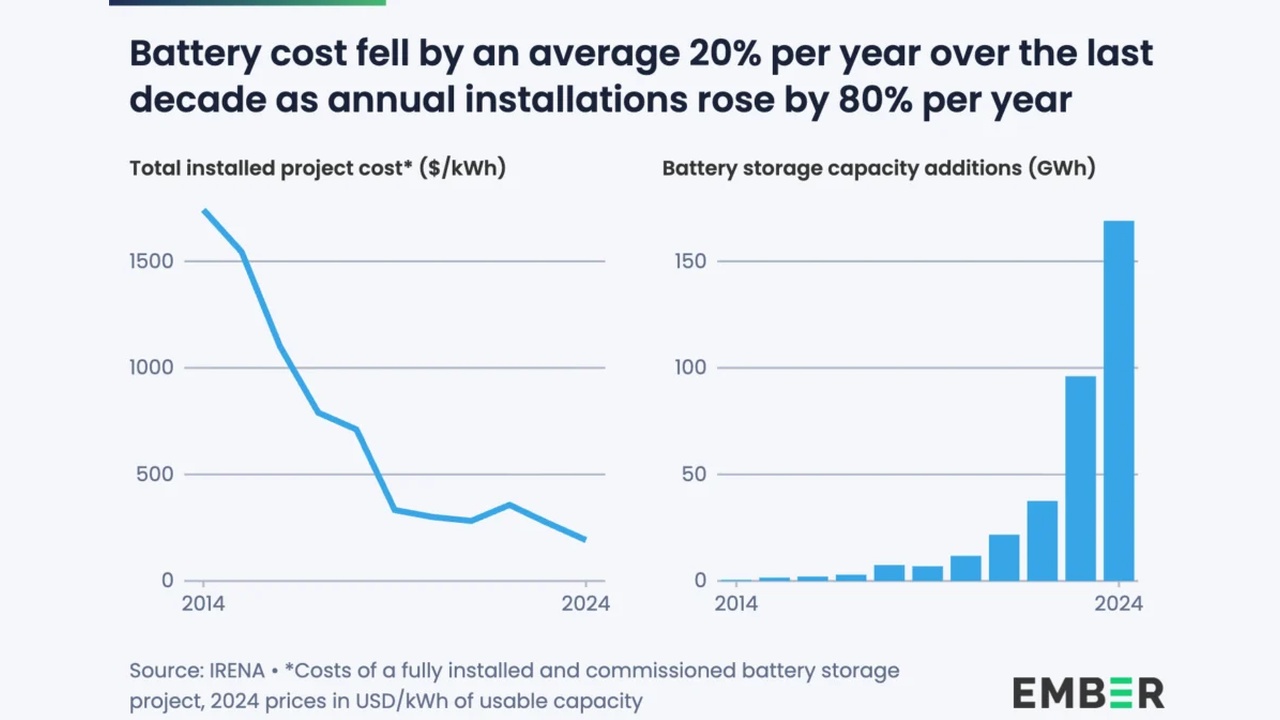
Battery Costs Plummet as Installations Skyrocket
The section discusses deployment delays “despite falling costs.” This chart directly illustrates the “falling costs” and rising installations, providing the essential backdrop for the section’s analysis of countervailing execution risks.
(Source: Energy-Storage.News)
$920 M Arevon Deal: BESS Financing Hinges on De-Risking Execution Hurdles
Despite significant execution risks, financing for well-structured BESS projects remains robust, but success is now contingent on securing long-term offtake agreements that mitigate merchant market volatility and provide revenue certainty. Investors are demonstrating a strong appetite for projects that have successfully navigated development and interconnection hurdles, as evidenced by a 42% quarter-over-quarter increase in publicly announced BESS deal activity in the U.S. during Q 1 2026.
- The criticality of long-term revenue streams was demonstrated by a landmark BESS project in Poland, financed in June 2026, which was made bankable by a 17-year capacity market contract secured through a state auction. This provided the long-term revenue certainty required by financiers like Erste Group.
- Similarly, a developer in Texas successfully closed project financing in July 2025 only after securing a 10-year offtake agreement, insulating the project from the high volatility of the ERCOT merchant market.
- Large-scale financing is flowing to de-risked projects. In March 2026, Arevon closed $920 million in financing for its 1, 200 MWh Nighthawk project in California, and es Volta secured $139.6 million for its Boxcar project, signaling investor confidence in projects with clear paths to commercial operation.

BESS Capex Breakdown Highlights Execution Costs
The section focuses on financing and “de-risking execution hurdles.” A chart breaking down capital expenditure to highlight the significance of “execution costs” is the perfect supporting data for a discussion on financing challenges.
(Source: Energy-Storage.News)
Table: Notable BESS Project Financing and Offtake Agreements (2025-2026)
| Partner / Project | Time Frame | Details and Strategic Purpose | Source |
|---|---|---|---|
| Erste Group / Polish BESS Project | Jun 2026 | Financed a landmark BESS project in Poland, which was de-risked by a 17-year capacity market contract, ensuring long-term revenue stability required for project financing. | Erste Group |
| Arevon / Nighthawk Project | Mar 2026 | Closed $920 million in financing for its 1, 200 MWh energy storage project in California, demonstrating strong investor appetite for large-scale, de-risked assets. | Arevon Energy |
| es Volta / Boxcar Project | Mar 2026 | Secured $139.6 million in financing for its Boxcar BESS project in Texas, indicating continued investment in the ERCOT market for projects with solid offtake structures. | Solar Builder Mag |
| Unnamed Developer / Texas BESS Project | Jul 2025 | Closed project financing after securing a 10-year offtake agreement, highlighting the necessity of long-term contracts to make projects bankable in volatile merchant markets like Texas. | POWER Magazine |
US vs. China: BESS Regional Disparities in Cost and Deployment
While China leads the world in low-cost manufacturing, the United States faces higher prices and significant deployment hurdles from grid interconnection, creating distinct regional market dynamics. The global BESS market is defined by a paradox: Chinese manufacturing oversupply has made hardware cheaper than ever, yet realizing projects in Western markets, particularly the U.S., is increasingly constrained by non-equipment factors.
- China’s vast production capacity has created an oversupply of battery cells, pushing prices to historic lows and solidifying its market leadership. Wood Mackenzie forecasts that utility-scale BESS costs in the APAC region will fall to just $84/k Wh by 2029.
- In contrast, the U.S. market has higher system prices due to tariffs and other logistical factors. Clean Energy Associates (CEA) reported the average price for a 20-foot DC container was $180/k Wh in 2023, falling to $148/k Wh in 2024, still well above Chinese benchmarks.
- The most significant regional difference is in project execution. The U.S. faces the most acute grid interconnection delays, which have surpassed cost as the primary deployment constraint. This bottleneck threatens to slow the 16.5 GW of standalone storage growth projected in key US markets.
- Other regions exhibit unique dynamics. Tenders in Saudi Arabia and Italy show all-in capex around $125/k Wh, while projects in India approach $120/k Wh, supported by subsidies but also subject to execution risks, as seen with the canceled 500 MW tender.

Solar and Wind Now Cheapest Power Sources
The section compares BESS deployment in the US and China. This chart explains a primary driver for BESS adoption—the need to support the cheapest but intermittent power sources (solar and wind)—providing crucial context for why regional deployment disparities are significant.
(Source: LinkedIn)
BESS Technology Maturity: LFP Dominance and Shifting Cost Structures
Lithium Iron Phosphate (LFP) chemistry has become the mature, dominant technology for stationary storage, a validation that has caused the industry’s cost focus to shift from the battery cells themselves to the Balance of System (BOS) and overall system integration. The commoditization of LFP cells means that value and competitive differentiation are migrating up the value chain to software, integration expertise, and bankability.
- LFP batteries now account for over 85% of deployed BESS capacity. Their superior safety profile, longer cycle life, and lower material cost compared to NMC chemistries made them the technology of choice for grid-scale applications between 2021 and 2024.
- The precipitous drop in battery pack prices, which BNEF reported fell to just $70/k Wh in 2025, represents a 45% decrease from 2024. This has fundamentally altered project cost structures.
- In 2026, battery cells and modules account for only 25% to 45% of total BESS capital expenditure. This is a significant change from years prior, when batteries dominated project budgets, and places greater emphasis on the cost of inverters, transformers, and control systems.
- While emerging technologies like Zinc-ion are showing progress and have reached a Technology Readiness Level (TRL) of 6, they are not yet commercially competitive. The market has standardized around mature and bankable LFP technology for the foreseeable future.

Storage Technology Costs Vary by Grid Application
The section analyzes “BESS Technology Maturity” and “Shifting Cost Structures.” This chart, which compares the costs of different storage technologies by application, directly supports the section’s theme by providing the core data for such an analysis.
(Source: How to store electricity?)
BESS 2026 Scenarios: Grid Delays Could Stall GW-Scale US Growth
For the year ahead, the BESS market’s growth trajectory will be determined not by equipment price, but by the industry’s ability to overcome grid interconnection bottlenecks and navigate geopolitical supply chain risks. The key variable is no longer if BESS is economical, but if it can be deployed in a timely and predictable manner.
- If this happens: If interconnection queue reform in key U.S. markets like CAISO and ERCOT fails to accelerate project timelines, the current momentum could stall despite strong federal incentives from the Inflation Reduction Act (IRA).
- Watch this: Watch for an increase in project cancellations and a growing number of developers shifting focus to regions with more favorable grid access or smaller-scale, behind-the-meter projects that can bypass lengthy utility studies. A key signal will be whether the average time from application to commercial operation begins to decrease by Q 4 2026.
- These could be happening: A premium will be placed on integrators and developers who can offer guaranteed interconnection timelines or have secured portfolios of sites with pre-existing grid capacity. We may also see a rise in M&A activity as larger players acquire smaller developers with advanced-stage project pipelines to circumvent early-stage development risk.