

Fluence BESS Supply Chain, Siemens AI Data Center Deal, $5.6 B Backlog, and U.S. Production Shift (2024 to 2026)
In 2026, Fluence Energy stands at a critical inflection point, executing an aggressive pivot of its supply chain to the U.S. to mitigate its deep-seated reliance on China. This strategic shift is not optional but a direct response to a confluence of geopolitical risks and compelling financial incentives. The increase of Section 301 tariffs on Chinese batteries to 25% on January 1, 2026, and the strict Foreign Entity of Concern (FEOC) rules under the Inflation Reduction Act (IRA), create significant risk for projects using Chinese components. Simultaneously, the IRA’s 10% domestic content bonus, on top of a 30% base credit, provides a powerful economic motive for onshoring. The success of this strategy is being validated by the explosive growth in power demand from AI data centers, a sector that prioritizes supply chain security over absolute lowest cost. Landmark deals, including master supply agreements with two major hyperscalers in May 2026 and Siemens’ selection of Fluence batteries for NVIDIA AI data centers, underscore this trend and position the company as a key enabler of the AI revolution. While this pivot caused a near-term revenue decline of 16.1% in fiscal year 2025 to $2.26 billion, a record $5.6 billion backlog signals strong future demand for its de-risked, domestic BESS offerings.
BESS Supply Chain Risks from Chinese Component Dependency
The global Battery Energy Storage System (BESS) industry is navigating a structural realignment forced by the extreme concentration of its supply chain in China, compelling companies to prioritize resilience over pure cost optimization.
- In 2025, the BESS market reached a critical dependency threshold, with Chinese integrators like Sungrow capturing 76% of the global market and Chinese manufacturers producing over 75% of all lithium-ion cells. This concentration, which offered cost benefits prior to 2024, now represents a significant geopolitical and operational risk for companies like Fluence.
- U.S. trade policy has directly targeted this dependency, with Section 301 tariffs on Chinese non-EV lithium-ion batteries increasing from 7.5% to 25% effective January 1, 2026. This tariff hike directly erodes the cost advantage of Chinese imports.
- The Inflation Reduction Act’s (IRA) Foreign Entity of Concern (FEOC) regulations further penalize reliance on Chinese components. Projects using FEOC-compliant materials are eligible for a 40% Investment Tax Credit (ITC), creating a powerful financial incentive for developers to source from domestic or allied suppliers.
- While BESS pack prices fell 45% to a record low of $70/k Wh in 2025, this decline masks the rising cost of diversification. Non-Chinese battery cells are more expensive, and analysts predict turnkey system prices may increase in 2026 due to supply chain consolidation within China.
Fluence Energy Strategic Investments for U.S. Onshoring
Fluence has committed significant capital to establish a vertically integrated U.S. manufacturing footprint, a direct response to policy incentives and customer demand for a de-risked supply chain.
- The company’s core strategy is to build a “domestic moat” by producing every major BESS component within the U.S. This insulates customers from geopolitical volatility and ensures eligibility for lucrative IRA domestic content credits.
- This onshoring effort led to a temporary revenue decline in fiscal year 2025, attributed to project pauses as customers assessed tariff impacts. However, the strategy is validated by a record $5.6 billion order backlog as of May 2026, indicating strong market confidence.
- The emerging AI data center market serves as a primary catalyst for this strategy. Hyperscale customers, whose electricity demand is projected to grow from 60 GW to as high as 296 GW by 2030, prioritize supply chain security and speed-to-market, making Fluence’s domestic offering highly attractive.
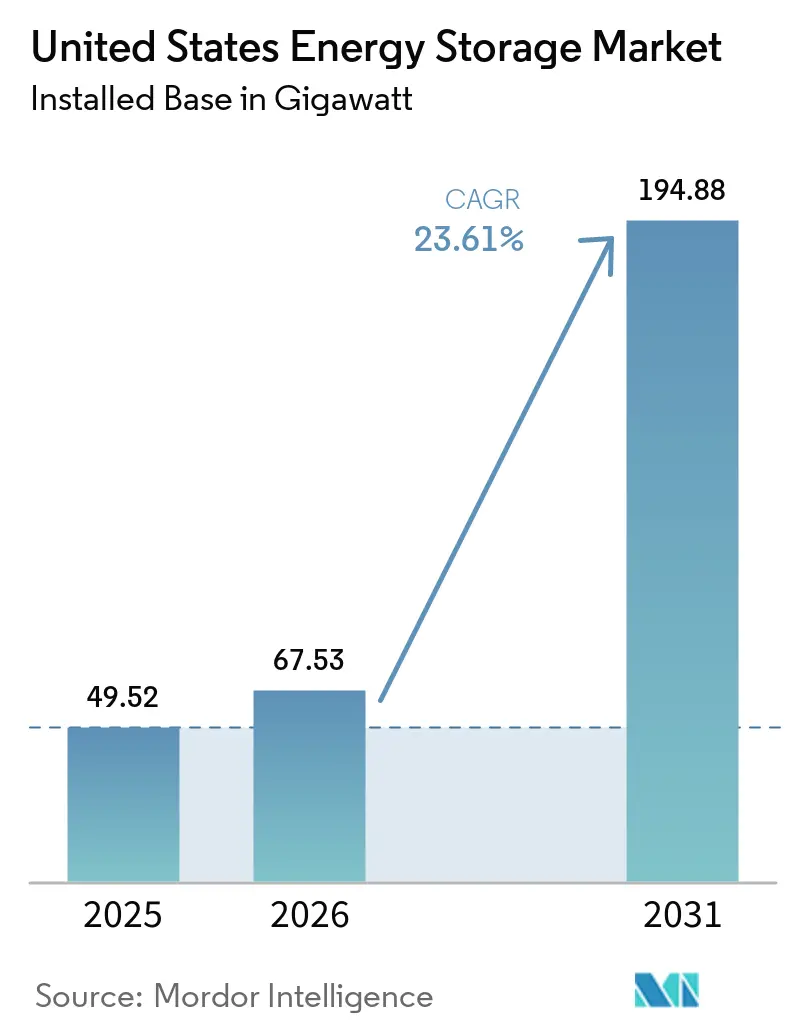
US Energy Storage Market to Quadruple by 2031
The chart provides the market rationale for Fluence’s strategic investments in U.S. onshoring, as it highlights the significant growth potential of the domestic market that justifies these investments.
(Source: Mordor Intelligence)
Table: Fluence Energy U.S. Manufacturing Investments
| Partner / Project | Time Frame | Details and Strategic Purpose | Source |
|---|---|---|---|
| U.S. Manufacturing Facility | Aug 22, 2025 | Established a new U.S. manufacturing plant with an announced annual production capacity of 35 GWh. This facility is the cornerstone of its domestic content strategy to capture IRA tax benefits for customers. | Energy-Storage.News |
| U.S. Component Onshoring | Aug 25, 2025 | Announced the goal of bringing production of “every major product and component” to the U.S. This includes battery cells, modules, inverters, and enclosures to create a fully U.S.-compliant BESS. | pv magazine USA |
| U.S. Module Manufacturing Initiation | Sep 10, 2024 | Officially began the U.S. manufacturing of its battery modules. This marked the first major operational step in its strategy to onshore the production of all key BESS components away from Asian imports. | Fluence Corporate News |
Fluence Energy 2 Hyperscaler Deals and Siemens Partnership
Fluence is securing high-value commercial agreements in growth sectors that prize supply chain stability, validating its strategic shift towards a de-risked, domestic manufacturing model.
- The company’s entry into the AI data center market was solidified in May 2026 with the signing of master supply agreements with two major, unnamed hyperscalers. This move opens a critical new revenue stream from a power-hungry sector that prioritizes reliability and speed over lowest cost.
- In June 2026, Siemens selected Fluence’s batteries for integration with NVIDIA’s AI data centers. This partnership strategically positions Fluence as an essential infrastructure provider for the AI industry and caused a 44% increase in its stock price, highlighting its market significance.
- In the utility-scale sector, Fluence continues to win large contracts, including an agreement with Avantus for the 200 MW / 800 MWh Rexford 2 project in California, demonstrating its continued leadership in its core market.
Table: Fluence Energy Key Commercial Agreements
| Partner / Project | Time Frame | Details and Strategic Purpose | Source |
|---|---|---|---|
| Unnamed Solar Project | Jul 13, 2026 | Secured an agreement to supply a 200 MW / 800 MWh Smart Stack BESS for a solar-plus-storage project in California, with construction expected to begin in 2027. | Street Insider |
| Two Major Hyperscalers | May 12, 2026 | Signed master supply agreements to provide BESS solutions for AI data centers, marking a strategic entry into a high-growth market segment that values supply chain security. | Utility Dive |
| Avantus / Rexford 2 | Jan 20, 2026 | Announced an agreement to supply the 200 MW / 800 MWh BESS for the Rexford 2 solar-plus-storage project in California. | Moomoo News |
| Unnamed U.S. Customer | Aug 01, 2024 | Secured a large-scale, 2.2 GWh supply agreement to reduce battery supply risks for a customer’s project pipeline in the U.S. | Yahoo Finance |
U.S. vs. China: Fluence Energy Geographic Focus
The global BESS market is geographically bifurcated, with China solidifying its domestic dominance through massive scale while the U.S. market becomes a distinct ecosystem shaped by policy-driven onshoring.
- China’s command of the global supply chain is comprehensive, controlling up to 90% of battery component production and targeting an additional 180 GW of new energy storage capacity by 2027. Chinese BESS manufacturers like BYD and CATL leverage this integrated ecosystem to maintain a strong cost advantage.
- The U.S. is rapidly building a parallel supply chain, with projected domestic battery assembly capacity set to grow from 69.4 GWh in 2025 to 235 GWh by 2030. This growth is a direct result of IRA incentives designed to counter Chinese dominance.
- Fluence has identified the U.S. as its primary growth market, with its domestic manufacturing strategy tailored specifically to meet the requirements of the IRA and provide customers with a secure, tariff-insulated supply chain.
- While Fluence continues to execute projects globally, such as the Liddell Battery Project in Australia and a 58 MWh project in Germany, its strategic and capital-intensive focus has decisively shifted to the U.S. to capitalize on this policy-driven market differentiation.
Technology Maturity of Fluence Energy’s Domestic BESS
While Fluence’s core BESS technology is commercially proven, its most significant recent technological advance is the maturation of a fully domesticated product stack designed for the post-IRA U.S. market.
- Prior to 2024, technology maturity was defined by system performance and software controls. Now, it is increasingly defined by supply chain origin. Fluence’s ability to offer a fully FEOC-compliant system, from cells and modules to enclosures and inverters, represents a critical shift in its value proposition.
- The company’s Smart Stack™ platform, a modular and factory-assembled BESS, is a mature product being deployed in large-scale projects, such as the 800 MWh system for a California solar project announced in July 2026.
- The key development from 2025 to today is the operationalization of its U.S. manufacturing. The initiation of U.S. module production in September 2024 and the ramp-up of its 35 GWh facility are tangible milestones in delivering this domesticated technology to customers.
- This shift creates a competitive advantage over rivals still entangled in Chinese supply chains, as it de-risks projects for developers seeking to maximize IRA tax credits and avoid potential tariff volatility.
SWOT Analysis for Fluence Energy Supply Chain Diversification
Fluence’s strategic pivot away from Chinese supply chains presents a clear set of opportunities and threats that will define its market position through 2026.
- The primary strength is its established position as a top-three global integrator combined with a proactive onshoring strategy that aligns with U.S. policy. Its weakness is the near-term financial impact of this transition, including higher costs and a temporary revenue dip.
- The largest opportunity is the power-hungry AI data center market, which values the supply chain security Fluence can now offer. The main threat is the execution risk associated with ramping up a new domestic supply chain while competing against the scale and low cost base of established Chinese players.
Table: SWOT Analysis for Fluence BESS Supply Chain Strategy
| SWOT Category | 2021 – 2024 | 2025 – 2026 | What Changed / Validated |
|---|---|---|---|
| Strengths | Market leadership as a top-tier global integrator; strong technology and software platform (Fluence OS). | Proactive domestic manufacturing strategy creates a “domestic moat”; record $5.6 B backlog; first-mover advantage in securing IRA compliance for customers. | The market has validated the domestic strategy, as shown by the backlog and major contracts with hyperscalers who prioritize supply security. |
| Weaknesses | High dependence on Asian, particularly Chinese, battery cell suppliers, creating geopolitical and logistical risk. | Near-term revenue decline (-16.1% in FY 2025) and potential margin pressure from higher-cost, non-Chinese components. | The “cost of diversification” became tangible, impacting short-term financials while the long-term strategic benefits were being built. |
| Opportunities | Growth in utility-scale solar-plus-storage projects driven by falling battery costs and decarbonization goals. | Explosive demand from AI data centers needing secure power; IRA’s 40% ITC for domestic content; new tariffs making domestic products more cost-competitive. | The AI boom and aggressive U.S. industrial policy created a massive new market segment perfectly aligned with Fluence’s pivot to a de-risked supply chain. |
| Threats | Price competition from low-cost Chinese BESS integrators; potential for supply chain disruptions from trade tensions. | Strict FEOC rule enforcement could create compliance challenges; competition from other companies also onshoring; potential for China to use export controls. | The threat of Chinese competition remains, but the landscape has shifted from a pure cost battle to one of compliance and supply chain resilience. |
Fluence Energy 2026 Scenario: AI Deals and FEOC Rules
The success of Fluence’s costly but necessary pivot to a domestic supply chain will be determined by two key external factors in the year ahead: strict enforcement of U.S. trade policy and the continued expansion of the AI data center market.
- If the U.S. Treasury provides and enforces strict FEOC guidance, it will significantly increase the value of Fluence’s compliant supply chain. Watch for final Treasury rulings and whether competitors’ projects are deemed ineligible for IRA credits, which would validate Fluence’s strategy.
- The first orders from the hyperscaler master supply agreements are expected in Q 3 FY 2026. If these materialize and are followed by further contracts, it will confirm the AI sector as a primary, high-margin growth driver for the company.
- Monitor Fluence’s ability to execute on its $5.6 billion backlog and meet its FY 2026 revenue guidance of a 49% rebound to $3.2 billion. Achieving these targets while managing a higher domestic cost base will prove the financial viability of its strategic pivot.
The questions your competitors are already asking
This report covers one angle of Fluence Energy’s commercial trajectory. The questions that matter most depend on your work.
- Other energy storage companies building US factories
- How Chinese battery companies respond to US tariffs
- Price impact of US battery production incentives
- Data center power contracts with battery storage suppliers
This report does not answer these. Enki Brief Pro does.
Your question, your angle, your framework. SWOT, PESTL, scenario modelling. The same niche depth, built around the decision your work actually depends on.
