

BESS Project Viability, CATL 36% Share, 1.2 GW Offtake, and Project Cancellations (2021 to 2026)
BESS Project Risk and the Shift to Financial Engineering
The market for Battery Energy Storage Systems (BESS) has fundamentally shifted from a phase driven by technology cost-down to one defined by financial engineering and non-hardware risk mitigation. Between 2021 and 2024, project viability was primarily a function of the steep decline in lithium-ion battery prices. As of 2025 and 2026, however, falling cell costs are no longer sufficient to guarantee project returns. The focus has pivoted to managing a new set of dominant variables: higher costs of capital, persistent Balance of Plant (BOP) expenses, and navigating complex regulatory and grid interconnection challenges.
- In the 2021-2024 period, developers modeled projects based on a continued sharp decline in the core battery component, which often represented the majority of capital expenditure.
- By 2026, this dynamic has inverted. Battery cells and modules now account for only 25% to 45% of total project CAPEX, meaning a 20% drop in cell price only yields a 5-9% reduction in total installed cost.
- Consequently, factors like interest rates, EPC costs, and grid connection fees, which comprise the remaining 55-75% of CAPEX, now have an outsized impact on project Internal Rate of Return (IRR).
- The commercialization of BESS in 2026 is now heavily dependent on “revenue stacking” from multiple grid services and securing bankable offtake agreements to de-risk projects for financiers.
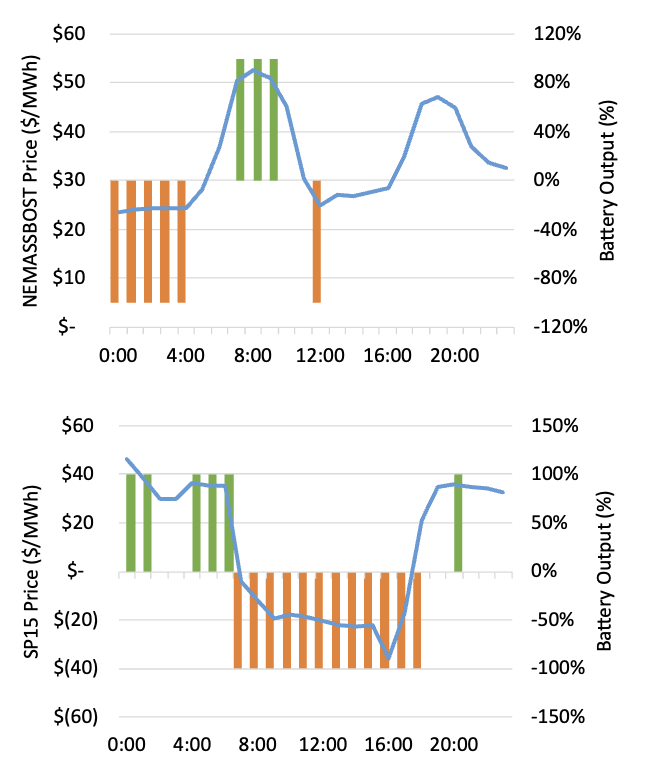
BESS Arbitrage Strategy in Two US Markets
This chart provides a concrete example of ‘financial engineering’ by showing how an arbitrage strategy is used to capture value, directly aligning with the section’s theme of managing risk through financial methods.
(Source: Ascend Analytics)
Project Cancellations Outpace Announcements Amid Headwinds
The convergence of higher financing costs, policy uncertainty, and logistical bottlenecks created a net negative development pipeline in the U.S. for the first time in 2025. This demonstrates that while the long-term demand for energy storage remains robust, near-term project economics are precarious, and cheap cells alone cannot overcome significant market friction.
- Analysis from 2025 shows that $11 billion in U.S. battery projects were canceled, while only $8 billion in new projects were announced, marking a significant contraction.
- This trend was part of a broader clean energy pullback, where nearly 1, 900 projects, representing 266 GW of capacity and approximately $400 billion in investment, were canceled in 2025.
- The primary drivers for these cancellations include not only higher capital costs but also significant delays and expenses associated with grid interconnection, with an estimated 890 GW of storage capacity waiting in queues as of 2025.
- Regulatory shifts, including the Foreign Entity of Concern (FEOC) rules associated with the Inflation Reduction Act and the enactment of the One Big Beautiful Bill Act (OBBBA), introduced new compliance burdens and uncertainty that have chilled investment.

Storage Buildout Erodes Ancillary Service Revenue
This chart clearly illustrates a major ‘headwind’—the erosion of a key revenue stream—which directly explains why project cancellations may be outpacing announcements.
(Source: Ascend Analytics)
Table: BESS Project Cancellations and Market Headwinds
| Partner / Project | Time Frame | Details and Strategic Purpose | Source |
|---|---|---|---|
| U.S. BESS Project Pipeline | 2025 | $11 billion in battery projects were canceled, exceeding the $8 billion in new projects announced. This net negative development signals severe market headwinds from rising costs and policy shifts. | CSIS |
| U.S. Clean Power Projects | 2025 | A total of 266 GW of clean power projects were canceled due to a combination of high costs, policy changes, and prolonged interconnection delays, impacting the BESS co-location pipeline. | Etica Group |
| Grid Interconnection Queues | 2025 | Approximately 890 GW of energy storage capacity was stalled in interconnection queues, adding significant costs and uncertainty to project development timelines and financial models. | CSIS |
Partnership Data Highlights Offtake Agreement Criticality
To achieve bankability in the challenging 2026 market, developers are prioritizing the establishment of long-term, structured offtake agreements. These contracts provide the revenue certainty required by lenders and investors, shifting the critical path for projects from procurement to commercial negotiation. Companies that successfully secure such agreements are best positioned to navigate the current financial environment.
- In a key market signal, European Energy secured 20 long-term offtake agreements in 2025, covering 1.2 GW of renewable projects, underscoring the importance of this model for de-risking investments.
- The market is seeing a rise in structured contracts beyond simple Power Purchase Agreements (PPAs), including tolling agreements where an offtaker pays a fixed fee to use the battery’s capacity.
- Contracts with floor prices are also gaining traction, as they mitigate downside merchant risk in volatile energy markets, making projects more attractive to debt and equity providers.
- The ability to secure a contract with a creditworthy counterparty has become a primary determinant of a project’s ability to obtain financing in mature markets like CAISO and ERCOT.
Table: BESS Strategic Partnerships and Agreements
| Partner / Project | Time Frame | Details and Strategic Purpose | Source |
|---|---|---|---|
| European Energy | 2025 | Secured 20 long-term offtake agreements for 1.2 GW of renewable projects. This strategy provides revenue certainty, making projects more bankable amidst market volatility and higher financing costs. | European Energy |
| Mature Market Financing | Q 3 2025 | In established U.S. markets like CAISO and ERCOT, securing a long-term offtake agreement (PPA, tolling agreement) is now considered a critical prerequisite for obtaining project financing. | Modo Energy |
North America and Europe Lead in Financial Maturation
While BESS deployment is a global phenomenon, North America and Europe are at the forefront of the market’s maturation, where success is dictated by navigating financial and regulatory complexities rather than just technology costs. In contrast, emerging markets face a more fundamental barrier in the form of significantly higher costs of capital, which even deeply reduced cell prices cannot fully overcome.
- In North America, particularly in the ERCOT and CAISO markets, developers are focused on sophisticated revenue stacking and securing contracts to manage merchant risk in increasingly saturated ancillary service markets.
- The U.S. market is also uniquely impacted by federal policy, with FEOC rules creating significant supply chain compliance challenges for developers seeking to qualify for tax credits.
- In Europe, the success of companies like European Energy in securing large-scale offtake agreements highlights a mature project finance market that prioritizes long-term revenue stability.
- Data from 2025 indicates that financing costs for BESS projects in emerging markets can be double those in advanced economies, creating a significant hurdle for deployment despite the global availability of low-cost battery cells.

North American BESS Market to Exceed $50B by 2031
This chart provides direct quantitative evidence for the section’s thesis that North America is a leading and financially maturing market for BESS projects.
(Source: Mordor Intelligence)
BESS Technology Shifts from Component to System-Level Risk
BESS technology is fully mature and commercialized at the component level, but the market’s focus has shifted to addressing system-level economic and logistical challenges. The precipitous drop in battery cell prices has successfully commoditized the core component, exposing the previously masked costs and risks associated with the Balance of Plant, project execution, and grid integration.
- Between 2021 and 2024, the primary technological goal was reducing the cost of the battery cell itself. This was largely achieved by 2026, with utility-grade LFP cells reaching prices as low as $55-$75/k Wh.
- This success has shifted the bottleneck. In 2026, the DC Block (including cells, racks, and thermal management) and enclosures constitute 50-60% of CAPEX, with other BOP components like inverters and transformers adding to the “sticky” costs that are not declining.
- The energy storage market is therefore maturing from being driven by hardware innovation to being governed by excellence in financial engineering, supply chain management, and regulatory navigation.
- The key players in this new environment, such as CATL, which holds over 36% of the global market, and Tesla, which leads in North America with 39% share, are those who can manage the entire system cost and supply chain. Peak Energy and CBAK Energy are also notable participants in the evolving supply chain.

Battery Material Prices Show Extreme Volatility
This chart’s focus on the volatility of battery material prices perfectly exemplifies the ‘component-level risk’ that the section describes, which must now be managed at a broader ‘system-level’.
(Source: Benchmark Source)
SWOT Analysis for BESS Project Economics
The current BESS market is characterized by a strong fundamental tailwind of falling component costs running into a wall of macroeconomic and regulatory headwinds. This dynamic creates a complex risk profile where opportunities are tied directly to a developer’s ability to mitigate financial and execution risks rather than relying on continued hardware cost declines.
- Strengths: The continued deflation of LFP battery cells provides a powerful, ongoing cost advantage at the component level.
- Weaknesses: The diminishing share of the battery pack in the total cost stack limits the overall economic benefit of falling cell prices.
- Opportunities: Sophisticated commercial strategies like revenue stacking and structured offtake agreements can de-risk projects and unlock financing.
- Threats: The combination of high interest rates, persistent interconnection queues, and policy uncertainty creates a high risk of project cancellation or delay.

Solar + Storage Cost Competitive By 2026
The impending cost-competitiveness of solar-plus-storage represents a major ‘Opportunity’ for BESS project economics, making this chart a perfect illustration for the SWOT analysis section.
(Source: Green Fuel Journal)
Table: SWOT Analysis for BESS Project Viability (2026)
| SWOT Category | 2021 – 2024 | 2025 – 2026 | What Changed / Validated |
|---|---|---|---|
| Strengths | Rapidly falling Li-ion pack prices were the primary driver of project economics and deployment growth. | LFP cell prices have collapsed to commodity levels ($55-$75/k Wh), and LCOS for 4-hour systems fell 27% Yo Y in 2025. | The deflationary trend in the core technology component has been validated and continues to provide a strong, albeit insufficient, economic tailwind. |
| Weaknesses | Balance of Plant (BOP) and soft costs were present but often overshadowed by the larger battery pack cost component. | BOP, EPC, and financing costs now dominate project CAPEX (55-75%). These costs are sticky and subject to inflation, eroding cell cost savings. | The relative importance of non-battery costs has grown significantly, becoming the primary area of financial risk for project developers. |
| Opportunities | Projects often relied on simple PPA structures and participated in a few key ancillary service markets. | Developers are forced to use sophisticated revenue stacking and structured contracts (tolling, floor prices) to achieve bankability. | Market maturation has validated the need for complex financial and commercial structuring to ensure project viability. Players like GM Energy and Antora Energy are exploring new models. |
| Threats | Financing costs were low, and policy (e.g., IRA) was seen as a stable, long-term tailwind. Interconnection queues were growing but less acute. | Higher interest rates, policy uncertainty (FEOC rules), and massive interconnection backlogs (890 GW) are causing project cancellations to outpace announcements. | Macroeconomic and regulatory risks have overtaken technology risks as the primary threats to BESS deployment, a significant shift in the risk landscape. Companies like Ford and even Deutsche Bank are closely watching these risks. |
Scenario Modelling: Bankable Contracts are the Critical Path for BESS Projects
For 2026, the single most critical action for BESS developers is securing bankable, long-term offtake agreements that de-risk revenue streams for financiers. The ability to execute this commercial strategy, more than the ability to procure cheaper cells, will determine which projects move forward and which are added to the growing list of cancellations.
- If this happens: Developers increasingly announce projects that are already backed by long-term tolling agreements or PPAs with strong credit counterparties.
- Watch this: The ratio of announced projects with secured offtake agreements versus those being developed on a purely merchant basis. A higher ratio indicates a healthy, maturing market that can attract institutional capital.
- This could be happening: A bifurcation of the market may occur. Large, well-capitalized developers with strong track records in structuring deals will consolidate the project pipeline, while smaller, merchant-focused developers will struggle to secure financing, leading to further project cancellations or acquisitions.

Storage Project Economics Depend on Policy Incentives
This chart highlights a critical variable (policy) for ‘scenario modelling’ and underscores why ‘bankable contracts’ are the critical path to de-risk projects against such dependencies.
(Source: Ascend Analytics)
The questions your competitors are already asking
This report covers one angle of battery storage project viability. The questions that matter most depend on your work.
- Companies signing battery tolling agreements US
- Which US battery storage projects are getting financing now
- Worst grid interconnection queues for storage
- US battery projects using non-Chinese technology
This report does not answer these. Enki Brief Pro does.
Your question, your angle, your framework. SWOT, PESTL, scenario modelling. The same niche depth, built around the decision your work actually depends on.
