

Flow Battery AI Projects, Invinity Energy Systems’ Swiss Deal, Form Energy’s 12 GWh Crusoe Pact, and Ford’s 20 GWh Entry (2021 to 2026)
BESS Adoption for AI, Data Center Demand Spurs Alternative Chemistries
The energy storage market is shifting from a primary focus on lithium-ion chemistries for grid balancing to a more diverse landscape of application-specific technologies, a trend driven by the unique power reliability and duration requirements of artificial intelligence data centers. Before 2025, battery storage adoption was largely a story of lithium-ion systems providing 2-to-4-hour ancillary services. Now, the acute, volatile power demands of AI are creating a distinct and urgent market for long-duration, high-safety, and high-cycle-life alternatives, validating technologies previously considered niche.
- Between 2021 and 2024, the market’s primary objective was scaling lithium-ion battery production to support the integration of intermittent renewable energy, with technology choices centering on cost and energy density.
- The period from 2025 to today is defined by the AI power crunch, where grid connection queues and the need for 24/7 reliability for high-value computing have created commercial openings for alternative battery chemistries.
- The most significant market signal is the selection of UK-based Invinity Energy Systems by Swiss developer Flexbase Group to supply vanadium flow battery (VFB) technology for what is set to be the world’s largest VFB project, specifically designed to power a new AI data center complex.
- This trend is further validated by Form Energy‘s partnership with data center operator Crusoe Energy for a 12 GWh project using iron-air batteries, another long-duration technology directly targeting AI infrastructure loads.
- The urgency of this new market segment is attracting new, high-profile entrants, demonstrated by Ford launching its Ford Energy subsidiary in May 2026 with plans to build 20 GWh of battery energy storage systems (BESS) for utilities and data centers.
Partnerships for AI Data Center Power, Invinity Energy Systems Leads Deals
Strategic partnerships between alternative battery innovators and major energy users, particularly data center developers, are validating new technologies and establishing market leaders in the long-duration storage segment. These collaborations move beyond pilot projects to large-scale commercial deployments, signaling a new phase of bankability and trust in non-lithium technologies for mission-critical applications.
- The alliance between Flexbase Group and Invinity Energy Systems in May 2026 is the market’s most prominent example, pairing a Swiss developer with UK flow battery technology to directly address the power stability needs of an AI computing complex.
- Similarly, Form Energy secured a landmark 12 GWh deal in March 2026 with AI infrastructure firm Crusoe Energy, directly linking its novel iron-air battery technology to the challenge of powering AI with stranded or curtailed renewable energy.
- Hyperscale data center operators are now directly engaging with these new technologies. Meta is exploring novel solutions like space-based solar, while Google has contracted with Form Energy to support a Minnesota data center, showing a clear appetite for solutions that offer long-term energy security.
- The market has also attracted industrial giants, with Ford‘s launch of Ford Energy in May 2026 representing a significant new competitive force focused on providing BESS for the same utility and data center customers targeted by incumbent storage providers.
Table: Key Energy Storage Partnerships for AI & Data Centers (2026)
| Partners / Project | Time Frame | Details and Strategic Purpose | Source |
|---|---|---|---|
| Flexbase Group & Invinity Energy Systems | May 2026 | Selection of Invinity’s vanadium flow batteries for the world’s largest VFB project, designed to power a Swiss AI data center complex and provide grid stabilization services. Validates VFB for mission-critical AI applications. | Financial Times |
| Crusoe Energy & Form Energy | March 2026 | Partnership for a 12 GWh iron-air battery project to power AI infrastructure. Aims to use long-duration storage to enable the use of stranded or intermittent renewable energy for power-intensive computing. | ESS News |
| POET & Antora Energy | May 2026 | A 5 GWh project deploying Antora’s thermal batteries to provide zero-emissions heat and power for industrial processes. While not directly for AI, it showcases another commercially viable long-duration, non-lithium technology. | ESS News |
| Ford Energy Launch | May 2026 | Ford launched a new subsidiary to build 20 GWh of BESS for utilities and data centers, signaling a major new competitor entering the stationary storage market, driven explicitly by AI-related demand. | Electrek |
| Overview Energy & Meta | May 2026 | Meta is exploring novel power sources, including securing up to 1 GW of space-based solar power, to ensure resilient and sustainable energy for its global AI operations, highlighting the extreme measures being considered. | Enlit World |
Europe vs. US, Invinity Energy Systems Data Center Power Focus
While the United States leads in the sheer scale of planned BESS deployments and AI data center growth, Europe, through the Swiss-UK technology axis, is establishing a distinct leadership position in deploying advanced, non-lithium battery technologies to solve the AI power challenge. The focus in Europe appears to be on technological differentiation and safety for critical infrastructure, whereas the US market is currently driven more by raw capacity additions.
- Before 2025, the global BESS market was geographically dominated by the US and China, with both regions focused on massive grid-scale lithium-ion projects to manage renewable intermittency.
- From 2025 onward, the Swiss-UK corridor has emerged as a key hub for technological validation. The Flexbase–Invinity project in Switzerland, using UK technology, demonstrates Europe’s strategic role in pioneering alternative chemistries for critical national infrastructure.
- The US remains the epicenter of AI-driven energy demand, with interconnection queues in markets like ERCOT and CAISO driving an urgent need for on-site power. This has created the market for large-scale projects from players like Crusoe and Google, which are now anchoring demand for technologies like Form Energy‘s iron-air batteries.
- China continues to scale its own VFB technology at a national level, exemplified by Dalian Rongke Power’s gigawatt-hour-scale project. However, the Swiss project is globally significant for its specific application to a Western AI data center, a more direct and replicable model for European and North American markets.
Commercial Scale, Invinity Energy Systems’ Vanadium Flow Battery Validation
Vanadium flow batteries have successfully transitioned from a niche, pilot-stage technology to a commercially viable and bankable solution for critical, long-duration applications. This maturity is validated by the technology’s selection for the world’s largest VFB project, which is intended to provide mission-critical power to a high-value AI data center, an application with zero tolerance for failure.
- In the period from 2021 to 2024, VFBs were largely considered a promising but unproven alternative to lithium-ion, with deployments confined to smaller, grant-funded pilots and R&D projects focused on proving long-duration capabilities.
- The Invinity–Flexbase deal in 2026 marks the technology’s commercial inflection point. It proves that VFB systems are now considered mature enough by conservative developers and financiers for large-scale, critical infrastructure where safety and long-term operational stability are paramount.
- This market validation is reinforced by the operational success of competing projects, such as Dalian Rongke Power bringing a gigawatt-hour-scale VFB project online in China in early 2026, which demonstrates the technology’s fundamental scalability.
- The key technical advantages driving this adoption are now commercially decisive: a VFB’s cycle life of over 15, 000 cycles, minimal to no capacity degradation over its lifespan, and an inherently safe, non-flammable water-based electrolyte. These features directly address the primary long-term operational risks and costs associated with lithium-ion batteries in stationary applications.

Invinity Energy Systems Details BESS Cost Reduction Roadmap
A clear cost reduction roadmap is a crucial element of achieving commercial scale and validating a new technology. This chart directly supports the section’s theme by showing a concrete plan for making Invinity’s technology economically viable for large-scale deployment.
(Source: Twitter)
SWOT Analysis, Flow Battery and Long-Duration Storage Market Position
The primary strength of flow batteries lies in their technical superiority for long-duration and high-cycle applications, but they face a significant threat from the incumbent lithium-ion supply chain’s immense scale and rapidly falling costs. The opportunity created by AI’s power demands is the key factor enabling flow batteries to overcome their historical weakness of higher upfront capital cost.

Chart Shows Massive Battery Cost Reduction Since 1990
This chart illustrates a critical market dynamic for the SWOT analysis. The historical cost decline of incumbent battery technologies represents a significant ‘Threat’ and competitive pressure for emerging flow batteries, shaping their market position and strategy.
(Source: Not Boring by Packy McCormick)
Table: SWOT Analysis for Flow Battery Technology in AI Data Center Applications
| SWOT Category | 2021 – 2024 | 2025 – 2026 | What Changed / Validated |
|---|---|---|---|
| Strength | Long cycle life, no capacity degradation, and non-flammable electrolyte were known theoretical advantages. | These advantages are now commercially decisive factors, as validated by the selection of Invinity‘s VFB for a mission-critical AI data center where safety and 20+ year asset life are prioritized. | The market has shifted from prioritizing upfront cost per k Wh to valuing total cost of ownership, reliability, and safety, making VFB’s core strengths more bankable. |
| Weakness | Higher initial capital cost ($/k Wh) and lower energy density (larger physical footprint) compared to lithium-ion were significant barriers to adoption for general grid services. | While still more expensive upfront than LFP, the premium is now justifiable for high-value AI applications. The larger footprint is manageable for new-build, campus-style data centers. | The extreme value of AI uptime and the high cost of grid connection delays have changed the economic calculation, making the higher CAPEX for a more reliable, safer, and longer-lasting asset acceptable. |
| Opportunity | The general need for long-duration energy storage (LDES) to support renewable energy grids was a growing but diffuse market opportunity. | The exponential, non-negotiable power demand from AI has created a massive, urgent, and highly specific new market segment for reliable, on-site, multi-hour storage. This demand is projected to be a multi-billion dollar market by 2030. | The AI power crisis has become the single largest commercial catalyst for LDES technologies, moving them from the future of the grid to a present-day necessity for critical industries. |
| Threat | The primary threat was the rapidly falling cost curve and massive manufacturing scale of Chinese LFP battery producers like CATL and BYD. | The threat from LFP remains, but it is now segmented. LFP dominates the 2-4 hour market, but its limitations in duration, cycle life, and thermal risk create a distinct lane for VFB. New competition is also emerging from other LDES tech like Form Energy‘s iron-air. | The market is fragmenting by application. Instead of a single winner, different technologies are proving optimal for different use cases, creating a more diverse but also more competitive landscape. |
Invinity Energy Systems 2027 Outlook: Hybrid Storage for AI
The next evolutionary step for data center power infrastructure will be the widespread adoption of hybrid energy storage systems. These systems will likely combine short-duration lithium-ion batteries for fast frequency response and peak shaving with long-duration flow batteries for sustained power through grid outages and for smoothing multi-hour renewable energy gaps, creating a new design standard for AI infrastructure resilience.
- If the Flexbase–Invinity project in Switzerland successfully demonstrates its cost-effectiveness and reliability in smoothing volatile AI workloads, watch for other major data center developers in Europe and the US to replicate this VFB-centric power model by late 2027.
- Watch for major lithium-ion system integrators like Fluence Energy or Tesla to either develop their own long-duration technology or form a strategic partnership with a flow battery leader like Invinity to offer integrated, hybrid solutions. An acquisition would be the ultimate validation of this multi-technology approach.
- These trends could be happening if new requests for proposals (RFPs) from hyperscalers such as Meta, Amazon, or Google begin to explicitly require hybrid or multi-hour duration storage solutions (6-12 hours) beyond the current 4-hour lithium-ion standard for new data center campuses.
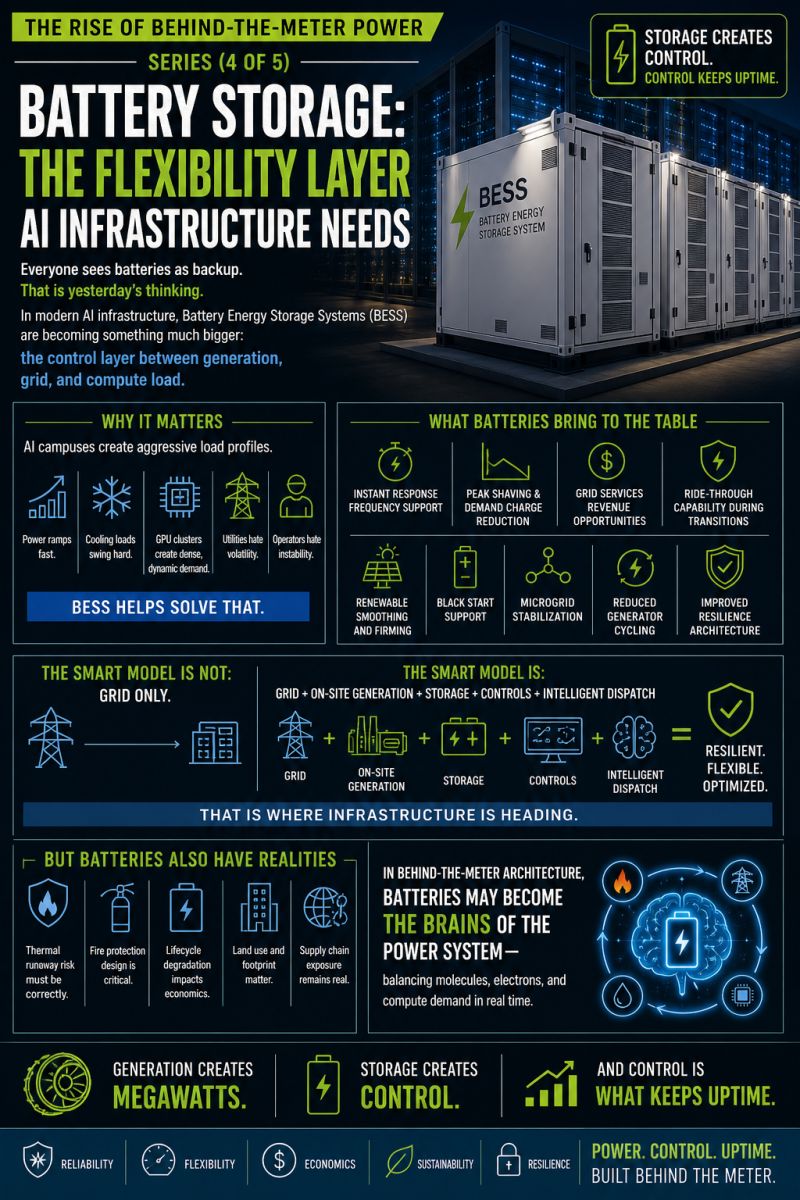
Battery Storage as Critical Flexibility for AI Infrastructure
The chart establishes the fundamental need for battery storage to support AI infrastructure, setting the stage for the section’s discussion on Invinity’s forward-looking hybrid storage solutions designed to meet this specific demand.
(Source: LinkedIn)
The questions your competitors are already asking
This report covers one angle of the battery technology shift driven by AI data center power demand. The questions that matter most depend on your work.
- Which battery companies are gaining ground in the AI data center power market, and which are losing their early lead?
- What is the status of the Invinity and Flexbase Group project? Is it on track to become the world’s largest VFB deployment?
- How do vanadium flow batteries compare to iron-air and lithium-ion for powering AI data centers?
- Which data center and hyperscale operators are adopting non-lithium long-duration energy storage?
This report does not answer these. Enki Brief Pro does.
Your question, your angle, your framework. SWOT, PESTL, scenario modelling. The same niche depth, built around the decision your work actually depends on.
