

CCUS Project Cancellations, $3.7 B DOE Funding Cut, 24 Projects Terminated, and 30 UK Delays (2021 to 2026)
Project Cancellations: CCUS Market Faces $3.7 B DOE Cut and 30 UK Delays
Despite a surge in announcements driven by policy incentives, the Carbon Capture, Utilization, and Storage (CCUS) industrial build-out is defined by significant execution risk, with project cancellations and delays accelerating after 2024. While the period from 2021 to 2024 was characterized by a rapid expansion of the project pipeline, the post-2025 phase reveals a critical gap between ambition and reality, as financial, regulatory, and market uncertainties derail previously planned developments.
- The most significant setback occurred in late 2025 when the U.S. Department of Energy (DOE) terminated 24 CCS and decarbonization projects, canceling a total of $3.7 billion in planned investment and signaling a rationalization of the public-funded pipeline.
- In the United Kingdom, a persistent lack of policy clarity on business models has caused nearly 30 projects to be paused or delayed over the past two years, undermining the country’s hub-and-cluster strategy.
- Uncertainty in the voluntary carbon markets led to the cancellation or delay of several planned Bio-Energy with Carbon Capture and Storage (BECCS) projects in Sweden during 2025, highlighting the fragility of projects dependent on non-governmental credit revenue.
- A 2026 review of 16 flagship global CCS projects revealed that none had consistently achieved their target capture rates, with operational performance falling short of nameplate capacity and raising questions about the industry’s technical credibility at scale.
Execution Headwinds: US vs. Europe CCUS Market Setbacks and Policy Gaps
High-profile project terminations in both the United States and Europe since 2025 confirm that policy incentives alone do not guarantee project completion, as regulatory hurdles and market volatility emerge as primary obstacles. The cancellation of government funding and moratoria on new developments expose the execution fragility facing the global CCUS construction wave.
Table: Notable CCUS Project Setbacks and Cancellations
| Partner / Project | Time Frame | Details and Strategic Purpose | Source |
|---|---|---|---|
| Swedish BECCS Projects | Mar 2026 | Several planned Bio-Energy with Carbon Capture and Storage (BECCS) projects were canceled or delayed in 2025 due to financing struggles and uncertainty in the voluntary carbon markets, which were intended to provide a key revenue stream. | IEA |
| United Kingdom Project Pipeline | Dec 2025 | Nearly 30 CCUS projects have been paused or delayed over the past two years as developers await further clarity from the government on business models and support mechanisms, stalling progress on industrial decarbonization hubs. | Business Green |
| Louisiana New Projects | Oct 2025 | Governor Landry ordered a moratorium on all new carbon capture projects in Louisiana, a key geographic hub, citing the need for further safety and regulatory review. This action created significant uncertainty for future investment in the region’s storage infrastructure. | American Press |
| U.S. Department of Energy (DOE) | Oct 2025 | The DOE announced the termination of 24 projects related to CCS and other decarbonization initiatives, withdrawing $3.7 billion in planned funding. This move signaled a significant reassessment of the federal project portfolio and its viability. | [PDF] Global CCS Institute |
Partnership Models: CCUS Hubs like Northern Lights and Pathways Alliance (2021 to 2026)
In response to high capital costs and infrastructure risks, the dominant commercial model that solidified after 2024 is the development of large-scale industrial hubs, where consortiums of emitters and midstream players collaborate to share transport and storage infrastructure. This approach reduces unit costs and de-risks investment compared to standalone, single-source projects.
- In Europe, the Northern Lights project, a joint venture of Equinor, Shell, and Total Energies, became operational and established the first open-source CO₂ transport and storage service, setting the template for a “decarbonization-as-a-service” model.
- In Canada, the Pathways Alliance, a consortium of six major oil sands producers including Suncor and Cenovus, is developing a shared CO₂ trunk pipeline to serve multiple facilities, demonstrating a sector-wide collaborative approach to decarbonization.
- The US Gulf Coast has seen the emergence of similar hub concepts led by companies like Exxon Mobil and Occidental Petroleum, which are leveraging existing pipeline infrastructure and geological expertise to build commercial CCUS service businesses targeting industrial clusters.
- The success of these hub models is now seen as critical, as they offer the only viable path to connect disparate industrial emitters to limited, high-capacity geological storage sites, a lesson learned from the limitations of early, isolated projects.
Geographic Focus: North America and Europe Lead Policy-Driven CCUS Growth
The global CCUS map is being drawn by distinct policy approaches, with North America’s direct financial incentives driving rapid project announcements, while Europe’s state-backed, infrastructure-led strategy fosters the creation of integrated hubs. The period after 2024 clarified that the nature of government support dictates the structure and pace of regional market development.
- The United States leads in project volume, driven by the enhanced Section 45 Q tax credit, which provides a direct, bankable incentive of up to $85 per ton of stored CO₂, making it the most powerful mechanism for attracting private capital to individual projects.
- Canada employs a more targeted approach, combining an investment tax credit with direct government investment and offtake agreements, such as the Canada Growth Fund’s $200 million investment backstopped by a 15-year carbon credit purchase agreement, which removes market price risk.
- Europe, through its Innovation Fund and national programs, prioritizes the development of shared infrastructure via grants and Contracts for Difference (Cf D). This method de-risks the entire value chain for industrial clusters, as seen in projects like Net Zero Teesside in the UK and the Northern Lights project in Norway.
Technology Costs: CCUS Market Faces $400/ton DAC and $40/ton Point Source Gap
While post-combustion capture technology using amine scrubbing is commercially mature (TRL 9), the central challenge for the CCUS market post-2024 is not invention but managing the high cost of deployment. The significant economic gap between capture costs and prevailing carbon prices makes government subsidies the determinative factor for project viability across all technology types.
- The cost of capturing CO₂ from industrial point sources, such as cement or power plants, ranges from $40 to $120 per ton. This cost is now often covered by incentives like the $85/ton 45 Q tax credit in the U.S., making many of these projects financially viable for the first time.
- Direct Air Capture (DAC), a technology critical for removing atmospheric CO₂, remains substantially more expensive, with current costs ranging from $400 to $600 per ton. This makes DAC projects entirely dependent on premium incentives and voluntary market credits.
- The primary operational cost (OPEX) driver is the energy penalty associated with the capture process, particularly for regenerating solvents in chemical absorption systems, which remains a key focus for technology improvement.
- The successful non-recourse debt financing of major projects like Net Zero Teesside in 2025 marked a critical milestone, indicating that the financial sector now views the policy-backed business model for mature capture technologies as robust and bankable.
SWOT Analysis: CCUS Market Policy Strengths and Infrastructure Threats (2021 to 2026)
The strategic outlook for the CCUS market is a balance of powerful tailwinds and critical structural weaknesses. While strong and durable policy support enacted between 2021 and 2025 created an unprecedented investment environment, the market’s ability to execute is now severely threatened by emerging infrastructure and regulatory bottlenecks.
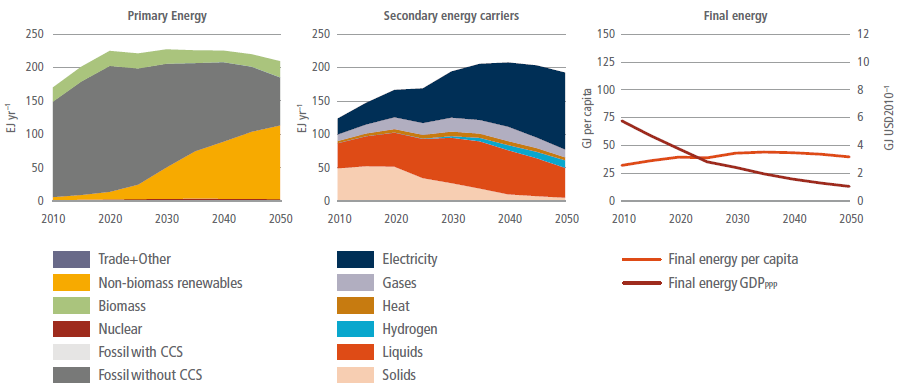
Long-Term Forecasts Highlight CCUS Challenges
This energy forecast provides strategic context for the market’s weaknesses and threats, showing that CCUS is projected to play a minimal long-term role, underscoring execution risks.
Table: SWOT Analysis for the Global CCUS Industrial Build-Out
| SWOT Category | 2021 – 2024 | 2025 – 2026 | What Changed / Validated |
|---|---|---|---|
| Strengths | Technology validation at pilot scale; growing policy support (e.g., IRA passage). | Bankable, long-term policy incentives (e.g., enhanced 45 Q, Canadian CCOs); first large-scale projects secure non-recourse financing (e.g., Net Zero Teesside). | Policy incentives proved strong enough to make projects bankable, shifting the primary risk from policy uncertainty to execution. |
| Weaknesses | High capture costs; history of project failures and underperformance; reliance on EOR for economic viability. | Persistent performance gap (actual vs. nameplate capacity); high cost of DAC ($400-$600/ton) remains a major barrier to scalability. | The core economic weakness of high costs remains, but direct subsidies like 45 Q now bridge the gap for many point-source applications. |
| Opportunities | Decarbonization of hard-to-abate sectors (cement, steel); development of industrial hubs. | Explosive demand from new gas-fired power plants for data centers; development of “decarbonization-as-a-service” business models by hub operators. | The market opportunity expanded from existing industrial emitters to include the massive projected growth in new, unabated power generation. |
| Threats | Public opposition; long permitting timelines for storage sites; policy reversal risk. | Infrastructure bottlenecks (CO₂ transport and storage); regulatory moratoria (e.g., Louisiana); large-scale project cancellations ($3.7 B in DOE funding). | The primary threat shifted from policy risk to physical and regulatory bottlenecks, as the pipeline of capture projects outpaces the development of transport and storage. |
Scenario Modeling: CCUS Market Faces Critical Transport and Storage Infrastructure Risk
The single most critical variable for the CCUS market’s growth trajectory in the next 18 months is the rate of development of CO₂ transport and storage infrastructure. The industry has successfully catalyzed a wave of capture projects, but the value chain will break if there is no place for the captured CO₂ to go. The primary bottleneck has officially shifted from capture economics to midstream logistics and sequestration capacity.
- If this happens: Permitting for Class VI injection wells in the U.S. and equivalent storage sites in Europe continues to face long delays and local opposition.
- Watch this: The number of final investment decisions (FIDs) for large-scale capture projects will slow dramatically, regardless of the 45 Q credit value, as developers cannot secure offtake agreements without certified storage.
- These could be happening: A growing number of “stranded” capture facilities that are mechanically complete but unable to operate, leading to financial distress and a loss of investor confidence. The October 2025 moratorium on new carbon capture projects in Louisiana serves as a stark warning of this risk becoming reality.
The questions your competitors are already asking
This report covers one angle of the execution risk in the CCUS industrial build-out. The questions that matter most depend on your work.
- What is actually happening with the 24 CCS projects terminated by the U.S. Department of Energy (DOE) after the $3.7 billion funding cut?
- What is the outlook for CCUS deployment in the US and Europe through 2030, considering recent project cancellations and policy delays?
- What is the actual operational performance of flagship CCUS projects versus their nameplate capture rates, and what are the key technical risks to deployment at scale?
This report does not answer these. Enki Brief Pro does.
Your question, your angle, your framework. SWOT, PESTL, scenario modelling. The same niche depth, built around the decision your work actually depends on.
