

Chevron Green Hydrogen Strategy, $5 B Project Labrador, 30 Iwatani Stations, and 5 Major Projects (2021 to 2026)
Dual-Track Adoption, Chevron $5 B Blue Hydrogen Project vs. Green Pilots
In 2025, Chevron solidified a pragmatic dual-track hydrogen strategy, prioritizing large-scale, economically viable blue hydrogen for immediate market impact while cultivating smaller green hydrogen projects to build future capabilities. This approach is a direct response to the current economic and technological realities of the hydrogen market.
- By advancing its planned $5 billion Project Labrador blue hydrogen facility in Texas, Chevron is leveraging its core competencies in natural gas processing and large-scale project execution to produce low-carbon hydrogen at a competitive cost.
- Simultaneously, the company achieved first production at the Advanced Clean Energy Storage (ACES) green hydrogen project in Utah and proposed the Lost Hills Solar to Hydrogen Project in California. These ventures, while smaller in capital scale, are critical for mastering electrolysis and storage technologies.
- This two-pronged approach allows Chevron to generate near-term returns from blue hydrogen, supported by incentives like the $3/kg 45 V tax credit, while de-risking its eventual transition to green hydrogen as technology costs decrease and renewable capacity expands.
- The period leading up to 2025 involved strategic planning and partnership formation, but 2025 marked the year of execution, with major project announcements and key operational milestones demonstrating the tangible application of this dual strategy.
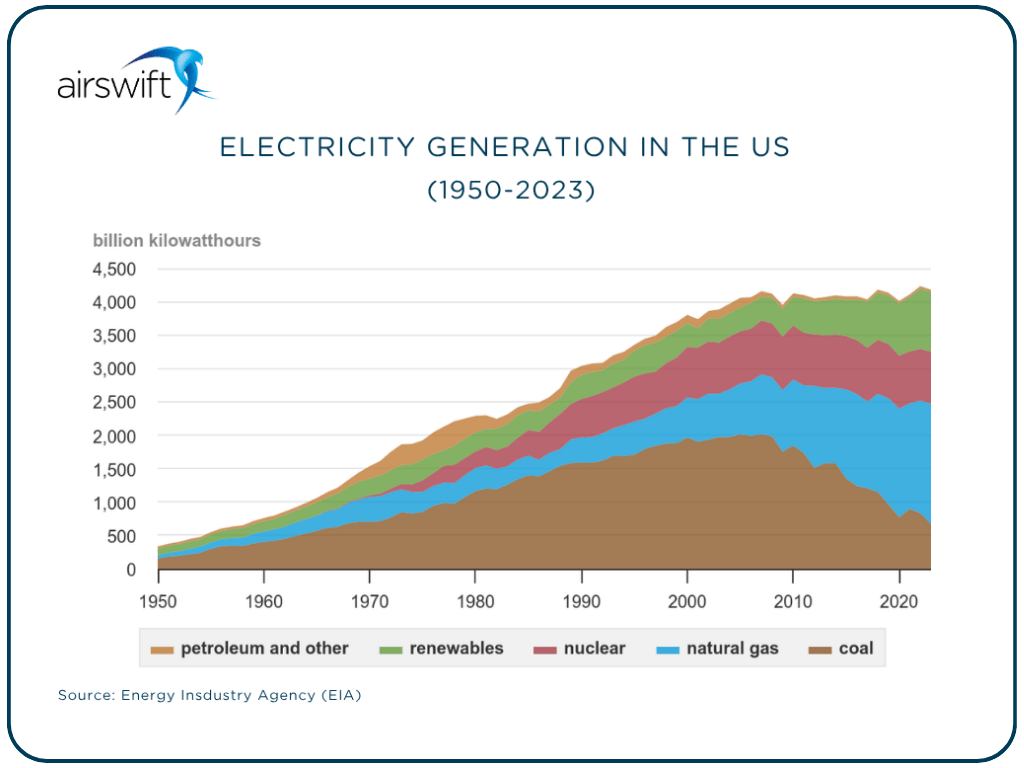
Natural Gas and Renewables Reshape US Power
This chart perfectly illustrates Chevron’s ‘dual-track’ hydrogen strategy by highlighting the two primary energy sources: natural gas (the feedstock for its blue hydrogen projects) and renewables (the power source for its green hydrogen pilots). It shows how Chevron’s strategy aligns with broader energy sector trends.
(Source: Airswift)
$10 B in Low-Carbon Funds, Chevron Hydrogen Capital Allocation Strategy
Chevron’s 2025 investment announcements reveal a capital allocation strategy that funnels the majority of its near-term hydrogen investment into a single, massive blue hydrogen project, all under the umbrella of a broader corporate low-carbon budget. This demonstrates a clear focus on achieving scale and cost-effectiveness by leveraging existing fossil fuel infrastructure and expertise.
- The company is operating within its commitment to invest $10 billion in low-carbon projects by 2028, a fund that finances its entire portfolio of hydrogen, renewable fuels, and carbon capture ventures.
- The centerpiece of its 2025 hydrogen investment strategy is the proposed $5 billion “Project Labrador” in Port Arthur, Texas, a blue hydrogen and ammonia plant that single-handedly represents a significant portion of the company’s total low-carbon budget.
- This major project is included within the company’s overall capital expenditure guidance of $18 billion to $19 billion for 2026, indicating that low-carbon projects are being integrated directly into traditional capital planning cycles.
- A separate $500 million fund for low-carbon solutions, announced in May 2025, provides additional capital for earlier-stage technologies and industrial decarbonization efforts, including hydrogen.

Global Clean Hydrogen Investment Surges Past $100B
This chart contextualizes Chevron’s $10 billion low-carbon fund by showing it is part of a larger global investment surge exceeding $100 billion into clean hydrogen. It positions Chevron as a major player within a rapidly capitalizing sector, validating its capital allocation strategy.
(Source: Precedence Research)
Table: Chevron Major Low-Carbon Investments (2025)
| Partner / Project | Time Frame | Details and Strategic Purpose | Source |
|---|---|---|---|
| Overall 2026 CAPEX | Dec 3, 2025 | Announced $18 B – $19 B organic capital expenditure budget for 2026, which includes allocations for lower carbon projects like hydrogen and carbon capture. | Chevron |
| Project Labrador | Jul 11, 2025 | Revealed plans for a $5 billion blue hydrogen and ammonia plant in Port Arthur, Texas, utilizing steam-methane reforming with carbon capture to produce low-carbon fuels at scale. | Yahoo Finance |
| Low-Carbon Solutions Fund | May 15, 2025 | Created a new $500 million fund dedicated to investing in low-carbon solutions, including industrial decarbonization and hydrogen technologies. | REN 21 |
| Broader Low-Carbon Projects | Nov 23, 2025 | Reiterated commitment to spend $10 billion by 2028 on a portfolio of lower-carbon ventures, including the development of green and blue hydrogen projects. | Industrial Info |
Chevron 6 Key Hydrogen and Low-Carbon Alliances (2025)
In 2025, Chevron strategically assembled a network of partners to address critical links across the hydrogen value chain, from securing production technology and building storage to creating downstream market demand. These collaborations are essential for mitigating risk and accelerating the commercialization of its hydrogen business.
- The agreement with Iwatani Corporation to develop 30 hydrogen fueling stations in California directly tackles the infrastructure gap, creating a guaranteed offtake market for Chevron’s current and future hydrogen production.
- Its joint venture with Mitsubishi Power for the ACES project provides access to world-class electrolysis and large-scale storage technology, validating a model for integrating intermittent renewable energy with dispatchable clean power.
- A development partnership with GE Vernova and Engine No. 1 aims to construct hydrogen-capable natural gas power plants, creating a long-term demand pathway for low-carbon hydrogen in the power generation sector.
- The collaboration with One H 2 expands hydrogen access through mobile fueling solutions, offering a flexible and lower-capital method to serve emerging transportation markets before permanent station infrastructure is built.

Energy Stakeholders Show Strong Interest in Transition
This chart illustrates the underlying driver for forming alliances by showing a strong, shared interest in the energy transition among various stakeholders. It explains why a collaborative environment exists, which Chevron leverages through its key partnerships to advance its hydrogen goals.
(Source: Wood Mackenzie)
Table: Chevron Hydrogen-Related Partnerships (2025)
| Partner / Project | Time Frame | Details and Strategic Purpose | Source |
|---|---|---|---|
| Iwatani Corporation | Jun 7, 2025 | To build and operate 30 hydrogen fueling stations in California by 2026, creating a retail offtake network for Chevron’s hydrogen. | H 2 FCP |
| Engine No. 1, GE Vernova | Mar 13, 2025 | To develop multi-gigawatt, hydrogen-capable natural gas power plants, establishing a future market for hydrogen in power generation. | Martindale Consultants |
| Mitsubishi Power | Jan 16, 2025 | Joint venture for the Advanced Clean Energy Storage (ACES) project in Utah, focused on large-scale green hydrogen production and salt cavern storage. | Mitsubishi Power |
| Bayer & Bunge | Dec 2, 2025 | Partnership to de-risk and develop new value chains for sustainable fuels, securing feedstock for its renewable fuels business which can be co-processed with hydrogen. | World Economic Forum |
US Gulf Coast vs. California, Chevron’s Regional Hydrogen Focus
Chevron’s hydrogen deployment strategy is not monolithic; it is a geographically targeted approach that places large-scale blue hydrogen production on the U.S. Gulf Coast and integrated green hydrogen ecosystems in California and the Intermountain West. This regional specialization allows the company to capitalize on unique local advantages, from geology and infrastructure to policy incentives.
- The U.S. Gulf Coast, specifically Port Arthur, Texas, was selected for the $5 billion Project Labrador due to its abundant natural gas supply, existing pipeline and industrial infrastructure, and favorable geology for carbon sequestration.
- California is the focal point for Chevron’s green hydrogen-to-mobility strategy, with the planned Lost Hills solar-to-hydrogen facility and the Iwatani fueling network designed to serve the state’s transportation market, driven by supportive policies like the Low Carbon Fuel Standard.
- Delta, Utah, was chosen for the ACES project primarily for its unique salt dome geology, ideal for storing vast quantities of hydrogen, thereby solving the intermittency of renewable power from across the Western U.S.
- While the planning for these regional hubs occurred in the 2021-2024 period, 2025 is the year these strategies became concrete, with formal project proposals, construction milestones, and the start of operations.

US Hydrogen Market Forecasted to Exceed $33B
The chart establishes the total addressable market in the US, providing critical financial context for the section discussing Chevron’s regional strategy. A $33 billion market justifies a focused approach on key hubs like the Gulf Coast and California.
(Source: MarketsandMarkets)
Technology Maturity, Chevron’s Use of SMR and Electrolysis
In 2025, Chevron deployed a technology strategy that relies on mature, proven technology for its large-scale commercial hydrogen push, while using pilot-scale projects to master emerging technologies. The company is primarily leveraging its deep expertise in hydrocarbon processing for its blue hydrogen ambitions, treating green hydrogen as a field for capability development.
- The choice of steam-methane reforming (SMR) with carbon capture for Project Labrador relies on technologies that have been used in the refining and industrial gas sectors for decades, minimizing technical risk for the $5 billion investment.
- For its green hydrogen projects like ACES, Chevron is deploying large-scale electrolyzers. While electrolysis is a known technology, achieving cost-effective operation at this scale (200 MW) and integrating it with intermittent renewables remain key challenges the project aims to solve.
- The use of salt cavern storage at ACES is another example of technology transfer, adapting a method long used for natural gas storage to the unique properties of hydrogen, thereby de-risking a critical component of the future hydrogen economy.
- The period from 2021 to 2024 was for technology evaluation, but the operational data from ACES starting in Q 3 2025 provides the first real-world validation of these technologies’ performance and economics at a commercial scale for Chevron.

SMR Dominates 2025 Low-Carbon Hydrogen Market
The chart provides market context for Chevron’s technology choices, showing that Steam Methane Reforming (SMR) is the dominant low-carbon hydrogen production method in the near term. This justifies Chevron’s focus on SMR-based blue hydrogen projects while it concurrently develops electrolysis for future green hydrogen.
(Source: maximize market research)
SWOT Analysis, Chevron’s 2025 Hydrogen Strategy Strengths and Risks
Chevron’s dual hydrogen strategy leverages its formidable legacy strengths to secure an early position in the clean energy transition, but it also exposes the company to significant policy risks and competition from more agile, pure-play green hydrogen firms. The events of 2025 brought both the advantages and vulnerabilities of this approach into sharp focus.
- Strengths: The ability to fund and execute massive capital projects like the $5 billion Project Labrador and leverage existing infrastructure are unmatched advantages.
- Weaknesses: A continued reliance on fossil fuels for its primary hydrogen pathway creates public perception challenges and exposure to methane price volatility.
- Opportunities: The 45 V production tax credit and a rapidly growing market (projected to exceed $300 billion by 2030) create a powerful tailwind for both blue and green hydrogen projects.
- Threats: Unfavorable final rulemaking on the 45 V tax credit, which could impact the economics of blue hydrogen, and rapid cost reductions in electrolysis, which could make green hydrogen competitive sooner than anticipated, pose the most significant threats.
Table: SWOT Analysis for Chevron Green Hydrogen Initiatives for 2025: Key Projects, Strategies and Market Impact
| SWOT Category | 2021 – 2023 | 2024 – 2025 | What Changed / Resolved / Validated |
|---|---|---|---|
| Strengths | Strong balance sheet, project management expertise, existing asset base in natural gas and refining. | Demonstrated ability to deploy capital at scale ($5 B Project Labrador plan), form key JVs (Mitsubishi, Iwatani). | The strategy moved from concept to execution in 2025, validating Chevron’s ability to leverage its traditional strengths in the low-carbon space. |
| Weaknesses | Heavy reliance on fossil fuels, limited operational experience with large-scale electrolysis. | Green hydrogen production cost remains high ($3.8-$11.9/kg). Dual strategy can appear unfocused to investors. | First production at ACES in Q 3 2025 began to address the operational weakness, but the high cost of green hydrogen was reinforced as a major hurdle. |
| Opportunities | Anticipation of IRA incentives (45 V tax credit). Growing demand for low-carbon fuels from policy and corporate goals. | Finalization of 45 V rules providing up to $3/kg. Hydrogen market forecasts showing strong growth to $311.89 B by 2030. | The $3/kg tax credit became a tangible financial driver in 2025, significantly improving the economic models for both blue and green hydrogen projects. |
| Threats | Policy uncertainty, competition from energy majors and startups, public opposition to “blue” hydrogen. | Final 45 V rules include strict requirements that could challenge blue hydrogen economics. “Chicken-and-egg” problem of supply vs. offtake remains. | The “chicken-and-egg” problem was addressed directly with the Iwatani deal in 2025, but the strictness of the final 45 V rules emerged as a new, more defined threat. |

Green Hydrogen Market Poised for Explosive Growth
The chart’s forecast of explosive growth in the green hydrogen market directly visualizes a key ‘Opportunity’ for a SWOT analysis focused on Chevron’s green initiatives. This rapid market expansion justifies strategic investment and highlights the potential for significant returns.
(Source: CarbonCredits.com)
Scenario Modeling, Chevron’s FID on Project Labrador and Offtake Agreements
The single most critical event to watch for is a Final Investment Decision (FID) on Project Labrador, as it would represent the largest single capital commitment to low-carbon hydrogen by a U.S. major to date and fully lock in Chevron’s blue hydrogen strategy.
- If this happens: Chevron announces a positive FID for the $5 billion Project Labrador in late 2025 or early 2026. Watch this: The immediate announcement of long-term offtake agreements with industrial partners or international buyers for the produced ammonia. Also, watch for the selection of an EPC contractor.
- These could be happening: A positive FID would signal that Chevron is confident it can meet the strict lifecycle emissions requirements of the 45 V tax credit, making blue hydrogen profitable at scale. It would also likely trigger similar large-scale announcements from competitors on the Gulf Coast.
- If this does not happen: An announced delay or cancellation of the Project Labrador FID. Watch this: Any statements citing “unfavorable market conditions” or “policy uncertainty, ” which would likely be code for the 45 V rules making the project uneconomical. Also, watch for an increase in capital allocated to renewable fuels or smaller, modular green hydrogen projects.
- These could be happening: A delay would signal that green hydrogen’s cost reduction curve and the regulatory hurdles for blue hydrogen are shifting the economic balance faster than anticipated, potentially forcing Chevron to re-evaluate its dual-track strategy and pivot more quickly to green alternatives.

Global Hydrogen Market to Exceed $426B by 2031
This long-term global market forecast is a critical data point for the scenario modeling mentioned in the section. It helps justify a Final Investment Decision (FID) for a major undertaking like Project Labrador by quantifying the substantial future market that offtake agreements will be based on.
(Source: Consegic Business Intelligence)
The questions your competitors are already asking
This report covers one angle of Chevron’s dual-track hydrogen strategy execution. The questions that matter most depend on your work.
- Chevron’s hydrogen investments and funding. Is the $5 billion Project Labrador on track for its announced production targets?
- How does Chevron’s blue hydrogen from Project Labrador compare to its green hydrogen from the ACES project on a cost basis, considering the $3/kg 45V tax credit?
- Chevron’s activities in green hydrogen. Are the ACES and Lost Hills pilots progressing to larger-scale deployment?
This report does not answer these. Enki Brief Pro does.
Your question, your angle, your framework. SWOT, PESTL, scenario modelling. The same niche depth, built around the decision your work actually depends on.
