

COSCO Shipping Lines Distributed Energy Initiatives for 2025: Key Projects, Strategies and Market Impact
Here is the blog post:
COSCO’s Green Gambit: How Billions in Investments and Strategic Partnerships are Redefining Maritime Logistics
In the high-stakes race to decarbonize global trade, few sectors face a challenge as monumental as maritime shipping. Against this backdrop, COSCO Shipping Lines is making waves not just with its vast fleet, but with an aggressive, multi-billion-dollar pivot towards green logistics. The global shipping giant is executing a decisive strategy anchored in two core pillars: massive capital investment in a new generation of energy-efficient vessels and a pragmatic, multi-fuel approach to a post-fossil fuel world. This isn’t just about compliance; it’s a strategic repositioning to lead the industry’s energy transition, blending proven efficiency gains with bold bets on the fuels of tomorrow, like ammonia and methanol. As we’ll explore, while the company’s primary focus is on propulsion, it is also beginning to integrate distributed energy resources directly onto its vessels, signaling a future where ships are not just cargo carriers, but active nodes in a cleaner energy ecosystem.
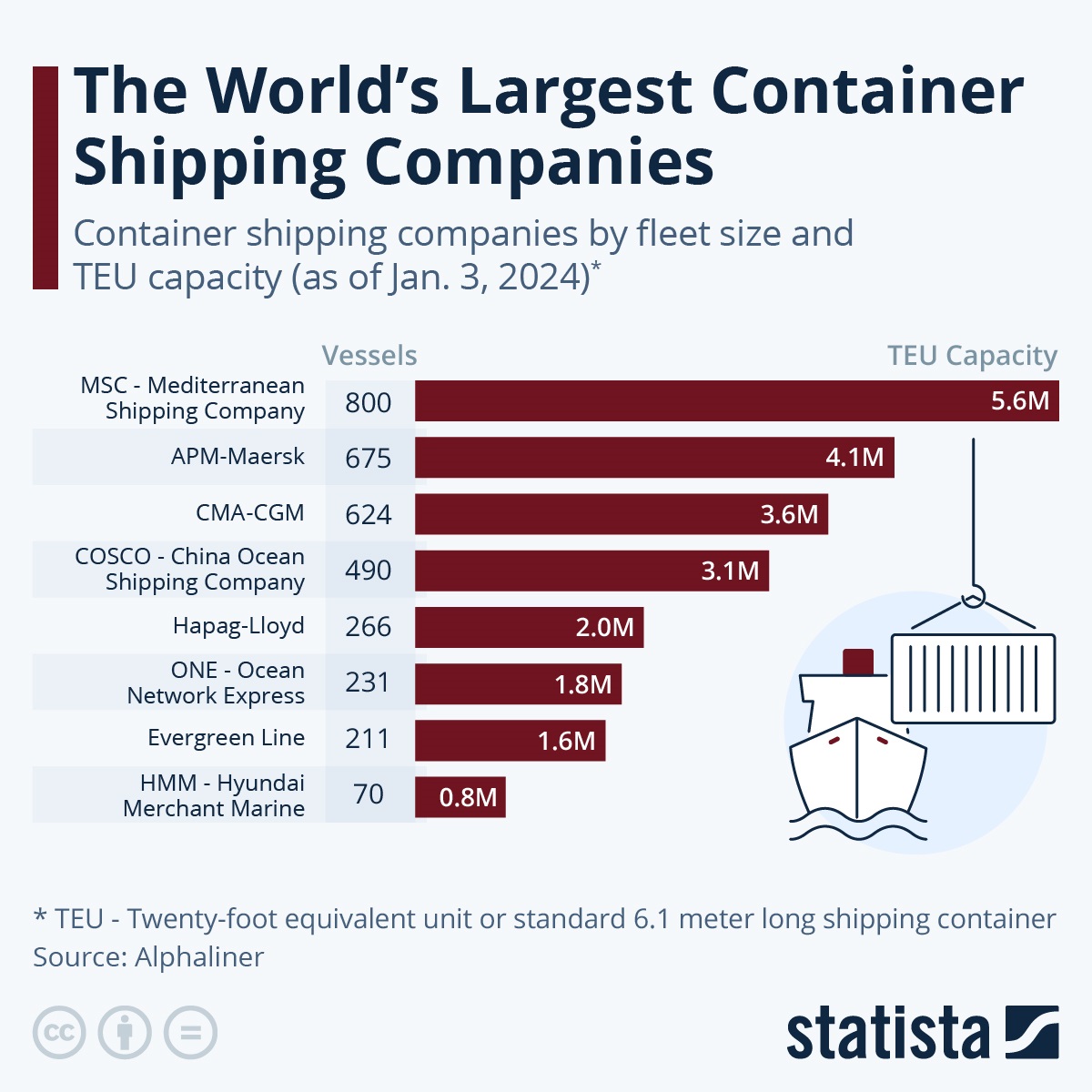
COSCO Ranks as World’s 4th Largest Shipping Line
This chart establishes COSCO as a dominant force in global shipping. By highlighting its rank as the world’s 4th largest shipping line, it underscores why the company’s sustainability initiatives—its ‘Green Gambit’—are significant for the entire maritime industry.
(Source: Statista)
A Tidal Wave of Green Investment
COSCO is underpinning its green ambitions with staggering financial commitments, leaving no doubt about the seriousness of its decarbonization strategy. In late 2025 alone, the company dedicated over $8.75 billion to fleet modernization, a clear signal that renewing its armada with state-of-the-art, energy-efficient vessels is its primary lever for change. The centerpiece is a historic $7 billion order for 87 new ships from China State Shipbuilding Corporation (CSSC), a move designed to supercharge its expansion while integrating next-generation designs. This was preceded by a $1.75 billion newbuilding program aimed squarely at enhancing environmental performance across the fleet. To fuel this expansion, its tanker and gas unit, COSCO Shipping Energy Transportation, announced plans to raise over a billion dollars, earmarking the capital for modern, environmentally friendlier vessels. This financial firepower, bolstered by strong profitability, enables COSCO to simultaneously upgrade its fleet and pilot the next wave of maritime technology.
Table: COSCO Shipping’s Strategic Decarbonization Investments
| Partner / Project | Time Frame | Details and Strategic Purpose | Source |
|---|---|---|---|
| Mega-order for new vessels | Dec 9, 2025 | A landmark $7 billion order for 87 new energy-efficient, alternative-fuel-ready vessels from CSSC to accelerate fleet renewal. | COSCO supercharges expansion with $7bn order for 87 ships |
| Newbuilding Program | Nov 3, 2025 | A $1.75 billion investment in new ships specifically designed to reduce emissions and modernize the existing fleet. | COSCO invests significant sum in newbuilding orders to modernize … |
| New Share Issuance | Jan 27, 2025 | COSCO Shipping Energy raised $1.1 billion to fund the expansion of its tanker and gas shipping fleet with modern, greener vessels. | Cosco Shipping Energy to raise $1.1bn for fleet expansion with … |

COSCO Revenue History Shows Financial Power for Green Push
The section discusses a ‘tidal wave of green investment,’ and this chart directly provides the financial context. It illustrates COSCO’s strong revenue history, explicitly linking this financial power to its capacity to fund a large-scale ‘green push’ and make substantial decarbonization investments.
(Source: Statista)
Building an Ecosystem for Decarbonization
Recognizing that no single company can solve maritime decarbonization alone, COSCO is strategically building a powerful ecosystem of partners. This network spans technology providers, major charterers, and strategic advisors, creating a collaborative framework to tackle the challenge from multiple angles. In early 2026, a partnership with equipment manufacturer XCMG focused on creating integrated and sustainable supply chains. To guide its long-term vision, COSCO engaged LR Advisory in an 18-month project to develop a sophisticated, data-backed decarbonization pathway. More tactically, the company is working directly with engine manufacturer MAN Energy Solutions to co-develop retrofit solutions, enabling its existing fleet to run on future fuels like methanol and ammonia. A pivotal collaboration with mining giant BHP aims to deploy ammonia-powered bulk carriers on key iron ore routes, creating a real-world green corridor. Even vessel efficiency is addressed through partnerships, such as the one with PPG to apply advanced low-friction hull coatings that reduce fuel consumption.
Table: COSCO Shipping’s Key Decarbonization Partnerships
| Partner / Project | Time Frame | Details and Strategic Purpose | Source |
|---|---|---|---|
| XCMG | Jan 14, 2026 | Deepen collaboration on integrated and sustainable global supply chains. | XCMG and COSCO SHIPPING Lines Deepen Strategic Partnership … |
| LR Advisory | Nov 27, 2025 | An 18-month advisory project to create a data-backed decarbonization strategy and transition pathway. | Powered by Perspective: COSCO Energy Transition – LR.org |
| BHP | Jul 3, 2025 | Collaboration to deploy ammonia dual-fuelled bulk carriers for commercial iron ore transport, pioneering a green corridor. | BHP, COSCO Sign Deal for Ammonia Dual-Fuelled Bulk Carriers |
| MAN Energy Solutions | Apr 10, 2025 | Cooperation agreement to retrofit existing ships, enabling them to operate on methane, methanol, and ammonia. | MAN ES and COSCO eye new decarbonization retrofit projects with … |
| PPG | Mar 18, 2025 | Application of PPG SIGMAGLIDE low-friction hull coatings to reduce GHG emissions by improving vessel efficiency. | PPG announces first drydocking for COSCO Shipping with … |

COSCO Maintains #1 Global Fleet Ranking
This chart demonstrates the immense scale of COSCO’s operations by ranking it #1 globally by fleet size. This scale is the foundation of its decarbonization ‘ecosystem,’ giving it the leverage to influence standards across its vast network of vessels, ports, suppliers, and partners.
(Source: Splash247)
From Hull Coatings to Green Corridors: A Multi-Pronged Approach
The diversity of COSCO’s initiatives reveals a sophisticated, portfolio-based strategy. The company is simultaneously pursuing immediate, incremental gains while investing in long-term, transformative solutions. On one end of the spectrum are readily deployable efficiency technologies like the underwater hull-cleaning robots and PPG’s low-friction coatings, which offer immediate fuel savings and emissions reductions. In the middle are the transition fuels. The launch of LNG dual-fuel carriers like the “YUAN HAI KOU” and the delivery of a breakthrough methanol dual-fuel ship show a commitment to commercially available, lower-carbon alternatives. At the cutting edge is the push into zero-carbon fuels. The world’s first green ammonia bunkering pilot and the commercial agreement with BHP to operate ammonia-fueled carriers represent a major step towards making a zero-emission fuel viable for deep-sea shipping. This layered approach allows the company to reduce its carbon footprint today while paving the way for a net-zero future.
Anchored in Asia, Aiming for Global Green Routes
COSCO’s strategy is deeply rooted in its geographic and industrial position as a Chinese state-owned enterprise. The company is masterfully leveraging China’s world-leading shipbuilding capacity, exemplified by the massive $7 billion vessel order placed with the China State Shipbuilding Corporation (CSSC). This allows COSCO to influence vessel design and accelerate its fleet renewal at a scale few competitors can match. However, its ambitions are global. The partnership with Australian mining giant BHP to create a green corridor for iron ore transport demonstrates a focus on decarbonizing major international trade routes. Furthermore, digital initiatives like the “Hi ECO Green Shipping Certificate,” which uses blockchain for carbon traceability, are designed for a global customer base, including partners like BOE, to provide transparent data on the environmental impact of their supply chains. This strategy of leveraging a strong regional industrial base to project global green leadership is a powerful model for the industry.
Beyond the Horizon: Balancing Proven Tech with Future Fuels
An analysis of COSCO’s activities reveals a clear and pragmatic view of technology maturity. The company is scaling technologies that are commercially proven while actively piloting the next generation. In the scaling category are LNG dual-fuel propulsion, advanced hull coatings, and digital tools for emissions tracking. These are mature solutions being deployed fleet-wide to achieve immediate efficiency gains. In early commercial deployment is the use of methanol as a marine fuel, with COSCO taking delivery of its first dual-fuel container ship. Similarly, the “YUAN HAI KOU” car carrier, which features an onboard distributed solar PV system for auxiliary power, represents an initial, tactical application of distributed generation. This project uses specialized marine solar modules from LONGi to reduce reliance on diesel generators, a small but significant step. Meanwhile, green ammonia remains in the pilot phase. COSCO’s successful bunkering trial and its agreement with BHP are crucial projects designed to de-risk ammonia as a fuel and prove its operational viability before wider commercial rollout.

COSCO’s Fleet Composition by Vessel Type in 2023
The section focuses on balancing current technology with future innovations. This chart details COSCO’s current fleet composition, providing a clear snapshot of the ‘proven tech’ that forms the baseline for its transition towards next-generation vessels and ‘future fuels.’
(Source: Statista)
Charting the Course for Net-Zero Shipping
COSCO’s actions signal a clear future direction: a relentless focus on fleet renewal and a multi-fuel strategy are the core pillars of maritime decarbonization for the next decade. The sheer scale of its investments in new, efficient vessels will reshape its operational footprint. Critically, watch the progress of its partnerships in ammonia and methanol. The BHP collaboration on ammonia-fueled carriers could be an industry-wide tipping point if it proves successful on commercial routes. Likewise, COSCO’s stated goal of building a green methanol industry chain bears monitoring. The most intriguing long-term trend, however, is the nascent move into distributed energy. While the solar-equipped “YUAN HAI KOU” is a promising start, the true transformative potential lies in expanding this concept to COSCO’s vast network of land-based assets. The future to watch is whether the company will begin integrating port-side microgrids, shore power, and green fuel bunkering facilities into its terminal operations. Such a move would transform its ports from simple cargo hubs into critical infrastructure for the new energy economy, creating a fully integrated land-and-sea green logistics ecosystem.

Global Shipping Energy Consumption Remains High
This chart sets the stage for the article’s conclusion by highlighting the urgency and scale of the challenge. By showing that global shipping’s energy consumption remains high, it frames COSCO’s ‘course for net-zero’ as a critical response to a pressing global environmental problem.
(Source: Statista)
Frequently Asked Questions
What is COSCO’s main strategy for decarbonizing its shipping fleet?
COSCO’s strategy rests on two core pillars: first, making massive, multi-billion-dollar investments in a new generation of energy-efficient vessels, and second, adopting a pragmatic multi-fuel approach. This involves using transitional fuels like LNG and methanol while actively piloting future zero-carbon fuels like green ammonia.
How much has COSCO committed financially to its green initiatives?
The company has made staggering financial commitments to modernize its fleet. In late 2025 alone, COSCO dedicated over $8.75 billion, which includes a $7 billion order for 87 new energy-efficient ships and a separate $1.75 billion newbuilding program. Its tanker unit also raised over $1 billion for greener vessels.
What kind of partnerships has COSCO formed to support its green transition?
COSCO has built a strategic ecosystem of partners. This includes working with China State Shipbuilding Corporation (CSSC) for vessel construction, mining giant BHP to pilot ammonia-powered ships on a ‘green corridor,’ engine manufacturer MAN Energy Solutions to retrofit existing ships, and technology firm PPG to apply fuel-saving hull coatings.
What specific green technologies and fuels is COSCO currently using or piloting?
COSCO employs a range of technologies. For immediate gains, it uses low-friction hull coatings and hull-cleaning robots. For the medium-term, it is deploying LNG and methanol dual-fuel vessels. For the long-term, it is at the cutting edge with pilots for green ammonia, including a successful bunkering trial and a commercial agreement to operate ammonia-fueled carriers.
Besides new fuels, what other innovations is COSCO exploring for a greener future?
COSCO is beginning to integrate distributed energy resources directly onto its ships, highlighted by the ‘YUAN HAI KOU’ car carrier which features an onboard solar PV system to reduce diesel generator use. The company is also leveraging digital tools, like its blockchain-based ‘Hi ECO Green Shipping Certificate,’ to provide carbon traceability for its customers.
Want strategic insights like this on your target company or market?
Build clean tech reports in minutes — not days — with real data on partnerships, commercial activities, sustainability strategies, and emerging trends.
