

DRC Cobalt Supply Squeeze, 150% Price Surge, $12 B US Response, and 2 State Control Mechanisms (2025-2026)
Cobalt Supply Chain Risk, 150% Price Hikes, and DRC State Control Mechanisms
The Democratic Republic of Congo (DRC) has fundamentally altered the global cobalt market by implementing aggressive state-controlled supply constraints, ending a period of oversupply and triggering extreme price volatility that exposes deep structural risks for the entire battery supply chain.
- Between 2021 and 2024, the market was characterized by a supply glut and falling prices. The dynamic shifted abruptly in February 2025 when the DRC, which supplies over 70% of the world’s cobalt, imposed a complete ban on exports to drain global stockpiles and drive up prices.
- This ban was replaced in October 2025 with a strict quota system, capping annual exports at 96, 600 tonnes for 2026 and 2027, a figure significantly below the production capacity of miners like CMOC and Glencore.
- The price reaction was immediate and severe. Spot cobalt metal prices surged 160% from $10 per pound in February 2025 to $26 per pound by December 2025, while the price of cobalt hydroxide, a key battery intermediate, jumped from $6 to $23 per pound in the same period.
- In April 2026, the DRC solidified its control by establishing a state-run strategic reserve, which acquires 10% of all export quotas plus any unused allocations, giving the government a direct mechanism to manage supply and influence global prices.
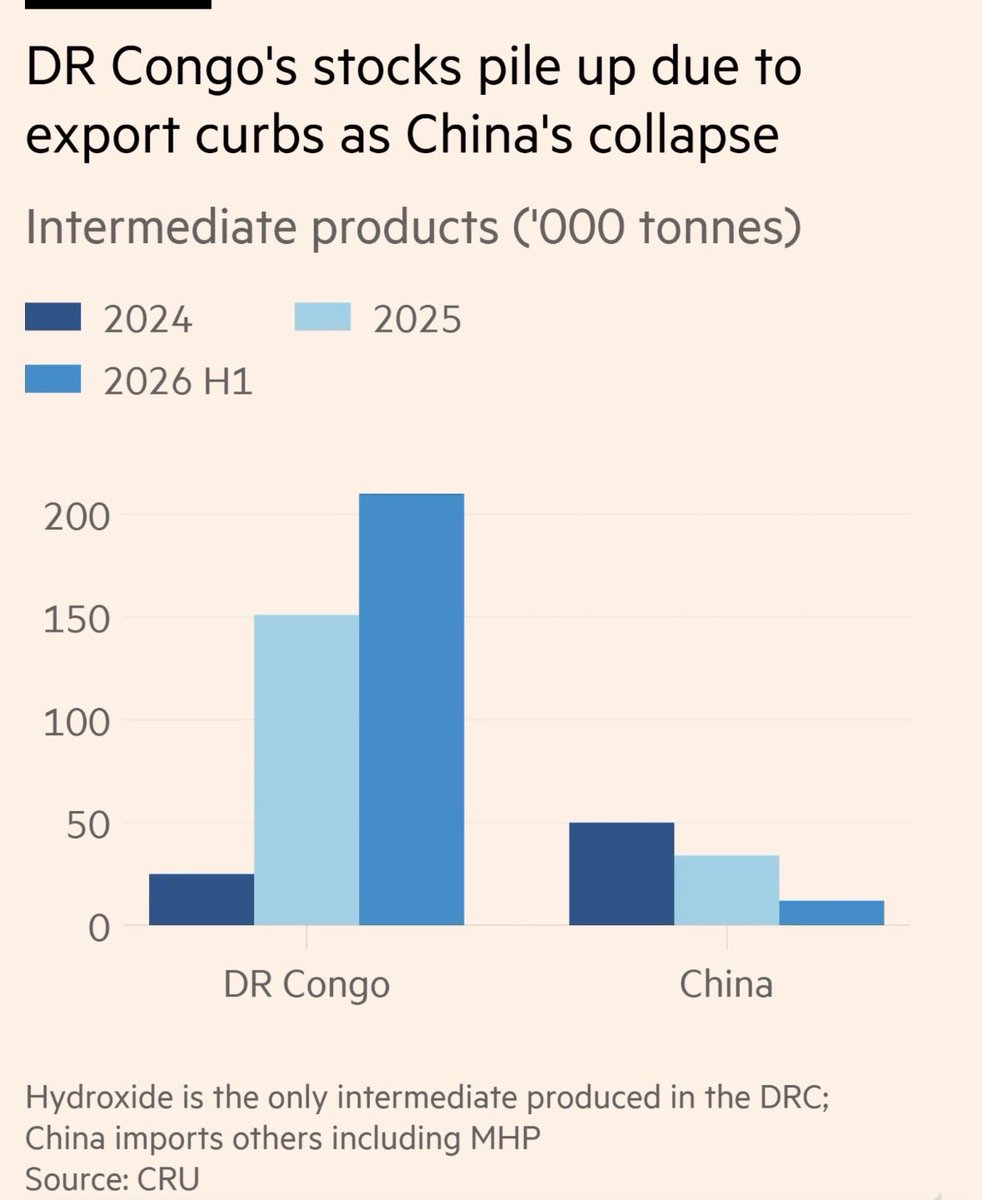
DRC Cobalt Stocks Skyrocket Amid Export Curbs
This chart directly illustrates the real-world impact of the ‘DRC State Control Mechanisms’ mentioned in the section heading. The skyrocketing stocks resulting from export curbs are a primary indicator of the ‘Cobalt Supply Chain Risk’ that this section addresses.
(Source: Twitter)
$12 B US Response, Orion CMC’s DRC Mine Stake, and EVelution’s $850 M Offtake
The DRC’s supply restrictions have catalyzed a wave of strategic government-backed and private-sector investments aimed at securing cobalt supply chains outside of Chinese-controlled processing channels.
- The United States has launched Project Vault, a $12 billion initiative designed to reshape cobalt supply lines by directly investing in mining and refining assets to reduce dependency on foreign adversaries.
- In a significant strategic move in February 2026, U.S.-backed consortium Orion CMC agreed to acquire a 40% stake in two of Glencore’s major copper-cobalt mines in the DRC, marking a direct Western equity interest in the country’s most critical assets.
- U.S. cobalt refiner EVelution Energy is developing a direct supply chain from the DRC, negotiating an agreement with state-owned EGC that could fulfill up to 40% of U.S. demand. The company secured a crucial $850 million offtake agreement with Mitsui in April 2026 for its future U.S.-based production.
- These investments directly counter the trend seen in 2025, where market uncertainty contributed to the cancellation of $11 billion in planned U.S. battery projects, highlighting a pivot from broad-based investment to targeted, strategic capital deployment.
Table: Strategic Cobalt Investments and Offtakes (2025-2026)
| Partner / Project | Time Frame | Details and Strategic Purpose | Source |
|---|---|---|---|
| EVelution Energy / Mitsui | Apr 2026 | EVelution Energy secured an $850 million offtake agreement with Mitsui for cobalt sulfate to be produced at its planned U.S. refinery. This secures a buyer for future U.S.-based production, de-risking the project. | Business Wire |
| Orion CMC / Glencore | Feb 2026 | U.S.-backed consortium Orion CMC agreed to acquire a 40% equity stake in Glencore‘s Mutanda and KCC copper-cobalt mines in the DRC. This marks a direct Western re-entry into DRC’s upstream mining sector. | The Economist |
| Gécamines / Mercuria / U.S. DFC | Dec 2025 | DRC state miner Gécamines and trading house Mercuria launched a joint venture to develop copper-cobalt assets, backed by financing from the U.S. International Development Finance Corporation (DFC) to provide an alternative to Chinese financing. | Mercuria |
| U.S. EV Supply Chain | 2025 | Broader market turmoil and uncertainty contributed to the cancellation or delay of $22 billion in planned EV supply chain projects and $11 billion in battery-specific projects in the U.S. | CSIS |
US-DRC Direct Deals, Gécamines-Mercuria JV, and the Western Push to Bypass China
The DRC’s market interventions have directly spurred the formation of new strategic alliances designed to establish mine-to-refinery supply chains that circumvent Chinese processing dominance.
- Prior to 2025, the prevailing cobalt supply route was from DRC mines, largely operated by Chinese companies, to Chinese refineries, which process over 70% of the world’s cobalt.
- The U.S. is now actively fostering direct partnerships, such as the U.S. DFC’s backing of the Gécamines and Mercuria joint venture. This provides Western capital and offtake channels for DRC assets, creating a clear alternative to Chinese-led financing and development.
- Discussions between the DRC’s state cobalt enterprise, EGC, and U.S. firm EVelution Energy represent a foundational attempt to build a vertically integrated U.S. supply chain, from sourcing raw materials in the DRC to refining battery-grade cobalt on U.S. soil.
- The agreement by U.S.-backed Orion CMC to purchase a stake in Glencore’s DRC mines is the most direct partnership, giving a Western-aligned entity significant equity in upstream production and a share of the output.
DRC Cobalt Dominance, Indonesia’s Rise, and the US Refinery Push (2025-2026)
While the DRC remains the inescapable center of the cobalt universe, its aggressive market control is accelerating geographic diversification efforts, with Indonesia emerging as a secondary supply hub and the U.S. pushing to establish a domestic refining footprint.
- The DRC’s position, controlling over 70% of global mined production, remains the single most critical factor in the market. The policy shift from 2025 onward confirms that all supply chains must account for geopolitical decisions made in Kinshasa.
- Indonesia is rapidly increasing its cobalt output, produced as a byproduct of its massive nickel industry. While this cannot replace DRC production, it provides a crucial alternative source of supply for battery makers like CATL and helps mitigate the full impact of the DRC’s quotas.
- The most significant geographic shift is the strategic push, led by the U.S., to build out refining capacity outside of China. Projects like EVelution Energy‘s planned Arizona refinery are designed to process cobalt from the DRC and other friendly nations, directly challenging China’s midstream dominance.
LFP Battery Adoption, Cobalt Price Pressure, and the Move to Cobalt-Free Chemistries
The sustained high prices and supply volatility engineered by the DRC are accelerating the commercial transition away from cobalt-intensive battery chemistries and toward mature, cobalt-free alternatives like Lithium Iron Phosphate (LFP).
- In the 2021-2024 period, LFP batteries were already gaining traction as a lower-cost alternative to Nickel Manganese Cobalt (NMC) chemistries, primarily for standard-range vehicles.
- The cobalt price shock of 2025-2026 has transformed this gradual shift into an urgent strategic priority. The high cost of cobalt erodes or eliminates the performance advantage of NMC batteries for many vehicle segments, making LFP the default economic choice.
- This trend is further reinforced by emerging technologies like sodium-ion batteries, which eliminate lithium, nickel, and cobalt entirely. Their successful commercialization would represent a long-term structural threat to cobalt demand in the battery sector.
SWOT Analysis, DRC’s Market Leverage, and Downstream Supply Vulnerabilities
The DRC’s actions have solidified its strength as the dominant market force in cobalt, but in doing so, have exposed profound weaknesses in global supply chains and created significant threats and opportunities for the entire energy transition ecosystem.
- Strength: The DRC has successfully proven its ability to exert near-total control over global supply and dictate market pricing.
- Weakness: The global battery industry’s extreme reliance on a single, volatile source creates a critical point of failure for the EV and electronics sectors.
- Opportunity: The high-price environment creates a massive incentive for investment in cobalt-free battery chemistries, recycling (urban mining), and the development of higher-cost cobalt mines outside the DRC.
- Threat: By driving prices too high, the DRC risks accelerating demand destruction for cobalt as automakers and battery manufacturers aggressively engineer it out of their products, potentially damaging the mineral’s long-term value.
Table: SWOT Analysis of the Global Cobalt Market Post-DRC Curbs
| SWOT Category | 2021 – 2024 | 2025 – 2026 | What Changed / Validated |
|---|---|---|---|
| Strength | DRC held latent power due to its 70% market share but operated in a surplus market with low prices. | DRC weaponized its market share via an export ban and quota system, successfully driving prices up 160%. | The DRC validated its ability to act as a cartel of one, transforming latent geological dominance into active market power. Reuters |
| Weakness | The battery industry’s reliance on the DRC-to-China supply chain was known but tolerated due to low, stable prices. | The supply chain’s fragility was exposed as a critical vulnerability, with feedstock for Chinese refiners drying up. | The risk of relying on a single chokepoint was validated, revealing the lack of resilience in the global battery supply chain. Financial Times |
| Opportunity | Cobalt-free LFP batteries were a growing, cost-focused niche. Non-DRC mining projects were largely uncompetitive. | High cobalt prices make LFP economically superior for many applications, accelerating adoption. Indonesia emerges as a key alternative supplier. | The business case for cobalt substitution and supply diversification was validated, accelerating investment in LFP and non-DRC mining. Mining Technology |
| Threat | The primary threat to cobalt demand was long-term technological substitution. | The immediate threat is that high prices and supply uncertainty will cause “demand destruction” as customers are forced to adopt alternatives faster than planned. | The DRC’s strategy confirmed that resource nationalism is a primary threat, which in turn accelerates the long-term threat of substitution. Bloomberg |
2026 Cobalt Scenarios, DRC Quota Adherence, and the Pace of LFP Substitution
The critical variable for the cobalt market in 2026 is the DRC’s policy discipline: whether it will maintain its strict quota system to support high prices or be tempted to increase exports to maximize short-term revenue, which would in turn influence the urgency of Western diversification efforts.
- If the DRC maintains strict quota discipline: Watch for a continued high-price environment and further announcements of U.S. and allied investments in alternative supply chains, including Indonesian mining projects, recycling facilities, and U.S.-based refineries. This scenario would also accelerate R&D and offtake agreements for sodium-ion and other cobalt-free chemistries.
- If the DRC loosens export quotas: This could be signaled by granting large, unannounced quota exemptions to major producers like CMOC or Glencore. A flood of stockpiled material would cause a temporary price crash, relieving short-term pressure on battery makers but undermining the DRC’s long-term strategy and potentially slowing the pace of Western investment in alternatives.
- What is happening now: The creation of the strategic reserve in April 2026 suggests the DRC is doubling down on its control strategy. The market is currently operating under the assumption that supply will remain tight, which is why strategic investments like the Orion CMC deal and EVelution‘s offtake are proceeding with urgency.
The questions your competitors are already asking
This report covers one angle of the battery supply chain’s response to DRC-driven cobalt price volatility. The questions that matter most depend on your work.
- Which cobalt miners like CMOC and Glencore are gaining or losing ground under the DRC’s new state-controlled quota system?
- Which EV and battery manufacturers are most exposed to the cobalt price surge, and which are actively securing non-DRC supply chains?
- What is the outlook for cobalt-free battery chemistries in the EV sector given the DRC-driven price volatility?
- What is actually happening with the $12B US response to the cobalt supply squeeze?
This report does not answer these. Enki Brief Pro does.
Your question, your angle, your framework. SWOT, PESTL, scenario modelling. The same niche depth, built around the decision your work actually depends on.
