

USA Rare Earth Processing, $1.6 B CHIPS Act Fund, $2.8 B Serra Verde Deal, and 1 SC Magnet Plant (2025-2026)
The global rare earth element (REE) supply chain is undergoing a foundational shift away from decades of Chinese control. This strategic realignment accelerated after April 2025, when Beijing imposed export controls on critical rare earths and magnet technologies, threatening an estimated $6.5 trillion in downstream manufacturing for dependent nations. In response, a wave of government-backed investment across North America, Australia, and Europe is now focused on closing the most critical supply chain gap: the midstream refining and processing stage, where China has historically controlled over 90% of global capacity.
Rare Earth Refining Projects, MP Materials and USA Rare Earth Reach Commercial Scale
Western nations are transitioning from planning to execution, with key companies now commissioning and constructing the first significant non-Chinese REE separation and metallization facilities in decades. This marks a strategic move beyond simple ore extraction to establish vertically integrated “mine-to-magnet” supply chains capable of directly competing with Chinese state-backed enterprises.
- Prior to 2025, Western efforts were fragmented, with most miners like Australia’s Lynas sending ore concentrate to China for the complex separation process. The period from 2025 to 2026 saw a decisive shift toward building domestic processing capacity in response to China’s export restrictions.
- MP Materials is leading this charge in the U.S. by ramping up its Stage II separation facility at Mountain Pass, California. The company is simultaneously advancing its Stage III magnet manufacturing plant in Fort Worth, Texas, aiming to create a fully domestic supply chain for neodymium-praseodymium (Nd Pr).
- USA Rare Earth is developing a parallel integrated supply chain, boosted by significant U.S. government investment. The company plans a $1.2 billion magnet manufacturing and refined metals facility in South Carolina and in April 2026 acquired the producing Serra Verde heavy rare earth asset in Brazil to secure feedstock.
- The movement extends beyond the U.S. In Australia, Arafura Resources is advancing its Nolans Project, which integrates a mine and processing facility designed to produce 4, 440 tonnes of Nd Pr oxide annually.
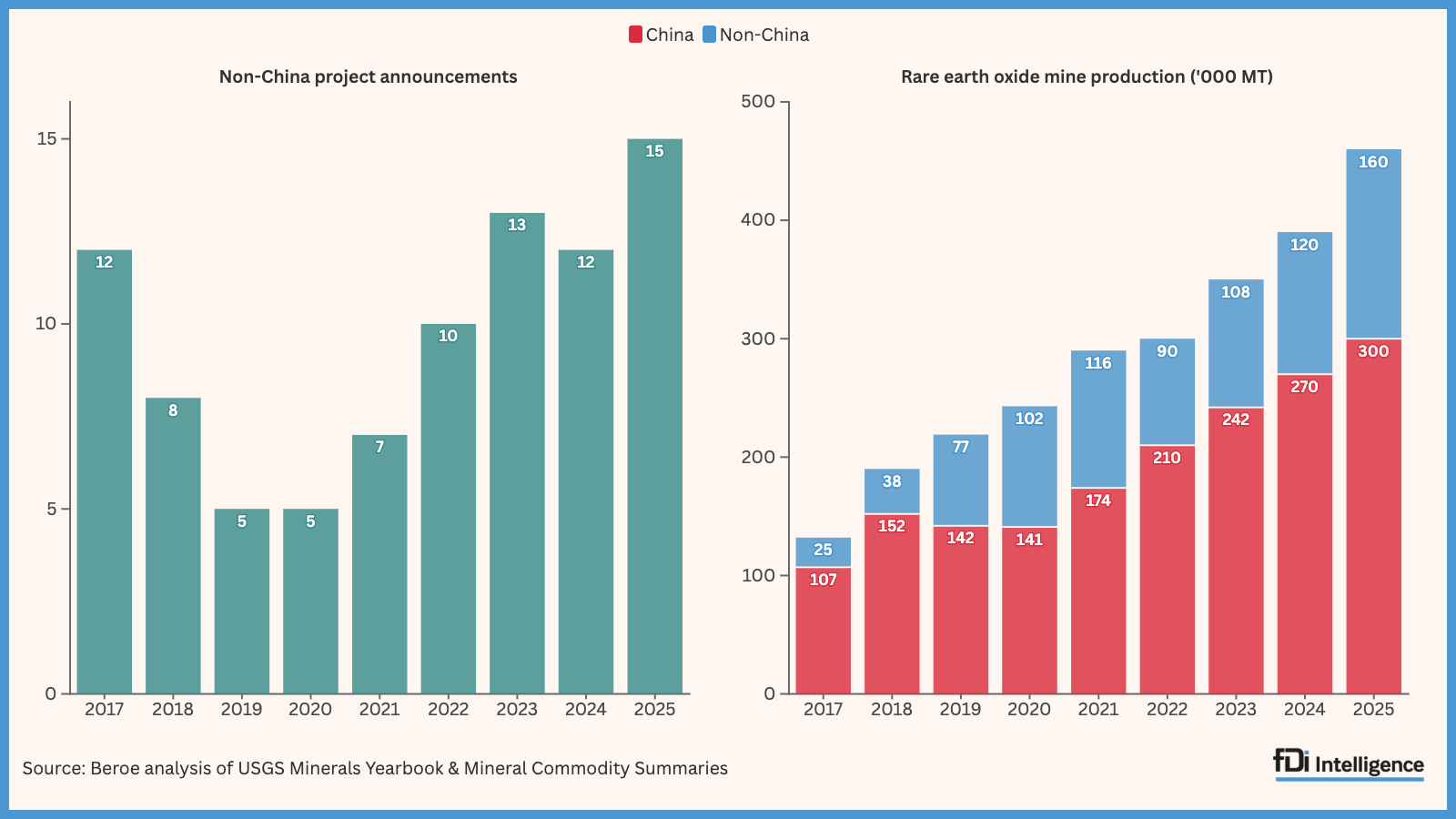
Non-China Rare Earth Projects and Production See Significant Boost
Non-China rare earth project announcements surged to 15 in 2025, a threefold increase from 2019 levels, signaling a decisive push to build refining capacity outside China. Concurrently, non-China mine production is projected to reach 160,000 MT by 2025, nearly six times its 2017 output, actively reducing reliance on Chinese supply.
Diversification Efforts Reshape Global Rare Earth Supply Chain
This aggressive capacity build-up outside China is critical for mitigating geopolitical supply risks and achieving rare earth independence. As non-China production dramatically scales, the market’s previous reliance on China (which still commands 65% of global mine output in 2025) will gradually erode, fostering a more resilient global supply chain.
China Controls 91% of Rare Earth Refining
China currently refines 91% of the world’s rare earths, dominating critical mineral supply chains. This near-monopoly extends to 18 other essential minerals, averaging 70% of global refined production across sectors like AI, defense, and renewables, as of 2025.
(Source: Developing Rare Earth Processing Hubs: An Analytical Approach)
$1.6 B for USA Rare Earth, US Government Direct Equity Investment Signals Policy Shift
Direct government financial intervention became the primary catalyst for de-risking and advancing capital-intensive REE processing projects outside China in 2025-2026. This policy shift, moving from indirect support to direct investment and offtake guarantees, provided the commercial certainty necessary to attract private capital and begin construction.
- In 2026, the U.S. government made its largest-ever investment in the sector, with USA Rare Earth receiving access to up to $1.6 billion in proposed funding under the CHIPS Act. The deal reportedly included the Commerce Department taking an equity stake in the company, signaling a new model of public-private partnership.
- The U.S. Department of Defense (Do D) established a critical commercial backstop for MP Materials through a 10-year offtake agreement. This deal set a price floor of $110/kg for Nd Pr, insulating the project from Chinese-driven price volatility and securing a foundational customer for its magnet output.
- Private funding also gained traction on the back of government support. In 2026, REalloys announced it was fully financed to build the Western Hemisphere’s first commercial-scale heavy rare earth metallization facility after securing approximately $100 million from investors.
Arafura Resources Secures Offtake Agreements for Nolans Project (2025 to 2026)
To secure project financing and guarantee a market for their future output, emerging Western REE refiners are aggressively forming strategic partnerships, particularly binding offtake agreements with downstream customers and government agencies. These agreements are crucial for demonstrating commercial viability to lenders and investors.
- Australia’s Arafura Resources is actively securing binding offtake agreements for its Nolans Project to underwrite the project’s financing ahead of a final investment decision. This strategy is essential for a greenfield project facing high upfront capital costs.
- The most significant partnership model established is the MP Materials 10-year offtake agreement with the U.S. Department of Defense. This arrangement not only guarantees revenue but also validates the strategic importance of the project for national security.
- Specialized processors are also locking in their supply chains. REalloys signed long-term supply agreements with the Saskatchewan Research Council (SRC) in Canada, securing the separated heavy rare earths needed for its metallization facility.
- In Europe, a joint venture was formed between Critical Metals Corp. and the Romanian state-owned company RMGC. This partnership aims to establish a European REE processing facility, demonstrating cross-border collaboration to build regional supply chains.
Table: Key Rare Earth Processing Partnerships and Agreements (2025-2026)
| Partner / Project | Time Frame | Details and Strategic Purpose | Source |
|---|---|---|---|
| MP Materials & U.S. Department of Defense | Jul 2025 | 10-year offtake agreement with a price floor of $110/kg for Nd Pr to de-risk magnet plant investment and secure defense supply. | Reuters |
| REalloys & Saskatchewan Research Council (SRC) | Jul 2026 | Long-term supply agreements for separated heavy REEs to provide feedstock for the first commercial heavy REE metallization facility in the Western Hemisphere. | Guru Focus |
| Critical Metals Corp. & Romania (RMGC) | Dec 2025 | Formation of a joint venture to develop a rare earth processing plant in Romania, aiming to create a European domestic supply chain. | Mining Technology |
US and Australia Lead, Non-Chinese Rare Earth Processing Hubs Emerge
North America and Australia have solidified their positions as the primary centers for developing an ex-China REE supply chain, with each region leveraging distinct advantages in government policy, resource availability, and existing infrastructure. Europe is emerging as a third hub, focused on processing and recycling to serve its industrial base.
- The United States is focused on building fully integrated “mine-to-magnet” capabilities, leveraging massive federal support. Key projects include MP Materials‘ operations in California and Texas and USA Rare Earth‘s planned facilities in Texas and South Carolina. Activity in North America is further supported by Canada’s critical minerals strategy, which includes funding for processing technology developers like Ucore.
- Australia is leveraging its significant rare earth deposits to build integrated “mine-to-oxide” facilities. This strategy is exemplified by Arafura Resources’ Nolans Project and Iluka Resources’ Eneabba refinery. These projects aim to capture more value onshore rather than exporting raw concentrate, a model also pursued by Lynas Rare Earths with its processing plant in Kalgoorlie.
- Europe is creating a regional processing capacity to reduce its import reliance. The joint venture in Romania between Critical Metals Corp. and the government is a key example, aiming to process REEs for the continent’s automotive and renewable energy sectors.
From Pilot to Production, MP Materials and Energy Fuels Validate Separation Technology
In 2026, Western REE processing technologies began a critical transition from pilot scale to commercial production, primarily using established solvent extraction methods for light rare earths (LREEs). While LREE separation is now proven outside China, the capacity for separating more valuable heavy rare earths (HREEs) at scale remains a developing capability.
- Prior to 2025, most non-Chinese separation technologies were at the demonstration or pilot stage. In 2026, MP Materials began ramping up its Stage II commercial separation facility, providing the first major validation of scaled LREE production in the U.S. in decades.
- Energy Fuels repurposed its White Mesa Mill in Utah to successfully produce separated Nd Pr oxide from monazite sands, demonstrating the viability of using existing licensed facilities. The company is now targeting commercial production of heavy rare earths like terbium by 2027, with a feasibility study showing low projected production costs of $29.39/kg for Nd Pr.
- While proven methods advance, development of novel technologies continues. Ucore Rare Metals is advancing its Rapid SX™ separation technology with support from the Canadian government, aiming to establish a North American Strategic Metals Complex.
- Downstream processing is also maturing. REalloys is moving forward with the first commercial-scale heavy rare earth metallization facility in the West, a critical step that converts separated oxides into the metals required for magnet production.
SWOT Analysis, USA Rare Earth Navigates Price Volatility and Execution Risk
While robust government support and clear market demand provide powerful tailwinds for the emerging Western REE industry, new processors face significant execution risks. These include potential market manipulation by China, high capital costs, and the long, complex timelines required to build and scale first-of-a-kind facilities.
- The primary strength of the Western REE sector is unprecedented government backing, exemplified by direct investments and offtake agreements that mitigate market risk.
- A key weakness is the immense capital required and the lack of recent operational expertise in building and running these complex chemical processing plants at scale compared to China.
- The greatest opportunity lies in capturing a share of the rapidly growing demand from the EV and renewable energy sectors, which are actively seeking to diversify their supply chains.
- The most significant threat remains China’s ability to manipulate global prices. By flooding the market, it could render new Western projects unprofitable without continued government price support mechanisms.
Table: SWOT Analysis for Western Rare Earth Processing (2021-2026)
| SWOT Category | 2021 – 2024 | 2025 – 2026 | What Changed / Validated |
|---|---|---|---|
| Strengths | Large undeveloped REE deposits in Australia, Canada, US. Strong political will but limited funding. | Direct government funding ($1.6 B CHIPS Act for USA Rare Earth), offtake price floors (MP Materials/Do D), integrated mine-to-magnet models. | Political will translated into direct, bankable financial commitments, de-risking initial project development. |
| Weaknesses | Near-total reliance on China for processing. High CAPEX and lack of project financing. Absence of a skilled workforce. | Continued high capital costs and long construction timelines. Technical execution risk on first-of-a-kind plants. Limited operational experience. | The fundamental challenges of building complex industrial plants remain, shifting the focus from financing risk to execution risk. |
| Opportunities | Rising demand from EV and wind sectors. Geopolitical desire for supply chain diversification. | Proven demand from defense and energy sectors willing to sign long-term offtakes. Creation of a non-Chinese price index. | The abstract desire for diversification solidified into concrete commercial agreements and strategic partnerships. |
| Threats | Threat of Chinese export restrictions and price manipulation. Environmental and permitting hurdles. | China’s export controls were enacted in 2025. Ongoing risk of Chinese entities dumping product to undermine Western producers. | The theoretical threat of Chinese supply weaponization became a reality, validating the entire Western investment thesis. |

Non-China Rare Earth Capacity Building Accelerates Rapidly
Non-China rare earth project announcements surged 114% from 7 in 2021 to 15 in 2025, indicating a robust acceleration in building refining capacity outside China. This growth is mirrored by non-China rare earth oxide mine production, projected to increase over 6x from 25 ‘000 MT in 2017 to 160 “000 MT by 2025, signaling a significant shift in the global rare earth supply landscape as the world gears up for 2026 and beyond.
Diversified Rare Earth Supply Chains Enhance Geopolitical Resilience
This aggressive capacity expansion outside China is a direct response to geopolitical risks and critical material supply chain vulnerabilities. By 2025, non-China production is projected to reach 160 “000 MT, securing diversified access to essential rare earth elements vital for defense, advanced electronics, and EV manufacturing. This trend is crucial for global economic resilience, mitigating dependence on single-source suppliers and stabilizing prices in key industrial sectors.
China’s Near-Monopoly in Rare Earth Refining Exposed
China dominates global rare earth refining, holding a 91% market share. This near-monopoly extends across 19 of 20 critical minerals, highlighting profound supply chain vulnerabilities for key sectors like AI, defense, and clean energy.
(Source: Can the U.S. Reduce Its Reliance on Imported Rare Earth Elements? | Econofact)
If China Expands Controls, Watch USA Rare Earth and MP Materials for Price Signals
The primary variable shaping the 2027-2028 trajectory of the Western REE industry is China’s next strategic move on export controls. Should Beijing tighten its grip on processed materials or magnets, the pace of Western diversification will be determined by the speed of follow-on government funding and the durability of alternative pricing mechanisms.
- If China expands export restrictions to include Nd Pr oxide or finished magnets, watch for the U.S. government and its allies to issue additional high-volume offtake agreements with guaranteed price floors. This would signal a commitment to insulating the entire emerging industry from Chinese market manipulation.
- Watch the final investment decision and construction progress at USA Rare Earth‘s South Carolina magnet plant. As the recipient of a landmark government investment, its ability to execute on schedule will serve as a critical bellwether for the de-risked public-private investment model.
- Monitor for further consolidation and vertical integration. Moves like USA Rare Earth’s acquisition of the producing Serra Verde mine in Brazil show that companies are seeking to accelerate timelines and secure feedstock through M&A rather than relying solely on lengthy greenfield development.
The questions your competitors are already asking
This report covers one angle of the emerging non-China rare earth processing market. The questions that matter most depend on your work.
- New rare earth processing plants North America
- Companies signing rare earth supply contracts
- Heavy rare earth separation technology companies
- Impact of new China export controls on magnets
This report does not answer these. Enki Brief Pro does.
Your question, your angle, your framework. SWOT, PESTL, scenario modelling. The same niche depth, built around the decision your work actually depends on.
