

Rare Earths Supply Risk, $6.5 T IEA Warning, 10 US Firms Targeted, and MP Materials’ $110/kg Do D Deal (2025-2026)
Industry Risks from China’s REE Export Controls
China’s implementation of rare earth element (REE) export controls throughout 2025 and 2026 exposed profound, long-standing vulnerabilities in global supply chains, placing an estimated $6.5 trillion in downstream industrial output at risk. The actions, moving from threat to reality, demonstrated Beijing’s willingness to use its near-monopoly on REE processing as a tool of statecraft, forcing Western nations and corporations into a reactive and costly scramble to secure alternative supplies for critical defense, energy, and technology sectors.
- Prior to 2025, the risk from China’s dominance was largely theoretical, despite its control over 90% of REE processing and magnet manufacturing. Western industries operated on the assumption of uninterrupted supply, creating deep dependencies.
- On April 4, 2025, China enacted export controls on seven heavy rare earths and permanent magnets, causing immediate price volatility and supply disruptions for automotive and defense manufacturers. This marked the first major translation of supply chain dominance into active geopolitical leverage.
- The controls were intensified on October 9, 2025, with a more comprehensive regime covering a wider range of REEs, as well as the processing equipment and technologies required to build a competing supply chain. This signaled a strategic intent to not only control the materials but also to inhibit the development of alternative production capabilities.
- While the October controls were temporarily suspended in November 2025 for one year, the initial shock and a subsequent tightening of controls against 10 specific U.S. companies in June 2026 confirmed that the threat remains active, fundamentally altering the risk calculus for industries reliant on these materials.
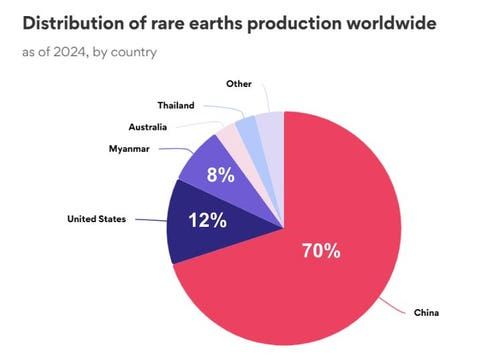
China Controls 70% of Global Rare Earth Production
As of 2024, China commands a dominant 70% share of global rare earth production, far outpacing the United States (12%) and Myanmar (8%). This extreme concentration creates a critical single point of failure in the global supply chain, exacerbating geopolitical risks.
Supply Concentration Poses $6.5 Trillion Global Industrial Output Risk
China’s overwhelming rare earth dominance exposes $6.5 trillion in global industrial output to significant risk, as potential 2026 export controls could cripple critical sectors like EVs, defense, and advanced electronics. This strategic dependency demands urgent, proactive de-risking efforts.
Rare Earth Exports Plunge Post-April 2025 Controls
China’s rare earth exports to the US plummeted from average monthly highs of over 100 metric tons in late 2024 (e.g., 123 MT in Dec 2024) to near-zero levels post-April 2025, after export controls took effect. An unexpected surge to 72 MT occurred in March 2026, primarily Yttrium and Lutetium, followed by an immediate sharp decline, indicating continued volatility and a largely restricted supply.
(Source: China announces rare earth export restrictions – The Oregon Group)
$110/kg Price Floor, US Government De-Risks REE Investment
Direct government intervention through price guarantees and strategic funding has become the primary mechanism to de-risk private investment in a Western rare earth supply chain that cannot compete with China on cost alone. These financial backstops are essential to attract the long-term capital required for projects that would otherwise be unviable against China’s state-subsidized price structure.
- The most significant intervention is the U.S. Department of Defense’s 10-year offtake agreement with MP Materials, which establishes a price floor of $110/kg for Neodymium-Praseodymium (Nd Pr) oxide. This provides the revenue certainty needed to support the company’s investment in a fully integrated U.S. mine-to-magnet supply chain.
- This guaranteed price is critical because non-Chinese producers require an incentive price of $75-$105/kg to be commercially viable, while Chinese producers can operate profitably at prices below $65/kg, giving them the ability to flood the market and bankrupt competitors.
- The need for such interventions highlights the market failure in critical minerals; the entire global REE market was valued at only $9.06 billion in 2025, a fraction of the $6.5 trillion in downstream value it enables, making it an asymmetric lever for China. Similar supply chain security efforts are seen in the auto industry, where companies like GM have made direct investments in miners like Lithium Americas to secure battery materials.
Table: Key Public-Private Investments in the REE Supply Chain
| Partner / Project | Time Frame | Details and Strategic Purpose | Source |
|---|---|---|---|
| MP Materials / Do D | July 2025 | 10-year offtake agreement with a $110/kg price floor for Nd Pr oxide. Designed to provide long-term revenue certainty and de-risk the establishment of a domestic U.S. mine-to-magnet supply chain. | Sprott Rare Earths Ex-China ETFs Investor Presentation |
| IEA Analysis | July 2026 | The IEA identified a $6.5 trillion risk to Western industrial output, underscoring the urgency for public funding to secure supply chains independent of China’s control. | Reuters |
| China Export Controls | April 2025 | China’s export controls on magnets and heavy REEs catalyzed Western government action, framing investment not as a commercial decision but as a matter of national and economic security. | CSIS |
US and Allies, Geographic Focus for a “China+1” Strategy
China’s actions have accelerated a geographic re-alignment of the critical minerals supply chain away from a single point of failure and toward a “China+1” or “friend-shoring” model, centered on the U.S., Australia, and Canada. While China remains the dominant player, significant policy and investment efforts are now directed at building parallel supply networks within allied nations, though these efforts remain in their infancy.
- The United States is the epicenter of this shift, with government policy and funding focused on re-shoring the entire value chain, exemplified by support for MP Materials‘ Mountain Pass facility in California. This project aims to restore domestic processing and magnet production, which was lost to China decades ago.
- Australia, home to Lynas Rare Earths, the largest non-Chinese REE producer, serves as a cornerstone of the alternative supply chain. Lynas has partnered with the U.S. Do D to build processing facilities in Texas, directly linking Australian mining with U.S. downstream manufacturing needs.
- Canada is emerging as a key partner, leveraging its rich mineral resources and proximity to the U.S. market. Federal programs are in place to support the development of Canadian critical mineral projects, from miners like Hudbay Minerals to tungsten developers like Almonty Industries, positioning the country as a secure North American source.
- Chilean copper miners like Antofagasta and Canadian developers such as Eldorado Gold are also part of the broader effort to diversify sources of all critical minerals beyond single-country dependency.
Technology Maturity: A Decades-Long Gap in Mid-Stream Processing
The core technological challenge for the West is not in mining REEs but in replicating the complex, capital-intensive, and environmentally challenging mid-stream processing and refining capabilities that China has consolidated over 30 years. While mining and end-product manufacturing are well-understood, the separation of individual rare earth oxides and their conversion into metals and alloys at scale represents a critical and long-term capability gap.
- Upstream mining technology is mature in the West. Companies have the technical ability to extract ore, but until 2025, nearly all ore, including that mined in the U.S., was sent to China for processing due to a lack of domestic capacity.
- Mid-stream separation and refining is the primary bottleneck. China controls 91% of this capacity. Building a single integrated mine-to-magnet supply chain is estimated to take 10-15 years and billions in capital, a timeline that leaves Western industries exposed for the foreseeable future. Efforts by companies like Re Element to build new refining capacity are underway but are years from matching Chinese scale.
- Downstream, the production of high-performance Nd Fe B permanent magnets is also dominated by China (over 90%). While the technology is known, China’s scale, cost structure, and integration with the rest of the supply chain create formidable barriers to entry.
- Emerging technologies like REE recycling and material substitution, such as advanced graphene from firms like Avadain, offer potential long-term solutions but are not yet mature enough to mitigate the immediate supply risk. They represent R&D-stage alternatives rather than commercially scaled solutions for the current decade.
SWOT Analysis, China Rare Earths Supply Chain Risk
The strategic challenge for Western industries is defined by a fundamental mismatch in timelines and cost structures against a dominant, state-directed competitor. While the political will to act is a new strength, the structural weaknesses of high costs and long development cycles remain, with China’s market power representing an ever-present threat.
Table: SWOT Analysis of the Western REE Supply Chain Response
| SWOT Category | 2021 – 2024 | 2025 – Today | What Changed / Validated |
|---|---|---|---|
| Strength | Rich, undeveloped rare earth deposits in allied nations (U.S., Australia, Canada). Strong R&D and technological capabilities in materials science. | Bipartisan political will for supply chain security. Government funding and price guarantees (e.g., $110/kg Nd Pr floor) are now in place to de-risk private investment. | The latent potential of Western resources and policy was activated by a direct threat. Government intervention is now a validated and necessary component of the strategy. |
| Weakness | Near-total absence of mid-stream processing and refining capacity. High labor and environmental compliance costs compared to China. | The 10-15 year timeline to build a single integrated supply chain is now a stark reality. A significant talent gap exists in REE metallurgy and processing. | The theoretical weakness of a hollowed-out industrial base was validated as an immediate economic and national security vulnerability when China activated its controls. |
| Opportunity | Growing demand from EVs, wind turbines, and defense created a commercial case for diversification. “Green” branding for ethically sourced minerals. | “Friend-shoring” and trade bloc alignment (e.g., U.S.-Canada-Australia). Development of recycling technologies and substitution materials is accelerating. | The geopolitical risk has become the primary driver, transforming a commercial opportunity into a strategic imperative and unlocking significant public capital. |
| Threat | Latent threat of China weaponizing its REE dominance, as seen in a 2010 incident with Japan. Price volatility manipulated by Chinese quota adjustments. | China’s export controls are now a proven reality, not a theoretical threat. China can manipulate prices to make Western projects unprofitable, as its producers operate below the $75/kg viability threshold for new mines. | The primary threat was validated and escalated. China demonstrated not only its control over supply but its willingness to use it and to target specific companies and nations. |
Scenario Modeling for REE Supply Chains Post-2026
The single most critical catalyst to monitor is the status of China’s comprehensive export controls in November 2026, when the current temporary suspension is set to expire. Beijing’s decision to either re-impose, modify, or abandon the controls will dictate the urgency, pace, and financial risk of all Western diversification efforts for the remainder of the decade.
- If China re-imposes the full October 2025 controls, watch for an immediate spike in REE prices and a scramble to finalize offtake agreements and FIDs for Western processing facilities. This would validate the “national security” argument for public funding and likely trigger more aggressive government interventions and subsidies.
- If China allows the controls to lapse or replaces them with a less severe quota system, watch for a potential softening of REE prices. This could undermine the commercial viability of Western projects in development, making them dependent on sustained government price floors. The key signal will be whether private capital retreats, viewing the threat as diminished.
- Regardless of China’s action, the key trend to watch is the flow of capital into mid-stream processing. The number of bankable feasibility studies that convert into fully funded projects for separation and refining facilities in North America and Europe is the only true long-term indicator of successful diversification.
The questions your competitors are already asking
This report covers one angle of the geopolitical risk in the rare earth supply chain. The questions that matter most depend on your work.
- Rare earth processing projects outside China
- Impact of further China export controls on car manufacturing
- Companies securing long term rare earth supply contracts
- New rare earth mines in Canada and Australia
This report does not answer these. Enki Brief Pro does.
Your question, your angle, your framework. SWOT, PESTL, scenario modelling. The same niche depth, built around the decision your work actually depends on.
