

Top 10 Behind-the-Meter Power Projects: Fermi America’s 11, 000 MW Plan and 48 GW Surge (2024-2025)
The explosive power demand from artificial intelligence is forcing data center developers to adopt a radical new strategy: bypassing the public grid entirely. Analysis of project announcements in 2024 and 2025 reveals a decisive pivot towards large-scale, behind-the-meter (BTM) power generation. This “bring your own generation” model, dominated by reliable natural gas but with an eye towards future hybrid systems, is a direct response to multi-year grid interconnection delays and capacity shortfalls. Projects like the massive 11, 000 MW Fermi America campus and the 7, 650 MW GW Ranch highlight a fundamental re-architecting of how critical digital infrastructure is powered. The dominant theme for 2025 is energy self-sufficiency, with tech giants and developers directly funding and co-locating multi-gigawatt power plants to guarantee speed-to-market and operational uptime for their AI-driven operations.
1. Fermi America Data Center-Power Campus (Texas)
Company: Fermi America
Installation Capacity: 11, 000 MW (11 GW)
Applications: Hyperscale data centers (18 million square feet)
Source: Power Hungry: AI-Fueled Data Center Boom Sets Energy – ENR
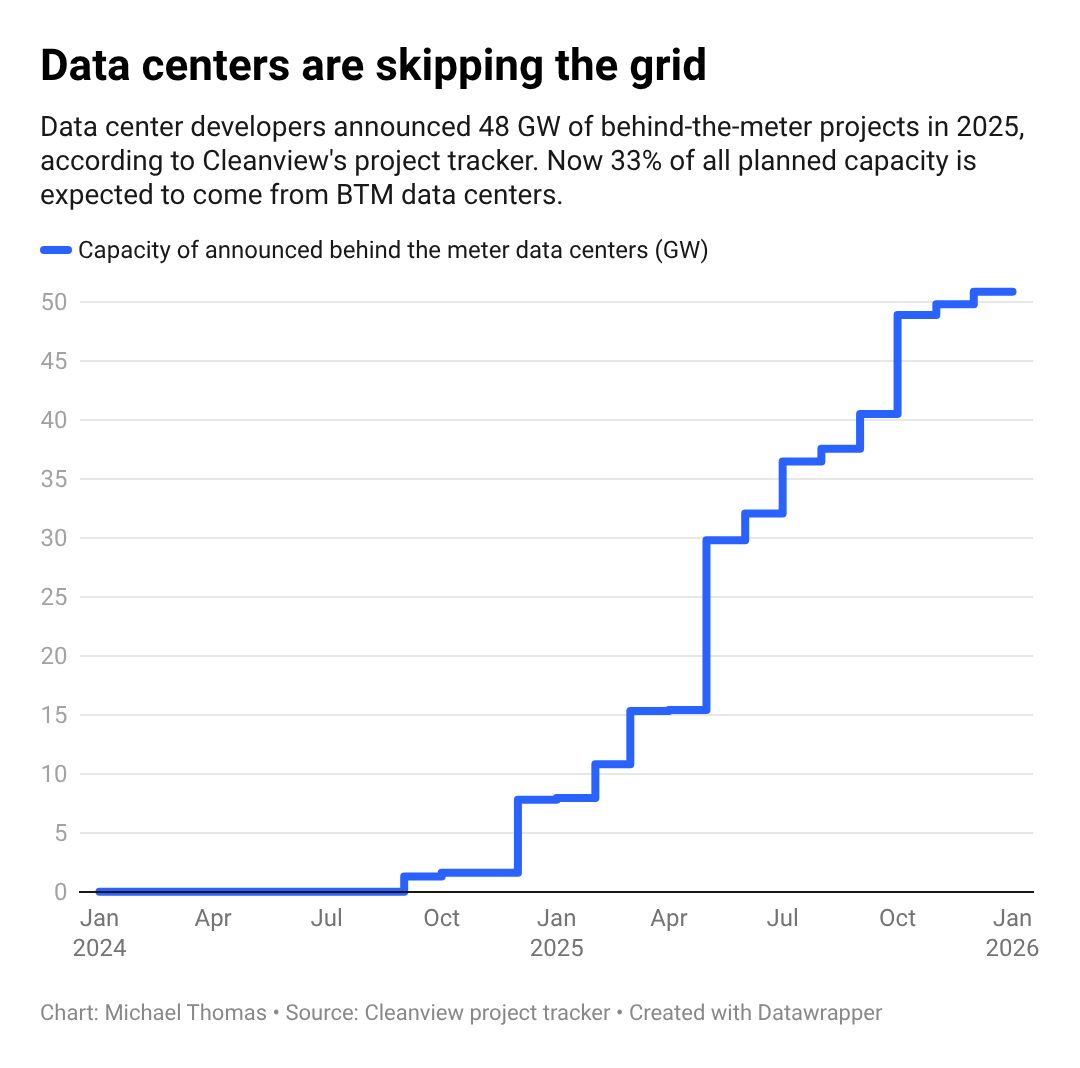
Data Centers Are Skipping The Grid
This section, the first project listed, describes a ‘Power Campus’ in Texas. It is matched with a chart that explains the foundational trend driving this and all subsequent projects: data centers are increasingly building their own power and ‘skipping the grid’.
(Source: Distilled)
2. GW Ranch (Texas)
Company: Pacifico Energy
Installation Capacity: 7, 650 MW (7.65 GW)
Applications: Off-grid power for data centers
Source: GW Ranch | Off-Grid Power Generation – Pacifico Energy

Behind-the-Meter Solar Cheaper Than Grid for AI Data Centers
While the section lacks detail, the name ‘GW Ranch’ combined with its Texas location strongly implies a large land area suitable for a solar farm, a common use for ‘ranch’ properties in the state. This makes it the most plausible match for the solar-specific cost chart.
(Source: Energy Industry Insights from Avanza Energy – Substack)
3. Homer City Redevelopment (Pennsylvania)
Company: Homer City Redevelopment
Installation Capacity: 4, 400 MW (4.4 GW)
Applications: AI-driven hyperscale data centers
Source: Project Overview – Homer City Redevelopment
4. Chevron, Engine No. 1, and GE Vernova Joint Development (USA)
Company: Chevron, Engine No. 1, and GE Vernova
Installation Capacity: Up to 4, 000 MW (4 GW)
Applications: U.S. data centers
Source: Chevron, Engine No. 1 and GE Vernova To Power U.S. Data Centers

US Plans Huge Power Capacity Additions Through 2029
This section describes a major, national-level joint development by energy giants. It aligns perfectly with the chart showing the massive scale of planned power capacity additions across the entire US.
(Source: Energy Central)
5. Oracle / Volta Grid Modular Gas Fleet (Texas)
Company: Oracle / Volta Grid
Installation Capacity: 2, 300 MW (2.3 GW)
Applications: Oracle Cloud Infrastructure data centers
Source: Oracle Taps Volta Grid for 2.3-GW Modular Gas Fleet to Power AI …

US Gas Power Plant Construction Remains High
The section details a specific project utilizing a ‘Modular Gas Fleet’. The chart provides the broader market context, showing that this technology choice is part of a significant, ongoing trend of gas power plant construction in the US.
(Source: Cleanview Newsletter)
6. MSB Global Data Center Campus (Texas)
Company: MSB Global Services
Installation Capacity: 1, 400 MW
Applications: Data center campus
Source: Sulphur Springs – MSB Global

Datacenter Power Redundancy Needs Increase with Unit Size
This section concerns a large ‘Data Center Campus’. The chart explains a critical technical consideration for such large-scale projects: the need for increased power redundancy (e.g., N+1, 2N) as the facility’s size and power demands grow.
(Source: SemiAnalysis)
7. Cloud Burst / Energy Transfer Gas Supply Agreement (Texas)
Company: Cloud Burst / Energy Transfer
Installation Capacity: ~1, 200 MW (1.2 GW)
Applications: Data center campus
Source: Energy Transfer and Cloud Burst Sign Agreement for Natural Gas …

Texas Power Demand Vastly Outstrips Grid Supply
The chart clearly illustrates the significant power supply deficit on the Texas grid. This directly explains the motivation for a ‘Gas Supply Agreement’ for on-site power, as described in the section; it’s a solution to the problem shown in the chart.
(Source: SemiAnalysis)
8. International Electric Power (IEP) Data Center Plant (Pennsylvania)
Company: International Electric Power (IEP)
Installation Capacity: 944 MW
Applications: Data center
Source: IEP plans 944-MW behind-the-meter gas plant to power PA data …
9. Williams Companies / Meta Socrates Power Solution (Ohio)
Company: Williams Companies / Meta
Installation Capacity: 400 MW
Applications: Meta-affiliated data center
Source: Socrates Power Solution Facilities – Williams Companies
10. Quantum Loophole Data Center Campus (Maryland)
Company: Quantum Loophole
Installation Capacity: 1, 800 MW (1.8 GW)
Applications: Multiple hyperscale data centers
Source: Top 10: Biggest Data Centre Projects
Table: Top Behind-the-Meter Power Projects for Data Centers (2024-2025)
| Company / Developer | Installation Capacity (MW) | Applications | Source |
|---|---|---|---|
| Fermi America | 11, 000 | Hyperscale data centers | Power Hungry: AI-Fueled Data Center Boom Sets Energy – ENR |
| Pacifico Energy | 7, 650 | Off-grid power for data centers | GW Ranch | Off-Grid Power Generation – Pacifico Energy |
| Homer City Redevelopment | 4, 400 | AI-driven hyperscale data centers | Project Overview – Homer City Redevelopment |
| Chevron, Engine No. 1, GE Vernova | 4, 000 | U.S. data centers | Chevron, Engine No. 1 and GE Vernova To Power U.S. Data Centers |
| Oracle / Volta Grid | 2, 300 | Oracle Cloud Infrastructure data centers | Oracle Taps Volta Grid for 2.3-GW Modular Gas Fleet to Power AI … |
| Quantum Loophole | 1, 800 | Multiple hyperscale data centers | Top 10: Biggest Data Centre Projects |
| MSB Global Services | 1, 400 | Data center campus | Sulphur Springs – MSB Global |
| Cloud Burst / Energy Transfer | ~1, 200 | Data center campus | Energy Transfer and Cloud Burst Sign Agreement for Natural Gas … |
| International Electric Power (IEP) | 944 | Data center | IEP plans 944-MW behind-the-meter gas plant to power PA data … |
| Williams Companies / Meta | 400 | Meta-affiliated data center | Socrates Power Solution Facilities – Williams Companies |

Data Center Power Waits Can Exceed 7 Years
The Quantum Loophole project is located in Maryland, a state known for having some of the longest grid interconnection queues in the country. The chart perfectly illustrates the acute problem of multi-year wait times that this project is designed to solve.
(Source: Energy Industry Insights from Avanza Energy – Substack)
48 GW in 2025, Data Centers Adopt Behind-the-Meter Power
The adoption of behind-the-meter power is no longer a niche consideration but a central strategic pillar for hyperscale and AI-focused data center operators. The sheer scale, with nearly 48 GW of BTM capacity announced in 2025 alone, signals a widespread industry movement. This is driven by major technology companies like Meta and Oracle, which are securing their power supply to avoid business disruption. The diversity of adoption models further underscores this trend. These range from developing massive, integrated energy parks like the Fermi America campus to re-purposing industrial sites like the Homer City coal plant redevelopment. This variety implies that the BTM approach is flexible enough to be applied in different contexts, whether through new-builds, modular deployments, or infrastructure retrofits, solidifying its role as a key solution to the data center power challenge.

Data Centers Plan 90 GW of Private Power
The section heading states that data centers are adopting behind-the-meter power. The chart quantifies the enormous scale of this trend (’90 GW of Private Power’), providing a wider context for the ’48 GW in 2025′ figure mentioned in the section.
(Source: Cleanview)
Texas Leads US, Behind-the-Meter Power for Data Centers
Geographic analysis of these projects reveals a strong concentration in Texas, which has emerged as the epicenter of the BTM data center boom. With over 21 GW of BTM capacity announced across projects from Fermi America, Pacifico Energy, MSB Global, and Cloud Burst, the state’s combination of a favorable regulatory environment, extensive natural gas infrastructure, and high demand for data center capacity makes it an ideal location. However, the trend is not exclusive to the Lone Star State. Significant projects are also underway in the industrial heartland, such as the 4, 400 MW Homer City redevelopment and the 944 MW IEP plant in Pennsylvania, along with the 400 MW Williams/Meta project in Ohio. This geographic spread indicates that the strategy is being replicated in any region that possesses both a growing data center presence and access to the necessary energy resources, particularly natural gas pipelines.

Texas Dominates in Behind-the-Meter Power Capacity
This is a direct match. The section heading ‘Texas Leads US, Behind-the-Meter Power for Data Centers’ and the chart headline ‘Texas Dominates in Behind-the-Meter Power Capacity’ convey the exact same message.
(Source: Cleanview)
Volta Grid’s 2, 300 MW Modular Gas Fleet for Oracle (2025)
While nearly all projects rely on natural gas for its dispatchability, the data reveals different levels of technological maturity and future planning. Mature, proven combined-cycle gas turbine technology forms the backbone of large-scale projects like the Chevron/GE Vernova joint venture and the Williams facilities for Meta. These represent the most commercially ready, reliable solution for providing baseload power to multi-megawatt facilities today. In parallel, the market is embracing innovative deployment models. The 2, 300 MW deal between Oracle and Volta Grid in October 2025 highlights the growing maturity of modular, reciprocating natural gas generators that offer scalability and rapid deployment. Looking further ahead, the most ambitious projects like Fermi America and GW Ranch explicitly include solar, wind, battery storage, and even advanced nuclear in their long-term roadmaps. This signals that while natural gas is the indispensable bridge, the ultimate goal is a hybrid, integrated energy system that balances reliability with future sustainability objectives.

On-Site Power Cheaper Than Grid for Data Centers
This section highlights the Oracle/Volta Grid project as a key case study in behind-the-meter power. The chart provides the fundamental economic rationale for such a project, showing that on-site power is a cheaper alternative to the grid.
(Source: Energy Industry Insights from Avanza Energy – Substack)
Future Scenarios, Hybrid Energy Parks and Advanced Nuclear
The critical strategic action for the coming 18 months is the race to secure not just land, but integrated energy partnerships. If hyperscalers and developers successfully execute these initial BTM projects, watch for a profound shift in utility business models as they risk losing their largest growth customers. The competitive landscape will increasingly favor companies that can master energy development and fuel supply alongside data center operations.
- The consistent selection of natural gas in 2025 across major projects by Williams, Energy Transfer, and at Homer City confirms it is the only technology currently trusted to deliver the necessary reliability and scale for AI workloads in the near term.
- Ambitious hybrid models are gaining serious traction as the long-term vision. The plans for Fermi America (gas, solar, wind, nuclear) and GW Ranch (gas, solar, battery) are the strongest signals of a strategic pivot towards integrated, lower-carbon energy parks.
- The Volta Grid contract to supply 2.3 GW of modular power to Oracle demonstrates that rapid, scalable generation is now a mature and critical enabler, allowing companies to bypass the slower timelines of traditional power plant construction.
- The 4.4 GW Homer City project, which converts a decommissioned coal plant for data center use, establishes infrastructure reuse as a viable and potentially faster pathway for BTM development.