

Sempra Grid Modernization, $65 B Capital Plan, $36 B Oncor Investment, and $13 B 2026 Deployment (2024-2026)
Grid Modernization Risks, Sempra Navigates Execution and Supply Chains
U.S. utilities are escalating capital expenditures to unprecedented levels to meet a structural surge in electricity demand, but this rapid scale-up introduces significant execution, regulatory, and supply chain risks that threaten project timelines and costs. The focus has shifted from incremental upgrades for reliability to a full-scale race to build capacity, primarily driven by the power needs of new data centers and broad industrial electrification. This pivot has exposed critical vulnerabilities in the industrial base required to support such a build-out.
- Between 2021 and 2024, utility capital plans centered on grid resilience against extreme weather events and gradual modernization. During this period, Sempra operated under what was then a record $48 billion five-year plan, a figure that reflected a steady, predictable approach to upgrading aging infrastructure. The primary risk was managing discrete, regional projects.
- The period from 2025 to today is defined by a dramatic acceleration in response to revised load forecasts. Sempra’s capital plan jumped by over 35% to a new $65 billion five-year program announced in May 2026. This abrupt escalation, mirrored across the industry, immediately intensified pressure on an already constrained supply chain for essential components like large power transformers and high-voltage switchgear.
- The risk profile has fundamentally changed from managing contained infrastructure projects to navigating a systemic, industry-wide capacity shortage. The primary challenge is no longer just securing project financing but securing the physical equipment and skilled labor needed for execution in a highly competitive market where project lead times are extending significantly.
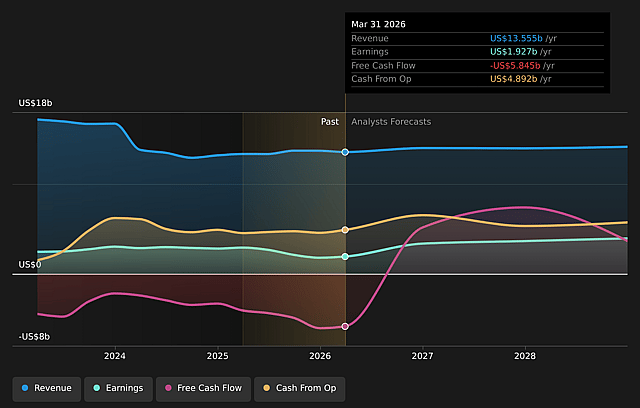
Sempra Financials Show Capex Impact on Cash
This section discusses the execution risks of grid modernization, and the chart illustrates a primary financial risk by showing how large capital expenditures can negatively impact cash flow.
(Source: Simply Wall St)
$65 B Capital Plan, Sempra Accelerates Investment for Grid Capacity
Sempra’s capital investment strategy shows a marked acceleration in 2025-2026, shifting from a previously record-high plan to a new, larger commitment that reflects the urgent need to expand grid capacity in high-growth markets. This front-loaded spending program is designed to address immediate demand pressures, particularly in Texas, and build a rate base that supports long-term earnings growth.
- Sempra’s five-year capital plan escalated from $48 billion for the 2024-2028 period to a new record of $65 billion for the subsequent five-year window, a clear indicator of the rising costs and expanding scope of grid modernization requirements.
- The planned capital deployment for the 2026 fiscal year alone is nearly $13 billion. This intense, front-loaded schedule is intended to get ahead of projected demand surges and underpins the company’s guidance for a 12% adjusted EPS growth target for the year.
- A substantial portion of this capital is channeled through its majority-owned Texas subsidiary, Oncor. Oncor announced its own aggressive $36 billion five-year capital plan for 2025-2029, with a strategic allocation of 60%, or approximately $21.6 billion, specifically for transmission projects to enhance grid stability and connect new generation.

Sempra Details $13B Investment for 2026
The section introduces Sempra’s broad $65B capital plan, and the chart provides a specific, concrete example of this investment by detailing the $13B planned for 2026, making the larger number more tangible.
(Source: BriefGlance)
Table: Sempra Capital Expenditure Plan Evolution
| Company / Entity | Time Frame | Details and Strategic Purpose | Source |
|---|---|---|---|
| Sempra | 5-Year Plan (Announced May 2026) | Record $65 billion capital plan for grid modernization and expansion, primarily in Texas and California, to meet surging demand from data centers and electrification. | Sempra Beats Estimates, Unveils $65 B Grid Modernization Plan |
| Sempra | 2026 Annual | Planned investment of nearly $13 billion in a single year to modernize infrastructure and support a targeted 12% adjusted EPS growth. | Sempra Reports First-Quarter 2026 Results |
| Oncor (Sempra Subsidiary) | 2025–2029 | A $36 billion five-year capital plan to support Texas’s rapid economic growth, with 60% ($21.6 B) dedicated to critical transmission projects. | ANNOUNCES $36 BILLION 2025-2029 CAPITAL PLAN |
| Sempra | 2024–2028 | Previous $48 billion five-year capital plan, which was a record at the time of its announcement and has since been superseded by the larger $65 billion plan. | What is Brief History of Sempra Company? |

Utility Capex Forecasts Shift to Grid Distribution
This section details the evolution of Sempra’s own capex plan. The chart provides the broader industry context, showing a strategic shift towards grid distribution, which likely explains the trends seen in Sempra’s evolving plan.
(Source: S&P Global)
Sempra 2 Strategic Alliances, Oncor and Conoco Phillips (2025)
Sempra’s execution strategy relies on two distinct partnership models: vertically integrated operational control through its subsidiary Oncor for regulated grid investment, and strategic commercial agreements with off-takers like Conoco Phillips for its non-regulated infrastructure projects. This dual approach allows the company to direct massive, rate-based investments while de-risking its large-scale energy export ventures.
- The primary vehicle for executing the Texas grid modernization is Sempra’s majority ownership in Oncor. This structure gives Sempra direct operational influence over the deployment of Oncor’s $36 billion capital plan, ensuring alignment with its broader corporate strategy and financial targets.
- In its non-regulated Sempra Infrastructure business, the company mitigates financial risk through long-term partnerships. The 20-year sales and purchase agreement with Conoco Phillips for the Port Arthur LNG project provides a guaranteed revenue stream that is essential for securing project financing for the multi-billion-dollar facility.
- Sempra also explicitly defines its relationship with policymakers and regulators as a form of collaborative partnership. This engagement is critical for aligning its infrastructure investments with state energy policies and, most importantly, for securing the regulatory approvals needed for timely cost recovery on its massive capital outlays.

North American LNG Export Capacity to Double
The section highlights a specific alliance with Conoco Phillips, a major player in oil and gas. The chart provides the market context for this partnership by showing the significant growth expected in LNG export capacity, a key strategic area for Sempra.
(Source: Seeking Alpha)
Table: Sempra Key Strategic Partnerships
| Partner / Entity | Time Frame | Details and Strategic Purpose | Source |
|---|---|---|---|
| Oncor | 2025-2029 | As a majority-owned subsidiary, Oncor acts as the primary execution arm for Sempra’s Texas grid strategy, deploying a $36 billion capital plan. | Sempra announces $56 B capital plan amid rapid Texas growth |
| Conoco Phillips | Announced Sep 2025 | Strategic partner and anchor offtaker for the Port Arthur LNG Phase 2 project, secured by a 20-year sales and purchase agreement that de-risks the investment. | Sempra Announces Strategic Transactions Advancing Goal… |
| Policymakers & Regulators | Ongoing | Collaboration to align infrastructure investments with state energy policies and secure regulatory approvals for cost recovery on capital-intensive projects. | 2024 Annual Report – Sempra |

Sempra Projects Strong EPS Growth Through 2030
A section outlining key strategic partnerships explains the ‘how’ of Sempra’s strategy. This chart shows the expected long-term result of these partnerships, linking the strategic initiatives to a key financial outcome: strong, projected EPS growth.
(Source: TIKR.com)
Texas and California, Sempra’s Concentrated Geographic Strategy
Sempra’s capital deployment is highly concentrated in Texas and California, two markets with divergent regulatory environments but a shared, urgent need for grid expansion driven by economic growth and energy transition policies. The recent acceleration in investment, however, shows a distinct strategic pivot toward Texas to meet its exceptional load growth.
- From 2021 to 2024, Sempra’s investments were more evenly balanced across its California (SDG&E) and Texas (Oncor) utilities, with a heavy focus on wildfire mitigation, public safety, and initial grid resilience measures in California.
- Beginning in 2025, the strategic emphasis and the bulk of new capital have decisively shifted towards Texas. Oncor’s $36 billion plan, with its massive $21.6 billion allocation to new transmission lines, is a direct response to the state’s projected load growth, which is among the highest in the nation due to data center proliferation and industrial expansion.
- California remains a core market, with ongoing investments directed at grid hardening, integrating a high percentage of renewable resources, and managing the demands of building and vehicle electrification. However, the sheer scale of new, concentrated industrial demand in Texas has made it the primary growth engine and the focus of Sempra’s most aggressive capital deployment.

US Data Centers Drive Gas Generation Projects
The section focuses on Sempra’s concentration in Texas and California. The chart explains a key demand driver in these markets, showing how the growth of data centers is fueling the need for new power generation, which validates Sempra’s geographic strategy.
(Source: Natural Gas Intelligence)
Grid Modernization Technology, Sempra Deploys at Commercial Scale
The technologies underpinning “grid modernization” are commercially mature, but the current challenge is deploying them at an unprecedented scale and speed, shifting the bottleneck from technology development to manufacturing capacity and project execution. The issue is not a lack of innovation but a shortage of the foundational industrial components needed for a nationwide grid build-out.
- Between 2021 and 2024, the deployment of grid technologies focused on improving efficiency at the distribution level. This included targeted rollouts of Advanced Metering Infrastructure (AMI) and distribution automation systems to enhance outage management and enable dynamic pricing.
- From 2025 onward, the investment focus has pivoted to the bulk power system. This involves the large-scale deployment of high-voltage transmission lines, new and expanded substations, and advanced grid control software designed to manage the highly variable loads from data centers and intermittent renewable generation. The successful operation of the digital grid is a core focus for companies like Aramco as well.
- While the core technologies like transformers, conductors, and control systems are well-established, the sudden, industry-wide surge in demand has exposed critical supply chain vulnerabilities. Lead times for large power transformers have stretched to years, not months, indicating a severe misalignment between the energy industry’s deployment ambitions and the manufacturing sector’s capacity to deliver.

Grid Upgrades Drive Utility Capex Forecast
This section discusses the deployment of grid modernization technology. The chart directly connects this activity (‘Grid Upgrades’) to its financial consequence (driving capex forecasts), providing the economic rationale for the technology deployment.
(Source: S&P Global)
$65 B Plan, Sempra Strengths and Execution Risks
Sempra’s strategic position is defined by its access to high-growth regulated markets, but its success in executing its $65 billion plan hinges on overcoming significant external threats related to supply chains and regulatory pushback on rate increases. The company is well-positioned to capitalize on a major secular trend, but the path is exposed to considerable macroeconomic and logistical friction.
- The company’s primary strength is its established, large-scale utility operations in Texas and California. These regions are at the epicenter of U.S. economic growth and electrification, providing a clear and compelling demand driver for new infrastructure investment.
- A key internal weakness is the sheer scale and complexity of simultaneously executing multiple billion-dollar projects. This massive undertaking creates significant exposure to construction cost inflation, labor shortages, and logistical challenges.
- The main opportunity is to solidify Sempra’s position as a critical infrastructure provider for the digital and clean energy economies. Successfully building out the grid in its service territories will generate stable, regulated returns for decades.
- The most significant external threat is a combination of severe supply chain bottlenecks for critical grid components and potential public or regulatory opposition to the substantial electricity rate increases required to fund the $65 billion investment.

Sempra EPS Growth Forecast Aligns with Plan
The section discusses the strengths of Sempra’s $65B plan. The chart visualizes a key strength by showing that the company’s EPS growth forecast is aligned with the plan’s execution, demonstrating confidence in its positive financial impact.
(Source: Seeking Alpha)
Sempra 2026 Scenario, Will Oncor’s $36 B Plan Meet Texas Demand?
The critical variable for Sempra in 2026 is whether its subsidiary Oncor can execute its capital plan fast enough to stay ahead of Texas’s surging power demand without facing significant delays from supply chain or regulatory hurdles. The company’s financial targets and its ability to support regional economic growth depend on its performance on this front.
- If Sempra and Oncor can secure timely delivery of large power transformers and other critical long-lead-time equipment, watch for an acceleration of new transmission project construction in the ERCOT footprint, particularly lines designed to serve data center hubs.
- If regulatory approvals for rate recovery from the Public Utility Commission of Texas are delayed or the approved returns are lower than requested, watch for potential downward revisions to the outer years of the capital plan or a negative impact on the company’s 12% EPS growth target.
- The most recent data from 2025-2026 shows a clear industry trend of front-loading capital to address the most urgent needs. The key signal to watch is whether Sempra’s quarterly capital deployment figures in 2026 consistently track toward its nearly $13 billion annual target, as any deviation could signal emerging execution problems.

Texas Grid Demand Creates Massive Project Backlog
This section poses a specific question about meeting Texas grid demand. The chart perfectly illustrates the scale of the challenge, showing that surging demand in Texas has created a massive backlog of projects, setting the stage for the analysis of Oncor’s plan.
(Source: Seeking Alpha)
The questions your competitors are already asking
This report covers one angle of the execution risks in Sempra’s massive grid modernization plan. The questions that matter most depend on your work.
- What is actually happening with Sempra’s $65 billion capital plan since the May 2026 announcement?
- Is Sempra’s grid modernization on track, given the systemic, industry-wide capacity shortage?
- Who are Sempra’s key suppliers for large power transformers and high-voltage switchgear?
This report does not answer these. Enki Brief Pro does.
Your question, your angle, your framework. SWOT, PESTL, scenario modelling. The same niche depth, built around the decision your work actually depends on.
