

Offshore Wind Policy Risk, RWE’s €17 B Plan, 50 NGOs, and 5 Halted Projects (2025 to 2026)
Policy Risk in Offshore Wind, RWE Navigates 5 Project Halts
The U.S. offshore wind sector shifted from a growth market to one defined by severe political risk in 2025, forcing developers to adopt dual strategies of public commitment and private mitigation. Before this period, developers like RWE made significant capital commitments, including over $1 billion for U.S. offshore leases. This changed dramatically in late 2025 as federal actions sought to dismantle the sector, creating a direct conflict between long-term project viability and immediate political and financial pressures.
- The new administration’s policy became explicit on December 22, 2025, when the Department of the Interior issued a stop-work order for all five U.S. offshore wind projects then under construction, directly affecting developers like Ørsted and Equinor.
- Federal agencies began actively negotiating lease buybacks, offering developers financial compensation to surrender their leases. Reports in May 2026 indicated RWE was in talks for a deal potentially worth over $1 billion, following an $885 million deal in April 2026 to end other offshore leases.
- In response, a coalition of over 50 U.S. non-governmental organizations sent a letter in May 2026 urging RWE to reject any buyout and uphold its clean energy commitments, adding public and reputational pressure to the company’s strategic calculus.
- A late-April 2026 federal court ruling that temporarily blocked the administration’s permit freeze for wind and solar projects provided a potential, though uncertain, legal pathway for developers to challenge the executive actions.
€17 Billion Investment, RWE’s US Renewable Capacity Growth
Despite direct threats to its offshore assets, RWE projected long-term confidence in the broader U.S. market by announcing a significant capital investment plan heavily weighted toward onshore renewables. This dual-track approach signals a strategy to de-risk its U.S. portfolio by focusing on politically insulated segments while preserving optionality in the offshore sector. The company’s actions present a stark contrast to other international energy firms that exited the U.S. offshore market entirely during this period.
- In March 2026, RWE announced a plan to invest €17 billion (approximately $18.3 billion) in the U.S. by 2031, targeting the addition of 9 GW of new net capacity, primarily in onshore wind, solar, and battery storage.
- This announcement followed the company’s tangible progress in 2025, during which it commissioned 2 GW of new renewable projects across 15 different sites in the United States.
- The new investment plan contrasts sharply with the more than $1 billion in capital already invested in offshore leases that are now at risk, suggesting a strategic reallocation of future capital toward less volatile onshore assets.
- This resilience differs from the path taken by competitors; in late 2025, firms including bp and JERA Nex ceased their U.S. offshore wind market operations, while both Ørsted and Equinor faced significant project disruptions and legal challenges.
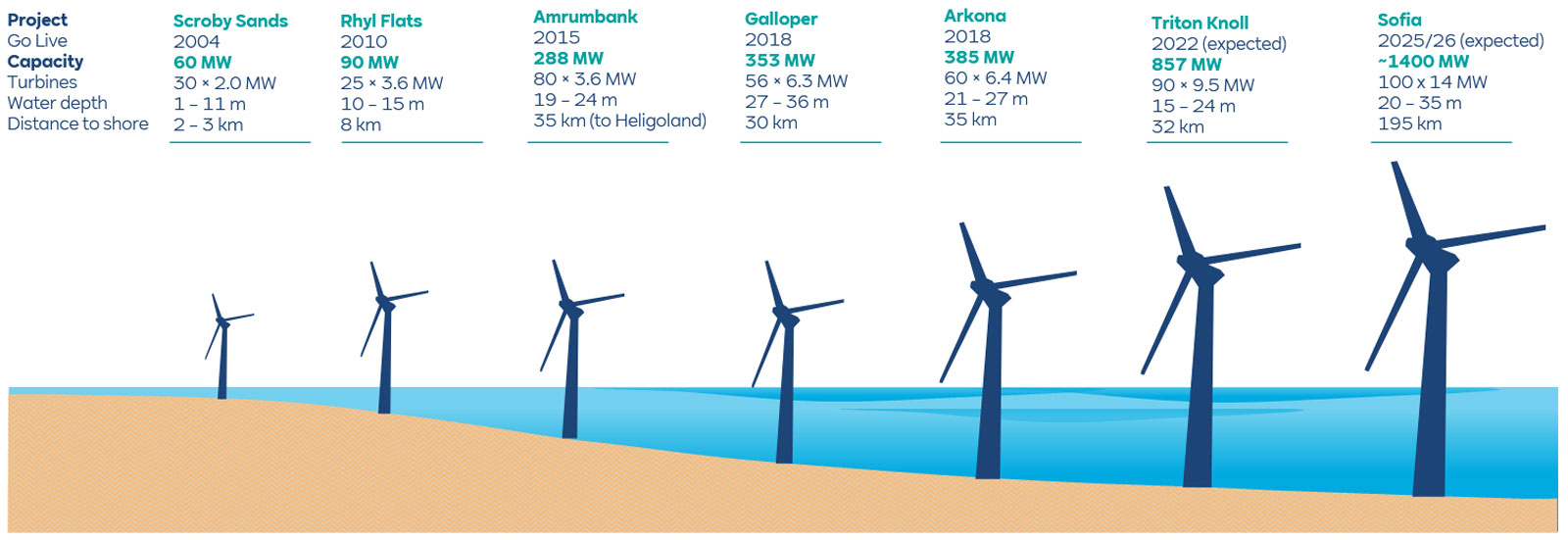
RWE’s Offshore Wind Projects Show Massive Scale-Up
This chart directly visualizes the ‘Massive Scale-Up’ of RWE’s own offshore wind projects, which is the direct result of the ‘€17 Billion Investment’ and contributes to the ‘US Renewable Capacity Growth’ discussed in this section.
(Source: RWE)
Table: RWE US Investment and Project Timeline
| Partner / Project | Time Frame | Details and Strategic Purpose | Source |
|---|---|---|---|
| RWE US Growth Plan | Mar 2026 | Announcement of a €17 billion investment plan to add 9 GW of new net capacity in the U.S. by 2031, focusing on onshore wind, solar, and storage. | RWE |
| RWE 2025 Commissioning | Mar 2026 | Completed commissioning of 2 GW of new U.S. renewable capacity during 2025 from 15 separate projects. | RWE |
| Federal Stop-Work Order | Dec 2025 | The Department of the Interior halted construction on all five U.S. offshore wind projects that had reached that stage, freezing the sector’s most advanced assets. | RTO Insider |
| RWE Project Valuation | Aug 2025 | CEO Markus Krebber stated there was no need for writedowns on a major 3 GW U.S. offshore wind project, signaling confidence in the asset’s long-term value prior to the administration’s most severe actions. | Reuters |
US East Coast vs. Onshore, RWE’s Geographic Focus Shift
Federal policy actions in 2025 created a geographic divergence in U.S. renewable investment, stalling East Coast offshore wind development while pushing capital towards more politically insulated onshore projects in regions with favorable conditions. Before 2025, investment was increasingly concentrated in securing high-value offshore lease areas to meet ambitious state-level renewable energy mandates. The subsequent policy reversal forced an immediate re-evaluation of geographic risk across corporate portfolios.
- From 2021 to 2024, the primary focus for major European developers including RWE, Ørsted, and Equinor was securing offshore wind leases off the U.S. East Coast, backed by offtake agreements with states like New York, New Jersey, and Massachusetts.
- Starting in late 2025, the federal stop-work orders and permit freezes specifically targeted these East Coast offshore projects, stranding billions in invested capital and disrupting state energy plans.
- RWE’s subsequent commissioning of 2 GW of onshore assets in 2025, combined with its €17 billion plan targeting a diversified U.S. portfolio, demonstrates a clear de-risking pivot away from the politically volatile offshore regions toward onshore markets like Texas.
- This trend was reinforced by cancellations from other developers, including the Attentive Energy lease cancellation in March 2026 and Golden State Wind’s voluntary lease termination in California in May 2026, confirming the market-wide retreat from offshore development.
SWOT Analysis, RWE’s Strengths and Market Threats in the US
RWE‘s financial strength and diversified U.S. portfolio provide resilience against acute political threats, but the viability of its high-capital offshore investments remains contingent on future policy changes. The company’s large, operational onshore asset base generates steady cash flow, allowing it to weather the freeze in its offshore development pipeline. However, the administration’s explicit goal of halting offshore wind poses a direct and substantial threat to a core pillar of the company’s long-term U.S. strategy.
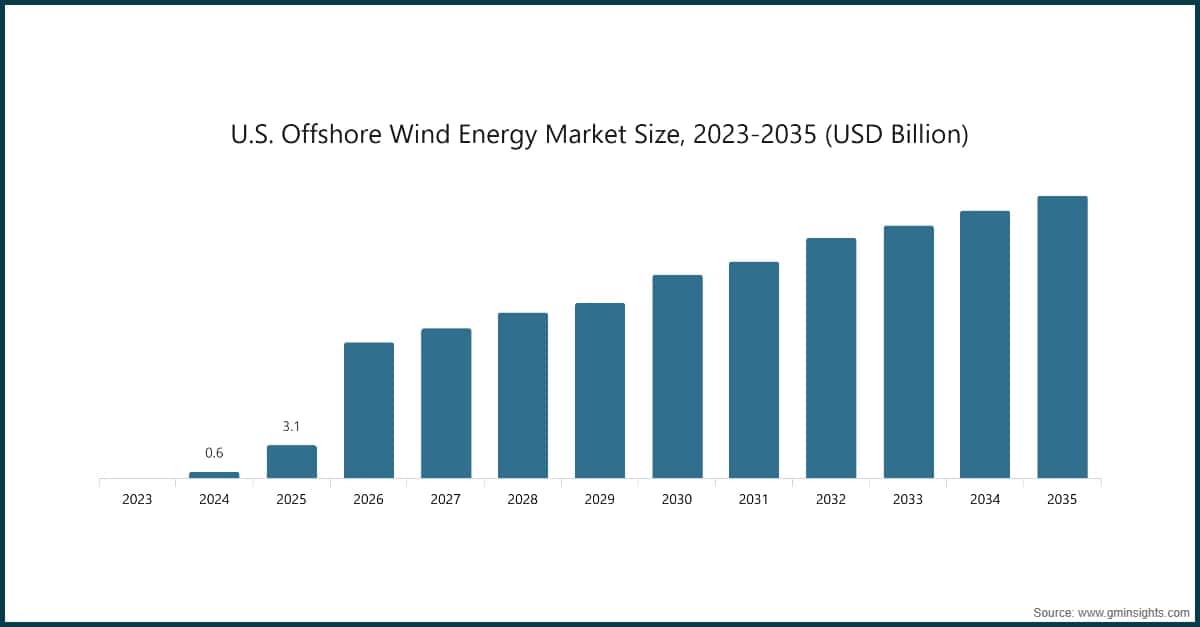
US Offshore Wind Market Forecasts Strong Growth
This chart illustrates the ‘Opportunity’ (the ‘O’ in SWOT) in the US market. The forecast for strong market growth provides essential context for the ‘SWOT Analysis’ of RWE’s position and potential in the United States.
(Source: Global Market Insights)
Table: SWOT Analysis for RWE US Offshore Wind
| SWOT Category | 2021 – 2024 | 2025 – 2026 | What Changed / Validated |
|---|---|---|---|
| Strengths | Large balance sheet and global offshore wind expertise. Secured key U.S. offshore leases for over $1 billion. | Diversified U.S. portfolio with nearly 9 GW of operational onshore assets. Announced a €17 billion U.S. investment plan. | The onshore portfolio proved to be a critical hedge, providing revenue and growth opportunities while the offshore segment was frozen. |
| Weaknesses | High capital concentration in a few, long-duration offshore projects with regulatory dependencies. | Over $1 billion in capital is tied up in offshore leases facing political threats of forced buyouts or permanent cancellation. | The weakness of regulatory dependency was fully realized, transforming a potential asset into a significant liability under a hostile policy regime. |
| Opportunities | Capitalize on strong state and federal support (e.g., Inflation Reduction Act) to build out a large-scale U.S. offshore wind business. | Leverage legal challenges and state-level support to preserve offshore lease value. Pivot capital to rapidly growing onshore solar, wind, and storage markets. | The political disruption validated a diversified portfolio strategy. The opportunity shifted from pure-play offshore growth to balanced, multi-technology U.S. expansion. |
| Threats | Supply chain inflation, rising interest rates, and local opposition (NIMBYism) to projects. | Direct federal policy designed to halt projects (stop-work orders) and force lease terminations. Loss of key tax credits under new legislation. | The primary threat shifted from manageable economic and local issues to existential political risk at the federal level. |
RWE 2026 Scenarios, Lease Buyout vs. Long-Term Hold
The critical indicator for the U.S. offshore wind market in 2026 will be RWE‘s decision on the reported lease buyout offer, which will signal the industry’s risk tolerance for politically driven asset impairment. This decision will serve as a bellwether for how multinational energy companies value long-term market potential against severe, near-term political and financial risk. The outcome will influence the strategic direction of all remaining players in the U.S. renewable sector.
- If RWE accepts the buyout: Watch for other developers with stranded assets to pursue similar deals, leading to a near-total collapse of the U.S. offshore wind pipeline. This would validate the administration’s reversal strategy and likely see RWE redeploying the recovered capital into its European portfolio or its U.S. onshore operations.
- If RWE rejects the buyout: Watch for increased legal and lobbying efforts to defend its assets, leveraging the April 2026 court ruling and strong state-level alliances. This would signal a strategic bet that the political headwinds are temporary and that the long-term value of the federally licensed leases outweighs the immediate risk.
- A potential middle ground: RWE could attempt to negotiate a formal pause or delay of its project obligations without a full surrender. Watch for announcements that push major capital expenditure and project timelines to a post-2028 timeframe, effectively putting the assets in a holding pattern.

Global Floating Wind Market Projects Massive Growth
This chart provides long-term technological context for the ‘RWE 2026 Scenarios’. The projected growth in floating wind is a critical factor that would influence the strategic decision between a ‘Lease Buyout’ and a ‘Long-Term Hold’ to capitalize on future technology.
(Source: MarketsandMarkets)
The questions your competitors are already asking
This report covers one angle of the strategic pressures facing RWE in the U.S. offshore wind market. The questions that matter most depend on your work.
- Which developers like RWE, Ørsted, and Equinor are gaining or losing ground in the U.S. offshore wind market amidst federal lease buyback offers?
- What is the outlook for U.S. offshore wind deployment by 2030 given the political risks and recent federal court rulings?
- What is the status of the 5 halted U.S. offshore wind projects following the December 2025 stop-work order?
- Is RWE’s global clean energy investment plan on track, considering the pressure from both NGOs and the U.S. administration?
This report does not answer these. Enki Brief Pro does.
Your question, your angle, your framework. SWOT, PESTL, scenario modelling. The same niche depth, built around the decision your work actually depends on.
