

ENOC CCUS Strategy: $4.5 B Market Context, 40 Global Projects, and a Pivot to SAF & Hydrogen Innovations (2025)
CCUS Adoption Risks, ENOC’s Pivot to SAF at Dubai Airshow 2025
In 2025, Emirates National Oil Company (ENOC) has prioritized commercially mature, lower-carbon fuel solutions over direct investment in large-scale carbon capture, utilization, and storage (CCUS) projects, signaling a pragmatic approach to decarbonization amid global market uncertainty. While peers like Exxon Mobil and Shell pursue capital-intensive CCUS ventures, ENOC’s public activities focus on immediate emission reduction opportunities in hard-to-abate sectors, reflecting a strategy of risk mitigation while the CCUS landscape matures.
ENOC’s Focus on Lower-Carbon Fuels
ENOC’s strategy in 2025 centers on displacing fossil fuels with readily available alternatives rather than capturing post-combustion emissions. The company’s showcase at the Dubai Airshow 2025 highlighted its commitment to supplying Sustainable Aviation Fuel (SAF) and developing hydrogen and biodiesel solutions for ground operations. This positions ENOC to service the aviation sector’s immediate decarbonization needs with existing technology, avoiding the long development timelines and infrastructure requirements associated with CCUS.
Global CCUS Project Headwinds
The broader market context validates ENOC’s cautious stance, as high costs and policy instability have created significant headwinds for CCUS adoption globally. In the U.S., for example, inflation and political uncertainty surrounding the 2025 outlook have reportedly dented investment enthusiasm for major projects. This environment makes large-scale capital commitments to CCUS a higher-risk proposition compared to investments in technologies like SAF, which have more established supply chains and clearer demand signals from sectors like aviation.
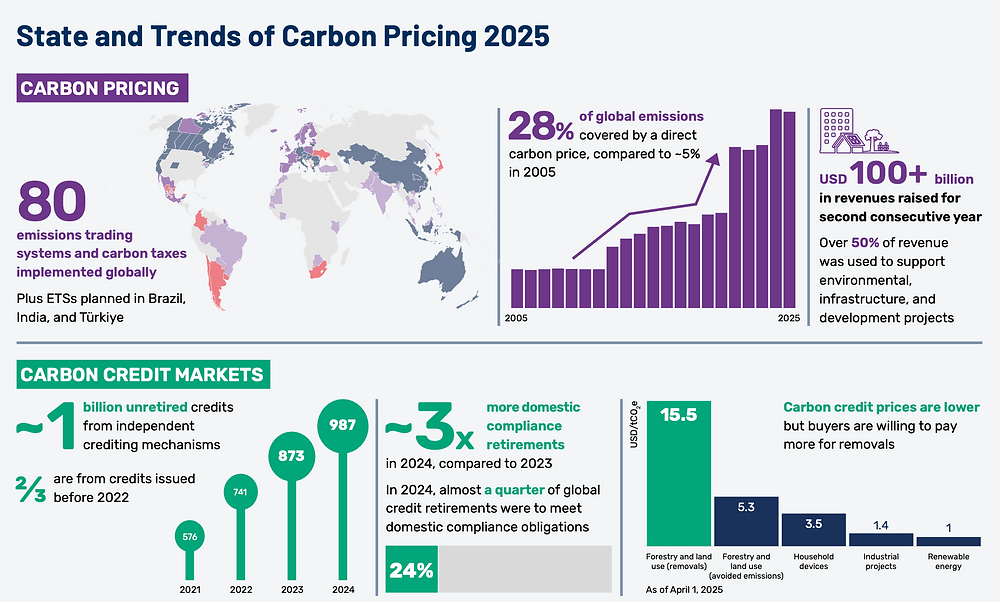
Carbon Pricing Reaches Global Scale, Driving Over $100 Billion in Revenue
By 2025, carbon pricing covers 28% of global emissions, generating over $100 billion annually in revenue, 50% of which funds environmental projects. This signifies a mature and expanding market for decarbonization.
Growing Compliance Market Drives Demand for High-Value Carbon Credits
Domestic compliance obligations are rapidly increasing, tripling in 2024 and constituting nearly a quarter of global credit retirements. This shift from voluntary to mandatory demand, particularly for removals priced at $15.5/tCO2e, validates investment in robust carbon solutions.
(Source: Saudi Aramco Carbon Capture 2025, $1.5B Larsen & Toubro)
$4.5 B Global CCUS Market, ENOC’s Cautious Stance Amid US Headwinds
The global oil and gas CCUS market was valued at an estimated $4.5 billion in 2025, with projections indicating a compound annual growth rate of 14.5% through 2035. Despite this growth, significant financial and policy barriers persist, influencing the investment strategies of national oil companies like ENOC. The high capital costs and uncertain regulatory frameworks create a challenging environment for new entrants, justifying a measured approach focused on monitoring market developments before committing significant capital.
Table: Global CCUS Market Projections and Status (2025)
| Metric | Time Frame | Details and Strategic Purpose | Source |
|---|---|---|---|
| Global CCUS Market Value | 2025 | The overall market was valued at $3.9 billion, with the power generation sector accounting for 70.1% of revenue. This shows the primary application remains tied to large, centralized emission sources. | Grand View Research |
| Oil & Gas CCUS Market Value | 2025 | The specific segment for the oil and gas industry was projected to reach $4.5 billion, with an expected CAGR of 14.5% through 2035. This reflects strong interest from the sector despite high costs. | Future Market Insights |
| Global Operational Capacity | 2025 | Approximately 40 operational projects worldwide captured between 42 and 49 million metric tons of CO 2 annually. This capacity is a fraction of what is needed for global climate targets, indicating a nascent industry. | Science Direct |
| Investment Headwinds | 2025 | High capital costs, policy uncertainty, and inflation were cited as significant barriers, particularly impacting large-scale projects in the U.S. This market friction supports a wait-and-see strategy for companies not already heavily invested. | Reuters |
| Forecast Provider⇅ | Market Segment⇅ | 2025 Market Size ($B)⇅ | 2026 Market Size ($B)⇅ | 2027 Market Size ($B)⇅ | 2028 Market Size ($B)⇅ | 2029 Market Size ($B)⇅ | 2030 Market Size ($B)⇅ | 2031 Market Size ($B)⇅ | 2032 Market Size ($B)⇅ | 2033 Market Size ($B)⇅ | 2034 Market Size ($B)⇅ | 2035 Forecast ($B)⇅ | CAGR (%)⇅ | Source⇅ |
|---|---|---|---|---|---|---|---|---|---|---|---|---|---|---|
| Future Market Insights | Oil & Gas CCS | 4.50 | 5.15 * | 5.90 * | 6.76 * | 7.74 * | 8.86 * | 10.15 * | 11.62 * | 13.30 * | 15.23 * | 17.30 | 14.50 | Oil & Gas Carbon Capture and Storage Market ↗ |
| Grand View Research | Overall CCS | 3.90 | 4.20 | 4.52 * | 4.86 * | 5.23 * | 5.62 * | 6.04 * | 6.49 * | 6.70 | 7.21 * | 7.77 * | 7.67 * | Carbon Capture & Storage Market Size Report, 2026-2033 ↗ |
| Roots Analysis | CCUS Absorption | 1.58 | 1.94 * | 2.39 * | 2.94 * | 3.62 * | 4.46 * | 5.49 * | 6.76 * | 8.32 * | 10.24 * | 12.56 | 23.06 | CCUS Absorption Market Size, Share & Growth Report, 2035 ↗ |
North America vs. UAE, ENOC Aligns with National Net Zero 2050 Strategy
While North America led the CCUS market in 2025 due to established regulatory incentives and demand for CO 2 in enhanced oil recovery, ENOC’s activities are shaped by the UAE’s specific national framework. The company’s current focus on cleaner fuels aligns with the broader goals of the UAE Net Zero 2050 Strategy, a multi-faceted initiative aimed at economic diversification and emissions reduction. This suggests ENOC’s future CCUS strategy will likely be driven by regional policy development, such as a potential carbon pricing mechanism, rather than by mirroring the EOR-driven model of the U.S.
UAE’s Strategic Framework
The UAE’s Net Zero 2050 Strategy encompasses over 25 programs targeting a transition to a net-zero economy. Within this national plan, ENOC’s role appears concentrated on providing lower-carbon energy products. This alignment allows the company to contribute to national targets through its core business operations while other entities, potentially in partnership with technology providers like Saudi Aramco or Total Energies, develop the foundational CCUS infrastructure. A proposed smart plan for CCUS in the UAE emphasizes a phased, policy-led approach, which would provide ENOC with the clarity needed for future investment.
North American Market Dominance
In contrast, North America’s market leadership in 2025 was supported by a mature ecosystem of technology suppliers and strong financial incentives. Companies like Occidental Petroleum have advanced large-scale Direct Air Capture (DAC) and point-source projects, often leveraging CO 2 for enhanced oil recovery. This model, while commercially viable in the U.S., is less applicable to ENOC’s operational context without similar government-led offtake agreements or carbon pricing structures in the UAE.
ENOC Technology Focus, CCUS Cost Barriers vs. Mature Biofuel Solutions
The decision to prioritize SAF and hydrogen over CCUS in 2025 reflects a calculated assessment of technology maturity and economic viability. CCUS technology continues to face significant hurdles, including high capital costs and substantial energy penalties for the capture process. In contrast, SAF and biodiesel represent more mature, drop-in solutions that can achieve immediate emissions reductions using existing distribution infrastructure, offering a more direct and less capital-intensive path to decarbonization for a company like ENOC.
CCUS Technology Challenges
A primary challenge for CCUS in 2025 remained its high cost and operational complexity. The substantial upfront capital required for project deployment and the energy needed to power the capture process create significant economic friction. This “energy penalty, ” often exceeding 3.5 gigajoules (GJ) per ton of CO 2 captured, directly impacts the operational efficiency and cost-effectiveness of a facility, making it a difficult investment without strong regulatory or financial support.
Maturity of Alternative Fuels
Compared to the developmental stage of large-scale CCUS hubs, SAF and biodiesel are commercially proven technologies. ENOC’s ability to supply SAF to customers like Jetex at the Dubai Airshow 2025 demonstrates a ready market and an operational supply chain. This focus allows the company to build expertise and market share in the growing low-carbon fuels sector, generating revenue and contributing to emission reduction targets while CCUS technology and its supporting infrastructure continue to de-risk.
SWOT Analysis, ENOC’s Strategic Position in the 2025 Decarbonization Market
ENOC’s strategic posture in 2025 reflects a balance between its strengths as a national oil company and the external market realities of the global energy transition. The company is leveraging its existing assets and alignment with national strategy while cautiously navigating the uncertainties of capital-intensive technologies like CCUS. This positions ENOC as a pragmatic follower in the CCUS space, prepared to act once policy and economic conditions become more favorable.
Table: SWOT Analysis for ENOC’s CCUS Strategy (2025)
| SWOT Category | Analysis | Supporting Evidence from 2025 Data |
|---|---|---|
| Strengths | Strong alignment with national policy and existing infrastructure for fuel distribution. | Activities are framed within the UAE Net Zero 2050 Strategy. Focus on SAF leverages existing aviation fuel logistics and customer relationships, as shown at the Dubai Airshow 2025. |
| Weaknesses | Lack of publicly disclosed, large-scale CCUS projects or announced partnerships. | Analysis of 2025 data reveals no specific CCUS projects tied to ENOC, in contrast to peers like Conoco Phillips or Chevron who have established CCUS programs. |
| Opportunities | Potential to become a key player in a future UAE-based CCUS hub, driven by new policy. | A proposed carbon pricing mechanism in the UAE could create the business case for investment. Development of a regional hub would de-risk infrastructure investment for individual companies. |
| Threats | High capital costs, global policy uncertainty, and competition from more mature decarbonization technologies. | Global CCUS market faces headwinds from inflation and high costs. ENOC’s own focus on more mature SAF and hydrogen solutions shows that alternatives are competing for the same investment capital. |
ENOC’s Future CCUS Entry, Watch for UAE Carbon Pricing and Policy Shifts
For ENOC to accelerate its entry into the CCUS market, the key catalyst will be the implementation of a clear and supportive domestic policy framework, particularly a carbon pricing mechanism. Such a policy would establish the economic foundation necessary to justify the high-capital investments required for CCUS projects. Until then, the company’s strategy of focusing on lower-carbon fuels like SAF and hydrogen remains the most financially prudent path, allowing it to achieve decarbonization goals while minimizing exposure to the risks currently impacting the global CCUS sector.
- If the UAE government formalizes a carbon pricing or tax credit system akin to the U.S. 45 Q, watch for ENOC to announce initial CCUS pilot projects or partnerships, likely focused on its own industrial emissions.
- If regional collaboration on shared CO 2 transport and storage infrastructure accelerates, similar to Europe’s Northern Endurance Partnership involving Equinor, this could trigger ENOC to invest as an anchor user of that network.
- If the cost of CCUS technology fails to decline and SAF or green hydrogen production costs fall faster than expected, ENOC may double down on its current strategy and delay CCUS investment indefinitely, cementing its role as a low-carbon fuel provider.
The questions your competitors are already asking
This report covers one angle of ENOC’s decarbonization trajectory. The questions that matter most depend on your work.
- Middle East oil company carbon capture investments
- UAE carbon pricing policy status
- Sustainable aviation fuel supply and cost outlook
- New carbon capture projects announced 2025
This report does not answer these. Enki Brief Pro does.
Your question, your angle, your framework. SWOT, PESTL, scenario modelling. The same niche depth, built around the decision your work actually depends on.
