

PEM Fuel Cell Distributed Power Entry, $640.6 M VC Funding, Xynteo Challenge, and 18 MNRE Startups (2021 to 2026)
Distributed Power Adoption, Hydrovert Energy Targets Diesel Replacement
The commercial adoption of fuel cell-battery hybrids for distributed power accelerated post-2025, shifting from foundational research and development to targeted product launches aimed at displacing diesel generators in emerging markets with unreliable grids. This strategic pivot reflects a maturing understanding of the technology’s most viable entry market, where the economic and environmental case against incumbent solutions is strongest. The period marked a transition from developing broad technological capabilities to packaging them into specific, marketable products that address a clear customer pain point.
- Between 2021 and 2024, the focus for startups like Hydrovert Energy was on foundational technology development. This phase, largely conducted within a lab environment, centered on creating and proving indigenous hydrogen fuel cell powertrains, a necessary precursor to any commercial application.
- The period from 2025 to today saw a decisive shift from R&D to commercialization. In May 2026, Hydrovert Energy launched its first commercial product: a line of stationary power generators from 5 k VA to 50 k VA designed for long-duration backup, directly targeting the diesel generator market.
- This commercial launch was supported by growing ecosystem maturity. In April 2026, India’s Ministry of New and Renewable Energy (MNRE) showcased 18 hydrogen startups, signaling strong government backing and a pipeline of companies moving toward commercial readiness.
- The market’s primary driver shifted from technology demonstration to solving a practical problem. The hybrid architecture, which uses a fuel cell for continuous power and a battery for peak loads, is now positioned as a solution for commercial and industrial customers needing reliable, zero-emission power in the face of intermittent grid supply.
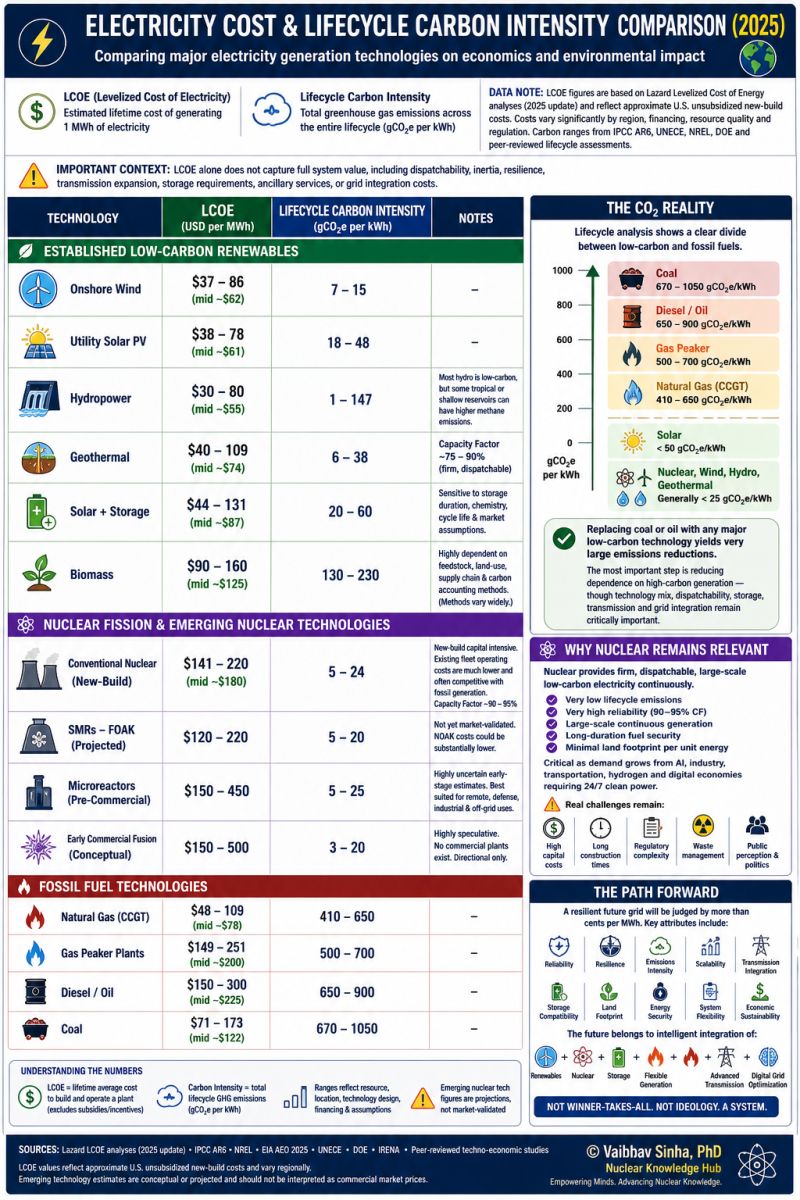
Diesel Generation Shows High Cost and Emissions
The section’s focus on Hydrovert Energy’s goal to replace diesel is directly supported by this chart, which quantifies the negative attributes of diesel (high cost and emissions) and establishes the problem the company aims to solve.
(Source: LinkedIn)
$640.6 M in Q 1 2026, Hydrovert Energy in a Competitive VC Market
While specific investments into Hydrovert Energy are undisclosed, the company is seeking capital within a buoyant Indian energy tech venture market, where funding is active but highly competitive. The significant capital flow into the sector underscores investor confidence in clean energy solutions, but it also means startups must demonstrate clear commercial traction and a scalable business model to secure funding against well-capitalized peers in adjacent technology verticals.
- A total of $640.6 million was invested into Indian energy tech startups in Q 1 2026 alone, creating a favorable but competitive environment for companies seeking growth capital to scale manufacturing and deployment.
- Investor appetite for hardware-focused energy solutions in India is strong, as demonstrated by adjacent deep-tech investments such as battery innovator e-TRNL Energy’s ₹27.4 Crore (approx. $3.3 million) seed round in February 2026.
- Government support provides an alternative pathway for funding and validation. Platforms like the April 2026 MNRE exhibition, which connected 18 startups to potential funders, offer access to non-dilutive grants and incentives that complement traditional venture capital.

Renewables Surpass Coal in Global Electricity Generation
This chart illustrates a major positive market shift toward renewables, providing context for why the sector is attracting significant investment and why the venture capital (VC) market, as discussed in the section, is so competitive.
(Source: LinkedIn)
Hydrovert Energy 2 Key Alliances, Xynteo and MNRE (2024 to 2026)
Hydrovert Energy’s strategic partnerships before its commercial launch focused on ecosystem integration and technology validation rather than direct sales, leveraging government and industry platforms to accelerate its journey from demonstration to deployment. This approach allowed the company to build credibility, refine its technology with industry feedback, and align itself with national energy priorities before entering the competitive market. These alliances were instrumental in de-risking the technology and validating the company’s potential to key stakeholders.
- The selection of Hydrovert Energy in the 2024 edition of Xynteo’s Energy Leap Innovation Challenge served as a crucial early-stage validation. This platform provided the company with an accelerated path from the demonstration phase toward initial deployment by connecting it to a broader network of industry experts and potential partners.
- Participation in the Ministry of New and Renewable Energy’s (MNRE) exhibition in New Delhi in April 2026 was not a formal partnership but a strategic alignment with India’s national hydrogen agenda. Being featured among 18 leading startups provided direct access to policymakers, funding bodies, and industry stakeholders.
- These relationships demonstrate a strategy focused on building foundational support. By engaging with ecosystem enablers first, Hydrovert Energy secured validation and visibility, which are critical for attracting future customers and investors in a nascent market.
India Market Focus, Hydrovert Energy Targets Domestic Distributed Power
The geographic focus for fuel cell-battery hybrid deployment has sharpened, concentrating on emerging economies like India where grid instability and a strong policy push away from diesel create a clear and immediate market opportunity that was less defined before 2025. This contrasts with more mature markets, where grid reliability is higher and the primary driver for alternative power is centered more on decarbonization mandates for large-scale, grid-tied applications rather than distributed resilience.
- From 2021 to 2024, development activity was geographically concentrated in Pune, where Hydrovert Energy originated from a campus lab, indicating a phase focused on localized research and development.
- Beginning in 2025, the strategy expanded to a national scale. The official product launch and participation in the New Delhi-based MNRE exhibition signal a deliberate go-to-market plan targeting the pan-India need for reliable backup power.
- India’s specific market conditions, including a commercial and industrial sector dependent on unreliable grid supply and polluting diesel generators, create a unique and sizable addressable market. The Indian Battery Energy Storage System (BESS) market alone is projected to reach nearly USD 19.5 billion by 2035.
- This domestic focus is underpinned by strong policy support, including India’s National Green Hydrogen Mission, which provides tailwinds for local companies like Hydrovert Energy and competitors in the space such as AVL Fuel Cell Canada.

Indian Research Institute Hiring for Electrochemical Projects
The section’s focus on the Indian market is substantiated by this chart, which indicates a growing local talent pool and research ecosystem in a relevant technological field (electrochemistry), supporting the viability of a domestic strategy.
(Source: LinkedIn)
From Demonstration to Commercial, Hydrovert Energy’s Hybrid Technology
Hydrovert Energy’s proprietary fuel cell-battery hybrid technology successfully transitioned from the demonstration phase to a commercially available product between late 2025 and mid-2026, validating its technical viability for the distributed power market. This rapid progression from a lab concept to a market-ready system demonstrates an effective R&D and productization cycle, a critical capability for any deep-tech hardware startup. The launch established the technology as a tangible solution, moving beyond the theoretical benefits of hybrid systems to a product with defined specifications and a clear use case.
- As of December 2025, the company’s technology was primarily described as being in development, with a focus on creating hydrogen fuel cell powertrains for both mobility and stationary applications.
- The technology’s potential was externally validated in 2024 through Xynteo’s Energy Leap Innovation Challenge, which explicitly aimed to accelerate solutions from “demonstration to deployment.”
- The official product launch in May 2026 of 5 k VA to 50 k VA stationary gensets marked the technology’s arrival at a commercial-ready Technology Readiness Level (TRL). This transformed the company from an R&D outfit to a product manufacturer.
- The core innovation, a hybrid architecture that combines a fuel cell for continuous power with a battery for transient peak loads, is now a key marketable feature, distinguishing it from standalone battery systems or pure fuel cell generators offered by larger players like Bloom Energy.

Pink Hydrogen Market Forecast to Reach $351.7B
As the section discusses the move from demonstration to commercialization of a hybrid technology, this chart provides a tangible market forecast for a related advanced energy source (hydrogen), underscoring the commercial potential and scale of the target market.
(Source: LinkedIn)
SWOT Analysis, Hydrovert Energy Market Position and Execution Risk
Hydrovert Energy’s primary strength is its timely and well-defined product-market fit for India’s distributed power needs, but this is counterbalanced by significant execution risks common to deep-tech hardware startups, chiefly the challenges of scaling manufacturing and navigating an immature hydrogen supply chain. The company’s strategic positioning is sound, but its long-term success will depend on its ability to convert technical innovation into commercial momentum and overcome operational hurdles.

Fossil Fuels Dominated 2025 Global Energy Supply
This chart provides the macro-environmental context for a SWOT analysis by showing the dominance of fossil fuels. This represents both the large market opportunity for disruption and a threat from entrenched players, which are core elements of assessing a company’s market position.
(Source: LinkedIn)
Table: SWOT Analysis for Hydrovert Energy
| SWOT Category | 2021 – 2024 | 2025 – Today | What Changed / Validated |
|---|---|---|---|
| Strengths | Indigenous R&D on fuel cell powertrains in a lab setting. | Proprietary hybrid architecture in a commercially launched product (5-50 k VA gensets). Clear value proposition as a zero-emission diesel replacement. | The technology was validated and moved from a theoretical concept to a tangible, market-ready product with a specific target application. |
| Weaknesses | Unproven technology at commercial scale. Lack of market presence or external validation. | Undisclosed funding status. Limited manufacturing capacity. High dependence on a nascent hydrogen supply chain. | While the technology is now proven at a product level, the business risks associated with scaling, funding, and supply chain have become the primary hurdles. |
| Opportunities | Growing global interest in hydrogen and clean energy. | India’s fuel cell market projected to hit $1.5 billion by 2034. Strong government support via MNRE. Favorable LCOS for hydrogen (€0.35/k Wh) vs. batteries for long duration. | The market opportunity became more concrete and quantifiable with new market reports and clear government policy signals (National Green Hydrogen Mission). |
| Threats | Competition from established diesel generator and battery storage incumbents. | Intense competition for VC funding ($640.6 M in sector in Q 1 2026). Hydrogen distribution bottlenecks identified as a major industry-wide risk. | The competitive landscape intensified with more startups entering the space, and systemic risks like hydrogen infrastructure gaps became more apparent. |
Hydrovert Energy Next Moves, Securing Offtake and Funding in 2027
The most critical action for Hydrovert Energy in the next 12-18 months is to secure its first significant commercial offtake agreement, which will serve as the primary catalyst for a successful Series A funding round needed to scale manufacturing. Without proof of market demand in the form of a signed customer contract, the company will struggle to attract the substantial capital required for its next growth phase. All strategic efforts should now be oriented toward this single commercial goal.
- If this happens: Hydrovert Energy announces a multi-unit deployment of its stationary generators with a notable industrial or commercial client in India, demonstrating market acceptance of its technology and pricing.
- Watch this: The announcement of a formal seed or Series A funding round exceeding $5 million in late 2026 or early 2027. This event would signal that the company has successfully translated its technical progress and early validation into investor confidence.
- These could be happening: Behind-the-scenes negotiations with hydrogen producers or industrial gas companies to create a bundled “power-as-a-service” offering are likely underway to de-risk fuel availability for potential customers. Concurrently, the company is probably exploring an expanded product roadmap for higher-capacity generators to target larger clients like data centers, a market actively pursued by global competitors like Fuel Cell Energy.
The questions your competitors are already asking
This report covers one angle of the commercial entry of fuel cell hybrids into India’s distributed power market. The questions that matter most depend on your work.
- Which other companies are gaining ground in India’s fuel cell stationary power market, following the 18 MNRE startups showcased in April 2026?
- Is Hydrovert Energy a good investment now that it has shifted from R&D to a commercial product launch?
- How does a fuel cell-battery hybrid compare to a diesel generator for long-duration backup power in the 5 kVA to 50 kVA range?
- Which Indian commercial and industrial sectors are the primary early adopters of stationary fuel cell power?
This report does not answer these. Enki Brief Pro does.
Your question, your angle, your framework. SWOT, PESTL, scenario modelling. The same niche depth, built around the decision your work actually depends on.
