

WATT Fuel Cell SOFC Rollout, 2 k W System with Peoples Gas, Hope Gas Pilots, and 26 Commercial Agreements (2021 to 2026)
Residential SOFC Adoption, WATT Fuel Cell 2 k W System Deployment with Peoples Gas
Gas utilities are repositioning themselves as integrated energy service providers by deploying residential Solid Oxide Fuel Cell (SOFC) systems, a strategy that progressed from contained pilots between 2021 and 2024 to initial commercial rollouts in 2025 and 2026. This business model innovation directly addresses the primary barrier to adoption, which is high consumer capital expenditure, while creating new, stable revenue streams for the utility that are insulated from commodity price volatility.
- Between 2021 and 2024, market activity was characterized by trials and technical validation. WATT Fuel Cell, in partnership with Peoples Natural Gas, focused on pilot programs to test its residential SOFC units, while other utilities like So Cal Gas conducted lab evaluations. The key technical milestone in this period was WATT Fuel Cell doubling its stack output to 2 k W in early 2022, making the unit robust enough for residential power needs.
- The period from 2025 to 2026 marks a clear shift from testing to commercialization. The first installation of the 2 k W WATT HOME™ system in December 2025 in Clarksburg, West Virginia, represents the first real-world commercial deployment under this new utility-led model, with a full residential launch planned for 2026.
- This model is designed to overcome the prohibitive upfront cost of SOFC systems, which was estimated at around $10, 000/k W in 2021 and remained high at $3, 000 to $4, 000 per k W in 2025. By having the utility absorb this cost, likely through a lease or rate-based service agreement, the technology becomes accessible to average homeowners.
- Broader market validation for SOFC technology in other sectors provided crucial momentum. The deployment of a 150 k W Bloom Energy system on an MSC Group cruise ship in 2025 and AEP’s landmark $2.65 billion deal with Bloom Energy in 2026 for data center power demonstrated the technology’s reliability at scale, building confidence for its entry into the more complex residential market.
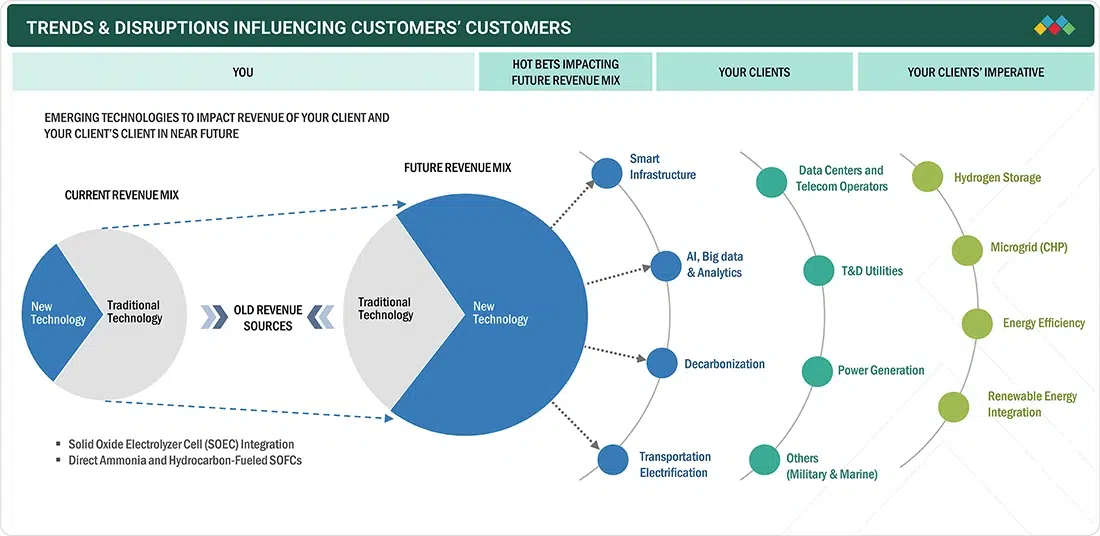
SOFCs Drive New Utility Revenue Models
This section describes how utilities are creating new service-based revenue streams with SOFCs, which is perfectly illustrated by the chart showing new technologies displacing traditional utility revenue.
(Source: MarketsandMarkets)
$3, 000-$4, 000/k W CAPEX, WATT Fuel Cell Residential Cost Barrier
The economic viability of residential SOFCs hinges on overcoming a significant capital cost barrier, with utility-led financing models and federal tax credits emerging as the primary mechanisms to bridge the gap between current manufacturing costs and mass-market consumer affordability. The success of the WATT Fuel Cell and Peoples Gas model depends entirely on making the high-cost asset invisible to the end-user’s balance sheet.
- The central challenge is the high capital cost, which has declined but remains a major obstacle. Estimates in 2021 placed the cost for a residential system as high as $10, 000/k W. By December 2025, the recognized market price for stationary SOFC systems was still in the $3, 000-$4, 000/k W range.
- This pricing stands in stark contrast to the U.S. Department of Energy’s long-term target of $900/k W, a cost point deemed necessary for widespread adoption without heavy reliance on subsidies. The current utility-led model serves as a bridge strategy while the industry works to achieve manufacturing scale and drive down costs.
- A critical enabler for this model is the federal Section 48 E Clean Electricity Investment Credit, which becomes effective for projects starting after December 31, 2025. This provision offers a 30% Investment Tax Credit (ITC) for qualified fuel cell property, directly reducing the capital burden on the utility and making a “no upfront cost” consumer offering financially feasible.
- While residential SOFCs are high-cost, large-scale investments in the broader SOFC sector signal a path toward cost reduction. The $2.65 billion agreement between Bloom Energy and AEP for up to 1 GW of data center power demonstrates the flow of substantial capital into the technology, which will support supply chain development and manufacturing efficiencies that benefit all market segments over time.
Table: WATT Fuel Cell and SOFC Cost Dynamics
| Technology | Time Frame | Details and Strategic Purpose | Source |
|---|---|---|---|
| Solid Oxide Fuel Cell (SOFC) | Dec 2025 | Market CAPEX for stationary systems was estimated at $3, 000 – $4, 000/k W. This high cost necessitates innovative business models like the utility-as-a-service approach to make residential deployment viable. | Semi Analysis |
| Solid Oxide Fuel Cell (SOFC) | Aug 2021 | An academic review cited a residential fuel cell cost of $10, 000/k W. This earlier, higher figure highlights the cost reduction progress but also the remaining gap to mass-market affordability. | PSE Community |
| Solid Oxide Fuel Cell (SOFC) | Dec 2025 | The U.S. Department of Energy maintained a long-term cost target of $900/k W. This goal serves as the industry benchmark for achieving widespread commercial adoption without subsidies. | Grizzly Reports |
| Battery Energy Storage System (BESS) | Jan 2024 | For comparison, the capital cost for a utility-scale 4-hour BESS was estimated by the EIA at $1, 369/k W in 2024, illustrating the competitive cost pressure SOFCs face from alternative resiliency technologies. | EIA |
WATT Fuel Cell 2 Utility Partnerships Drive Residential SOFC Model (2021-2026)
Strategic partnerships between technology developers like WATT Fuel Cell and established utilities are the central mechanism for de-risking market entry, aggregating consumer demand, and building the operational trust needed for residential SOFC deployment. These collaborations evolved from exploratory trials into formal commercial agreements, forming the backbone of the new service model.

Mapping the SOFC Corporate Value Chain
This section focuses on strategic partnerships as a key market driver. The chart identifies the key corporate players and their roles across the value chain, providing context for these partnerships.
(Source: MarketsandMarkets)
- The foundational partnership between WATT Fuel Cell and Peoples Natural Gas (a subsidiary of Essential Utilities) progressed from pilot trials in the 2021-2022 period to a formal commercial rollout agreement announced in December 2025. This demonstrates a multi-year collaborative effort to validate the technology and business case.
- This model expanded in late 2025 to include Hope Gas, with initial shipments of WATT HOME™ systems sent to the utility ahead of the planned 2026 full residential launch. This signals the replicability of the partnership model with other regional gas utilities.
- This direct utility-led deployment model contrasts with the technology licensing strategy used by other SOFC players. For example, Ceres Power‘s partnership with Doosan, which led to factory production in South Korea in March 2026, focuses on scaling manufacturing through an industrial partner rather than direct consumer market creation.
- Large-scale commercial agreements in other sectors, such as Bloom Energy‘s $2.65 billion deal with AEP in 2026, serve a different purpose. They validate SOFCs for mission-critical industrial loads like data centers, which in turn builds investor and supplier confidence for the entire ecosystem, including residential-focused companies.
Table: WATT Fuel Cell and SOFC Strategic Alliances
| Partner / Project | Time Frame | Details and Strategic Purpose | Source |
|---|---|---|---|
| WATT Fuel Cell & Peoples Natural Gas / Hope Gas | Dec 2025 | Announced the first commercial installation of the 2 k W WATT HOME™ system and initial shipments to Hope Gas. This partnership is designed to turn a complex technology into a consumer-friendly service with no upfront cost. | Fuel Cells Works |
| Bloom Energy & American Electric Power (AEP) | Feb 2026 | A $2.65 billion agreement to deploy up to 1 GW of SOFCs for data center power. This partnership validates the technology for large-scale, high-reliability applications, boosting the entire SOFC supply chain. | Climate Drift |
| Ceres Power & Doosan | Mar 2026 | Doosan commenced factory production of SOFC stacks in South Korea based on technology licensed from Ceres Power. This partnership is focused on achieving manufacturing scale and cost reduction through industrialization. | Ceres Power |
| Bloom Energy & MSC Cruises | Jun 2025 | Deployment of a 150 k W SOFC system on the MSC World Europa cruise ship. This project demonstrates a key application in the marine sector, opening a new market and proving fuel flexibility with liquefied natural gas (LNG). | NREL |
US vs. International, WATT Fuel Cell Geographic Strategy
While SOFC development is global, the utility-led residential deployment model is a distinctively North American strategy, with WATT Fuel Cell‘s initial rollout concentrated in Appalachia. This approach contrasts sharply with Europe’s focus on public R&D funding and Asia’s drive for manufacturing scale, creating distinct regional market dynamics.

Global SOFC Market Growth and Regional Dominance
The section contrasts the North American strategy with international markets. The chart provides the necessary global context, showing a strong market forecast and highlighting the Asia-Pacific region’s dominance.
(Source: MarketsandMarkets)
- In the United States, the strategy is market creation through utility partnerships. Activity from 2021-2024 involved regional pilots, such as with Peoples Gas in Pennsylvania. This culminated in 2025 with the first commercial installation in Clarksburg, West Virginia, cementing a regional focus in Appalachia where these utilities operate.
- European strategy, by contrast, has been driven by public-sector funding to advance technology and build a robust supply chain. The Clean Hydrogen Joint Undertaking’s 2022 work program, for instance, allocated significant funds for SOFC and Solid Oxide Electrolyser (SOEL) projects, focusing on technology readiness rather than a specific commercial model.
- Asia, particularly South Korea, has prioritized manufacturing leadership. The most significant recent event was Doosan commencing factory production of Ceres Power-licensed SOFCs in March 2026. This positions the region as a key global supplier of SOFC technology, aiming to serve markets worldwide.
- Interest is spreading to other regions, with several pilot projects featuring 100–500 k W SOFC systems reported to be underway in the UAE in late 2025. However, the core commercial strategies remain geographically distinct: the U.S. pioneers the service model, Europe funds the science, and Asia builds the factories.
Commercial-Ready Technology, WATT Fuel Cell 2 k W Residential System
Solid Oxide Fuel Cell technology has officially transitioned from an industrial-scale and pilot-phase technology to a commercially ready residential product. This maturity is demonstrated not by lab efficiencies, which have long been high, but by the shift from internal performance improvements between 2021 and 2024 to the first grid-connected commercial home installation in late 2025.

WATT’s Residential SOFC Technology Explained
This section details the commercial readiness of WATT’s 2 kW residential system. The chart is a perfect match as it provides a technical diagram explaining this specific technology.
(Source: WATT Fuel Cell)
- During the 2021–2024 period, the key technology milestone was proving performance. For WATT Fuel Cell, this was marked by doubling its stack output to 2 k W in 2022, confirming the unit’s capacity to power a standard home. The focus was on ensuring the technology was technically ready.
- The 2025–2026 period marks the pivot to market readiness. The successful installation and operation of the first WATT HOME™ system in a customer’s home in December 2025 is the ultimate validation, moving the technology from a controlled trial environment to a real-world commercial application managed by a utility.
- The core value proposition of high efficiency has been a long-standing attribute of SOFCs, with electrical efficiencies of 50-60% and combined heat and power (CHP) efficiencies over 85%. The recent breakthrough is the successful packaging of this complex technology into a user-friendly, reliable appliance that a utility can stand behind.
- While the current natural gas-powered SOFC is mature, the next test will be fuel flexibility. The ability of these deployed systems to operate on future blends of hydrogen in the existing gas network, a key area of research for utilities, will determine their long-term role and maturity as a decarbonization tool.
SWOT Analysis, WATT Fuel Cell and the Utility-as-a-Service Model
The utility-led residential SOFC model’s primary strength is its innovative financing structure that circumvents the high consumer capital cost, creating a new, resilient energy service. However, the model’s long-term success is threatened by the rapidly falling costs of solar and battery storage and remains highly dependent on a stable and favorable regulatory policy framework.

SOFCs Mitigate Traditional Grid Energy Loss
The SWOT analysis mentions efficiency and resilience as key strengths of the SOFC model. This chart illustrates the significant energy loss in the traditional grid, which is the core problem this model’s strengths address.
(Source: National Academies Press – National Academies of Sciences, Engineering, and Medicine)
- Strengths: The model leverages existing gas infrastructure and strong utility-customer relationships to deliver a high-efficiency (50-60% electrical) and resilient power source.
- Weaknesses: The underlying high CAPEX ($3, 000-$4, 000/k W) remains the core weakness, making the model entirely dependent on utility financing and subsidies like the 30% ITC.
- Opportunities: It opens new, non-commodity revenue streams for gas utilities, creates a platform for future hydrogen blending, and establishes a distributed virtual power plant for grid services.
– Threats: Intense competition from increasingly cost-effective solar and battery storage solutions, coupled with regulatory uncertainty around net metering policies, pose significant external risks.
Table: SWOT Analysis for the Utility-Led Residential SOFC Model
| SWOT Category | 2021 – 2024 | 2025 – 2026 | What Changed / Validated |
|---|---|---|---|
| Strengths | High electrical and CHP efficiency (up to 85%) and potential for resilience were key technical talking points. | The business model of “no upfront cost” for consumers, managed by a trusted utility, became the primary market-facing strength. | The strength shifted from a technical specification to a tangible commercial value proposition, validated by the first WATT HOME™ installation. |
| Weaknesses | Extremely high CAPEX (cited as $10, 000/k W in 2021) was a primary barrier, confining SOFCs to niche industrial uses and pilots. | CAPEX remains high ($3, 000-$4, 000/k W), but is now a managed cost for the utility rather than a direct barrier to the consumer. | The weakness was not eliminated but was strategically shifted from the consumer to the utility, where it can be mitigated by financing, rate-basing, and tax credits. |
| Opportunities | The potential to create new utility revenue streams and prepare the gas network for future hydrogen blends was largely theoretical. | The start of commercial rollouts and the introduction of the 30% Section 48 E ITC make these opportunities tangible and financially modelable. | Opportunities moved from strategic concepts to actionable business plans, validated by initial deployments and new federal incentives. |
| Threats | Competition from solar and storage existed, but the main threat was the technology’s own cost and maturity. | The threat from solar and storage is now more acute due to their continued cost declines. Regulatory risk also increased as states began actively revising net metering policies. | External threats from competing technologies and policy instability have become more pronounced, highlighting the fragile nature of the model’s current economics. |
2026 Outlook, WATT Fuel Cell Full Residential Launch with Peoples Gas
The critical event to watch for in 2026 is the full residential launch by Peoples Gas and Hope Gas. The success of this program, measured by customer adoption rates and, crucially, regulatory approval of the rate-basing model, will determine if this niche Appalachian pilot can become a replicable, scalable industry blueprint for gas utilities across North America.

SOFC Market Forecast Shows Strong Growth
This outlook section discusses the potential for future market replication and growth. The chart supports this forward-looking perspective by forecasting strong growth for the overall SOFC market to 2030.
(Source: MarketsandMarkets)
- If the launch is successful: Watch for other gas utilities, particularly those with a similar geographic and regulatory profile, to announce partnerships with SOFC manufacturers. A wave of similar pilot announcements in late 2026 or 2027 would be a strong signal that the business model is considered validated and replicable.
- A key signal is manufacturing investment: To meet potential demand from multiple utilities, WATT Fuel Cell or its suppliers would need to expand manufacturing capacity. An announcement of a new factory or a major investment in production lines would confirm that the demand signal from utilities is strong enough to trigger supply chain growth.
- If the launch stalls: The primary point of failure would likely be regulatory. If public utility commissions reject the utility’s proposal to add the SOFC assets to its rate base, the financial model collapses. This would halt the program and likely relegate residential SOFCs to a high-end, direct-to-consumer product.
- Watch net metering policies closely: The financial return for both the utility and the customer depends heavily on the rules for exporting excess power to the grid. As states continue to revise these policies, any adverse changes in Pennsylvania or West Virginia could undermine the economic proposition of the entire program, even if the technology performs perfectly.
The questions your competitors are already asking
This report covers one angle of the utility-led commercialization of residential fuel cells. The questions that matter most depend on your work.
- What is actually happening with the WATT Fuel Cell and Peoples Gas deployment since the first commercial installation in late 2025?
- What is the outlook for residential SOFC deployment through the utility-owned model by 2030?
- Which gas utilities, beyond Peoples Natural Gas and Hope Gas, are adopting residential SOFC solutions?
This report does not answer these. Enki Brief Pro does.
Your question, your angle, your framework. SWOT, PESTL, scenario modelling. The same niche depth, built around the decision your work actually depends on.
