

Enhanced Geothermal: Top 10 Countries, 300 MW Fervo Energy Deals, and 90 GW Potential (2024-2025)
The global geothermal sector is undergoing a strategic pivot from geographically constrained hydrothermal resources to next-generation technologies like Enhanced Geothermal Systems (EGS), positioning it as a key provider of clean, firm baseload power. This shift is driven by the urgent need for 24/7 energy to support the explosive growth of data centers and AI. While the United States continues to lead the world with a total installed capacity of 3, 937 MW, the market’s future is being defined by the commercialization of advanced geothermal, evidenced by strategic collaborations like Fervo Energy’s partnership with Baker Hughes to develop 300 MW of new capacity. The dominant theme for 2025 is the transition from pilot projects to scalable deployments, aiming to unlock the 90 GW of potential capacity forecasted by the U.S. Department of Energy by 2050.
Top 10 Countries by Geothermal Capacity
As of year-end 2024, the global installed geothermal capacity reached 16, 873 MW. The following list details the top 10 countries leading in geothermal power generation, reflecting both mature markets and high-growth challengers.
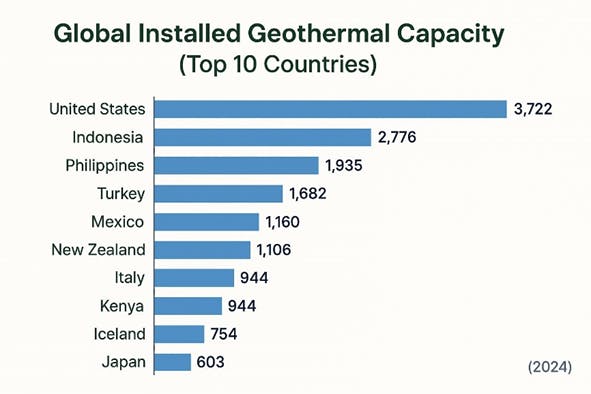
US Leads Top 10 Countries in Geothermal Capacity
This chart is a perfect match for the introductory section as its headline and visual content (a ranking of the top 10 countries) directly correspond to the section’s heading, ‘Top 10 Countries by Geothermal Capacity’.
(Source: Energy Central)
1. United States
Country: United States
Installed Capacity: 3, 937 MW
Application: Baseload electricity generation
Source: Think Geo Energy’s Top 10 Geothermal Countries 2024 – Power
2. Indonesia
Country: Indonesia
Installed Capacity: 2, 653 MW
Application: Baseload electricity generation
Source: Think Geo Energy’s Top 10 Geothermal Countries 2024 – Power
3. Philippines
Country: Philippines
Installed Capacity: 1, 959 MW
Application: Baseload electricity generation
Source: Think Geo Energy’s Top 10 Geothermal Countries 2024 – Power
4. Türkiye
Country: Türkiye
Installed Capacity: 1, 710 MW
Application: Baseload electricity generation
Source: Think Geo Energy’s Top 10 Geothermal Countries 2024 – Power
5. New Zealand
Country: New Zealand
Installed Capacity: 1, 042 MW
Application: Baseload electricity generation
Source: Think Geo Energy’s Top 10 Geothermal Countries 2024 – Power
6. Kenya
Country: Kenya
Installed Capacity: 1, 005 MW
Application: Baseload electricity generation
Source: Think Geo Energy’s Top 10 Geothermal Countries 2024 – Power
7. Mexico
Country: Mexico
Installed Capacity: 994 MW
Application: Baseload electricity generation
Source: Think Geo Energy’s Top 10 Geothermal Countries 2024 – Power
8. Italy
Country: Italy
Installed Capacity: 932 MW
Application: Baseload electricity generation
Source: Think Geo Energy’s Top 10 Geothermal Countries 2024 – Power
9. Iceland
Country: Iceland
Installed Capacity: 754 MW
Application: Baseload electricity generation
Source: Think Geo Energy’s Top 10 Geothermal Countries 2024 – Power

US vs. Iceland Geothermal Power Share Compared
This chart is an excellent fit for the section on Iceland as it provides specific, comparative data about Iceland’s geothermal power share, offering valuable context for that country’s profile.
(Source: ClearPath)
10. Japan
Country: Japan
Installed Capacity: 631 MW
Application: Baseload electricity generation
Source: Think Geo Energy’s Top 10 Geothermal Countries 2024 – Power
Table: Top 10 Countries by Geothermal Installed Capacity (2024)
| Country | Installation Capacity (MW) | Application | Source |
|---|---|---|---|
| United States | 3, 937 | Baseload electricity generation | Think Geo Energy |
| Indonesia | 2, 653 | Baseload electricity generation | Think Geo Energy |
| Philippines | 1, 959 | Baseload electricity generation | Think Geo Energy |
| Türkiye | 1, 710 | Baseload electricity generation | Think Geo Energy |
| New Zealand | 1, 042 | Baseload electricity generation | Think Geo Energy |
| Kenya | 1, 005 | Baseload electricity generation | Think Geo Energy |
| Mexico | 994 | Baseload electricity generation | Think Geo Energy |
| Italy | 932 | Baseload electricity generation | Think Geo Energy |
| Iceland | 754 | Baseload electricity generation | Think Geo Energy |
| Japan | 631 | Baseload electricity generation | Think Geo Energy |
Baseload Power Demand, Fervo Energy’s 300 MW Data Center Deals
The primary driver for the accelerated interest in geothermal energy is its ability to provide clean, firm, 24/7 power, a critical requirement for the rapidly expanding AI and data center industry. Unlike intermittent renewables such as solar and wind, geothermal offers a constant output that is essential for grid stability. Analysis indicates that geothermal could economically supply up to 64% of the projected growth in electricity demand from data centers by the early 2030 s. This has catalyzed a new wave of adoption, with companies like Fervo Energy partnering with energy majors to develop utility-scale projects specifically targeting this demand. This move signals a significant expansion beyond traditional utility power purchase agreements and into direct corporate procurement.
Asia-Pacific Growth, Indonesia Challenges U.S. with 2, 653 MW
While the United States remains the leader in total installed capacity, much of which comes from the long-established Geysers complex in California, the most dynamic growth is occurring in the Asia-Pacific region. Indonesia has firmly established itself as the world’s second-largest producer with 2, 653 MW and has been the global leader in capacity additions over the past two decades. Along with the Philippines (1, 959 MW), these countries benefit from their position along the Pacific Ring of Fire, which provides abundant high-quality hydrothermal resources. This rapid expansion in Asia, contrasted with the slower, more mature growth in North America and Europe, highlights how regional geology has historically dictated market leadership.
90 GW by 2050, EGS and Superhot Rock Commercialization
The most significant trend shaping the industry is the progression from conventional hydrothermal systems to next-generation technologies. Technologies like Enhanced Geothermal Systems (EGS) and superhot rock energy are moving from the pilot stage to commercial-scale deployment. This technical evolution is critical because it promises to decouple geothermal energy from the geographic lottery of naturally occurring hydrothermal vents. By creating engineered reservoirs, EGS can potentially be deployed globally, a capability that has prompted the U.S. Department of Energy to forecast that next-generation geothermal could achieve 90 GW of installed capacity in the U.S. alone by 2050. Partnerships between innovators like Fervo Energy and established firms like Baker Hughes are a clear indicator that the industry is building the supply chain for commercial scaling.
Geothermal Market $20.4 B Forecast and Next-Gen Scaling (2034)
The critical strategic action to watch in 2025 is how quickly next-generation geothermal developers can translate pilot success into bankable commercial projects with firm offtake agreements, especially from corporate buyers in the tech sector. The momentum is building, supported by strong market signals and policy tailwinds.
- The alliance between geothermal startups and established energy giants like Baker Hughes signifies a crucial move toward standardizing equipment and de-risking project execution, which is necessary for attracting large-scale capital.
- The relentless growth in electricity demand from AI is creating a pull for clean, firm power that current renewable portfolios cannot satisfy alone, making geothermal a uniquely attractive solution for major tech companies.
- With market forecasts projecting the global geothermal market to reach $20.4 billion by 2034, there is strong investor confidence in the long-term growth trajectory, driven primarily by the potential of these advanced technologies.
- Kenya’s emergence as Africa’s largest producer, with over 1 GW of capacity, and New Zealand’s recent commissioning of the world’s largest single-shaft geothermal turbine demonstrate continued global investment and innovation in conventional projects, providing a stable foundation for the industry’s next-gen leap.

Geothermal Has Smallest Land Footprint of Renewables
This chart illustrates a key benefit (low land use) that is a strong driver for market growth and scalability, making it a relevant visual for the section on market forecasts and next-gen scaling.
(Source: LinkedIn)
The questions your competitors are already asking
This report covers one angle of the global race for geothermal baseload power. The questions that matter most depend on your work.
- Which companies are gaining or losing ground in the enhanced geothermal systems (EGS) market?
- What is the outlook for EGS deployment to power AI data centers by 2030?
- Fervo Energy activities in EGS. Is the partnership with Baker Hughes progressing from pilot to its 300 MW target?
This report does not answer these. Enki Brief Pro does.
Your question, your angle, your framework. SWOT, PESTL, scenario modelling. The same niche depth, built around the decision your work actually depends on.
