

Hafslund Celsio CCUS Offtake Model, $31.6 M Frontier Deal, 1.1 M Tonne Microsoft Sale, and 4 Partnerships (2021-2025)
Commercial Offtake Model, Hafslund Celsio’s 2 Major Deals De-Risk BECCS Projects
Hafslund Celsio’s 2025 strategy validated a new financing model for capital-intensive decarbonization projects, shifting from reliance on government subsidies to a hybrid approach anchored by long-term, pre-sold carbon removal offtake agreements. This commercial innovation unlocked the project after it had previously stalled due to financial uncertainty, providing a new blueprint for the industry.
- Prior to 2025, the Klemetsrud carbon capture project was paused due to a funding gap and high costs, highlighting the limitations of a purely public-sector funding model for first-of-a-kind industrial decarbonization.
- The project was re-launched in January 2025 only after a new commercial strategy was established, centered on securing advance purchase commitments from the voluntary carbon market (VCM) to de-risk the investment.
- A pivotal agreement was announced on April 1, 2025, with Frontier, an advance market commitment coalition including Stripe, Alphabet, and Shopify. The deal committed $31.6 million to purchase 100, 000 tonnes of permanent carbon removal, establishing an early price benchmark and market validation.
- This was followed by a larger, 10-year agreement with Microsoft on July 2, 2025, for 1.1 million tonnes of carbon removals, providing the long-term revenue certainty required to underpin the project’s bankability.
- This “offtake-first” approach has created a replicable model that is being closely observed by other European waste-to-energy operators and industrial emitters looking to finance their own carbon capture projects. The project’s success is being watched by major players in the broader Carbon Capture & DAC Leaders: 2026 Market Analysis, as it provides a tangible blueprint for financing.
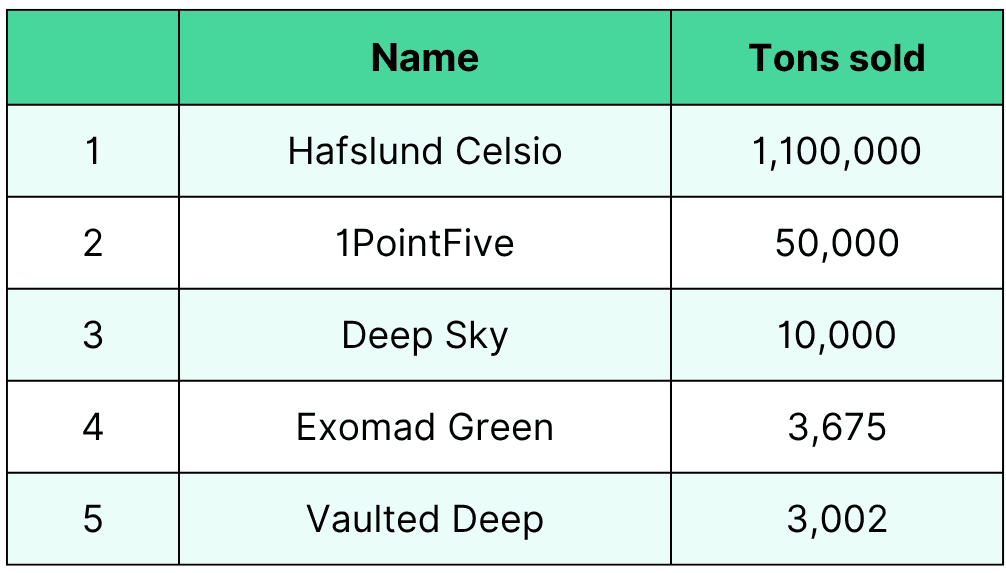
Hafslund Celsio Dominates 2025 Carbon Removal Market
The chart visually confirms the success of the commercial model and major deals described in the section by demonstrating Hafslund Celsio’s leading market share in 2025.
(Source: CDR.fyi)
$31.6 M Frontier Deal, Hafslund Celsio Investment Strategy
In 2025, Hafslund Celsio’s investment strategy pivoted from seeking grants to securing direct revenue commitments, with major offtake agreements effectively serving as the primary financial catalysts for the project’s Final Investment Decision (FID).
- The FID to resume the project on January 24, 2025, was directly enabled by the new commercial model. This decision followed a successful cost-reduction phase that trimmed approximately NOK 1 billion from the project’s budget, making it more attractive to both public and private funders.
- The $31.6 million pre-purchase commitment from Frontier served as a critical financial signal, proving market demand for high-integrity Bioenergy with Carbon Capture and Storage (BECCS) credits and establishing a viable price of $316 per tonne before the final investment was made.
- Following the FID and the securing of offtake revenue, Hafslund Celsio deployed capital into project execution, awarding a construction contract valued at approximately NOK 500 million (around $46 million) to AF Gruppen on September 29, 2025.

Microsoft Leads Carbon Removal Purchases in 2025
This chart provides context for the Frontier deal by highlighting the purchasing power of a key member, Microsoft, underscoring the strategic value of the offtake agreement.
(Source: CDR.fyi)
Table: Hafslund Celsio Key Financial Milestones (2025)
| Partner / Project | Time Frame | Details and Strategic Purpose | Source |
|---|---|---|---|
| AF Gruppen | Sep 29, 2025 | Awarded NOK 500 million (~$46 M) contract for groundwork and construction of the new technical building, initiating major capital expenditure. | AF Gruppen |
| Microsoft | Jul 2, 2025 | Signed 10-year offtake agreement for 1.1 million tonnes of carbon removal, securing a long-term revenue stream and enhancing project bankability. | Carbon Capture Magazine |
| Frontier | Apr 1, 2025 | Secured $31.6 million offtake deal for 100, 000 tonnes of carbon removal, providing critical early-stage validation and a price benchmark. | Frontier |
| Oslo CCS Project | Jan 24, 2025 | Final Investment Decision made after a NOK 1 billion cost reduction, officially sanctioning the project and unlocking capital. | Hafslund |

CDR.fyi Updates Carbon Removal Method Classifications in 2025
The chart on evolving carbon removal classifications is relevant to financial milestones because the definition and perceived quality of carbon credits directly impact their market value and the company’s financial performance.
(Source: CDR.fyi)
Hafslund Celsio 4 Key Partnerships from Technology to Offtake (2025)
Hafslund Celsio assembled a complete value chain in 2025 by securing a network of specialized partners for technology delivery, construction, revenue generation, and permanent CO 2 storage.
- Technology & Engineering: An Engineering, Procurement, Construction, Installation & Commissioning (EPCIC) contract was awarded to a consortium of Aker Solutions and SLB Capturi on January 27, 2025, to deliver the modular carbon capture plant.
- Construction: AF Gruppen was contracted for preparatory groundwork and foundations with a value of approximately NOK 500 million, marking the start of physical construction activities.
- Offtake & Revenue: Landmark agreements with Microsoft (1.1 million tonnes) and the Frontier coalition (100, 000 tonnes) provided the commercial foundation and long-term revenue certainty for the project.
- Transport & Storage: The project is fully integrated into Norway’s Longship initiative, with the captured CO₂ contracted for permanent storage by the Northern Lights JV (a partnership between Equinor, Shell, and Total Energies).

Chart Outlines the CCUS Value Chain
The chart visually maps the CCUS value chain, providing a clear framework to understand how Hafslund Celsio’s key partners, from technology to offtake, fit into the broader ecosystem.
(Source: Oil and Gas Climate Initiative | OGCI)
Table: Hafslund Celsio Strategic Partnerships (2025)
| Partner / Project | Time Frame | Details and Strategic Purpose | Source |
|---|---|---|---|
| AF Gruppen | Sep 29, 2025 | Construction partner for technical building and foundations. | AF Gruppen |
| Microsoft | Jul 2, 2025 | Anchor offtake partner for 1.1 million tonnes of CDR over 10 years. | Carbon Capture Magazine |
| Frontier | Apr 1, 2025 | Advance market commitment partner for 100, 000 tonnes of CDR. | Frontier |
| Aker Solutions & SLB Capturi | Jan 27, 2025 | EPCIC contract partners for the delivery of the carbon capture plant. | SLB |
| Northern Lights JV | Jan 27, 2025 | Designated partner for permanent CO 2 transport and sequestration. | Hitec Vision |

Framework for Carbon Capture Technologies and Infrastructure
The chart offers a high-level framework for different carbon capture technologies, helping to categorize and contextualize the specific roles of the strategic partners mentioned in the section.
(Source: ScienceDirect.com)
Norway Leads Europe, Hafslund Celsio’s Klemetsrud BECCS Project
Norway solidified its leadership in European CCS infrastructure in 2025, with Hafslund Celsio’s Klemetsrud project in Oslo becoming a focal point for applying BECCS technology at a commercial scale, backed by international private capital.
- Prior to 2025, the project was primarily a national-level initiative under Norway’s Longship project, but its financial viability was uncertain, demonstrating the limits of relying solely on public support mechanisms.
- The 2025 strategy successfully internationalized the project’s funding model by attracting major U.S.-based corporate buyers, including Microsoft and members of the Frontier consortium, to underwrite a significant portion of its future revenue.
- Despite the international funding, the project’s physical infrastructure remains distinctly Norwegian, leveraging capture technology expertise in Oslo and the country’s pioneering Northern Lights CO 2 storage infrastructure in the North Sea.
- This successful public-private model, combining Norwegian government support with global corporate demand for carbon removal, gives the country a significant first-mover advantage and establishes a clear path for other European nations to follow.
BECCS at Commercial Scale, Hafslund Celsio Deploys Just Catch™ 400
The Hafslund Celsio project advanced the maturity of BECCS not by inventing new technology, but by proving the commercial-scale integration and bankability of existing post-combustion capture technology in a novel Waste-to-Energy (Wt E) application.
- Before 2025, BECCS on Wt E was largely theoretical or in smaller pilot stages, with the full-scale Klemetsrud project stalled due to economic and technical uncertainty.
- The selection of the Aker Solutions and SLB Capturi consortium in January 2025 confirmed the use of the modular Just Catch™ 400 technology, a market-ready solution that had been recently validated at another Wt E facility in the Netherlands.
- The project’s true “product launch” in 2025 was not the capture hardware but the high-integrity, durable carbon removal credits derived from BECCS. The successful pre-sale of these credits to sophisticated buyers like Microsoft and Frontier validated their commercial viability.
- By moving forward, the project effectively advances this application of BECCS from a demonstration-level Technology Readiness Level (TRL 7-8) toward full commercial operation (TRL 9) upon its planned start in 2029.

Biomass CDR Dominates Q1 2025 Carbon Purchases
The section discusses the deployment of BECCS technology, and this chart validates that strategic focus by showing that the broader category of Biomass CDR dominates market purchases.
(Source: Carbon Removal Updates – Substack)
SWOT Analysis, Hafslund Celsio’s BECCS Commercial Model
Hafslund Celsio’s 2025 strategy successfully transformed a major financial weakness into a strength by creating a bankable offtake model, though it introduced new dependencies on the voluntary carbon market and execution partners.
- The analysis reveals a definitive pivot from financial uncertainty toward a clear commercial path, driven by private sector demand for high-quality carbon removal.
- The project’s key strengths are now rooted in its innovative financing structure and first-mover status in a nascent market.
- Identified weaknesses and threats are now centered on execution risk, including construction timelines, budget adherence, and reliance on the operational readiness of third-party infrastructure.

Europe’s DAC Market to Exceed $4B by 2034
This chart provides crucial external context for a SWOT analysis, illustrating both a market Opportunity (growing demand for CDR in Europe) and a competitive Threat (the rise of DAC technology).
(Source: Market Data Forecast)
Table: SWOT Analysis for Hafslund Celsio BECCS Commercial Model
| SWOT Category | 2021 – 2024 | 2025 | What Changed / Resolved / Validated |
|---|---|---|---|
| Strength | Part of government-backed Longship project; potential for negative emissions. | First-mover in bankable BECCS-for-CDR credits; secured anchor customers (Microsoft, Frontier). | The commercial value of BECCS-derived CDR credits was validated, moving from theoretical potential to a bankable asset. |
| Weakness | High projected cost and significant funding gap led to the project being stalled. | High dependence on execution partners (Aker Solutions, SLB, AF Gruppen) to meet budget and timelines. | The financial weakness was resolved via offtake agreements, but this shifted the primary risk to project execution and partner performance. |
| Opportunity | Potential to secure additional government funding or grants to close the financial gap. | Tapping into the growing VCM for high-quality CDR; setting a replicable model for the entire European Wt E sector. | The opportunity shifted from seeking public subsidies to creating a new private market for industrial carbon removal. |
| Threat | Project cancellation due to lack of funding; political uncertainty. | Construction delays/cost overruns; VCM price volatility; operational dependency on the Northern Lights storage facility. | The threat of cancellation was removed, but it was replaced by market-based and operational threats inherent in a complex, multi-party project. |

US Leads in Announced DAC Project Capacity
This chart informs the ‘Threats’ aspect of a SWOT analysis by highlighting strong international competition, specifically from the US in the DAC space, which could influence market share and investment.
(Source: Internationale Politik Quarterly)
Hafslund Celsio’s 2026 Focus, On-Time Construction and Budget Control
With financing de-risked through offtake agreements, the primary focus for Hafslund Celsio in 2026 shifts to execution risk, where adherence to the construction timeline and budget for the Klemetsrud plant will be the most critical signal to monitor.
- Watch this: The planned start of construction in 2026 and subsequent progress reports from Hafslund Celsio and its partner AF Gruppen will be the key indicators of the project’s health. Any announced delays or budget revisions would be a significant negative signal.
- If this happens: If the Northern Lights CO 2 storage infrastructure, which began operations in 2025, reports any technical or capacity issues, it could create downstream uncertainty for the entire value chain, including the Klemetsrud project.
- These could be happening: Other European Wt E operators, having seen Hafslund Celsio’s success, may announce their own offtake-backed BECCS projects. This would further validate the commercial model but also increase competition for a limited pool of high-quality corporate CDR buyers.