

IBM’s Data Center Solar Strategy 2025 and 2026: A Pivot to Technology Provider
International Business Machines Corporation (IBM) has executed a strategic pivot in its approach to data center energy, shifting from primarily being a corporate procurer of renewable power to becoming a key technology enabler for the entire energy transition. This dual-pronged strategy involves targeted on-site solar projects to decarbonize its own infrastructure, which then serve as real-world showcases for its expanding suite of high-margin sustainability software and AI-driven grid management solutions. This positions IBM to capitalize on the surging energy demands of the AI era by selling the essential digital tools required by the broader market.
IBM’s Commercial Shift: From Internal Solar Goals to Enabling the Industry 2026
IBM‘s strategy has matured from internal sustainability initiatives to a broad commercial offensive, leveraging its software and AI expertise to address the energy market’s most pressing challenges.
- Between 2021 and 2024, IBM‘s efforts were centered on achieving its internal corporate goals, such as the Power Purchase Agreement (PPA) with Boralex in France to support its target of sourcing 75% of its global electricity from renewables by 2025. During this period, it established foundational software relationships, notably with Digital Realty, which adopted the IBM Envizi ESG Suite to manage its environmental performance.
- The period from 2025 to today marks a significant external commercialization push. The planned on-site solar farm at its Hursley, UK data center, developed with Clean Energy Capital, is a tangible demonstration project. This is complemented by high-profile technology partnerships, including the Surya AI project with NASA for space weather forecasting and a strategic cloud partnership with Bharti Airtel to secure renewable energy in India.
- This evolution demonstrates a calculated shift from being a passive consumer of clean energy to an active provider of critical technologies. By offering solutions like IBM Maximo for Renewables, the company is effectively selling the digital “picks and shovels” to the global renewable energy industry.
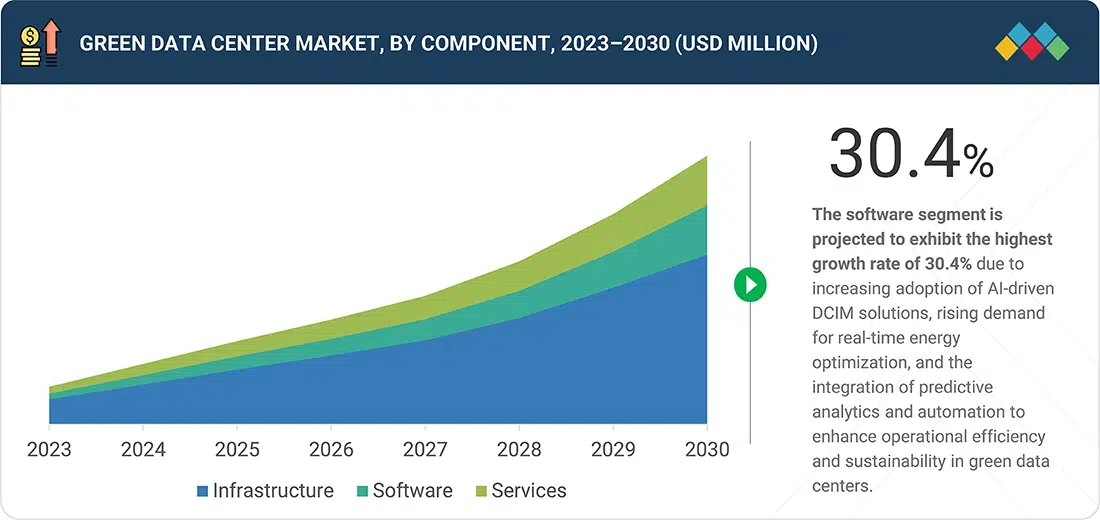
Software to Lead Green Data Center Market
This chart provides the market context for IBM’s strategic shift, showing that the software segment—where IBM is focusing its efforts—is projected to be the fastest-growing part of the green data center market.
(Source: MarketsandMarkets)
IBM’s Partnership Ecosystem: Building Alliances for a Greener Grid 2026
IBM has systematically assembled a network of strategic partnerships that expands its influence from direct data center operations to the broader ecosystem of sustainability reporting, real estate, and grid management.
- In the 2021-2024 timeframe, alliances were focused on securing renewable energy through PPAs, as seen with Boralex, and embedding its software with major infrastructure owners like Digital Realty. These early partnerships laid the groundwork for its software-centric strategy.
- Since 2025, collaborations have grown in ambition and scope. The project with Clean Energy Capital for the Hursley campus signifies a move into direct, on-site solar development, while the NASA partnership leverages advanced AI for grid-level resilience.
- Alliances with global service firms like JLL and Ramboll are critical for scaling its software solutions, integrating Envizi and TRIRIGA into the vast corporate real estate and ESG consulting markets.
- The agreement with Bharti Airtel to power data centers in India with 23, 000 MWh of renewable energy shows a clear strategy to support its cloud services in high-growth international markets while promoting its sustainability credentials.

Mapping the AI Data Center Value Chain
This chart maps the ecosystem of partners, including Digital Realty, that IBM is engaging with to expand its influence beyond its own operations, as described in the section.
(Source: Generative Value)
Table: IBM Strategic Partnerships in Solar and Sustainability
| Partner / Project | Time Frame | Details and Strategic Purpose | Source |
|---|---|---|---|
| Nasa | 2025-08-20 | Co-development of the Surya AI project to apply AI for space weather forecasting, aimed at protecting critical power grids from solar disruptions. | Nasa and IBM apply artificial intelligence to tackle solar digital … |
| Clean Energy Capital | 2025-03-17 | Partnering on a planning application for a dedicated solar farm to provide on-site power for IBM‘s Hursley data center campus in the UK, showcasing a direct decarbonization model. | How IBM is Ramping Up Renewables to Power its Data Centres |
| JLL | 2024-07-16 | Integrating IBM Envizi and TRIRIGA software to create a comprehensive sustainability management solution for corporate real estate clients, aiming to improve energy efficiency and ESG reporting. | JLL integrates IBM software into sustainability program management |
| Digital Realty | 2023-07-18 | Selected IBM Envizi ESG Suite to collect, analyze, and report on environmental performance across its global portfolio of data centers, turning raw data into actionable sustainability insights. | Digital Realty Selects IBM Sustainability Software to Transform Data … |
| Boralex | 2021-04-29 | Signed a renewable Power Purchase Agreement (PPA) in France to help power IBM‘s operations, directly supporting its corporate goal of sourcing 75% of its electricity from renewables by 2025. | Boralex Signs a New Renewable Power Purchase Agreement, to … |
IBM’s Global Solar Strategy: From European PPAs to UK On-Site Generation
IBM‘s geographic strategy has matured from broad regional renewable energy procurement to highly targeted, on-site generation projects and strategic entries into key international growth markets.
- During the 2021-2024 period, the focus was on securing large-scale renewable energy in established markets, exemplified by the PPA with Boralex in France to power its European operations.
- From 2025 onwards, the strategy became more localized and demonstrative with the plan to build a dedicated solar farm for its Hursley, UK data center, marking a shift toward energy self-sufficiency and creating a tangible case study.
- The partnership with Bharti Airtel in India, announced in October 2025, signals a strategic push to secure green power for its cloud infrastructure in the rapidly expanding Asian data center market.
- Further diversification is evident through technology deployments in other regions, such as the AI-driven grid balancing project with the City of Copenhagen and support for clean energy analysis tools for First Nations communities in Canada.

IBM’s Global Data Center Network
This map provides direct geographic context for IBM’s evolving solar strategy, highlighting its presence in the UK and France, key locations mentioned in the text for its PPA and on-site generation projects.
(Source: PR Newswire)
IBM’s Technology Maturation: From ESG Reporting Tools to AI-Powered Grid Management
IBM‘s technology portfolio has evolved from foundational ESG data management software to a sophisticated, AI-driven suite capable of asset-level optimization and grid-scale predictive analytics.
- Between 2021 and 2024, the emphasis was on establishing a comprehensive software foundation for corporate sustainability. Products like the IBM Envizi ESG Suite and its internal metrics for tracking renewable energy ratios provided the core functionality for data collection and reporting.
- The period since 2025 has been characterized by the launch of more specialized and advanced solutions. IBM Maximo for Renewables directly addresses the operational efficiency of solar and wind farms, while the IBM Cloud Carbon Calculator provides clients with granular emissions data for their workloads.
- The collaboration with NASA on the Surya project represents the current peak of this technological progression, utilizing AI for macro-level space weather forecasting to protect power grids—a commercially critical application for all data center operators.
- This advancement demonstrates a clear trajectory from passive data aggregation to active, predictive control, positioning IBM‘s software as a mature, enterprise-grade solution for the energy transition.

Dashboard for Solar Asset Performance
This dashboard visualizes the sophisticated, asset-level monitoring that represents the maturation of IBM’s technology portfolio from basic reporting to AI-powered predictive analytics.
(Source: ESG Today)
SWOT Analysis: IBM’s Evolving Data Center and Solar Energy Position
IBM‘s strategic pivot to a technology-first model leverages its core software strengths but simultaneously exposes it to new competitive pressures, a risk it mitigates through deep enterprise integration and high-value partnerships. This SWOT analysis captures the evolution of its position.
Table: SWOT Analysis for IBM Data Centers
| SWOT Category | 2021 – 2023 | 2024 – 2025 | What Changed / Resolved / Validated |
|---|---|---|---|
| Strengths | Established brand and existing enterprise software ecosystem (TRIRIGA). Strong client relationships in multiple industries. | Comprehensive, integrated sustainability software suite (Envizi, Maximo). Validated AI leadership (NASA partnership). Strong financial position supporting R&D ($19.69 B Q 4 2025 revenue). | The strategy shifted from leveraging existing software to building and acquiring a purpose-built, market-leading sustainability technology stack, validated by major client wins and partnerships. |
| Weaknesses | Strategy appeared less focused, primarily driven by internal renewable procurement targets. Lack of direct ownership or development of renewable assets. | High reliance on partners for physical project execution (Clean Energy Capital). Potential for customer confusion with a complex, multi-product software suite. | The strategy became clearer, but execution complexity increased. The on-site solar project at Hursley is a site-specific solution, not a broad global PPA strategy like some competitors. |
| Opportunities | Growing corporate demand for ESG reporting and compliance tools. Initial push for data center efficiency. | Explosive energy demand from the AI boom. Critical need for grid modernization and energy management. Ability to sell “picks and shovels” to the entire renewable energy sector. | The market opportunity expanded exponentially, moving from a niche ESG compliance market to the core challenge of powering the entire AI-driven global economy sustainably. |
| Threats | General competition in cloud services and enterprise software from established rivals. | Aggressive, large-scale energy procurement strategies by competitors (e.g., Microsoft‘s nuclear PPA). Rise of nimble, specialized ESG software startups. Global grid instability impacting data center uptime. | Competition became more direct and multi-faceted, coming from both tech giants pursuing different energy strategies and agile software players focused solely on the sustainability market. |
IBM’s 2026 Outlook: Monetizing the AI Energy Boom
IBM‘s primary strategic objective for the coming year is to translate the immense energy demand created by AI into commercial success for its sustainability and grid management software suite.
- The company’s success will be measured by its ability to use its own projects, such as the Hursley solar farm, as effective, cutting-edge showcases to drive adoption of its broader technology stack.
- The market traction of IBM Maximo for Renewables among major utilities and energy producers will be a critical indicator of whether IBM can establish itself as an indispensable technology partner in the energy sector.
- Continued expansion of the JLL partnership is a key initiative to watch, as it provides a vital channel to embed IBM‘s technology deep within the global real estate and facilities management sectors.
- A key challenge remains the effective integration of its diverse software offerings (Envizi, Maximo, TRIRIGA, and others) into a seamless, user-friendly platform to defend against focused, best-of-breed competitors.
Frequently Asked Questions
What is the main change in IBM’s energy strategy for its data centers?
IBM has pivoted from primarily being a corporate buyer of renewable energy to becoming a key technology provider. It now uses its own on-site solar projects, like the one in Hursley, UK, as real-world showcases to sell its sustainability software (like Envizi and Maximo) and AI-driven grid management solutions to the broader energy market.
What are the key software products central to IBM’s new strategy?
The core technologies include the IBM Envizi ESG Suite for environmental performance reporting, IBM Maximo for Renewables for optimizing wind and solar farm operations, and advanced AI solutions like the ‘Surya’ project developed with NASA for grid protection.
How does the Hursley, UK solar farm project fit into IBM’s strategy?
The planned solar farm at the Hursley campus, developed with Clean Energy Capital, serves as a tangible demonstration project. It is designed to decarbonize IBM’s own infrastructure while acting as a showcase to prove the effectiveness of its technology, helping to sell its solutions to other companies.
What is the significance of the partnership between IBM and NASA?
The partnership with NASA on the ‘Surya’ AI project is a high-profile collaboration to apply AI for space weather forecasting. Its strategic purpose is to create a tool that can protect critical power grids from solar disruptions, highlighting IBM’s advanced AI capabilities and its expansion into grid-level resilience technology.
According to the analysis, what is the biggest market opportunity driving IBM’s strategic shift?
The primary opportunity driving IBM’s pivot is the ‘explosive energy demand from the AI boom.’ The company aims to monetize this trend by selling the essential digital tools, or ‘picks and shovels,’ required by the entire renewable energy sector to manage and sustain the global economy’s growing power needs.
