

Advanced Reactor Commercialization, TVA’s 50 MW Kairos PPA, $400 M DOE Grant, and 4 Key Projects (2021 to 2026)
Industry Adoption of Advanced Nuclear, TVA’s Key Projects and Commercial Scale Plans
Industry Adoption of Advanced Nuclear, TVA’s Key Projects and Commercial Scale Plans
The commercial model for advanced nuclear shifted from early-stage research collaborations before 2025 to concrete, project-financing-enabling Power Purchase Agreements (PPAs) that directly address the massive electricity demand from data centers. This transition is defined by utilities moving beyond technology evaluation to acting as the critical offtaker that makes first-of-a-kind (FOAK) projects bankable, creating a replicable template to power the AI-driven economy. This approach is being closely watched by other technology giants, including Microsoft and Amazon.
- Prior to 2025, industry adoption was characterized by foundational support agreements. A key example is the May 2021 collaboration where the Tennessee Valley Authority (TVA) agreed to provide engineering and licensing expertise for Kairos Power’s Hermes demonstration reactor, establishing a long-term partnership without a firm power contract.
- The pivotal change occurred in August 2025 with the announcement of the first-ever U.S. utility PPA for a Generation IV reactor. TVA committed to purchasing up to 50 MW of power from Kairos Power’s Hermes 2 plant to supply Google’s data centers, creating the commercial validation and revenue stream necessary to advance the project from concept to construction.
- This commercial structure directly addresses the core challenge of surging data center demand, which is projected to double in TVA’s industrial load by 2030 and reach 123 GW nationally by 2035. By securing a firm, carbon-free power source, TVA positions its region as a prime location for digital infrastructure growth.
- TVA is mitigating technology risk through diversification. Alongside its Gen IV partnership with Kairos Power, the utility announced in April 2025 its intent to file the first construction permit for a GE-Hitachi BWRX-300, a Gen III+ Small Modular Reactor (SMR), signaling a portfolio approach to building its future nuclear fleet.

Data Center Power Demand Fuels Nuclear
The section states that the commercial model for nuclear is shifting to address “massive electricity demand from data centers.” This chart perfectly quantifies that surging demand, showing the core driver for TVA’s strategy.
(Source: CarbonCredits.com)
$400 M in Federal Funding, TVA Advanced Nuclear Investment Strategy
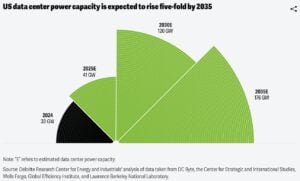
Data Center Power Demand Fuels Nuclear
The section states that the commercial model for nuclear is shifting to address “massive electricity demand from data centers.” This chart perfectly quantifies that surging demand, showing the core driver for TVA’s strategy.
(Source: CarbonCredits.com)
Federal grants and strategic offtake agreements, rather than direct utility equity in unproven reactor designs, are the primary financial mechanisms being used to bridge the commercialization gap for advanced nuclear. This model leverages public funds to de-risk high upfront capital costs and uses customer-backed PPAs to provide the revenue certainty required to attract private investment for construction.
- The cornerstone of this financial strategy is the $400 million grant from the U.S. Department of Energy (DOE), awarded to TVA in December 2025. This funding is specifically designated to support the development and deployment of the nation’s first SMR at the Clinch River site, significantly lowering the financial barrier for the initial project phases.
- This public funding is critical to offset the high Levelized Cost of Electricity (LCOE) for FOAK SMRs, which forecasts place as high as $180/MWh. While currently uncompetitive with solar’s projected 2030 LCOE of $30/MWh, the grant helps make the project viable while the industry works to achieve Nth-of-a-kind (NOAK) cost targets of $80-$100/MWh.
- The August 2025 PPA with Kairos Power and Google functions as a powerful financial catalyst without a direct upfront investment from TVA. By guaranteeing the purchase of power from the Hermes 2 plant, TVA provides Kairos with a bankable offtake agreement, a crucial asset for securing the private financing needed for the reactor’s construction.
- Further financial viability is provided by federal incentives like the Inflation Reduction Act’s (IRA) technology-neutral tax credits. These credits, specifically sections 45 Y and 48 E, can reduce project capital costs by up to 30%, improving the economic case for new nuclear builds.
Table: TVA Advanced Nuclear Funding and Financial Mechanisms
| Partner / Project | Time Frame | Details and Strategic Purpose | Source |
|---|---|---|---|
| DOE Grant (Clinch River SMR) | Dec 2, 2025 | TVA was awarded a $400 million federal grant to support the development of the first SMR at the Clinch River site, de-risking the initial phases of the project. | Tennessee Secures U.S. Department of Energy Grant… |
| Kairos Power PPA (Hermes 2) | Aug 18, 2025 | A power purchase agreement for up to 50 MW of electricity serves as a financial catalyst, providing revenue certainty for Kairos Power to secure project financing. | Bloomberg |
| Inflation Reduction Act (IRA) | Ongoing | Access to technology-neutral tax credits (45 Y and 48 E) can reduce overall project costs by up to 30%, making the LCOE more competitive. | [PDF] The Importance of Tax Credits for U.S. Leadership… |
TVA’s 4 Key Nuclear Partnerships with Google, Kairos, and GE-Hitachi (2021 to 2025)
TVA has constructed a multi-layered partnership ecosystem involving technology developers, power consumers, and government bodies to distribute risk, secure demand, and access critical funding. This strategic alignment ensures that each party’s objectives are met, creating a stable framework for deploying novel technologies.

Google, TVA, Kairos Partner on Nuclear
The section describes TVA’s multi-layered partnership ecosystem involving technology developers and power consumers. This chart specifically visualizes the key partnership between TVA, Kairos Power, and Google mentioned in the heading.
(Source: LinkedIn)
- Technology-Utility Partnership: The foundation was laid with collaborations between TVA and reactor developers. This began in May 2021 with an agreement to support Kairos Power’s Gen IV Hermes demonstrator and was expanded in April 2025 with the selection of GE-Hitachi’s Gen III+ BWRX-300 design for the Clinch River site.
- Utility-Customer Partnership: The August 2025 three-way PPA between TVA, Kairos Power, and Google is the model’s critical commercial link. This structure connects a specific advanced nuclear power source directly to a creditworthy hyperscale data center customer with massive, 24/7 energy needs.
- Utility-Government Partnership: Collaboration with the U.S. Department of Energy proved essential, culminating in the December 2025 announcement of a $400 million grant for the Clinch River SMR project. This public-private approach validates the national strategic importance of the project.
- International Design Standardization: In March 2023, TVA joined an international consortium with Ontario Power Generation (Canada) and Synthos Green Energy (Poland). This partnership aims to jointly fund and standardize the design of the GE-Hitachi BWRX-300, which can accelerate deployment and reduce costs through a shared supply chain.
Table: TVA Advanced Nuclear Partnership Timeline
| Partner / Project | Time Frame | Details and Strategic Purpose | Source |
|---|---|---|---|
| Holtec & DOE | Dec 3, 2025 | TVA and Holtec were selected by the DOE to advance the deployment of Holtec’s SMR technology, further diversifying TVA’s advanced nuclear portfolio. | Energy Department Selects TVA and Holtec… |
| Kairos Power & Google | Aug 18, 2025 | Signed the first U.S. utility PPA for a Gen IV reactor, agreeing to purchase up to 50 MW to power Google’s data centers. | Power Magazine |
| GE-Hitachi | Apr 17, 2025 | Announced intent to file the first construction permit application for the GE-Hitachi BWRX-300 SMR design at its Clinch River site. | Tennessee Valley Authority |
| OPG & Synthos Green Energy | Mar 23, 2023 | Joined an international consortium to jointly fund the development of the GE-Hitachi BWRX-300 standard design, promoting global collaboration. | Washington Examiner |
| Kairos Power | May 6, 2021 | Initial collaboration agreement for TVA to provide engineering and licensing support for the Hermes demonstration reactor in Oak Ridge, TN. | Power Magazine |
Tennessee Valley as Epicenter, TVA’s Advanced Nuclear Project Geography
The Tennessee Valley, particularly the area around Oak Ridge, has become the undisputed geographical epicenter for the first wave of U.S. advanced reactor deployment. This concentration is a deliberate strategy to leverage the region’s unique historical nuclear expertise, existing infrastructure, and skilled workforce to accelerate project timelines and reduce risk.
- All of TVA’s announced advanced nuclear projects are concentrated in Eastern Tennessee, close to the Oak Ridge National Laboratory. This area has a deep history in nuclear research and a community generally supportive of nuclear technology.
- The Kairos Power Hermes 2 demonstration plant, which broke ground in April 2026, is located at the East Tennessee Technology Park in Oak Ridge. This site choice capitalizes on the proximity to scientific and engineering talent.
- TVA’s planned deployment of a GE-Hitachi BWRX-300 SMR is targeted for its Clinch River site, also located near Oak Ridge. The utility has been pursuing development at this location for years, making it a well-understood and prepared site.
- This geographic focus stands in contrast to a scattered, nationwide approach. By concentrating resources, TVA aims to create a regional hub for SMR technology, fostering a localized supply chain and creating efficiencies that would not be possible with geographically dispersed projects.
From R&D to Commercial Build, TVA Advanced Reactor Technology Maturity
Advanced reactor technology is making a measurable transition from the regulatory approval phase that defined the 2021-2024 period to the physical construction and commercial demonstration phase that began in 2025. Key milestones in licensing and construction are validating the technology’s readiness for grid deployment, even as economic challenges remain.

Kairos Power’s Path to Commercial Nuclear
The section describes the transition of reactor technology from R&D to commercial demonstration. This chart perfectly illustrates that phased commercialization strategy, from testing to demonstration reactors like Hermes.
(Source: POWER Magazine)
- Between 2021 and 2024, the most significant maturity milestone was regulatory. The NRC’s issuance of a construction permit for the Hermes reactor in December 2023 was the first for a non-water-cooled reactor in over 50 years, proving a viable path through the existing regulatory framework.
- The period from 2025 to today shifted the focus to physical execution. The groundbreaking for the Hermes 2 plant in April 2026 marks the start of construction on a commercial-scale Gen IV demonstration reactor, moving the technology from paper to a tangible asset.
- A critical enabler for future maturity is the finalization of the NRC’s Part 53 rule in April 2026. This new, risk-informed licensing framework is designed to be more efficient for advanced reactors, reducing a major source of timeline uncertainty and cost for subsequent projects.
- While the technology is not yet at Nth-of-a-kind (NOAK) cost competitiveness, these steps are essential for the industry to gain the operational data and construction experience needed to drive down costs from the FOAK estimate of $180/MWh toward the target of $80-$100/MWh. This path is now being watched closely by other developers, including X-energy.
SWOT Analysis of TVA’s Advanced Nuclear Strategy for Data Centers
TVA’s primary strength lies in its first-mover advantage in forging a complete ecosystem of partners and securing federal support, which directly mitigates the high initial costs of the technology. However, this strategy remains exposed to external threats from political instability affecting federal incentives and the inherent execution risk of building first-of-a-kind industrial projects.

SMR Cost Projections Highlight Strategic Risk
The section discusses the strengths and weaknesses of TVA’s strategy, including execution risk. This chart quantifies a major financial risk by projecting that SMR construction costs will be high, which is a key threat.
(Source: CarbonCredits.com)
- Strengths have evolved from early-stage R&D partnerships to securing the first-ever Gen IV PPA with a major tech customer (Google), creating a bankable commercial model.
- Weaknesses remain centered on the high LCOE of initial SMRs compared to mature renewables, a gap that must be closed through learning-by-doing and manufacturing scale.
- Opportunities are expanding rapidly with the exponential growth of AI-driven data center demand and the creation of a streamlined NRC licensing pathway (Part 53).
- Threats include potential construction delays on the Hermes 2 project, which could damage confidence, and political shifts that could undermine the IRA tax credits crucial to project economics.
Table: SWOT Analysis for TVA’s Advanced Nuclear Strategy
| SWOT Category | 2021 – 2024 | 2025 – 2026 | What Changed / Validated |
|---|---|---|---|
| Strengths | – R&D partnerships (Kairos, 2021) – International design collaboration (GEH, 2023) |
– First Gen IV PPA (Kairos/Google, 2025) – $400 M DOE grant secured (2025) – Multi-technology portfolio (GEH, Holtec) |
The strategy shifted from theoretical collaboration to securing concrete, bankable commercial agreements and major federal funding, validating the public-private partnership model. |
| Weaknesses | – Unproven LCOE – No commercial-scale projects |
– High FOAK LCOE ($180/MWh) vs. solar ($30/MWh) – Dependency on a single customer (Google) for first PPA |
The high cost of FOAK technology was confirmed by market forecasts, but the PPA and grant funding provide a direct mechanism to address this weakness for the initial projects. |
| Opportunities | – Growing data center electricity demand – Bipartisan support for nuclear energy |
– Exponential AI data center load growth – Finalized NRC Part 53 streamlined licensing (2026) – Precedent set for other tech PPAs (e.g., with Meta) |
The scale of the market opportunity (data center demand) grew much faster than anticipated, and the regulatory path became clearer, increasing the urgency and feasibility of the strategy. |
| Threats | – NRC regulatory delays – High cost of HALEU fuel |
– Construction delays on Hermes 2 – Potential changes to IRA tax credits – Supply chain bottlenecks for FOAK components |
The primary threat shifted from regulatory uncertainty to execution risk. Successfully building the first projects on time and budget is now the main challenge. |
TVA’s 2026-2027 Nuclear Path: BWRX-300 Application and Hermes 2 Progress
The most critical path forward for TVA involves successfully filing its construction permit application for the BWRX-300 while the Hermes 2 project meets its initial construction milestones, demonstrating that the U.S. nuclear industry can execute on parallel advanced technology tracks. The ability to manage these concurrent projects will be a defining signal for the broader market.
- If this happens: TVA formally submits its construction permit application for the GE-Hitachi BWRX-300 to the NRC in the next 18 months. Watch this: The speed and efficiency with which the NRC handles this first-of-a-kind application under the new Part 53 framework. This could be happening: A successful review could trigger a final investment decision by TVA and establish a clear, multi-year timeline for the first BWRX-300 deployment in the U.S.
- If this happens: Construction of the Kairos Power Hermes 2 plant in Oak Ridge proceeds without significant delays or budget overruns through its initial phases. Watch this: Quarterly progress reports and any updates to the projected 2030 in-service date. This could be happening: Positive progress will build investor confidence in Gen IV molten salt reactor technology and validate the cost models used to justify the project.
- If this happens: Another major technology or industrial company announces a PPA for advanced nuclear, following the TVA/Google/Kairos template. Watch this: Announcements from hyperscalers like Oracle or data center operators like Equinix, who have publicly stated clean energy goals. This could be happening: A second major PPA would confirm a market-wide trend, creating a powerful demand signal to accelerate investment across the entire advanced nuclear supply chain.
The questions your competitors are already asking
This report covers one angle of advanced nuclear commercialization. The questions that matter most depend on your work.
- Which advanced nuclear companies are gaining ground in the race to power data centers?
- What is actually happening with the TVA-Kairos Power PPA for the Hermes 2 project since the announcement?
- What is the outlook for advanced nuclear deployment to power data centers by 2035?
- Which data center operators, beyond Google, are adopting advanced nuclear power?
This report does not answer these. Enki Brief Pro does.
Your question, your angle, your framework. SWOT, PESTL, scenario modelling. The same niche depth, built around the decision your work actually depends on.
