

CCUS Performance Gap: Air Products Pauses $4.5 B Plant, 2 New Projects Announced (2021-2026)
CCUS Commercial Scale Risks: Air Products Data Shows 50% Real-World Capture Rate
Operational data from the Air Products Port Arthur carbon capture facility reveals a persistent and significant performance gap between the advertised capture rates of new-build projects and the actual, long-term efficiency achieved in industrial settings. This disparity presents a primary risk to project economics and decarbonization targets, forcing a market-wide reassessment of blue hydrogen’s viability.
- From 2021 to 2024, the Port Arthur facility, one of the world’s longest-operating industrial carbon capture systems, demonstrated an average CO₂ capture rate of approximately 50-60%. This real-world metric starkly contrasts with the 95% to 98% capture rates advertised for next-generation projects, including Air Products’ planned Louisiana complex and Exxon Mobil’s Baytown facility.
- In May 2025, Air Products halted new spending on its $4.5 billion Louisiana blue hydrogen project. This decision, made despite the project’s eligibility for the lucrative $85/ton 45 Q tax credit under the Inflation Reduction Act, signals that even robust government incentives may not be sufficient to overcome the high capital costs and perceived performance risks.
- The Port Arthur business model relies on selling CO₂ for Enhanced Oil Recovery (EOR), which qualifies for a lower $60/ton tax credit and faces growing criticism. The market is shifting preference towards permanent geological sequestration, but the pause on the Louisiana project indicates this higher-value pathway still faces formidable economic and logistical hurdles.
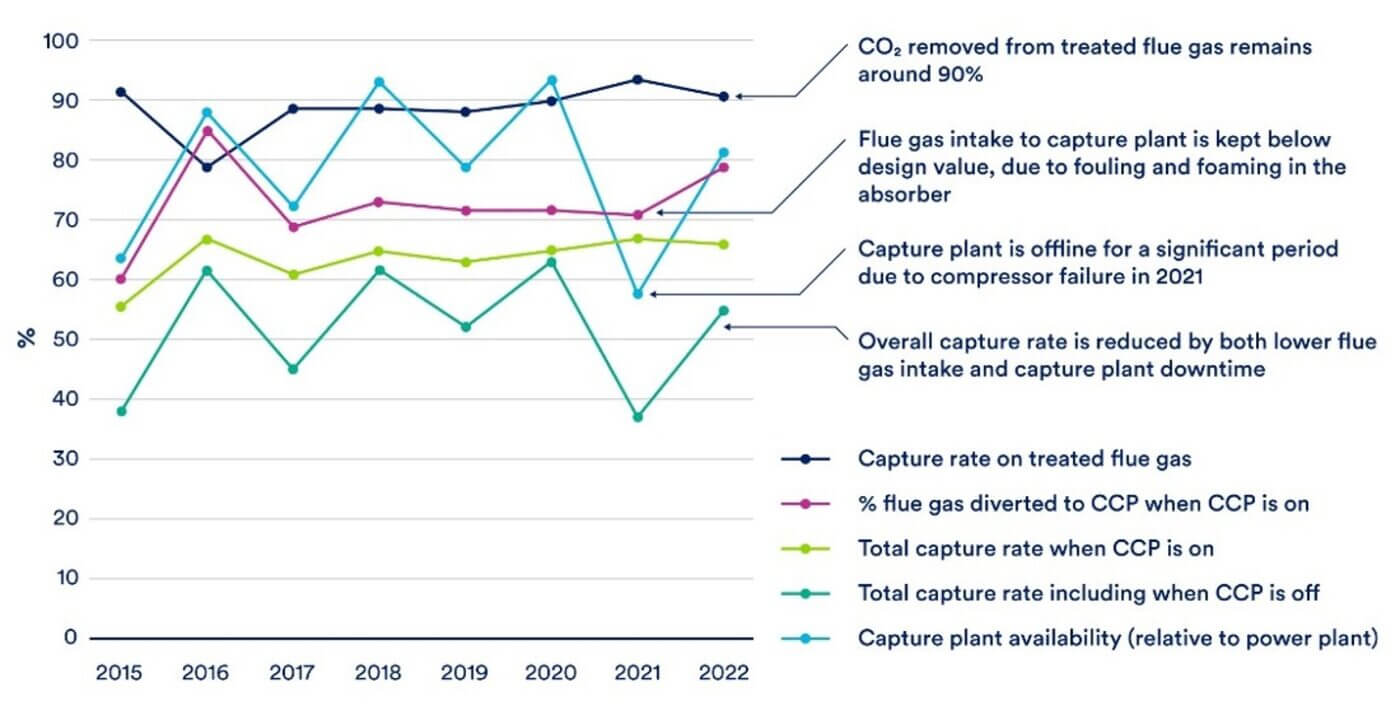
Real-World Capture Rates Fall Short
This chart illustrates the performance gap discussed in the section, showing how actual CCUS capture rates are significantly lower than potential rates due to operational realities.
(Source: Clean Air Task Force)
$4.5 B Project Pause: Air Products Halts Louisiana Blue Hydrogen Plant
The May 2025 decision by Air Products to halt new spending on its $4.5 billion Louisiana Clean Energy Complex indicates that extreme capital costs and uncertain returns are overriding even the most robust government incentives. This event serves as a critical market signal, highlighting the immense financial challenges of deploying new-build blue hydrogen facilities at scale.
- The estimated capital expenditure (CAPEX) for the proposed Louisiana facility ranged from $900 to $1, 400 per ton of annual CO₂ capacity. This figure is substantially higher than the industry average for retrofits, underscoring the prohibitive cost of integrated, greenfield blue hydrogen projects.
- Despite being poised to generate over $425 million in annual tax value from 45 Q credits, the project’s financial model was deemed untenable. This suggests that the combination of high CAPEX, rising material costs, and the difficulty of securing bankable, long-term offtake agreements for blue hydrogen creates an insurmountable investment barrier.
- This cancellation contrasts sharply with the financial profile of the operational Port Arthur project. While Port Arthur generates less revenue from tax credits ($60/ton vs. $85/ton), its initial capital costs were incurred over a decade ago, allowing it to function as a technical proof-of-concept rather than a model for future economic replication.
Table: Air Products Louisiana Project Cancellation Analysis
| Partner / Project | Time Frame | Details and Strategic Purpose | Source |
|---|---|---|---|
| Air Products Louisiana Clean Energy Complex | May 2025 | Air Products halted new spending on the $4.5 billion blue hydrogen project, which was designed to capture 5 million metric tons of CO₂ annually for permanent sequestration. The pause signals that the enhanced $85/ton 45 Q credit was insufficient to de-risk the project’s high CAPEX and uncertain market for blue hydrogen. | Earthworks |
US Gulf Coast Dominance: Air Products Texas Hub Sets CCUS Performance Benchmark
The U.S. Gulf Coast, particularly Texas and Louisiana, remains the undisputed epicenter for large-scale industrial carbon capture, driven by its unique combination of existing industrial infrastructure, favorable geology, and policy support. However, the operational record from projects like Air Products’ Port Arthur facility is now setting a cautionary benchmark for the wave of new developments planned for the region.

Port Arthur Plant a Key CCUS Milestone
This timeline highlights the Air Products Port Arthur facility, mentioned as a key performance benchmark in the section, within the global progression of CO2 capture projects.
(Source: ScienceDirect.com)
- Between 2021 and 2024, the Gulf Coast’s CCUS activity was defined by long-operating projects like Port Arthur. These facilities primarily used captured CO₂ for EOR, establishing a business model dependent on oil prices and a less generous tax credit regime.
- The 2025-2026 period reflects a strategic shift towards much larger, new-build projects targeting permanent geological storage, such as the now-paused Louisiana complex and Exxon Mobil’s massive Baytown project. This pivot is a direct response to the enhanced $85/ton 45 Q credit for sequestration.
- A critical bottleneck for regional growth is the lack of CO₂ transport infrastructure. The regulatory and public opposition that stalled projects like the Summit Carbon pipeline in the Midwest highlights the risk facing future developments, reinforcing the need for industrial clusters where multiple emitters can share infrastructure, such as the Pathways Alliance project in Canada.
CCUS Technology Maturity: Air Products Port Arthur Proves TRL 9, But Not Economic Viability
While the core carbon capture technologies employed at industrial sites are technically mature at a Technology Readiness Level (TRL) of 9, the operational data from Port Arthur proves that technical readiness does not equate to economic replicability or sustained high-efficiency performance at the system level.

CCUS Technologies Mapped by TRL
This diagram directly relates to the section’s focus on Technology Readiness Levels (TRL), mapping technologies to the TRL scale and illustrating the concept of TRL 9 maturity.
(Source: ScienceDirect.com)
- The Air Products Port Arthur project successfully proved the technical viability of integrating proprietary Vacuum-Swing Adsorption (VSA) technology with steam methane reformers (SMRs). At its peak, the facility captured over 1 million metric tons of CO₂ per year, confirming the technology works in an operational environment.
- However, analysis of its performance from 2021-2024 reveals the real-world challenges of long-term operation. Fluctuating capture ratios, declining injection rates, and performance degradation due to operational issues like fouling or compressor failures show that maintaining high efficiency is a constant struggle.
- The May 2025 pause of the Louisiana project, which was set to use a different technology (Autothermal Reforming, or ATR), demonstrates that the market’s primary challenge is economic, not technical. The struggle to secure financing for new-builds persists regardless of the specific capture pathway, even as firms like Samsung C&T and JFE Steel explore alternative capture methods.
SWOT Analysis: Air Products and the Industrial CCUS Performance Gap
A SWOT analysis based on the Port Arthur operational data reveals a core industry tension: while CCUS projects leverage proven technology and strong policy support, inconsistent performance and high costs create significant weaknesses and threats to future project replication and scaling.

CCS Deployment Reality Diverges From Ambition
This chart visualizes a core theme of a SWOT analysis by contrasting initial ambitions for CCS with the actual, more complex reality of its industrial deployment.
(Source: ScienceDirect.com)
- Strengths are rooted in a proven TRL 9 technology base and powerful financial incentives like the enhanced 45 Q tax credit.
- Weaknesses are exposed by the 50% real-world capture rate at Port Arthur, which undermines the economic case for projects reliant on per-ton credits, and the extremely high CAPEX of new facilities.
- Opportunities lie in the growing demand for decarbonized industrial products and the development of shared infrastructure to lower costs.
- Threats include cost inflation, public and regulatory opposition to pipelines and EOR, and the continued difficulty in establishing bankable offtake markets for blue hydrogen.
Table: SWOT Analysis for Industrial CCUS (2021-2025)
| SWOT Category | 2021 – 2024 | 2025 – Today | What Changed / Validated |
|---|---|---|---|
| Strengths | Operational history of projects like Port Arthur proves technical feasibility (TRL 9). Pre-IRA 45 Q credits provide a foundational incentive. | Enhanced $85/ton 45 Q credit from the IRA significantly strengthens the financial case for new projects targeting sequestration. A growing portfolio of operational projects provides more data. | The financial incentives for CCUS have become substantially stronger, shifting the primary challenge from policy support to execution and cost management. |
| Weaknesses | Operational data reveals a capture rate of 50-60% at Port Arthur, far below the 90%+ targets used in new project proposals. | The $4.5 B+ CAPEX for the planned Air Products Louisiana project highlights the extreme cost of new-build blue hydrogen facilities. | The performance gap and high CAPEX have been validated as systemic weaknesses, not isolated issues, as confirmed by the Louisiana project’s pause. |
| Opportunities | Growing corporate demand for low-carbon products and fuels. The business model is primarily focused on EOR revenue streams. | The higher $85/ton credit for sequestration creates a stronger business case for non-EOR projects. Focus shifts to developing industrial hubs with shared infrastructure. | The market opportunity has shifted from EOR-linked projects to a broader industrial decarbonization play, though infrastructure remains a key enabler. |
| Threats | Public opposition to EOR and concerns over the climate benefits of using CO₂ to produce more oil. Cost of capture remains high. | Intense public and regulatory opposition to CO₂ pipeline projects (e.g., Summit Carbon) creates a major infrastructure bottleneck. Cost inflation and supply chain issues further increase project CAPEX. | The primary threat has evolved from criticism of the EOR model to the systemic risk of being unable to build the required midstream infrastructure for sequestration at scale. |
CCUS Scenario 2026: Air Products Pause Signals Shift from EOR to Sequestration Focus
If the trend of high capital costs and operational underperformance continues, watch for a slowdown in final investment decisions for large-scale blue hydrogen projects and a strategic pivot towards projects with more favorable economics. The market will likely fragment, with only the most advantaged projects moving forward.

Future CCS Growth Projected to 2050
This forecast provides long-term context for the “Scenario 2026” discussion, illustrating the scale of projected CCS growth that current project pauses could impact.
(Source: Clean Air Task Force)
- The most critical signal to watch is whether other major developers, such as Exxon Mobil or Eni, delay final investment decisions on their large-scale blue hydrogen or CCUS hub projects. A pattern of delays would confirm that the financial and execution risks identified with the Air Products Louisiana project are systemic across the industry.
- A positive counter-signal would be an increase in partnerships focused on developing shared CO₂ transport and storage infrastructure. Such collaborations are essential to de-risk individual capture projects by socializing the high cost of midstream assets.
- The market may bifurcate. A handful of mega-projects will proceed with caution, while a larger number of smaller, sub-1-million-ton-per-year retrofits on high-purity CO₂ streams (e.g., ethanol, ammonia) will gain traction due to their superior economics. Projects in hard-to-abate sectors like cement, such as the one previously explored by Cemex, represent this alternative pathway.
The questions your competitors are already asking
This report covers one angle of commercial-scale carbon capture and storage (CCUS) performance risk. The questions that matter most depend on your work.
- What is actually happening with Air Products’ $4.5 billion Louisiana blue hydrogen project since the spending halt?
- Industrial carbon capture performance at scale. What are the technical and economic risks for new-build projects targeting 95% capture rates?
- What is the outlook for blue hydrogen deployment in the US Gulf Coast by 2030?
- Which companies are gaining or losing ground in the US carbon capture market?
This report does not answer these. Enki Brief Pro does.
Your question, your angle, your framework. SWOT, PESTL, scenario modelling. The same niche depth, built around the decision your work actually depends on.
