

First Solar US Manufacturing, $4.5 B Investment, NSG Group Supply Deal, and 18 GW Capacity Expansion (2024 to 2026)
US Solar Manufacturing, First Solar’s $4.5 B Expansion
First Solar has solidified its role as the primary U.S. counter to Chinese solar dominance by leveraging its proprietary Cadmium Telluride (Cd Te) technology and a massive, policy-driven domestic manufacturing expansion. The company’s strategy pivots on insulating its operations from the Chinese-controlled crystalline silicon (c-Si) supply chain, a critical move given that over 92% of global PV module manufacturing capacity faces U.S. import restrictions. By building a vertically integrated, non-silicon ecosystem within the United States, First Solar is positioned to capture demand in a protected market shaped by the Inflation Reduction Act (IRA).
- Prior to 2025, the U.S. solar industry was highly dependent on Asian imports, primarily c-Si modules, creating significant supply chain vulnerabilities. First Solar’s domestic production, while significant, represented a smaller fraction of the market compared to the scale of its post-IRA ambitions.
- From 2025 to today, First Solar accelerated a $4.5 billion investment to expand its U.S. manufacturing footprint, aiming for an annual nameplate capacity of approximately 18 GW by the end of 2026, with targets potentially exceeding 21 GW.
- This expansion is validated by strong execution in 2026, including record shipments of 3.8 GW of modules in Q 1 at a 96% utilization rate in its U.S. plants. This demonstrates the company’s ability to meet the surge in domestic demand from utility-scale developers.
- The strategic advantage of Cd Te thin-film technology is its independence from the silicon-polysilicon value chain dominated by Chinese manufacturers like LONGi. This insulates First Solar from geopolitical tensions, tariffs, and logistical risks affecting c-Si competitors.
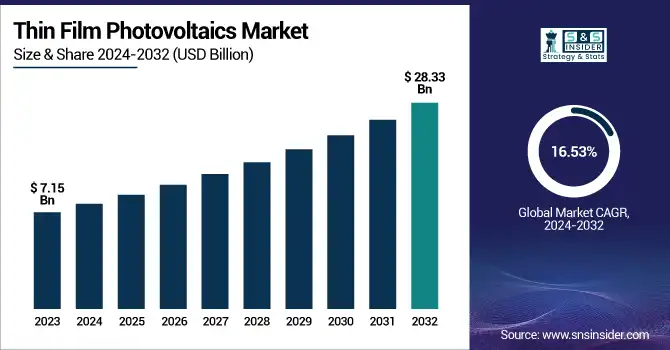
Thin-Film PV Market to Reach $28.3B by 2032
The chart quantifies the expected growth of the thin-film PV market, providing the strategic rationale and market context for First Solar’s $4.5 billion expansion in US manufacturing.
(Source: SNS Insider)
First Solar $2.1 B in Tax Credits, 2026 Financial Performance
The Inflation Reduction Act’s Section 45 X Advanced Manufacturing Production Tax Credit is the primary financial driver of First Solar’s 2026 operational and financial success. These incentives have created a highly profitable domestic market, providing the capital needed to fund an aggressive expansion strategy. The direct financial benefit from U.S. industrial policy has transformed the company’s profitability and cemented its ability to invest in next-generation technology.
- For the full year 2026, First Solar‘s financial guidance assumes it will receive between $2.10 billion and $2.19 billion in Section 45 X tax credits, representing a substantial government-backed revenue stream.
- This policy support translated directly to the bottom line, with the company reporting a record net income of $347 million and $1.0 billion in net sales for Q 1 2026, its strongest first quarter on record.
- These financial tailwinds are critical for funding the company’s capital-intensive expansion, including the $4.5 billion committed to new and upgraded facilities in Ohio, Alabama, and Louisiana.
- The IRA’s 10% domestic content bonus for project developers using First Solar’s U.S.-made modules further solidifies demand, creating a self-reinforcing cycle of protected demand and profitable growth.
Table: First Solar 2026 Investment and Financial Milestones
| Milestone | Time Frame | Details and Strategic Purpose | Source |
|---|---|---|---|
| U.S. Manufacturing Investment | Announced Feb 2026 | A cumulative $4.5 billion investment to expand the company’s U.S. manufacturing footprint and ramp up annual production capacity to approximately 18 GW. This capital is allocated to facilities in Ohio, Alabama, and Louisiana. | Saur Energy |
| Projected IRA Tax Credits | Q 1 2026 Guidance | The company anticipates receiving $2.10 billion to $2.19 billion in Section 45 X Advanced Manufacturing Production Tax Credits for the full year 2026, directly fueling profitability and funding expansion. | Business Wire |
| Record Q 1 Financial Results | Reported May 2026 | Achieved a record first quarter with $1.0 billion in net sales and a net income of $347 million, driven by record shipments of 3.8 GW of modules and benefits from the IRA. | PV Tech |
US Supply Chain, First Solar Secures NSG Group Glass Deal
To support its aggressive manufacturing ramp-up, First Solar has focused on securing a robust domestic supply chain for critical components, a move that de-risks its production and strengthens its “Made in America” marketing advantage. By locking in key material suppliers within the U.S., the company ensures its ability to meet the stringent domestic content requirements necessary for its customers to claim valuable IRA tax credits.
- The most significant partnership announced in 2026 is with NSG Group, which is expanding its solar glass production capacity in Ohio specifically to supply First Solar.
- This strategic alliance is crucial for maintaining a fully American supply chain for the company’s flagship Series 7 modules. A secure local supply of solar glass is a prerequisite for project developers seeking to claim the IRA’s 10% domestic content bonus.
- This vertically integrated approach contrasts sharply with the fragmented and geopolitically sensitive supply chains of c-Si module manufacturers, including other U.S.-based assemblers like Qcells, which often rely on imported cells and other components from Asia.
- By internalizing or localizing its supply chain, First Solar minimizes its exposure to international shipping costs, tariffs, and trade disputes that have plagued the broader solar industry.
Table: First Solar 2026 Strategic Partnerships
| Partner / Project | Time Frame | Details and Strategic Purpose | Source |
|---|---|---|---|
| NSG Group | Announced Feb 2026 | NSG Group will increase its solar glass production in Ohio to supply First Solar’s expanding manufacturing footprint. This secures a critical domestic component, de-risks the production ramp, and enables customers to qualify for IRA domestic content incentives. | Reshore Now |
18 GW Capacity, First Solar’s US Manufacturing Footprint
First Solar’s geographic strategy is defined by its singular focus on the United States, concentrating its entire manufacturing expansion within a few key states. This deliberate concentration in Ohio, Alabama, and Louisiana creates a domestic industrial base shielded by policy, optimized for serving large utility-scale projects like those developed by Next Era Solar 2026, and insulated from global geopolitical volatility.
- The company’s announced expansion will bring its total U.S. nameplate capacity to approximately 18 GW across six vertically integrated factories, with stated goals to potentially exceed 21 GW by the end of 2026.
- This manufacturing base is strategically located in Ohio, Alabama, and Louisiana, creating a centralized production hub that contrasts with the globally dispersed manufacturing footprints of its Chinese competitors.
- As a result of this domestic focus, First Solar’s Cd Te cell-equivalent production is forecast to account for approximately 80% of all solar cell production in the United States in 2026, making it the cornerstone of the nation’s solar manufacturing renaissance.
- This concentration allows First Solar to fully capitalize on the “policy-protected domestic market” created by the IRA, ensuring stable demand and favorable economics unmatched in other global markets. The immense scale of the US Solar 2026 project pipeline provides a ready market for this new capacity.
First Solar’s Cd Te Efficiency vs. 1 GW Perovskite Pilot
First Solar’s market dominance in the U.S. is built on a strategic trade-off: accepting a slight efficiency deficit in its mature Cd Te technology in exchange for supply chain security and a favorable cost structure. While its current modules are highly competitive for utility-scale projects, the company is actively addressing the long-term risk of falling behind technologically by investing in a clear R&D path toward higher-efficiency perovskite technology.
- In 2026, First Solar’s flagship Series 7 modules offer commercial efficiencies of 19% to 20%. While a significant improvement and economically viable, this lags behind leading Chinese c-Si products like TOPCon and HJT, which exceed 23-24% efficiency.
- The company’s competitive advantage relies not on peak efficiency but on its lower manufacturing costs, superior temperature coefficient, and the all-in value proposition of a non-Chinese, IRA-compliant module.
- To mitigate the long-term risk posed by the efficiency gap, First Solar announced in May 2026 an update to its perovskite technology roadmap. This move signals a concrete strategy to close the performance gap over time.
- The roadmap includes plans to establish a 1 GW perovskite pilot production line in 2027, a tangible step that moves the next-generation technology from the lab toward commercial viability and demonstrates a commitment to future innovation.
SWOT Analysis, First Solar Policy Strengths and Market Risks
First Solar’s strategic position in 2026 is overwhelmingly strong, rooted in its unique alignment with U.S. industrial policy and a defensible technology moat. However, this strength is counterbalanced by a heavy dependence on the continuation of favorable policies and the persistent threat of disruptive technological advancements from global competitors.
- Strengths are anchored in its proprietary, non-silicon Cd Te technology and a fully domestic, vertically integrated manufacturing model that perfectly aligns with IRA incentives.
- Weaknesses remain centered on the module efficiency gap compared to leading c-Si competitors and a smaller overall global scale than Chinese manufacturing giants.
- Opportunities are vast within the protected U.S. market, especially with the potential to close the efficiency gap through its investment in perovskite technology.
- Threats are primarily political and technological, including any potential rollback of the IRA, a weakening of its order book, and the rapid pace of c-Si innovation.
Table: SWOT Analysis for First Solar’s U.S. Strategy (2026)
| SWOT Category | Pre-IRA (2021-2022) | Post-IRA (2023-2026) | What Changed / Validated |
|---|---|---|---|
| Strengths | Proprietary Cd Te technology with a unique, non-silicon supply chain and a U.S. manufacturing presence. | Massive financial benefits from IRA Section 45 X credits ($2.1 B+ in 2026). Status as the premier supplier for domestic content bonuses. Record profitability. | The company’s long-standing strategy of domestic, vertically integrated manufacturing was validated and supercharged by U.S. industrial policy, turning a strategic choice into a decisive market advantage. |
| Weaknesses | Noticeable efficiency gap versus mainstream c-Si modules. Smaller production scale compared to Chinese Tier-1 manufacturers. | Efficiency gap persists (19-20% vs. >23%), though its economic impact is offset by IRA benefits. Production scale is growing rapidly but still a fraction of global leaders. | While the fundamental weakness of lower efficiency remains, the IRA’s financial incentives have made it largely irrelevant for the U.S. utility-scale market in the near term. |
| Opportunities | Growing demand for non-Chinese solar panels due to trade tensions and tariffs. Steady R&D in next-gen thin-film. | A protected, high-demand U.S. market. A clear roadmap for a 1 GW perovskite pilot line to address the efficiency gap. Ability to command premium pricing for IRA-compliant modules. | The IRA created a massive, protected market that did not exist before, turning the general demand for non-Chinese panels into a specific, highly profitable opportunity for First Solar. |
| Threats | Rapid cost reductions and efficiency gains from Chinese c-Si competitors. Geopolitical risks affecting raw material supply chains. | Potential softening of its order book (reported May 2026). Heavy dependence on the continuation of the IRA and favorable trade policies, creating significant political risk. | The primary threat shifted from being out-competed on pure cost/efficiency to the political risk of the policies that created its protected market being altered or reversed. |
US Policy Risk, First Solar’s Backlog and Capacity Execution
For First Solar, the path forward in 2026 and beyond is governed by two critical variables: its ability to execute flawlessly on its historic manufacturing expansion and its exposure to the volatile nature of U.S. energy policy. The company’s strategy is predicated on a stable policy environment that may not be guaranteed, making operational excellence and market demand signals the key indicators to watch.
- If this happens: If First Solar successfully ramps up its new facilities in Alabama and Louisiana to meet its stated 18 GW to 21 GW capacity targets while maintaining high utilization rates, it will solidify its financial dominance in the U.S. market and maximize its multi-billion-dollar IRA tax credit opportunity.
- Watch this: The health of the company’s order book is the most critical near-term signal. Following a May 2026 report of a shrinking backlog, all eyes will be on subsequent quarterly earnings announcements for updates on new bookings. Sustained weak demand could challenge the rationale behind its massive capital expenditures.
- These could be happening: A change in the U.S. political administration could lead to modifications or a repeal of the IRA, which would fundamentally alter the competitive landscape and erase much of First Solar’s protected market advantage. Simultaneously, Chinese competitors continue to advance c-Si technology, and any breakthrough that dramatically lowers cost or increases efficiency could re-introduce competitive pressure.