

TEPCO AI Grid Infrastructure, ¥420 B Investment, NTT Joint Venture, and 3 Key Projects (2025)
AI Grid Demand, TEPCO Shifts to External Infrastructure Provider in 2025
In 2025, Tokyo Electric Power Company (TEPCO) executed a strategic pivot from using AI for internal grid management to becoming a primary infrastructure provider for the external AI industry. This shift is a direct response to the massive increase in energy demand from generative AI, which requires a fundamental re-evaluation of the utility business model and a significant capital investment cycle to reinforce power grids and build new, high-growth revenue streams.
- Before 2025, TEPCO’s AI initiatives focused on internal efficiencies, such as using analytics for predictive maintenance and grid security. The core business remained traditional power generation and distribution, with digital technology serving a supporting role.
- The turning point in 2025 was the establishment of TEPCO Digital Infrastructure Co., Ltd. in June, a new subsidiary designed to directly enter the data center and AI computing market. This formalized the company’s new objective: to capitalize on the AI energy surge rather than just react to it.
- This strategic change is underpinned by projects aimed at directly serving the AI industry, including a joint venture with NTT to develop a 50 MW data center and a plan to build data center parks near the Kashiwazaki-Kariwa nuclear plant to offer stable, large-scale power.
- The company is also applying AI to its own grid modernization efforts. A pilot with the University of Tokyo and Fujitsu tests inter-regional workload shifting, using AI to balance grid load and reduce carbon emissions, demonstrating a dual strategy of enabling AI externally while leveraging it internally.
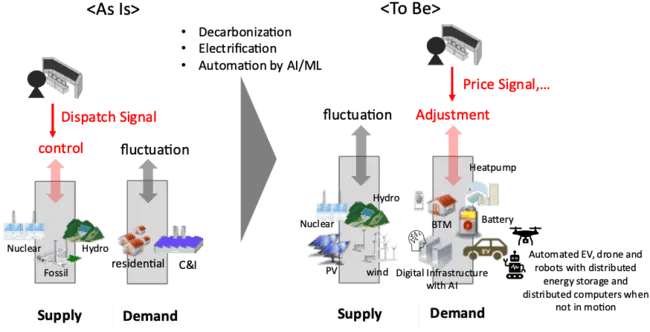
TEPCO Envisions AI-Driven Grid Shift
This diagram perfectly illustrates the section’s theme of a strategic shift, contrasting the current grid with a future model designed to support digital infrastructure and AI.
(Source: Energy Central)
$3.2 B Investment, TEPCO Grid Upgrades for AI Data Centers
TEPCO’s multi-billion-dollar investment program in 2025 highlights the scale of infrastructure upgrades required to support AI-driven data centers, with capital commitments far exceeding typical annual grid maintenance expenditures. These investments are not merely for capacity expansion but are targeted, strategic deployments to create a more resilient and intelligent grid capable of handling the concentrated, high-density power demands of AI workloads.
- In July 2025, TEPCO announced two major investments totaling over ¥420 billion (approximately $2.7 billion USD) specifically to reinforce its power grid for data centers. A ¥200 billion project targets northwestern Chiba prefecture, a major data center hub, while another ¥220 billion is allocated to enhance distribution networks across its service area.
- These figures are part of a larger reported investment of over $3.2 billion, indicating a comprehensive overhaul of its power transmission and distribution systems. This level of spending reflects the urgency to secure a competitive advantage in a power-constrained market.
- The scale of this investment is put into perspective when compared to the spending of the technology companies driving the demand. In 2025, Microsoft announced a $2.9 billion expansion of its AI and cloud infrastructure in Japan, while AWS committed $15 billion, signaling a sustained, long-term demand for power that TEPCO aims to capture.
Table: TEPCO and Competitor Investments in Japan’s AI Infrastructure (2025)
| Company | Time Frame | Details and Strategic Purpose | Source |
|---|---|---|---|
| TEPCO | Jul 2025 | Announced a combined ¥420 billion (approx. $2.7 billion) investment to specifically upgrade grid infrastructure in Chiba and other service areas to provide stable power for AI data centers. | Nikkei Asia |
| AWS (Competitor) | Mar 2025 | Announced a $15 billion investment to expand its cloud infrastructure in Japan, significantly increasing future power demand in regions served by TEPCO and other utilities. | TM Forum Inform |
| Microsoft (Competitor) | Mar 2025 | Committed $2.9 billion over two years to expand its AI and cloud services in Japan, creating further demand for high-reliability power from providers like TEPCO. | TM Forum Inform |
Japan-focused Alliances, TEPCO’s NTT Data Center JV
To mitigate market entry risk and accelerate its push into digital infrastructure, TEPCO is forming strategic partnerships with established technology and data center operators. These collaborations combine TEPCO’s control over power infrastructure with the partner’s expertise in data center construction, operation, and customer acquisition, creating a vertically integrated offering that is difficult for competitors to replicate.
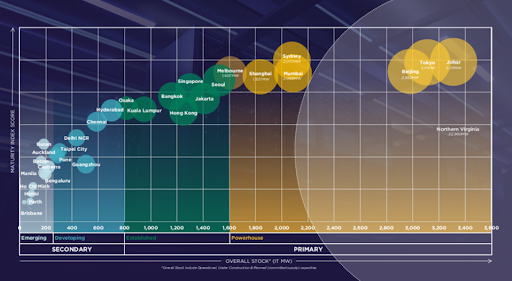
Tokyo’s Massive Data Center Market
This chart quantifies the Tokyo data center market’s large capacity, providing the competitive landscape and market context for the investments by TEPCO and its rivals.
(Source: W.Media)
- The most significant partnership in 2025 is the joint venture between TEPCO Power Grid and NTT Data to develop the 50 MW Shiroi Data Center Campus near Tokyo. This project serves as a blueprint for TEPCO’s new business model, leveraging its grid assets to co-develop digital infrastructure.
- In sustainability, TEPCO is a key participant in the “Project for Green Transformation” with the University of Tokyo. This project led to a December 2025 pilot with Fujitsu to test a carbon-neutral cloud computing environment, aligning its energy-intensive data center strategy with decarbonization goals.
- The company is also engaging in power purchase agreements to support its data center clients’ renewable energy targets. In December 2025, TEPCO HD was a party to a 10 MWp solar PPA signed by data center giant Equinix, demonstrating its role as an enabler of green digital infrastructure.
Table: TEPCO AI & Digital Infrastructure Partnerships (2025)
| Partner / Project | Time Frame | Details and Strategic Purpose | Source |
|---|---|---|---|
| University of Tokyo & Fujitsu | Dec 2025 | Launched a pilot project for inter-regional workload shifting between data centers, using AI to balance grid load and reduce carbon emissions. Part of a broader green transformation initiative. | Data Center Dynamics |
| Equinix & ESR | Dec 2025 | Party to a 10 MWp solar Power Purchase Agreement (PPA) to supply clean energy to Equinix data centers, supporting client sustainability goals. | Equinix Newsroom |
| NTT Data | Aug 2025 | Formed a joint venture to develop the 50 MW Shiroi Data Center Campus. This alliance combines TEPCO’s power supply advantage with NTT’s data center expertise. | Introl Blog |
TEPCO Focus on Chiba and Kashiwazaki-Kariwa (2025)
TEPCO’s AI infrastructure strategy is geographically concentrated within its own service territory, targeting areas with existing data center ecosystems or access to large-scale power generation. This focused approach allows the company to maximize its existing grid asset advantage and create specialized infrastructure hubs designed for high-density computing, rather than pursuing a diffuse national strategy.

TEPCO’s Integrated Infrastructure Vision
The chart’s focus on managing ‘workload shifts’ directly corresponds to the specific pilot project with the University of Tokyo detailed in the section’s partnership table.
(Source: Energy Central)
- The northwestern part of Chiba prefecture is a primary focus of TEPCO’s grid reinforcement efforts, receiving over ¥200 billion in investment. This region is already a major hub for data centers due to its proximity to Tokyo, and the upgrades are designed to support both existing expansion and new AI-focused facilities.
- In a more ambitious move, TEPCO announced plans in December 2025 to develop data centers in close proximity to the Kashiwazaki-Kariwa nuclear power plant. The strategic intent is to attract major tech companies by offering a stable, large-scale, and potentially lower-cost power source, which is a critical differentiator for energy-intensive AI operations.
- This regional strategy is a direct response to a broader trend in Japan, where data center construction faces bottlenecks from labor shortages and supply chain constraints. By pre-investing in grid infrastructure in specific zones, TEPCO aims to reduce lead times for data center connections, a key competitive advantage.
Technology Maturity: TEPCO AI From Internal Optimization to External Enablement
TEPCO is pursuing a dual-track technology strategy, applying mature, commercially available AI to optimize its internal grid operations while simultaneously building the foundational infrastructure required to power the next generation of external AI hardware. The company is not developing proprietary AI models for general use but is instead positioning itself as a critical enabler of the entire AI technology stack by providing the most fundamental resource: reliable power.
- Prior to 2025, TEPCO’s use of AI was focused on proven applications like demand forecasting, managing grid stability with renewables, and optimizing Vehicle-Grid Integration (VGI) through its advanced metering infrastructure. These are mature, risk-managed applications aimed at internal efficiency.
- The 2025 shift is defined by the launch of TEPCO Digital Infrastructure Co., Ltd., which is explicitly designed to support cutting-edge hardware. The subsidiary’s goal is to make GPU-equipped servers operational within months, directly addressing the speed-to-market pressure in the AI industry.
- The “workload shifting” pilot with the University of Tokyo and Fujitsu represents a bridge between these two tracks. It uses sophisticated AI for grid management but does so in the context of serving external data centers, hinting at future value-added services beyond simple power provision. This pilot is part of a larger ‘Project for Green Transformation, ‘ which reflects a broader industry trend where companies explore various decarbonization pathways, including carbon capture, to offset the environmental impact of energy-intensive computing.
SWOT Analysis, TEPCO AI Infrastructure Strengths and Execution Risks
TEPCO’s 2025 strategy leverages its incumbency as a grid operator to enter a high-growth market, but its success is exposed to significant regulatory and execution risks. The pivot to becoming a digital infrastructure provider is a necessary diversification, yet it ties the company’s financial future to the controversial restart of its nuclear assets and its ability to deliver complex infrastructure projects on time.
Table: SWOT Analysis for TEPCO’s AI Infrastructure Strategy
| SWOT Category | 2021 – 2024 | 2025 | What Changed / Validated |
|---|---|---|---|
| Strengths | Monopoly on power distribution in service area; extensive grid assets and operational expertise. | Leveraging grid ownership as a competitive advantage for data center development; significant $3.2 B+ capital commitment demonstrates strategic resolve. | The 2025 strategy validated that grid control is a powerful lever for entering the adjacent data center market, moving from a passive provider to an active participant. |
| Weaknesses | Heavy financial liabilities from the Fukushima disaster; public and regulatory opposition to nuclear power. | Strategy’s economic viability is highly dependent on the restart of the Kashiwazaki-Kariwa nuclear plant for low-cost, stable power. | The data center pivot in 2025 heightened the company’s dependence on its nuclear assets, making their restart a critical point of failure for the new strategy. |
| Opportunities | Growing electricity demand from digitalization; potential for new revenue streams. | Exponential growth in AI-driven energy demand; formal entry into the high-margin data center market through TEPCO Digital Infrastructure Co. | The AI boom of 2025 provided TEPCO with a clear, high-growth market to justify a major strategic diversification needed for its long-term financial recovery. |
| Threats | Competition from renewable energy providers; ongoing regulatory scrutiny. | Construction bottlenecks and labor shortages in Japan threaten project timelines; competition from hyperscalers (AWS, Microsoft) investing in their own power solutions. | The scale of investment by tech giants in 2025 validated the market size but also signaled a threat of them vertically integrating into power, bypassing traditional utilities. |
Scenario Modeling: TEPCO’s Nuclear Restart is the Critical Signal
The single most critical factor determining the success of TEPCO’s AI infrastructure strategy is the regulatory and political approval to restart the Kashiwazaki-Kariwa nuclear power plant. This event will act as the primary catalyst, dictating the pace, scale, and economic viability of the company’s data center ambitions for the remainder of the decade.

TEPCO’s Current Power Generation Mix
This chart shows TEPCO’s current power generation mix and demand fluctuations, providing crucial context for why a stable baseload from nuclear restart is critical to its strategy.
(Source: Energy Central)
- If the restart is approved in the near term: Watch for TEPCO to immediately accelerate the development of the data center park near the plant. This would likely trigger major partnership announcements with hyperscale cloud providers seeking large-scale, stable power. The company’s stock and financial outlook would improve significantly, validating its diversification strategy.
- If the restart is delayed or denied: Watch for TEPCO to shift focus to smaller-scale data center projects powered by a mix of renewables and the existing grid, which would be less competitive on cost and scale. This could force the company to seek new capital alliances to fund more expensive power sources or scale back its ambitions. The power constraints in the market could also drive more interest in on-site generation solutions like Solid Oxide Fuel Cells (SOFC) from data center operators.
- What could be happening: TEPCO is likely already engaging in parallel discussions with potential data center tenants and financial partners, with contract terms contingent on the nuclear plant’s operational status. The outcome of the workload-shifting pilot with Fujitsu could also open up new commercial services for grid balancing, providing an alternative revenue stream if the large-scale data center plans face delays.
The questions your competitors are already asking
This report covers one angle of TEPCO’s strategic pivot into the AI infrastructure market. The questions that matter most depend on your work.
- What is actually happening with the TEPCO-NTT joint venture since the 50 MW data center announcement?
- TEPCO’s ¥420B investment. Is the plan to build data center parks near the Kashiwazaki-Kariwa nuclear plant on track?
- Which hyperscalers are adopting TEPCO’s new data center power and infrastructure solutions?
This report does not answer these. Enki Brief Pro does.
Your question, your angle, your framework. SWOT, PESTL, scenario modelling. The same niche depth, built around the decision your work actually depends on.
