

Weatherford Green Hydrogen Strategy, 1 Eclipse Energy Partnership, 1 Decahydron Investment, and 2 Joint Projects (2025)
Industry Adoption: Weatherford’s Subsurface Hydrogen Pivot
In 2025, Weatherford International executed a strategic pivot from its traditional oilfield services to become a technology enabler for the nascent subsurface hydrogen market. Instead of competing in the capital-intensive electrolysis sector, the company focused on leveraging its core competencies in subsurface engineering and well construction. This move repositions Weatherford as a key partner for companies developing novel in-situ hydrogen production methods, aiming to establish a first-mover advantage in a market segment distinct from conventional green hydrogen.
- Prior to 2025, Weatherford’s new energy activities were largely extensions of its core business, such as adapting well integrity services like Secure View® for Carbon Capture, Utilization, and Storage (CCUS) applications.
- The definitive shift occurred in late 2025 with two strategic partnerships targeting different forms of subsurface hydrogen: one with Eclipse Energy for biotechnological production and another with Decahydron for geologic hydrogen stimulation.
- This strategy allows Weatherford to repurpose its existing technology portfolio and global operational footprint, creating a capital-efficient pathway to enter a hydrogen market projected to reach USD 226.37 billion by 2030.
- The company is targeting a new energy resource category that aims to produce hydrogen directly from geologic formations or depleted reservoirs, bypassing the need for external energy inputs like renewable electricity.
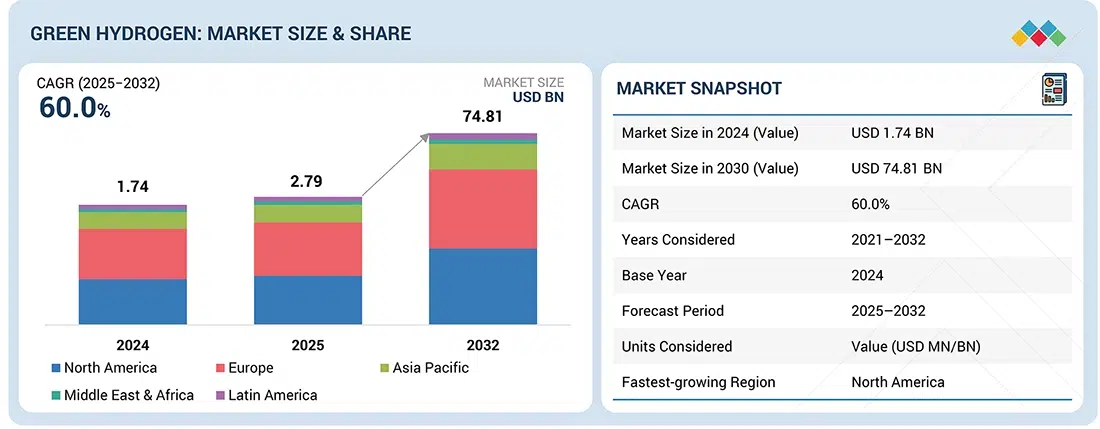
Green Hydrogen Market Forecasts 60% CAGR
The chart’s forecast of a 60% CAGR powerfully illustrates the rapid industry adoption of green hydrogen, providing the core justification for Weatherford’s strategic pivot into this high-growth sector.
(Source: MarketsandMarkets)
Weatherford’s 2 Hydrogen Investments, Eclipse Energy & Decahydron (2025)
Weatherford’s market entry was backed by direct strategic investments in its technology partners, signaling a clear financial commitment to validating and scaling subsurface hydrogen production. These investments secure access to proprietary technologies and align the company’s success with the commercialization of these new energy pathways. While the investment amounts were not disclosed, their strategic purpose is to accelerate development from concept to commercial viability.
- The investment in Eclipse Energy, announced in December 2025, is intended to scale a subsurface biotechnology platform with a stated potential to produce up to 250 billion kilograms of low-carbon hydrogen.
- The strategic investment in Decahydron, announced in November 2025, supports the development of technology to stimulate and extract hydrogen from ultramafic rock formations, a segment often called “geologic” or “white” hydrogen.
- These moves differentiate Weatherford from competitors focused on blue or green hydrogen and position it as a critical service and technology provider for an emerging, lower-CAPEX production method. This is similar to how other specialized firms like Fervo Energy are pioneering new subsurface energy extraction methods.

Hydrogen Market to Exceed $214B in 2025
This chart provides crucial market context for Weatherford’s 2025 investments. It shows that the company’s entry into deals with Eclipse Energy and Decahydron is timed to capitalize on a hydrogen market projected to be worth over $214 billion.
(Source: Global Market Insights)
Table: Weatherford Strategic Investments
| Company | Time Frame | Details and Strategic Purpose | Source |
|---|---|---|---|
| Eclipse Energy | Dec 2025 | Strategic investment to scale subsurface biotechnology for in-situ hydrogen production. The goal is to commercialize technology with a potential yield of 250 billion kilograms of hydrogen. | Energy Capital HTX |
| Decahydron | Nov 2025 | Strategic investment to help scale technology for producing geologic hydrogen from ultramafic rock formations, positioning Weatherford in the exploration and production of naturally occurring hydrogen. | Decahydron |
Partnership Analysis, Weatherford’s 2 Subsurface Hydrogen Deals
The foundation of Weatherford’s 2025 hydrogen strategy rests on two key collaborative partnerships designed to merge its operational scale with nascent technology. These alliances are structured to de-risk the commercialization process, combining Weatherford’s global well-engineering expertise with the specialized intellectual property of its partners. This symbiotic model allows Weatherford to function as a deployment accelerator rather than a primary producer.
- The partnership with Eclipse Energy combines Weatherford’s global expertise in well construction and production management with Eclipse’s subsurface biotechnology platform to jointly commercialize the technology.
- The collaboration with Decahydron leverages Weatherford’s investment to advance the technical and commercial readiness of geologic hydrogen production, a field that was largely theoretical prior to such industrial partnerships.
- Both agreements represent a strategic move to build a defensible niche as a service provider and technology integrator for subsurface hydrogen, sidestepping direct competition with major energy producers like RWE in the electrolysis market.

Hydrogen to Power Market Forecasted for Major Growth
The analysis of Weatherford’s hydrogen deals is contextualized by this chart, which highlights significant growth in the ‘Hydrogen to Power’ end-market. This suggests the partnerships are strategically positioned to serve a key application within the hydrogen value chain.
(Source: Fortune Business Insights)
Table: Weatherford Hydrogen Partnerships
| Partner | Time Frame | Details and Strategic Purpose | Source |
|---|---|---|---|
| Eclipse Energy | Dec 2025 | A collaborative partnership to accelerate the commercial deployment of Eclipse’s technology for producing clean hydrogen directly in subsurface reservoirs using biotechnology. | Fuel Cells Works |
| Decahydron | Nov 2025 | A collaboration underpinned by a strategic investment to scale technology for producing hydrogen from geologic sources, specifically ultramafic rock. | Decahydron |

Green Hydrogen Market to Exceed $242B by 2035
Accompanying the table of partnerships, this long-term forecast illustrates the massive future market size ($242B by 2035) that Weatherford and its partners are collectively targeting, underscoring the strategic ambition of these collaborations.
(Source: Market Research Future)
Global Scope, Weatherford Subsurface Hydrogen Strategy
Weatherford’s hydrogen strategy is inherently global, designed to be deployed across its existing operational footprint rather than being confined to a single geographic region. By focusing on subsurface technologies, the company can target regions with mature oil and gas basins or favorable geology, leveraging local infrastructure and regulatory frameworks. This approach provides significant geographic flexibility compared to green hydrogen projects that are tethered to specific locations with abundant renewable energy resources.
- The partnerships with Eclipse Energy and Decahydron are not limited by geography, enabling Weatherford to potentially deploy these technologies in any of its operating regions worldwide, from North America to the Middle East.
- The strategy of repurposing depleted oil and gas wells (with Eclipse) or exploring geologic formations (with Decahydron) allows the company to capitalize on regions where it already has a deep understanding of the subsurface and established operational presence.
- While no specific project locations were announced in 2025, the global nature of Weatherford’s business and the technologies themselves suggest a diversified geographical deployment strategy moving forward, targeting areas with the best combination of geological potential and commercial opportunity.

Hydrogen Project Pipeline Shows Massive Growth Ambition
The chart’s depiction of a global hydrogen project pipeline provides a direct visual representation of the ‘Global Scope’ discussed in this section. It shows that Weatherford’s strategy is aligned with a worldwide trend of developing hydrogen infrastructure.
(Source: Nature)
Technology Maturity: Weatherford’s Pre-Commercial Scale Focus
In 2025, Weatherford deliberately invested in technologies at the pre-commercial pilot stage, positioning itself at the frontier of hydrogen innovation. Both subsurface biotechnology and geologic hydrogen stimulation are emerging fields with significant technical hurdles to overcome before achieving industrial scale. Weatherford’s role is to provide the engineering, operational, and digital expertise required to transition these technologies from the laboratory to the field.
- The core technologies from partners Eclipse Energy and Decahydron are not yet proven at commercial scale; 2025 marked the beginning of the industrial validation phase, backed by Weatherford’s investment and operational support.
- Weatherford is also applying its existing, mature technologies to this new market. The Secure View® service, a proven tool for well integrity in oil, gas, and CCS, is being adapted to ensure the safety and containment of hydrogen in storage and production wells.
- The company’s digital “Industrial Intelligence” platform, designed to optimize upstream operations, will be another critical enabler, providing the monitoring and data analytics needed for these complex new processes, mirroring the growing need for AI & data center energy solutions in the broader industry.
- The success of this strategy is contingent on moving these novel technologies up the technology readiness level (TRL) scale through successful field pilots planned for 2026 and beyond.

Green Hydrogen Storage Market Projected to Grow
This section details Weatherford’s focus on pre-commercial subsurface hydrogen technology. The chart, forecasting growth specifically in the hydrogen storage market, validates the strategic importance and future commercial potential of this niche.
(Source: Market Research Future)
Weatherford SWOT Analysis: Strengths and Execution Risks
Weatherford’s pivot into subsurface hydrogen is a calculated move that builds on its core strengths while exposing it to the risks inherent in backing early-stage technology. The 2025 initiatives created a clear strategic direction that differentiates the company but also ties its future growth in this sector to the success of unproven concepts. The key change from prior years is the direct financial and operational commitment to a specific, high-risk, high-reward niche in the energy transition.

Weatherford Growth Strategy Illustrated
A chart illustrating Weatherford’s growth strategy serves as a perfect visual foundation for the SWOT analysis. It outlines the very strategy whose strengths, weaknesses, opportunities, and risks are being evaluated in the section.
(Source: Porter’s Five Forces)
Table: SWOT Analysis for Weatherford Green Hydrogen Initiatives
| SWOT Category | 2021 – 2024 | 2025 | What Changed / Validated |
|---|---|---|---|
| Strength | Deep subsurface knowledge and global oilfield service infrastructure primarily for oil and gas. | Leveraged existing subsurface expertise and global footprint to enter a new energy market with a low-CAPEX model. | Validated a strategy to repurpose core competencies for the energy transition without requiring massive new capital outlays for manufacturing. |
| Weakness | Primarily dependent on the fossil fuel industry, with limited exposure to new energy growth sectors. | Success in hydrogen is entirely dependent on the unproven, early-stage technologies of its partners (Eclipse Energy, Decahydron). | The company’s risk profile shifted from market risk in oil and gas to technology risk in a completely new energy sector. |
| Opportunity | Potential to apply existing well-related services to adjacent markets like geothermal and CCUS. | Carved out a defensible niche as a first-mover technology enabler in geologic and subsurface biotech hydrogen, avoiding crowded electrolysis market. | Created a potential new, high-growth revenue stream aligned with decarbonization that could disrupt the clean hydrogen supply landscape. |
| Threat | Cyclical nature of the oil and gas industry and pressure from energy transition policies. | Conventional green hydrogen costs could fall faster than expected, making this niche uneconomical. Competing service companies could replicate the strategy. | The emergence of specific technology and execution risks became the primary threat to the new venture’s success, superseding broader market threats. |

Shale Gas Fracturing Market Forecast to Grow
This chart, showing continued growth in Weatherford’s traditional shale gas business, provides crucial context for the SWOT analysis table. It represents a key ‘Strength’ (cash flow from legacy operations) and a potential ‘Threat’ (risk of being tied to fossil fuels).
(Source: Future Market Insights)
Scenario Modelling: Weatherford’s Pilot Data is Key for 2026
The critical factor for Weatherford’s hydrogen strategy in the year ahead is the execution and performance of the first field pilot projects with Eclipse Energy and Decahydron. The success of these initiatives hinges on validating the commercial viability of the underlying technologies. If pilot data demonstrates competitive production rates and a favorable Levelized Cost of Hydrogen (LCOH), it will validate the entire strategic pivot and likely trigger further investment and expansion.
- If this happens: Initial data from pilot projects in 2026 shows a viable production cost and yield.
- Watch this: Announcements of specific LCOH metrics, hydrogen production volumes, and plans for scaling up to commercial-sized projects.
- This could be happening: Weatherford could establish a formal “New Energy” division, secure additional partnerships, and begin marketing a suite of integrated services for geologic hydrogen exploration and production, solidifying its first-mover advantage.

Green Hydrogen Market to Reach $231B by 2035
Scenario modeling requires long-range projections. This chart’s forecast of a $231B market by 2035 provides a critical data point for building models to evaluate the potential long-term financial impact of the pilot data expected in 2026.
(Source: Precedence Research)
The questions your competitors are already asking
This report covers one angle of Weatherford’s strategic pivot into the subsurface hydrogen market. The questions that matter most depend on your work.
- Weatherford’s activities in subsurface hydrogen. Are its partnerships with Eclipse Energy and Decahydron progressing from pilot to deployment?
- Is Weatherford a good investment at this stage of the subsurface hydrogen market cycle?
- How does biotechnological production (Eclipse Energy) compare to geologic stimulation (Decahydron) for in-situ hydrogen production?
- What are the opportunities for subsurface engineering services in the geologic hydrogen market?
This report does not answer these. Enki Brief Pro does.
Your question, your angle, your framework. SWOT, PESTL, scenario modelling. The same niche depth, built around the decision your work actually depends on.
