

AI Compute Offtake Agreements, 190 GW Hyperscale Pipeline, $9.8 B Hut 8 Deal, and 777 Projects (2021 to 2026)
Compute Offtake Adoption, How AI Power Demand Drove 190 GW of Projects
The insatiable energy requirements of Artificial Intelligence have forced a fundamental restructuring of infrastructure deal-making, rendering the traditional, siloed procurement of power and data center capacity obsolete. By 2026, the market has standardized around the integrated compute offtake agreement, a model that bundles power generation directly with AI compute capacity into a single, long-term contract. This shift was driven by the realization that power availability, not capital, is the primary constraint on the AI buildout, with multi-year grid interconnection queues and transformer shortages creating unacceptable delays for hyperscalers and AI developers.
- Between 2021 and 2024, data center developers primarily relied on securing land with access to existing grid infrastructure, followed by separate negotiations for Power Purchase Agreements (PPAs) and colocation Master Service Agreements (MSAs). This model proved too slow and uncertain as U.S. data center electricity demand began its climb from ~180 TWh toward a projected 400-600 TWh by 2030 (AI data center energy in 2026 – dev/sustainability).
- Starting in 2025 and accelerating through 2026, the model inverted. Developers now lead with dedicated, often behind-the-meter, power generation strategies and secure a single, creditworthy offtaker for the combined power and compute asset. This structure transforms the project from a speculative real estate play into a bankable, utility-scale asset, unlocking project financing needed to build out the 190 GW of announced hyperscale capacity (Roadmap: The AI data center stack).
- This new structure is a direct response to market failures, where analysts in 2026 estimated that 30% to 50% of planned AI data center deployments in the U.S. would face delays or cancellation due to power constraints alone (Nearly half of US data centers planned for 2026 are facing …). The integrated agreement de-risks deployment by internalizing the power supply chain.
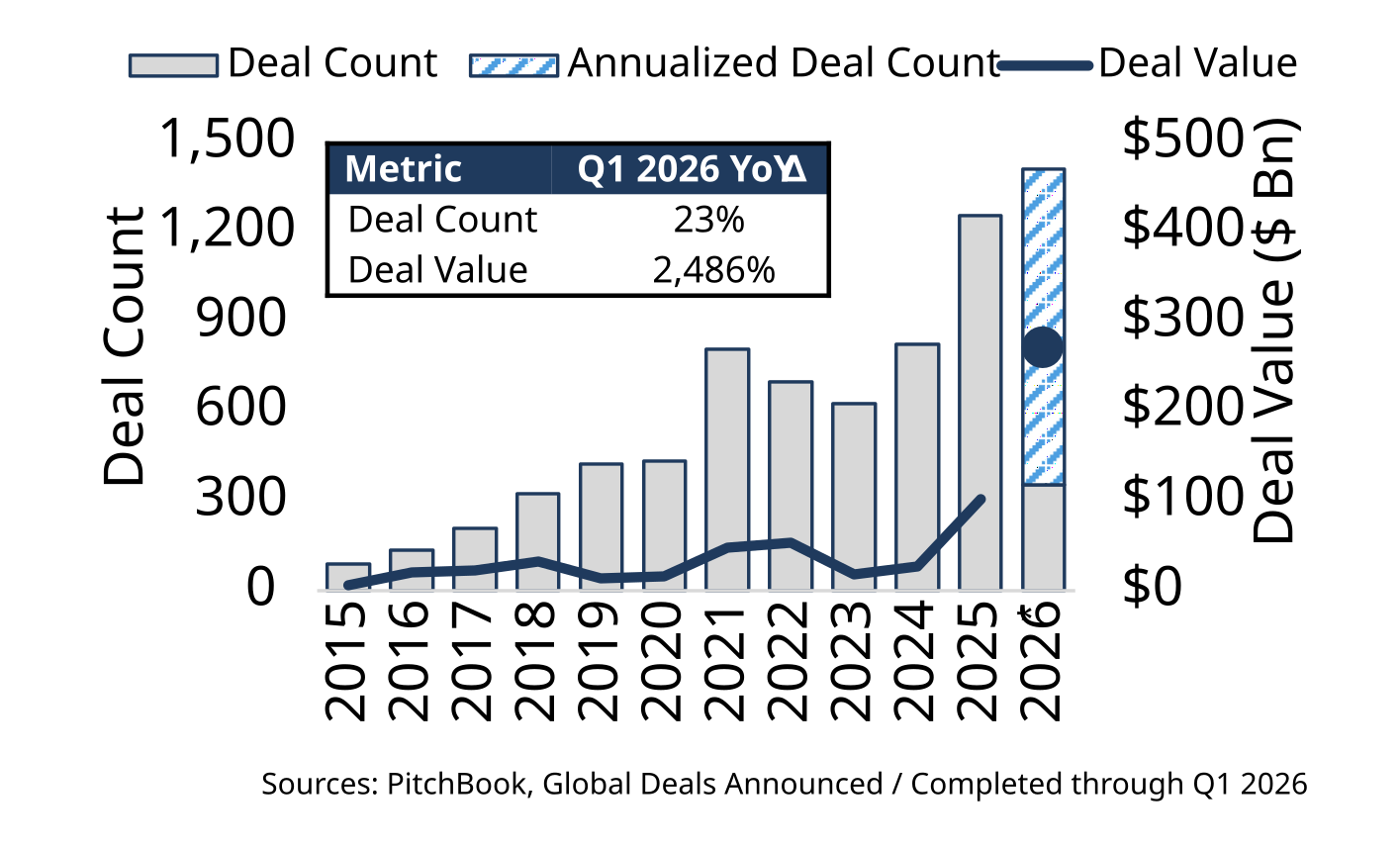
Deal Value Set for 2,486% Q1 2026 YoY Surge, Reaching $275B Annualized
Global deal value is projected to surge by an astonishing 2,486% year-over-year for Q1 2026, reaching an annualized total of approximately $275 billion. This exponential growth, far outpacing the 23% increase in deal count, signals a dramatic shift towards significantly larger, high-value transactions dominating the market.
Disproportionate Deal Value Growth Signals Emergence of Mega-Deals
The massive disparity between the 2,486% deal value increase and the 23% deal count growth indicates a fundamental restructuring of deals, aligning with ‘Compute Offtake Agreements” where power and AI capacity are bundled. This signifies a maturing market where large-scale, capital-intensive agreements are becoming the norm, rather than just an increase in transaction volume.
AI-Driven CAPEX Skyrockets Towards $1.6 Trillion by 2027
Annual CAPEX for major tech players (MSFT, AMZN, GOOG, META) is on track to exceed $1T by 2026, an 83% Y/Y increase from 2025’s $550B, primarily driven by AI infrastructure. This colossal investment sets the stage for a trillion-dollar market by 2027, with potential highs of $1.6T.
$9.8 B in Deals, Hut 8 and Next Era Signal New Investment Cycle
The integrated compute offtake agreement has become the key that unlocks project financing and large-scale mergers and acquisitions in the AI infrastructure sector. By providing a long-term, predictable revenue stream from a creditworthy counterparty, these agreements make gigawatt-scale data center projects bankable. This has attracted a new class of investors from the energy and infrastructure sectors and has fueled a surge in M&A activity, with power utilities acquiring data center assets and vice-versa to create vertically integrated platforms.
- In July 2026, Hut 8 fully commercialized its 1 GW Beacon Point AI data center campus by signing a landmark $9.8 billion, 352 MW lease with a major AI hyperscaler (Hut 8 Signs $9.8 B, 352 MW AI Data Center Lease). This deal exemplifies the new model, where a single large-scale agreement underpins the economics of an entire campus.
- The convergence of energy and data infrastructure is driving significant M&A, with power and utilities M&A activity surging 173% in the first half of 2026. This trend was highlighted by the rumored $420 billion merger discussions between Next Era and Dominion Energy, a deal explicitly motivated by the need to consolidate energy generation to meet exponential AI-driven load growth (Power and utilities M&A surges 173% on AI demand in 2026).
- The demand for this new asset class is so strong that the Bank for International Settlements noted in March 2026 that private credit funds and infrastructure investors are increasingly financing the AI boom through these off-balance-sheet structures (Financing the AI infrastructure boom: on- and off-balance …). This indicates a mature, financeable market has formed around the integrated offtake model.
Table: Significant Compute Offtake and Infrastructure Deals (2025-2026)
| Company / Project | Time Frame | Details and Strategic Purpose | Source |
|---|---|---|---|
| Hut 8 / Beacon Point Campus | July 2026 | Signed a $9.8 billion, 352 MW AI data center lease with an unnamed hyperscaler. This agreement underwrites the commercial viability of its 1 GW campus, demonstrating the bankability of large-scale integrated offtake deals. | Stock Titan |
| Next Era / Dominion Energy | July 2026 | A rumored $420 billion merger between the two largest U.S. utilities, driven by the need to secure generation capacity to serve massive data center load growth. Signals the strategic consolidation of energy assets for AI. | Market Scale |
| Various Hyperscalers | March 2026 | Major hyperscalers, including Amazon, Google, and Microsoft, signed the White House’s “Ratepayer Protection Pledge, ” committing to help fund grid upgrades and new generation required for their data centers. | POWER Magazine |
| Oracle / Bloom Energy | July 2025 | Oracle partnered with Bloom Energy to deploy on-site power solutions for its global data centers. This early move signaled the shift toward behind-the-meter generation to ensure power certainty for AI workloads. | Data Center Frontier |
US Regional Shifts, How Power Availability is Redrawing the Data Center Map
The geographic distribution of AI data center development has shifted away from traditionally dominant but power-constrained markets toward regions with ample energy resources and supportive regulatory environments. Whereas proximity to internet exchange points and fiber routes dictated location between 2021 and 2024, the primary siting criterion by 2026 is access to gigawatt-scale power. This is creating a “parallel energy system” and fundamentally redrawing the U.S. data center map.
- Before 2025, markets like Northern Virginia were the epicenter of data center development due to their dense fiber networks. However, by 2024, utilities in these areas began signaling that the grid was saturated, with connection delays stretching for years, forcing developers to look elsewhere.
- By 2026, development is migrating to states with deregulated energy markets and abundant power potential, such as Texas, as well as regions with significant hydroelectric or nuclear capacity. A Dallas Fed study in 2026 highlighted the significant impact of data center load on wholesale electricity markets, confirming this trend (The Effect of Data Centers on Wholesale Electricity Markets).
- This geographical diversification is not just about grid connections. Developers are actively co-locating data centers with power generation assets. This includes building next to existing power plants or developing new renewable or natural gas facilities dedicated to a single data center campus, a strategy that was rare before 2024. This includes exploring novel sources like geothermal, where firms like Chevron are active.
Deal Structure Maturity, From Novelty to Bankable Standard (2021 to 2026)
The integrated compute offtake agreement evolved from a niche, innovative solution in the early 2020 s to the de facto standard for financing and developing large-scale AI infrastructure by 2026. This rapid maturation was a direct market response to the systemic risks posed by bifurcated procurement models in an era of extreme power demand. The structure’s ability to provide revenue certainty has made it the foundational instrument for the entire AI data center stack, from power generation to semiconductor supply from firms like TSMC.
- From 2021-2023, project finance for data centers was largely based on a multi-tenant real estate model, with risk spread across numerous smaller customers. Financing for dedicated, single-tenant AI facilities was challenging due to the high concentration of credit risk and the uncertainty of securing power.
- The period of 2024-2025 served as the validation phase. Early adopters, including hyperscalers and specialized “neocloud” providers, began signing large, integrated deals that bundled power and compute. These deals, often with behind-the-meter power from partners like Mainspring, proved that the model could successfully bypass grid bottlenecks.
- By 2026, the model has achieved full maturity and market acceptance. Legal and financial frameworks are now standardized, and a liquid market of infrastructure funds and private credit providers exists specifically to finance these integrated assets (Data Center Investment in 2026: AI Demand, Power …). The offtake agreement itself, not the physical real estate, is now considered the primary asset (In AI Infrastructure, the Offtake Agreement Is the Asset).

New AI Cloud Contracts Solidify Power-Compute Bundling
The chart reveals over ten major AI cloud contracts, largely announced in late 2025, explicitly bundling “Critical IT Power Contracted” (MW) with specific AI chip types (GB300, GB200, TPU v7). This signifies a critical shift toward integrated power and compute capacity deals among hyperscalers like Microsoft, Meta, OpenAI, and Anthropic.
Integrated Deals Drive Efficiency, Consolidate AI Infrastructure
The explicit inclusion of dedicated power alongside AI capacity underscores AI’s growing energy intensity and the need for guaranteed supply. This integrated approach, often involving multi-year terms (4-6 years), shifts power supply risk to compute providers, driving market consolidation and demanding robust, scalable power solutions for next-gen AI infrastructure.
Power, Packaging, and Memory are AI’s Hard Physical Limits by 2026
Power is the ‘ultimate constraint,’ with hyperscalers aiming for 40-50 GW of new capacity by 2026. This massive demand means leading AI companies are effectively becoming power utilities, locking in generation through long-term contracts. Critical bottlenecks also include TSMC’s CoWoS packaging (60% for NVIDIA) and HBM4 memory, with 70% of world output directed to AI.
SWOT Analysis, Examining the Strengths and Risks of Integrated Agreements
The integrated compute offtake agreement model presents a powerful solution to the AI power crunch, but it also introduces new complexities and risks. Its primary strength lies in its ability to de-risk and accelerate deployments by internalizing power generation. However, the structure’s reliance on a single, long-term tenant and the complexities of developing combined power and data facilities create significant execution and counterparty risks.
Table: SWOT Analysis for Integrated Compute Offtake Agreements
| SWOT Category | 2021 – 2023 | 2024 – 2026 | What Changed / Validated |
|---|---|---|---|
| Strengths | Hypothetical ability to bypass grid queues. Theoretical financing advantages. | Bankability: The model is proven to unlock project finance for GW-scale projects (In AI Infrastructure, the Offtake Agreement Is the Asset). Speed-to-Market: Directly addresses the primary bottleneck (power), reducing project timelines. |
The model moved from a theoretical concept to a proven, bankable standard, validated by multi-billion dollar deals like Hut 8’s $9.8 B lease (Stock Titan). |
| Weaknesses | High counterparty risk with a single offtaker. Complex to structure legally and financially. | Execution Risk: Requires expertise in both energy development and data center construction, a rare combination. Counterparty Risk: High dependency on the financial health and long-term AI strategy of a single tenant. |
While the financial structure is now standardized, the operational and construction complexities remain a major hurdle, leading to high-profile delays and cancellations for 30-50% of projects (Reddit). |
| Opportunities | Serve the nascent but growing demand for AI training compute. | Massive Demand: U.S. AI data center market projected to hit $142.5 B in 2026 and grow at a 27.4% CAGR (Marketsand Markets). New Technologies: Creates a dedicated market for novel power sources like SMRs and geothermal. |
The scale of the market opportunity has been validated, with demand forecasts consistently revised upwards. The need for 24/7 power also creates a clear business case for integrating new firm power technologies. |
| Threats | Potential for local opposition to data center construction. Uncertainty in long-term AI demand. | Regulatory Scrutiny: States and the EU are introducing energy standards and tax regimes for data centers (Reuters). Supply Chain Constraints: Persistent shortages of transformers and other grid components (Rabobank). |
Regulatory and supply chain risks have intensified. What were once project-level concerns are now systemic threats to the entire AI buildout, requiring direct intervention like the White House’s “Ratepayer Protection Pledge” (White House). |
2027 Projections, Hyperscalers to Become De Facto Energy Companies
If the current trajectory of AI power demand continues, the line between technology companies and energy companies will blur significantly. Expect to see hyperscalers and large AI developers move beyond just signing offtake agreements to taking direct equity stakes in power generation assets or even developing their own, effectively becoming unregulated, vertically integrated utilities to secure their growth.
- If this happens: Watch for hyperscalers announcing direct investments in or acquisitions of independent power producers, SMR developers, or geothermal companies. A key signal would be a company like Microsoft or Google creating a dedicated energy development subsidiary.
- Watch this: The evolution of the White House’s “Ratepayer Protection Pledge.” The initial March 2026 pledge was a commitment to fund upgrades. The next step would be direct co-development of transmission and generation projects with utilities, moving from customer to partner.
- These could be happening: We are already seeing the early signals. In July 2026, rumors of the Next Era–Dominion merger were explicitly tied to creating an entity large enough to handle the AI power demand. By 2027, Gartner forecasts AI servers will consume more power than all conventional data center hardware combined, making energy strategy inseparable from compute strategy (Tom’s Hardware).
The questions your competitors are already asking
This report covers one angle of AI data center deal structuring. The questions that matter most depend on your work.
- regions getting new data centers and power plants
- which utility companies are partnering with data centers
- on-site power technology for new data centers
- who is financing bundled power and data center projects
This report does not answer these. Enki Brief Pro does.
Your question, your angle, your framework. SWOT, PESTL, scenario modelling. The same niche depth, built around the decision your work actually depends on.
