

Compute Offtake Agreements: Securing 55 GW for US Data Centers via Power-First Deals with Chevron and Google (2024-2026)
Compute Offtake Adoption, Driven by 7 GW in AI Project Delays and Grid Interconnection Queues
The traditional Power Purchase Agreement (PPA) model has failed to meet the speed and scale required for AI, forcing the industry to adopt integrated Compute Offtake Agreements that bundle power with compute capacity to de-risk project development. This new structure has become the dominant financing model in 2026 because it solves for the primary constraint on AI expansion: securing massive blocks of power on a timeline that matches the pace of technology demand.
- Prior to 2025, hyperscalers typically pursued a fragmented procurement strategy, separately signing a long-term lease with a data center operator and a PPA with a power producer. This two-part process introduced significant timing and development risks, as a data center could be ready for years before its contracted power source could achieve grid connection.
- The AI boom rendered this model obsolete. By early 2026, an estimated 1, 400 GW of power generation and 890 GW of storage projects were stuck in multi-year U.S. grid interconnection queues, making it impossible to guarantee power delivery on AI development timelines.
- This power bottleneck directly caused significant commercial disruption. Up to 50% of large data centers scheduled for completion in 2026 faced delays, with an estimated 7 GW of planned U.S. AI capacity being stalled or cancelled due to the inability to secure power.
- The Compute Offtake Agreement resolves this by making guaranteed power delivery the central pillar of the deal. It shifts the primary financeable asset from physical real estate to the credit-backed, long-term revenue stream for GPU-dense compute, which is only valuable if the power is available from day one.
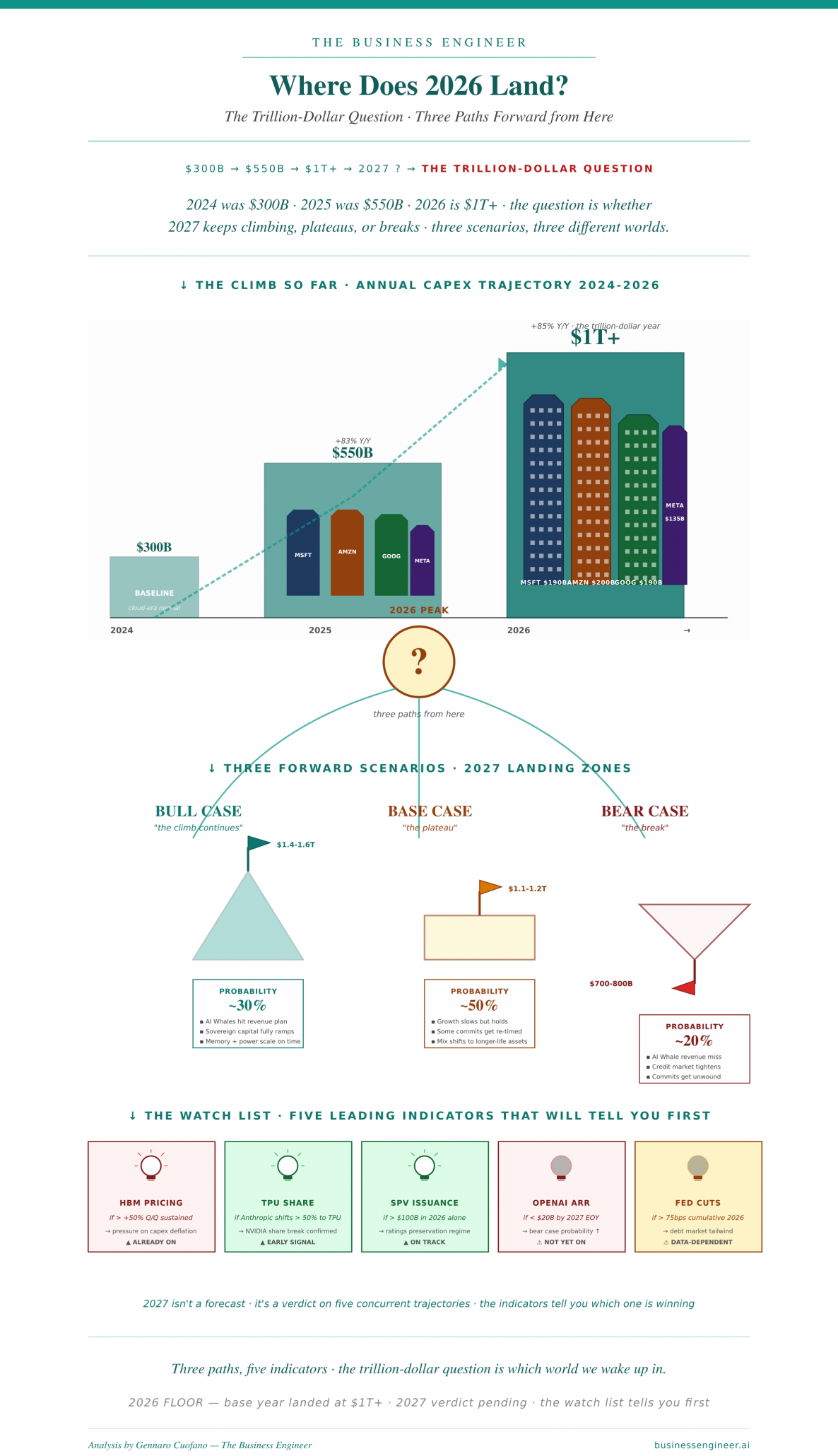
Trillion-Dollar AI Capex Surges, 2026 Peak Projected
Annual CAPEX from major tech giants (MSFT, AMZN, GOOG, META) is projected to surge from $300B in 2024 to over $1T in 2026, indicating an unprecedented investment peak in AI infrastructure. This rapid expansion sets the stage for a critical 2027, with future growth trajectories highly dependent on market indicators.
AI Infrastructure Demand Fuels New Strategic Deal Structures
This massive, sustained CAPEX, particularly where “power scale on time” is a success factor (30% probability Bull Case), creates immense pressure to secure future AI compute and power resources. The sheer scale necessitates innovative procurement models, making “Compute Offtake Agreements” essential for ensuring supply chain stability and mitigating investment risk for “AI Whales” and sovereign capital.
CSPs Forecast Quadruple CapEx by 2026, Fueling AI Infrastructure Boom
The top nine global Cloud Service Providers (CSPs) are projected to increase their capital expenditure (CapEx) nearly five-fold, from $172.6 billion in 2023 to an estimated $830 billion by 2026. This aggressive spending signifies a massive build-out of data center and AI infrastructure, with a staggering 79% year-over-year growth forecasted for 2026.
(Source: Summary of the AI Index Report 2026 – by Michael Spencer)
7 GW in 2026, AI Data Center Cancellations and Delays Caused by Power Scarcity
Power availability has become the primary gating factor for AI infrastructure deployment, leading to a significant number of project delays and outright cancellations in 2026. The inability of grid operators and traditional procurement models to keep pace with demand has created a tangible gap between planned capacity and operational reality, representing a major risk for hyperscalers and investors.
- In the U.S. alone, an estimated 7 GW of AI data center capacity faced delays or cancellations in 2026 due to power constraints. This represents a substantial portion of the planned build-out and highlights the failure of the legacy development model.
- Globally, reports from early 2026 indicated that between 30% and 50% of large data center projects scheduled to come online in the year were expected to be delayed, with power shortages and equipment lead times cited as the main causes.
- The crisis has also triggered a regulatory backlash. In February 2026, Illinois Governor Pritzker announced a two-year suspension of state tax incentives for new data centers, citing the immense strain these facilities place on the state’s power grid and resources.
- This environment of scarcity and regulatory uncertainty directly accelerated the move toward integrated deals. By securing a dedicated or co-located power source from the outset, developers can bypass much of the public grid uncertainty that is stalling competing projects. On-site generation from firms like Mainspring is also gaining traction as a way to circumvent grid dependency.
New Deal Structures, 11+ Integrated Energy and Compute Partnerships Redefine AI Infrastructure (2024-2026)
A new class of partnerships is emerging, directly linking energy producers with hyperscalers to co-develop power and compute infrastructure, bypassing traditional utility procurement pathways. These alliances are designed to solve the “speed-to-power” problem by integrating the development timelines for generation and data center construction under a single, unified agreement.
- These integrated partnerships are structured to deliver gigawatt-scale power blocks on accelerated timelines. The core innovation is the vertical integration of the supply chain, where an energy company commits to delivering power to a specific data center site being built concurrently.
- The economic model is underpinned by a long-term Compute Offtake Agreement, where a hyperscaler commits to purchasing a certain amount of compute capacity (e.g., in GPU-hours) over a 10-15 year term. This creditworthy offtake contract provides the revenue certainty needed to secure project financing for both the power plant and the data center.
- This contrasts with the pre-2025 model, where project finance for a data center was primarily backed by its real estate value, and renewable projects were financed separately against a PPA. The new model finances the entire stack as a single infrastructure asset. The demand for underlying components from companies like TSMC and Broadcom ultimately fuels the need for these large-scale integrated projects.
Table: Notable Integrated Power and Compute Partnerships (2024-2026)
| Partners | Time Frame | Details and Strategic Purpose | Source |
|---|---|---|---|
| Chevron, Microsoft, Engine No. 1 | March 2026 | Chevron signed an exclusivity agreement to develop geothermal and other novel power sources directly for Microsoft’s AI data centers. The partnership aims to create a replicable model for powering compute with 24/7 clean energy, bypassing grid constraints. | Chevron |
| Google, Intersect Power | December 2024 | Google and Intersect Power filed a request with FERC to develop a co-located solar-plus-storage energy park to directly power a Google data center in Texas. This behind-the-meter arrangement is designed to secure reliable, renewable power and avoid interconnection delays. | Utility Dive |
| Babcock & Wilcox, Unnamed AI Client | November 2025 | Babcock & Wilcox announced an agreement to supply Bright Loop chemical looping technology for a new-build AI data center project. This will generate hydrogen and carbon-ready power on-site to ensure operational resilience and reduce reliance on the grid. | Babcock & Wilcox |

Hyperscalers Pour $765B+ into 2026 AI Compute Landscape
Hyperscalers are projected to commit over $765B in CAPEX by 2026, driving a $1T architecture centered on AI compute. Amazon AWS leads with $200B, closely followed by Microsoft and Google at $190B each, signifying an intense capital race to build and secure foundational AI infrastructure.
AI Whales Dictate Compute Offtake, Reshaping Hyperscaler Strategy
The bulk of hyperscaler CAPEX is directly allocated to AI compute, not general cloud expansion. This creates a new economic model where ‘AI Whales” like OpenAI ($718B committed) and Anthropic ($330B committed) secure capacity through deep, often equity-backed, compute offtake agreements, redefining the value chain for AI-driven services.
CSPs to Inject $830 Billion into Infrastructure by 2026 Amid AI Boom
The top nine global Cloud Service Providers (CSPs) are forecast to dramatically increase capital expenditure (CapEx), reaching $830 billion by 2026. This represents a robust 79% Year-over-Year growth, following a significant rebound from a -2% decline in 2023, indicating an aggressive investment cycle in compute infrastructure.
(Source: The 2026 AI playbook: what is powering the AI trade?)
US Power Demand Surge, Data Centers Drive 55 GW of New Load and Shifting State Incentives
The United States has become the epicenter of AI data center growth due to the concentration of hyperscalers, but the resulting power demand shockwave is forcing a reckoning at the state and local level. While some regions with available power are capitalizing on the boom, others are actively pushing back against new developments due to the immense strain on grid resources and the impact on electricity prices for existing residents and businesses.
- Data centers are expected to drive an incremental power demand of 55-60 GW in the U.S. by 2030, a staggering figure that is forcing utilities to completely rewrite their long-term load forecasts. The U.S. Energy Information Administration (EIA) updated its forecast in May 2026 to project a 3.1% increase in total power demand in 2027, largely attributed to data center expansion.
- Prior to 2024, states aggressively competed for data center projects with generous tax incentives. However, the scale of AI power consumption has changed this dynamic. By 2026, states like Illinois, Georgia, and Virginia began suspending or re-evaluating these tax breaks, concerned that the grid impact outweighs the economic benefits.
- This has created a bifurcated landscape. “Power-rich” regions with legacy thermal generation, ample renewables, or favorable geology for geothermal are becoming magnets for new AI developments. In contrast, “power-poor” regions with congested grids are becoming no-go zones, regardless of prior incentives.
- The pressure is forcing innovation in power sourcing, including direct partnerships with energy firms and exploration of on-site generation. These strategies are no longer just for cost savings or clean energy goals; they are a necessity for securing the power required to operate at all.
SWOT Analysis, Compute Offtake Agreement Strengths vs. Long-Term Market Risks
While the Compute Offtake Agreement solves the immediate speed-to-power problem for AI, it also introduces new complexities in risk allocation and long-term financing that the market is still pricing. The model’s core strength is its ability to de-risk development in a power-constrained world, but its long-term viability depends on managing novel counterparty and technology risks.
- Strength: The structure’s primary advantage is providing a bankable, credit-backed contract that allows for the simultaneous financing and development of both power generation and data center assets, drastically reducing project timelines.
- Weakness: These are highly complex, bespoke contracts that carry significant counterparty risk. The failure of either the power provider or the compute offtaker can jeopardize the entire project, a risk not present in the traditional separated model.
- Opportunity: This model can unlock “stranded” energy assets. Power generation projects that were previously unviable due to a lack of transmission access can now be developed by co-locating them with a data center that acts as a dedicated, on-site buyer.
- Threat: The long-term nature (10-15 years) of these agreements creates a significant technology-obsolescence risk. The underlying value is tied to specific GPU hardware, which may be superseded by more efficient technology from companies like Applied Materials or ASML long before the contract expires, potentially stranding the asset.
Future Scenarios, 3 Signals to Watch as Energy and AI Markets Converge Post-2026
If the Compute Offtake Agreement becomes the universal standard for AI infrastructure, watch for increased vertical integration where energy companies acquire data center assets and hyperscalers make direct investments in power generation. The line between technology companies and energy companies will continue to blur as securing power becomes inseparable from deploying compute.
- If grid interconnection queues remain at current levels or worsen, watch for a surge in development of behind-the-meter and on-site generation. This includes not only solar and storage but also advanced nuclear, geothermal, and efficient gas-powered solutions that can provide firm, 24/7 power.
- If hyperscalers continue to co-develop their own power sources, watch for regulated utilities to respond with new offerings. These could include specialized “AI-Ready” tariffs that provide guarantees on power availability and quality, or new infrastructure-as-a-service models where the utility builds and manages dedicated substations for large customers.
- If the model proves successful and standardized, watch for the emergence of new financial players. Expect to see infrastructure funds and private equity firms that specialize exclusively in financing integrated power and compute projects, potentially bundling them into new asset-backed securities for the capital markets.
The questions your competitors are already asking
This report covers one angle of AI infrastructure development. The questions that matter most depend on your work.
- Data centers building their own power plants
- US regions with available power for data centers
- Geothermal power for data centers
- Managing hardware risk in long term compute contracts
This report does not answer these. Enki Brief Pro does.
Your question, your angle, your framework. SWOT, PESTL, scenario modelling. The same niche depth, built around the decision your work actually depends on.
