

Top 10 Nuclear Deals: Meta’s 6.6 GW Commitment and Microsoft’s $1.6 B Constellation PPA (2025 to 2026)
Hyperscale data center operators are fundamentally altering their energy procurement strategies, pivoting to large-scale nuclear power to secure the vast, reliable, and carbon-free electricity required for the AI boom. This strategic shift is highlighted by landmark deals from Microsoft and Meta, which are moving beyond intermittent renewables to lock in 24/7 baseload power through multi-billion-dollar, long-term nuclear agreements. Key announcements include Meta‘s plan for 6.6 GW of nuclear projects and Microsoft‘s $1.6 billion Power Purchase Agreement (PPA) with Constellation Energy to power its data centers with the restarted Three Mile Island nuclear plant. The dominant theme emerging between 2025 and 2026 is that securing gigawatt-scale, constant power is now the primary constraint for AI expansion, pushing tech giants to underwrite the revitalization of the nuclear industry and even build their own generation to bypass grid limitations.
1. Soft Bank & SB Energy Ohio AI Data Center Platform
Companies: Soft Bank, SB Energy
Capacity: 10, 000 MW
Application: AI data center platform
Source: 10 GW Ohio AI Campus and $12 B Meta Deal Signal Next Phase of …
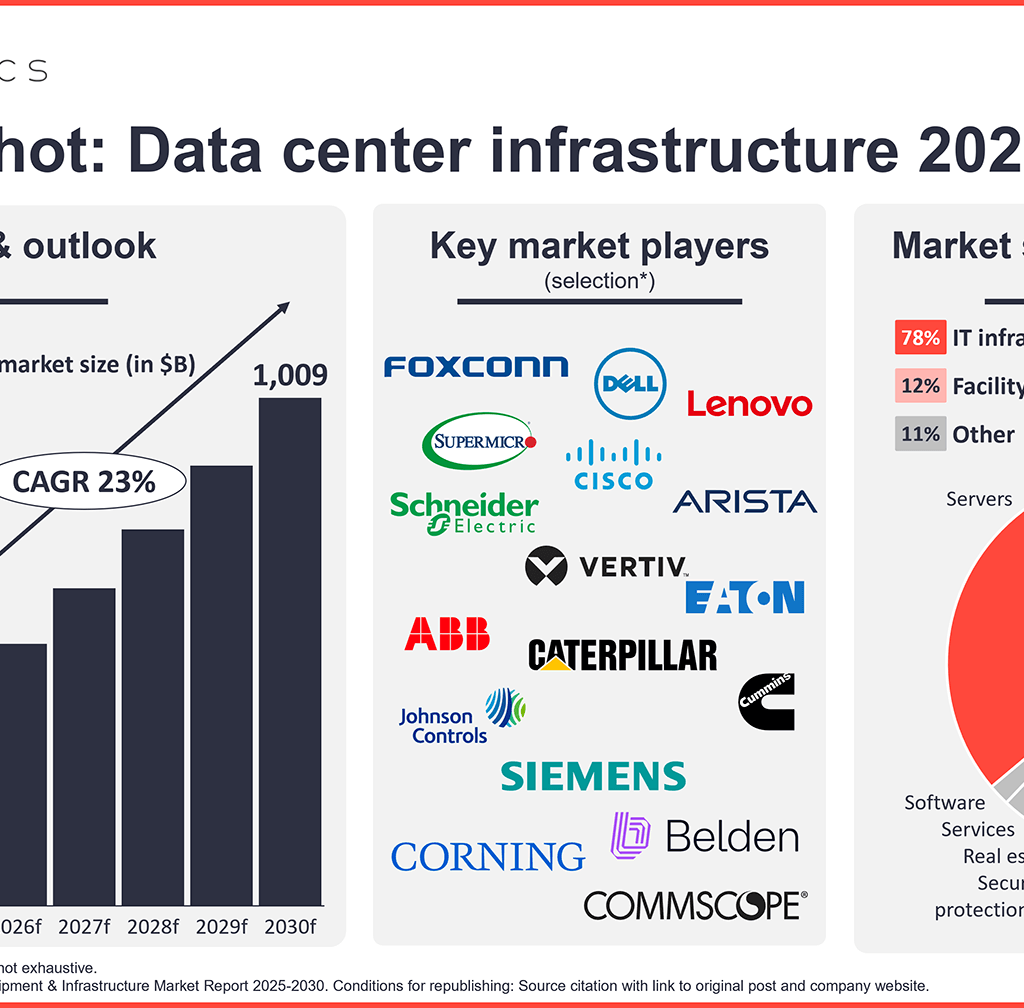
Data Center Infrastructure Market to Exceed $1T by 2030
The Soft Bank and SB Energy platform in Ohio represents a significant local investment within a global trend, as the chart shows the entire data center infrastructure market is projected to grow into a trillion-dollar industry by 2030.
(Source: IoT Analytics)
2. Microsoft On-Site Gas Power Plant
Company: Microsoft
Capacity: 900 MW
Application: On-site power for data center infrastructure
Source: ‘160% data center carbon footprint increase, ‘ research finds

Data Center Energy Demand Projected to Skyrocket
Microsoft’s decision to build its own on-site gas power plant is a direct response to the challenge illustrated by this chart: the skyrocketing energy demand from data centers, which is beginning to outstrip the capacity of local grids.
(Source: National Center for Energy Analytics)
3. Crusoe & Tallgrass Energy “Project Jade”
Companies: Crusoe, Tallgrass Energy
Capacity: 10, 000 MW
Application: Data center development using gas-fired generation with carbon capture
Source: The 20 Largest Data Centers Being Developed in North America
4. Cipher Mining & AWS AI Data Center Agreement
Companies: Cipher Mining, Amazon Web Services (AWS)
Capacity: 300 MW
Application: 15-year AI data center capacity agreement
Source: Top 25 Largest Data Center Companies in the U.S. by Active IT …

Data Center Spending to Exceed Office Spending
The agreement between Cipher Mining and AWS is part of a major economic shift. As the chart illustrates, capital investment in digital infrastructure like data centers is now surpassing traditional commercial real estate like office buildings.
(Source: National Center for Energy Analytics)
5. Total Energies & Google Solar PPA
Companies: Total Energies, Google
Capacity: 1, 000 MW
Application: Solar PPAs for data center operations
Source: Total Energies to Provide 1 GW of Solar Capacity to Power Google’s …

Renewable Project Pipeline Shows Thousands of New MWs
The solar PPA between Total Energies and Google is one of many such deals contributing to the massive renewable project pipeline shown in the chart, which is being filled to meet corporate demand for clean energy.
(Source: Deloitte)
6. Google’s Acquisition of Intersect Power
Companies: Google (Alphabet), Intersect Power
Capacity: N/A
Application: Strategic acquisition of data center and energy infrastructure company
Source: Google’s $4.75 B Intersect Power Acquisition Marks New Era – Introl

Energy Transition Investment Reaches $2.3 Trillion
Google’s acquisition of a power developer is a strategic move to vertically integrate within the multi-trillion-dollar energy transition market, as quantified by the chart, allowing it to secure its own power supply.
(Source: CarbonCredits.com)
7. Meta’s Nuclear Energy Commitment
Companies: Meta, Vistra
Capacity: 6, 600 MW
Application: Nuclear energy projects for constant, carbon-free power for AI
Source: Meta Announces 6.6 GW Of Nuclear Energy Projects To Power AI …
8. Reliance Jamnagar AI Data Center
Company: Reliance Industries
Capacity: 3, 000 MW
Application: AI data center development
Source: Power Is the Moat: How Gigawatt Data Centers Redraw Global AI …
9. Meta & Next Era Energy Clean Energy Deals
Companies: Meta, Next Era Energy Resources
Capacity: 2, 500 MW
Application: Portfolio of clean energy PPAs and Energy Storage Agreements (ESAs)
Source: Next Era Energy Resources and Meta Strengthen American Energy …

AI Demand Drives $67B NextEra-Dominion Deal
This section details Meta’s clean energy deals with NextEra, while the chart provides the larger context, showing how the intense power demand from AI is a key driver for major M&A activity in the utility sector, such as the NextEra-Dominion deal.
(Source: FXLeaders)
10. Microsoft & Constellation’s Three Mile Island Nuclear PPA
Companies: Microsoft, Constellation Energy
Capacity: 835 MW
Application: 20-year nuclear PPA to power AI data center
Source: Nuclear power for AI: inside the data center energy deals | Introl Blog

Big Tech CapEx Projected to Exceed $500B
Microsoft’s major nuclear PPA is an operational necessity to power the massive infrastructure investments it is making. The chart shows that these investments are part of a broader Big Tech capex surge projected to exceed half a trillion dollars.
(Source: National Center for Energy Analytics)
Table: Summary of Top AI Energy Infrastructure Deals (2025-2026)
| Companies Involved | Capacity (MW) | Application | Energy Source |
|---|---|---|---|
| Soft Bank, SB Energy | 10, 000 MW | AI data center platform | Not specified |
| Crusoe, Tallgrass Energy | 10, 000 MW | Data center with CCUS | Natural Gas |
| Meta, Vistra | 6, 600 MW | AI infrastructure power | Nuclear |
| Reliance Industries | 3, 000 MW | AI data center | Not specified |
| Meta, Next Era Energy | 2, 500 MW | Data center PPAs & ESAs | Clean Energy |
| Total Energies, Google | 1, 000 MW | Data center PPAs | Solar |
| Microsoft | 900 MW | On-site data center power | Natural Gas |
| Microsoft, Constellation Energy | 835 MW | AI data center PPA | Nuclear |
| Cipher Mining, AWS | 300 MW | AI data center capacity | Not specified |
| Google (Alphabet) | N/A | Vertical integration acquisition | Renewables/Infrastructure |
AI’s Energy Demand, Microsoft and Meta Secure Over 7 GW of Nuclear Power
The adoption of nuclear power by tech leaders signals a crucial pivot in corporate energy strategy, driven by AI’s unique power profile. Unlike general-purpose data centers, AI workloads require constant, high-density power that intermittent renewables like solar and wind cannot supply alone. Meta’s 6.6 GW nuclear plan and Microsoft‘s 835 MW PPA for the Three Mile Island plant are not just about securing clean energy; they are about securing baseload, 24/7 power. This move represents a new phase of adoption where hyperscalers are acting as anchor tenants for large-scale energy projects. This is a stark contrast to other major deals, such as Google‘s 1 GW solar PPA with Total Energies, which addresses clean energy goals but not the baseload reliability challenge. The diversity of deals, from nuclear to on-site natural gas and large-scale solar, shows that hyperscalers are building diversified portfolios, but nuclear is emerging as the strategic choice for core AI workloads.
US Epicenter, Ohio and Texas Emerge as 10 GW AI Power Hubs
The geographic concentration of these mega-deals is almost exclusively within the United States, cementing its position as the global center for AI infrastructure development. States like Ohio, Texas, and Pennsylvania are becoming critical hubs due to favorable regulatory environments, land availability, and existing energy infrastructure. The 10 GW AI data center platform announced by Soft Bank in Piketon, Ohio, and a separate 10 GW “Project Jade” from Crusoe and Tallgrass Energy, point to the creation of dedicated “AI power parks.” Texas is another hotspot, home to Microsoft‘s 900 MW on-site gas plant and Cipher Mining‘s $5.5 billion deal with AWS. However, the development of a 3 GW AI data center in Jamnagar by India’s Reliance Industries indicates that this is a global trend, with other nations poised to compete for a share of the AI compute market by replicating the U.S. model of co-locating massive power generation with data centers.

AI Data Centers’ Growing Share of Power Demand
The emergence of 10 GW power hubs in Ohio and Texas is a direct result of the trend shown in the chart: AI data centers are consuming an increasingly significant share of the total power demand, requiring geographic concentration of infrastructure.
(Source: Center on Global Energy Policy – Columbia University)
$5.5 Billion Deal, Cipher Mining and AWS Signal AI Infrastructure Scale
These recent announcements reveal a market that has moved beyond pilot projects into full-scale commercial deployment of dedicated AI energy infrastructure. The sheer scale of capital and long-term commitment is staggering. For example, the 15-year, $5.5 billion agreement between Cipher Mining and AWS is for a relatively modest 300 MW, implying a multi-trillion-dollar market for powering the entire sector. The most telling deal regarding technology maturity is Microsoft’s PPA with Constellation. The decision to finance the restart of a conventional nuclear plant, Three Mile Island, specifically for one corporate customer is a landmark event. It shows that for mission-critical AI baseload power, hyperscalers are prioritizing proven, reliable, large-scale nuclear technology over more developmental solutions. This marks a strategic shift from simply buying renewable energy credits to directly underwriting the physical generation assets needed to guarantee 24/7 power.

Hyperscalers Plan Massive AI Capex Surge by 2026
The $5.5 billion deal involving Cipher Mining and AWS is a prime example of the trend highlighted in this chart. It represents one of the initial, concrete data points of the massive AI-driven capital expenditure surge planned by hyperscalers.
(Source: Futurum Research)
Microsoft’s 835 MW Nuclear PPA, A Model for Future AI Energy Strategy
The primary strategic expectation for the year ahead is that other hyperscalers and large enterprises will replicate the nuclear procurement models established by Microsoft and Meta, either through direct PPAs with existing nuclear operators or through strategic investments in future capacity.
- The landmark agreement in December 2025 for Microsoft to offtake 835 MW from the restarted Three Mile Island plant created a commercially viable blueprint for using AI demand to revitalize the existing nuclear fleet.
- Meta’s subsequent announcement in January 2026 of a massive 6.6 GW commitment to nuclear power confirmed this was a new, industry-wide strategy, not a one-off deal.
- The trend is accelerating beyond simple power contracts and towards direct control of the energy supply chain, as demonstrated by Google’s $4.75 billion acquisition of energy infrastructure developer Intersect Power in January 2026.
- If grid interconnection queues for renewables remain long and natural gas faces increasing ESG scrutiny, nuclear power will solidify its position as the only technology capable of providing carbon-free, 24/7 power at the gigawatt-scale AI requires.

US Data Center Power Demand to Nearly Triple
Microsoft’s landmark 835 MW nuclear PPA is a direct, scaled response to the forecast shown in the chart. The deal’s size is necessary to address the projected tripling of power demand from US data centers.
(Source: Electric Choice)
The questions your competitors are already asking
This report covers one angle of the strategic shift by hyperscalers toward securing gigawatt-scale nuclear and baseload power for AI data centers. The questions that matter most depend on your work.
- Which hyperscalers are gaining or losing ground in the race to secure gigawatt-scale power for AI data centers?
- What is the outlook for nuclear power deployment to meet AI data center demand by 2030?
- How does a long-term nuclear PPA, like Microsoft’s with Constellation, compare to building an on-site gas plant for powering AI data centers?
- What is the status of Meta’s 6.6 GW nuclear plan and Microsoft’s $1.6B PPA with Constellation?
This report does not answer these. Enki Brief Pro does.
Your question, your angle, your framework. SWOT, PESTL, scenario modelling. The same niche depth, built around the decision your work actually depends on.
