

Alibaba Nuclear Power Strategy 2026: Securing Clean Energy for AI Data Center Dominance
Alibaba Group’s Commercial Scale Projects Target Energy Security for AI 2026
Alibaba Group is strategically pivoting to secure nuclear power for its AI data centers, a decisive move to manage the immense energy consumption required by its commercial-scale artificial intelligence operations and establish a long-term cost and carbon advantage.
- Between 2021 and 2024, Alibaba’s focus was on developing its foundational AI models like Tongyi Qianwen and investing in AI startups, with infrastructure treated as a standard operational cost. The strategy centered on building cloud capacity and a software ecosystem.
- From 2025 onward, the strategy has matured to address the physical constraints of scaled AI, specifically energy. The announcement in January 2026 that Alibaba is actively pursuing nuclear-backed power agreements marks a critical shift from simply building data centers to strategically powering them for cost stability and sustainability.
- This adoption of nuclear energy is a direct response to the successful commercialization of its AI stack, including the trillion-parameter Qwen 3-Max model and the Rynn Brain robotics platform, whose energy demands exceed what conventional grids can predictably supply.
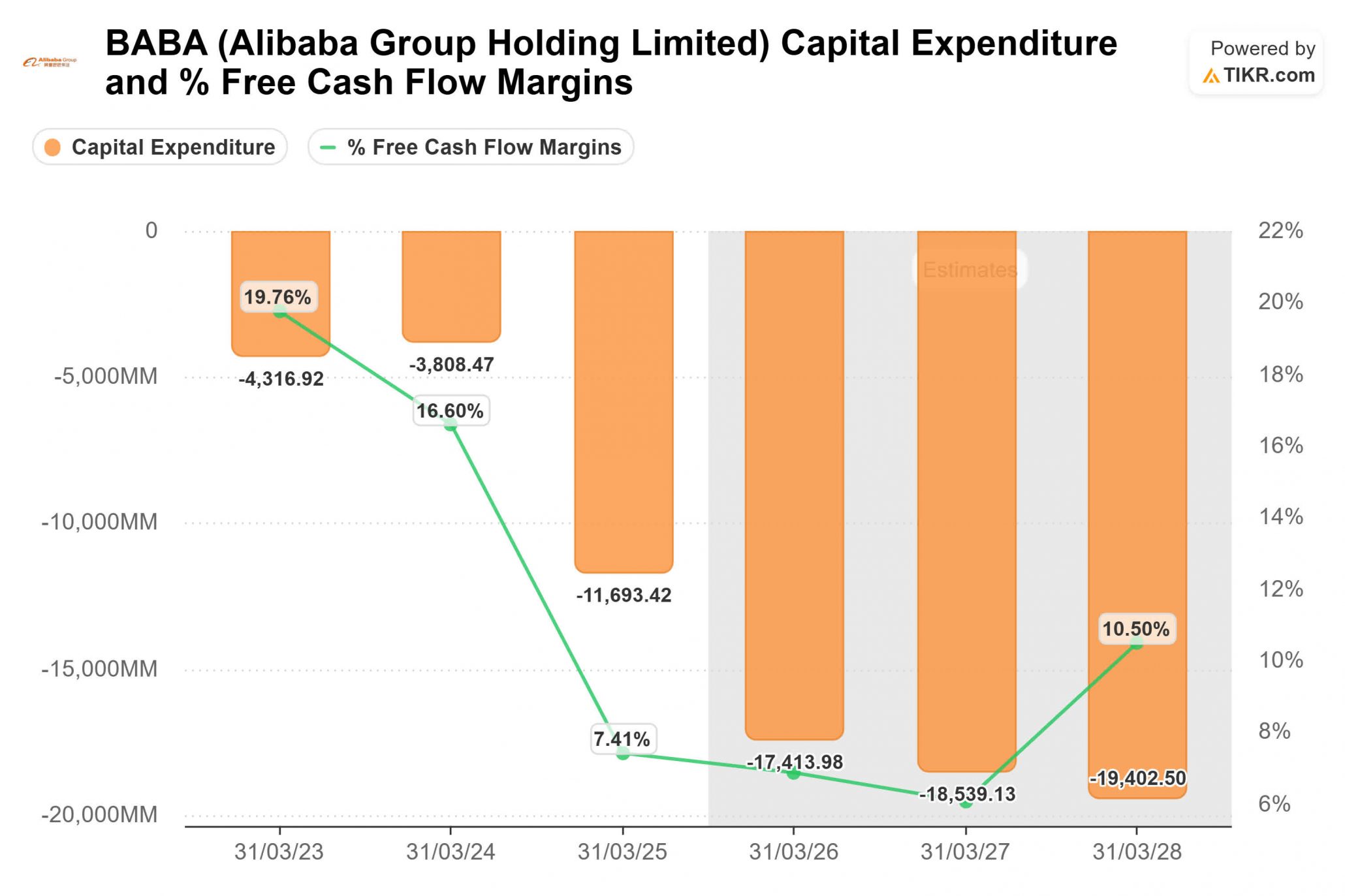
Alibaba’s AI Ambitions Drive Skyrocketing Capital Expenditure
This chart illustrates the massive increase in capital spending required for Alibaba’s AI operations, directly supporting the section’s focus on managing the immense energy consumption and infrastructure costs.
(Source: Seeking Alpha)
Alibaba’s AI Investment Data and Financial Commitments
Alibaba’s capital allocation has shifted toward massive, targeted investments in AI infrastructure, with energy sourcing emerging as a critical component of its long-term operational expenditure strategy to support this build-out.
- The company’s landmark three-year investment plan of RMB 380 billion (approximately US$53 billion), announced in February 2025, underpins its entire AI infrastructure strategy. This commitment is designed to build a competitive moat in AI compute capacity.
- Execution is proceeding at a rapid pace, with approximately RMB 120 billion in capital expenditure deployed in the four quarters leading up to November 2025. This spending directly funds the data center expansion that necessitates a new energy strategy.
- The move to secure nuclear power, reported in January 2026, is a strategic action to control the long-term operational costs associated with this massive capital investment, ensuring the economic viability of its “AI factories.”

Alibaba’s Stock Surges on Landmark $53B AI Investment
This chart directly visualizes the market impact of the US$53 billion investment plan mentioned in the text, confirming the significance of this specific financial commitment to Alibaba’s AI strategy.
(Source: Medium)
Table: Alibaba Group Strategic AI Investments
| Partner / Project | Time Frame | Details and Strategic Purpose | Source |
|---|---|---|---|
| Qwen AI App Promotion | February 2026 | Deployed $420 million in operational spending to drive user adoption of its consumer-facing AI app, creating demand that justifies the underlying infrastructure investment. | Yicai Global |
| Ongoing CAPEX Deployment | November 2025 | Expended RMB 120 billion (~$16.5 B) in capital expenditure over the prior four quarters to aggressively build out its AI and cloud infrastructure footprint. | Alibaba Group |
| Three-Year Strategic Investment | February 2025 | Announced a plan to invest at least RMB 380 billion (~$53 B) over three years to advance its cloud and AI data center infrastructure, exceeding its total spend in the area over the past decade. | Alibaba Cloud |
Alibaba Partnership Analysis for AI Ecosystem Growth
Alibaba’s recent partnerships have focused on embedding its AI across global industries, creating the widespread demand that now necessitates a sophisticated energy sourcing strategy, including future alliances with nuclear power providers.
- In the 2021-2024 period, Alibaba’s partnerships centered on technology enablement, such as supporting Meta’s Llama model and launching Salesforce services on its cloud in China.
- Beginning in 2025, partnerships expanded into deep industry integration with leaders like BMW for automotive AI, SAP for enterprise software, and Nvidia for advanced AI hardware and robotics. These alliances scaled the use of Alibaba’s AI services.
- The January 2026 report of pursuing nuclear power signals an upcoming phase of partnerships. To execute this strategy, Alibaba will need to forge new, critical alliances with utility operators, energy producers, and potentially nuclear technology firms.

Forrester Confirms Alibaba’s AI Leadership Position
This chart validates the success of the partnership strategy described in the text, showing that by late 2025, Alibaba was recognized as a ‘Leader’ in AI infrastructure, an outcome of its ecosystem growth.
(Source: LinkedIn)
Table: Alibaba Group Strategic AI Partnerships
| Partner / Project | Time Frame | Details and Strategic Purpose | Source |
|---|---|---|---|
| GAC Group | November 2025 | Expanded an automotive partnership to develop full-stack AI solutions, driving demand for high-performance AI compute. | Gasgoo |
| Nvidia | September 2025 | Formed a strategic partnership to integrate Nvidia’s AI development tools into Alibaba Cloud, accelerating physical AI and robotics capabilities that require substantial power. | Sherwood News |
| SAP | May 2025 | Partnered to combine SAP’s enterprise software with Alibaba Cloud’s infrastructure and AI, driving large-scale enterprise adoption of its energy-intensive cloud services. | SAP News |
| BMW Group | March 2025 | Deepened a strategic partnership to integrate Alibaba’s Qwen LLM into BMW vehicles in China, establishing a presence in the energy-demanding automotive AI sector. | Euronews |
Alibaba Group’s Geographic Expansion Drives Need for Global Energy Solutions
Alibaba Group is executing an aggressive global data center expansion, creating a geographically diverse demand for massive, stable power that positions its nuclear energy initiative as a potential template for future international operations.
- Before 2025, Alibaba’s infrastructure was primarily concentrated in mainland China, with initial forays into other parts of Asia. Its energy needs, while significant, were managed within established regional markets.
- In 2025, the company announced a major international push, with plans for new data centers in Brazil, France, the Netherlands, Malaysia, and the Philippines. This global footprint transforms energy from a regional issue into a global strategic challenge.
- The pursuit of a nuclear power agreement in 2026, while not tied to a specific location in the source data, represents a scalable model. If successful, this strategy of securing low-carbon, baseload power could be replicated across its new international hubs to ensure uniform operational stability and cost predictability.

Alibaba Dominates China’s Cloud Market in 2025
This chart quantifies Alibaba’s dominant position in its primary market, Mainland China, which serves as the foundation for the global expansion and increased energy needs discussed in the section.
(Source: Seeking Alpha)
Alibaba Group’s AI Technology Maturity Creates an Energy Imperative
Alibaba Group has successfully advanced its AI technology from research and development to full-stack commercial deployment, making the immense energy required to run these systems a primary strategic bottleneck that it now aims to solve with nuclear power.
- During the 2021-2024 period, Alibaba focused on developing and iterating its foundational models, with the initial launch of Tongyi Qianwen in 2023 marking a key milestone in moving from R&D to product integration.
- By 2025-2026, its technology reached commercial maturity with the launch of the trillion-parameter Qwen 3-Max, the robotics-focused Rynn Brain model, and the proprietary Zhenwu 810 E AI chip. This transition to a full, vertically integrated stack has massively increased its computational and energy demands.
- The decision to seek nuclear power in 2026 is a direct consequence of this technological success. Scaled, commercial AI requires a level of stable, high-density power that is difficult to secure from renewable or fossil fuel sources alone, making nuclear energy a logical next step for a company operating at this scale.

Alibaba’s Full-Stack AI Ecosystem Visualized
This diagram directly illustrates the ‘full-stack commercial deployment’ mentioned in the section, providing a clear visual of the technology’s maturity from infrastructure to applications.
(Source: Alibaba Cloud)
SWOT Analysis of Alibaba Group’s AI and Energy Strategy
Alibaba Group’s pivot to AI creates a dominant market position, but this strength is directly challenged by geopolitical supply chain risks and immense energy costs, which it now seeks to resolve through a targeted clean energy strategy.
- The company’s key strength is its massive capital commitment to a vertically integrated AI stack, while its primary weakness is the resulting pressure on free cash flow and its dependency on external energy grids.
- Its pursuit of nuclear power represents a significant opportunity to de-risk its energy supply and lower long-term operating costs, but it remains threatened by U.S. chip sanctions that could limit the capabilities of the very infrastructure it seeks to power.

Alibaba’s Cloud Market Share Declines Amid Competition
This chart provides data for a key weakness in the SWOT analysis, showing the erosion of market share in China, which highlights the competitive pressures driving the company’s strategic pivot to AI and new energy sources.
(Source: Tech Buzz China Insider – Substack)
Table: SWOT Analysis for Alibaba Group
| SWOT Category | 2021 – 2024 | 2025 – 2026 | What Changed / Resolved / Validated |
|---|---|---|---|
| Strengths | Dominant cloud market share in China; strong e-commerce and logistics foundation. | Massive $53 B investment in AI; vertically integrated stack (Qwen LLMs, Zhenwu 810 E chip); robust partnership ecosystem (Nvidia, SAP). | The strategy shifted from leveraging existing cloud dominance to actively building a new, defensible AI infrastructure moat with dedicated capital and technology. |
| Weaknesses | Slowing cloud revenue growth; facing intense domestic competition. | High CAPEX (138% Yo Y increase) impacting free cash flow; immense energy consumption of new AI data centers. | The aggressive investment strategy validated the high cost of competing in AI, introducing energy as a new, critical operational weakness. |
| Opportunities | Growing demand for cloud services in China; international expansion. | Securing low-cost, low-carbon nuclear power; expanding into new verticals like robotics (Rynn Brain); capturing a share of the projected $2.48 trillion AI market. | The opportunity evolved from general cloud growth to capturing high-value AI workloads, with energy strategy now a key enabler. |
| Threats | Regulatory scrutiny in China; competition from Tencent and Huawei. | U.S. chip sanctions (led to canceled Cloud IPO); geopolitical tensions; volatile energy prices impacting OPEX. | External threats intensified, with chip sanctions becoming a direct constraint on AI infrastructure ambitions, validating the need for supply chain and energy independence. |
Future Outlook: Alibaba’s Nuclear Power Play as a Global Precedent
The single most critical action to monitor for Alibaba Group in the coming year is the successful execution of its first nuclear power agreement, as this will establish the cost structure and sustainability model for its entire global AI infrastructure.
- The January 2026 report on pursuing nuclear power is the most significant forward-looking signal, indicating that Alibaba views energy security as a core competitive differentiator. A successful deal would provide a template for its other international data centers.
- The ongoing global expansion into Brazil, France, and Southeast Asia will depend on securing reliable and affordable power. Success with a nuclear strategy would de-risk these multi-billion dollar build-outs.
- The increasing adoption of power-hungry technologies like the Rynn Brain robotics model and its integrations with partners like BMW will only intensify energy demand. This makes the move toward a stable, baseload power source like nuclear not just strategic but necessary for sustained growth.

Alibaba Revenue Forecast Shows Sustained Growth to 2028
This chart provides the broad, forward-looking financial context for the ‘Future Outlook’ section, showing the projected revenue growth that underpins the company’s ability to execute long-term strategic plays like its nuclear power initiative.
(Source: Yahoo Finance)
Frequently Asked Questions
Why is Alibaba pursuing nuclear power for its AI data centers?
Alibaba is pursuing nuclear power to secure a stable, low-carbon, and cost-predictable energy source for its massive AI operations. The energy demands of its advanced AI models like Qwen 3-Max exceed what conventional grids can reliably and affordably supply, making nuclear a strategic choice for long-term cost control and sustainability.
What prompted this shift in Alibaba’s energy strategy in 2025-2026?
The shift was prompted by the successful commercialization and scaling of its AI technology stack. After focusing on developing foundational models from 2021-2024, the company launched power-intensive commercial applications, including trillion-parameter models and robotics platforms, which made securing a massive, stable energy supply a critical business need.
How much is Alibaba investing in the AI infrastructure that requires this energy solution?
Alibaba announced a three-year strategic investment plan in February 2025 to commit at least RMB 380 billion (approximately US$53 billion) to its cloud and AI data center infrastructure. The move to secure nuclear power is a direct strategy to manage the long-term operational costs of this massive capital deployment.
What are the main risks associated with Alibaba’s AI and energy strategy?
The primary risks include the immense capital expenditure (CAPEX) required for the AI build-out, which pressures free cash flow, and geopolitical threats, specifically U.S. chip sanctions that could limit the capabilities of the very infrastructure it is trying to power. Volatile energy prices are also a threat, which the nuclear strategy aims to mitigate.
Is this nuclear power strategy just for Alibaba’s operations in China?
While the report doesn’t specify the location of the first nuclear agreement, it presents the strategy as a scalable model for Alibaba’s global operations. Given the company’s 2025 expansion into new data centers in Brazil, France, the Netherlands, and Southeast Asia, a successful nuclear power deal could be replicated in these international markets to ensure uniform cost and operational stability.
