

Data Center Grid Constraint, $130 B in Canceled Projects, 7 GW Lost Capacity, and 50% of Builds Delayed (2025 to 2026)
Data Center Project Delays, 50% of 2026 U.S. Capacity at Risk Due to Power Constraints
The gap between data center power demand and grid supply has materialized into significant project attrition, with a substantial portion of the 2026 U.S. development pipeline now facing delays or cancellation due to power unavailability and supply chain backlogs.
- Nearly half of the approximately 12 GW of U.S. data center capacity planned for 2026 has been canceled or significantly delayed, creating a power availability gap of at least 7 GW.
- The primary cause is the extension of power interconnection timelines by 24 to 72 months in high-demand markets, which is compounded by a five-year backlog for critical large power transformers.
- The trend accelerated from 2025, when project cancellations quadrupled and removed 4.7 GW of electricity demand from the development pipeline due to a combination of power constraints and local opposition.
- This issue is global, with estimates from early 2026 indicating that between 30% and 50% of large data center projects planned for the year are experiencing delays due to power and equipment shortages.
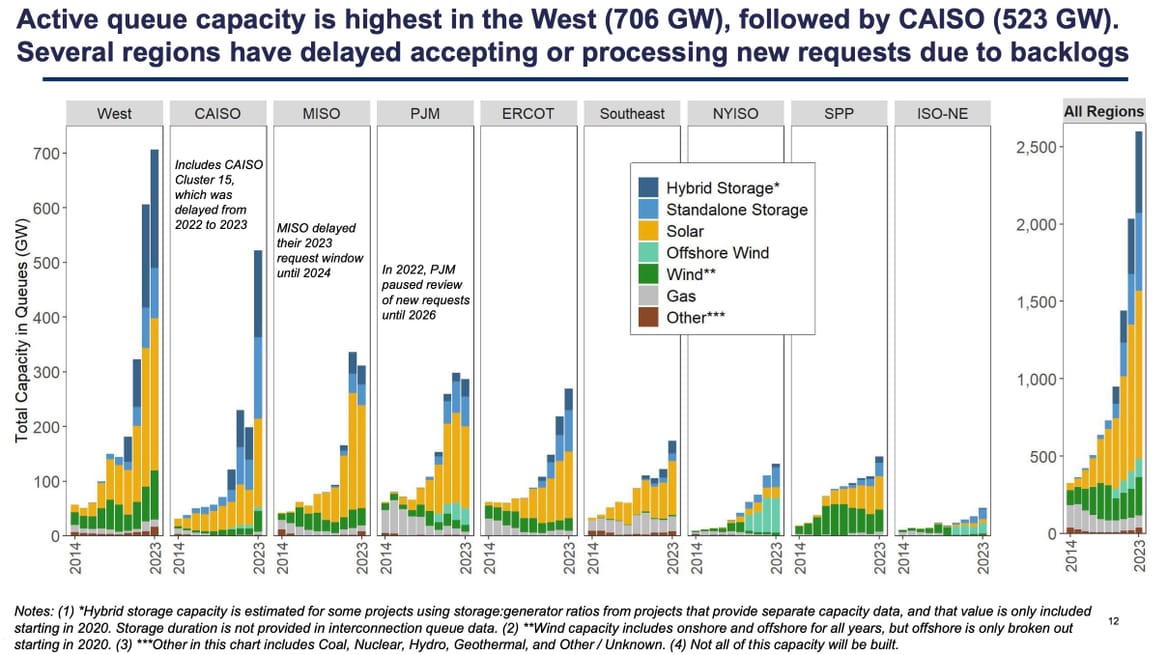
US Grid Interconnection Queues Face Massive Backlog
The section describes project delays threatening U.S. data center capacity. The chart directly illustrates a primary cause: the massive and growing backlog in grid interconnection queues, which prevents new projects from connecting to the power network in a timely manner.
(Source: Canary Media)
$130 B in Canceled Data Center Projects, Analyzing Financial Impact of Grid Constraints
The direct financial impact of grid limitations is substantial, with over one hundred billion dollars in projects being stalled or canceled in early 2026 alone. This quantifies the economic cost of insufficient power infrastructure and creates a clear barrier to sector growth.
- In the first quarter of 2026, data center projects valued at more than $130 billion were stalled or canceled in the U.S. as a direct result of power constraints and associated community opposition.
- This follows a significant increase in project attrition during 2025, when canceled projects would have accounted for at least 4.7 GW of new electricity demand.
- The construction slowdown, first observed in 2025 due to lagging power supply, has now become the defining constraint for the industry, affecting a reported 17% of construction activity in that year and escalating since.

Most Grid Interconnection Requests Are Withdrawn
The section quantifies the financial losses from canceled projects. The chart reveals a key driver for these cancellations, showing the high percentage of projects that are withdrawn from the grid interconnection process, effectively representing failed or abandoned investments.
(Source: Canary Media)
Table: Data Center Project Delays & Cancellations (2025-2026)
| Date | Region | Details and Strategic Purpose | Source |
|---|---|---|---|
| Jun 2026 | U.S. | Projects worth $130 billion were stalled or canceled in Q 1 2026 due to a combination of community opposition and power constraints, indicating a major financial impediment. | The Cooldown |
| May 2026 | U.S. | Approximately 50% of the planned 2026 data center capacity buildout was delayed or canceled, with a 5-year backlog on grid transformers cited as a primary cause. | Tech Investments.io |
| Apr 2026 | U.S. | A capacity gap of 7 GW was identified for 2026, attributed directly to power grid bottlenecks and related supply chain issues for critical electrical components. | Tech-Insider.org |
| Feb 2026 | Global | Between 30% and 50% of large data center projects scheduled for 2026 were delayed, signaling a worldwide problem driven by power and equipment shortages. | Latitude Media |
| Jan 2026 | U.S. | Canceled projects in 2025 would have accounted for 4.7 GW of new electricity demand, highlighting the escalating scale of project attrition. | Gizmodo |
Google and Brookfield Lead $22.5 B in Data Center Energy Deals
In response to grid constraints, data center operators are executing strategic partnerships with energy producers and infrastructure firms. This represents a definitive shift away from traditional power purchase agreements toward securing dedicated generation to bypass public grid limitations.
- A new model of co-locating data centers with power generation is emerging, exemplified by the partnership between Google and Intersect Power to develop “powered land” with $20 billion in new renewable energy and storage projects.
- On-site power generation is a key strategy, as shown by the expanded $2.5 billion partnership between Brookfield and Bloom Energy to deploy fuel cell energy servers for data centers and AI infrastructure.
- The “bring your own power” trend is accelerating, with nearly 60 data centers nationwide planning to build their own natural gas power plants to ensure power reliability, highlighting the severity of public grid constraints.
- Sovereign wealth is also entering the space, with a joint venture between France and the UAE’s MGX investment fund announced in June 2026 to pursue AI data center development, indicating nation-state level concern over compute and power security.

Data Center Investment to Rival Energy Markets
The section highlights landmark multi-billion dollar investments in data center energy. The chart provides critical context by comparing the scale of data center investment to entire energy markets, demonstrating that these deals represent a significant shift in capital allocation.
(Source: Oil Price)
Table: Strategic Investments & Partnerships in Data Center Power
| Partner / Project | Time Frame | Details and Strategic Purpose | Source |
|---|---|---|---|
| Brookfield, Bloom Energy | Jul 2026 | Expanded partnership to $2.5 billion to deploy on-site fuel cell energy servers. This secures reliable, grid-independent power for data centers. | Power Magazine |
| France, UAE (MGX) | Jun 2026 | Announced a joint venture with a reported value over $30 B to pursue AI data center development, securing sovereign compute capacity. | Carnegie Endowment |
| Generate Capital | Jan 2026 | Raised $1.5 billion in capital commitments from institutional investors to fund sustainable infrastructure, including data center power solutions. | Generate Capital |
| Google, Intersect Power, TPG Rise Climate | Dec 2024 | Partnership to co-locate Google data centers with $20 billion in new renewable energy and storage, creating a “powered land” model to bypass grid interconnection queues. | Utility Dive |
U.S. vs. Global, Data Center Policy Shifts from Incentives to Cost Allocation
The geographic landscape for data center development is shifting from a focus on tax incentives to an emphasis on power availability and regulatory certainty. States and nations are actively re-evaluating policies to manage grid strain, moving from attraction to cost allocation.
- In the U.S., at least 37 states offer tax incentives for data centers, but the strain on local grids is forcing a policy re-evaluation. This is a marked change from the 2021-2024 period when such incentives were rarely questioned.
- Virginia, a primary data center market, has debated modifying its sales and use tax exemption to reduce its value after 2035, signaling that even the most established hubs are reaching infrastructure limits.
- This policy scrutiny is not limited to the U.S. The formation of a high-value data center partnership between France and the UAE reflects a global strategic priority to secure both compute and the power required for it.
- The new paradigm forces developers to consider grid upgrade costs and interconnection viability as primary site selection criteria, a factor that was secondary to tax benefits and fiber connectivity in prior years.

US Electricity Demand Decouples From GDP Growth
The section explains a policy shift toward cost allocation. The chart provides historical context for this debate by showing the long-term decoupling of electricity demand from GDP, a trend now being sharply reversed by data centers, forcing a re-evaluation of who pays for grid expansion.
(Source: Wood Mackenzie)
On-Site Power Generation, Data Centers Adopt Fuel Cells and Plan for SMRs
To circumvent grid limitations, data center operators are accelerating the adoption of commercially mature on-site power technologies like fuel cells and natural gas turbines. This is a near-term solution while they concurrently plan for next-generation, firm power sources such as Small Modular Reactors (SMRs).
- From 2025-2026, on-site power has transitioned from a backup function to a primary power strategy. The $2.5 billion Brookfield and Bloom Energy fuel cell partnership is a direct signal of this commercial-scale deployment for baseload power.
- The plan for nearly 60 data centers to build their own natural gas plants indicates a reliance on proven, dispatchable technology to meet immediate multi-megawatt needs, a significant change from the 2021-2024 focus on intermittent renewable Power Purchase Agreements (PPAs).
- While SMRs and advanced geothermal remain in development, hyperscalers are forming strategic partnerships to integrate these technologies post-2026. The market has shifted from purchasing renewable energy credits to directly securing or developing 24/7 clean, firm power assets.

Chart Visualizes Data Center Power Deficit
The section details the adoption of on-site power solutions. The chart provides the central motivation for this trend by visualizing a significant deficit between data center power demand and available grid supply, forcing operators to seek energy independence.
(Source: LinkedIn)
Data Center 2027 Outlook, Growth Hinges on Vertically Integrated Power
Looking toward 2027, the primary determinant of data center growth will be an operator’s ability to execute a vertically integrated power strategy. This involves either direct asset ownership or deep joint ventures, as access to the public grid remains a significant and unresolved constraint.
- If the trend of project cancellations and multi-year delays continues at the current rate, watch for a market bifurcation between hyperscalers who can finance their own power and smaller operators who will be locked out of growth markets.
- If “powered land” models like the Google–Intersect Power deal prove successful and scalable, watch for a wave of similar announcements from other hyperscalers and private equity firms throughout 2027.
- This could be happening: The current gridlock is accelerating the business case for dispatchable, clean, on-site power. This may shorten the commercial adoption timeline for technologies like advanced geothermal and SMRs specifically for the data center sector.
The questions your competitors are already asking
This report covers one angle of the data center power crisis. The questions that matter most depend on your work.
- data centers building their own power plants
- new data center markets US power availability
- nuclear power for data centers timeline
- utility investment plans for data center demand
This report does not answer these. Enki Brief Pro does.
Your question, your angle, your framework. SWOT, PESTL, scenario modelling. The same niche depth, built around the decision your work actually depends on.
