

Google SMR Strategy, 500 MW Kairos Power Deal, 3, 000 MW Brookfield Agreement, and 12 GW in PPAs (2024 to 2026)
AI Power Demand, Google Secures 12 GW in PPAs and Advanced Nuclear Deals
Google’s energy procurement has fundamentally shifted from a focus on matching annual consumption with renewable energy credits to a strategic imperative to acquire massive volumes of firm, 24/7 carbon-free power. This pivot is a direct response to the exponential electricity demand from its AI infrastructure and is designed to de-risk future growth from severe grid constraints. Where the strategy before 2024 centered on leadership in renewable energy PPAs, the period between 2025 and today is defined by a new urgency to secure reliable, baseload power that can operate around the clock, independent of weather conditions.
- Prior to 2024, Google’s approach was primarily focused on purchasing enough solar and wind energy to match its annual electricity consumption, establishing it as a corporate leader in renewable procurement.
- The strategy evolved significantly in 2025-2026 to address the reliability gap of intermittent renewables. This is demonstrated by landmark agreements for firm power, including a Hydro Framework Agreement with Brookfield for up to 3, 000 MW and a first-of-its-kind corporate agreement for a 500 MW fleet of Small Modular Reactors (SMRs) with Kairos Power.
- The scale of this strategic shift is immense, with Google signing over 12 GW of new clean energy deals in 2025 alone, a necessary response to a reported 37% year-over-year surge in its electricity consumption driven by AI.
- This aggressive procurement mitigates the primary risk to data center expansion: grid interconnection queues, which can delay new projects by five to seven years and represent the single greatest constraint to scaling AI operations.
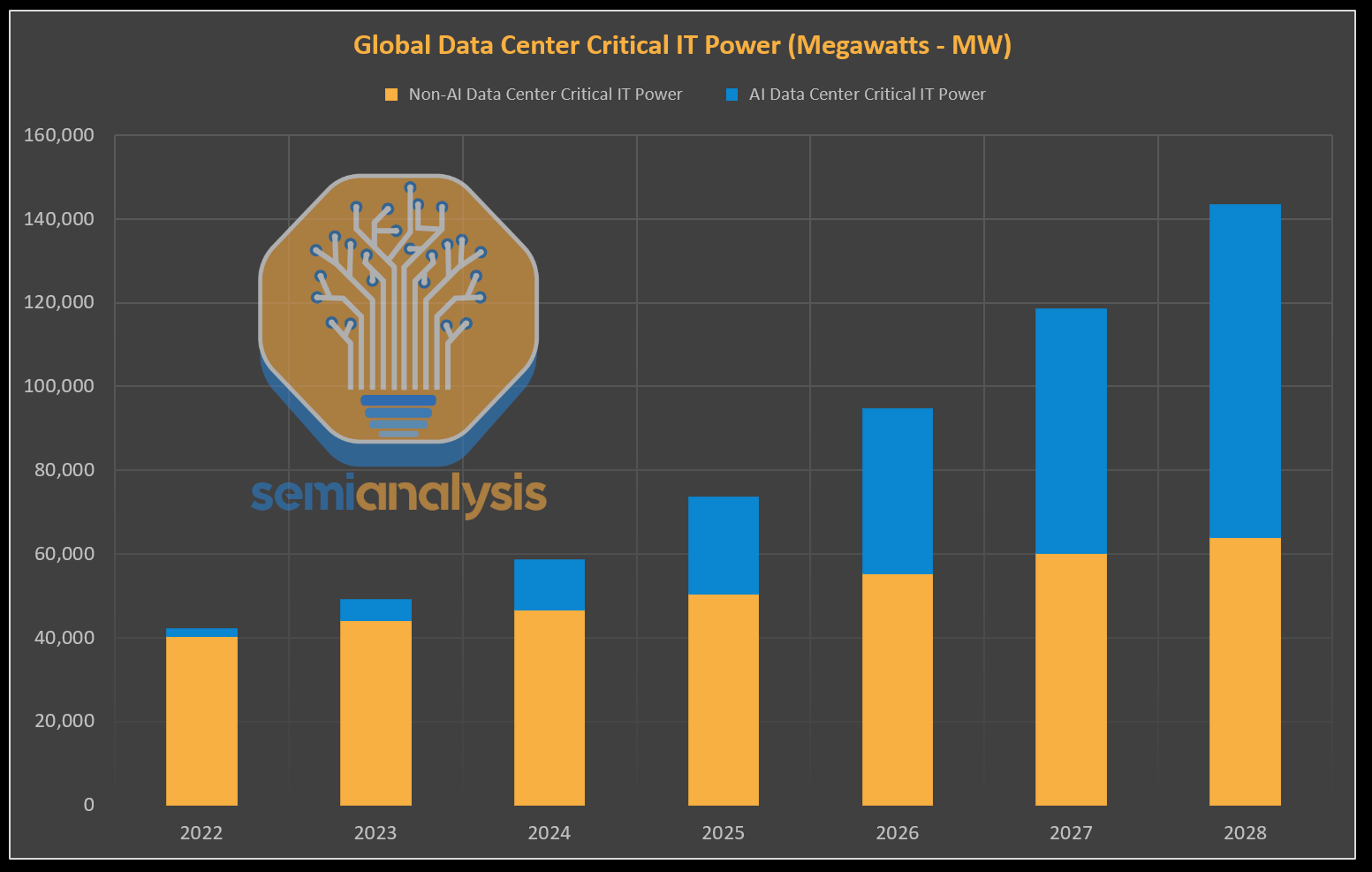
AI Power Demand to Surpass Non-AI by 2028
The section heading begins with ‘AI Power Demand,’ which is the exact subject of this chart. The chart provides the critical context for why Google is securing large power agreements, directly visualizing the crossover point where AI power consumption becomes the dominant factor.
(Source: SemiAnalysis)
$432 B in Collective CAPEX, Google AI Infrastructure Expansion Accelerates
Google is part of an unprecedented capital deployment cycle, with hundreds of billions in spending allocated to AI infrastructure, where securing dedicated power supply is now a primary driver of investment. This financial commitment reflects the new reality that energy availability, not just computing hardware, dictates the pace of AI development. The massive increase in capital expenditure is a direct effort to build a vertically integrated infrastructure that controls both data processing and the power required to run it.
- In 2025, Google joined Amazon, Microsoft, Meta, and Oracle in a collective capital expenditure deployment of approximately $432 billion, representing an 80% increase from 2024, with the majority directed at AI infrastructure.
- Underscoring its accelerating investment, Google raised its 2025 capex guidance by $10 billion and signaled that it expects capital expenditures to be even higher in 2026.
- This investment extends beyond servers to the energy supply chain itself. On March 4, 2026, Google signed the Ratepayer Protection Pledge, committing to pay for any new grid infrastructure costs driven by its growth, internalizing expenses that were previously socialized.
- This contrasts with the pre-2024 period, where capex was more focused on traditional data center construction and hardware procurement without such a direct and explicit financial link to building out dedicated energy infrastructure.

Big Tech AI Capex Soars Past $70B Quarterly
The section discusses the ‘$432 B in Collective CAPEX’ for AI infrastructure. This chart provides a granular, quarterly data point that illustrates the magnitude and acceleration of this spending trend across the tech sector, directly supporting the section’s headline claim.
(Source: CB Insights)
Table: Google and Tech Sector AI Infrastructure Investments
| Company / Group | Time Frame | Details and Strategic Purpose | Source |
|---|---|---|---|
| 2026 | Announced that 2026 capex is expected to be higher than the increased 2025 guidance, signaling an acceleration of investment in data centers and related energy infrastructure. | S&P Global | |
| Amazon, Google, Microsoft, Meta, Oracle | 2025 | Collectively deployed $432 billion in capital expenditure, an 80% increase from 2024, primarily driven by the build-out of AI infrastructure. | The Diligence Stack |
| Amazon, Google, Meta | 2025 | Combined capital expenditure on data center construction alone was estimated at $364 billion, highlighting the intense investment race for compute and energy capacity. | Green Fuel Journal |
| 2025 | Raised its 2025 capex guidance by $10 billion to fund accelerated infrastructure build-out to meet AI-driven demand. | S&P Global |
Google’s Advanced Energy Alliances, Kairos Power and Brookfield (2024 to 2026)
Google is constructing a portfolio of strategic energy partnerships that extends far beyond conventional power purchase agreements to include joint development of next-generation technologies. These alliances are designed to secure a diversified, resilient supply of firm power by backing technologies like advanced nuclear and large-scale hydropower. This marks a strategic decision to become an active participant in energy technology commercialization rather than a passive buyer of electrons.
- The Master Plant Development Agreement with Kairos Power, signed in October 2024 for a 500 MW SMR fleet, is the first multi-reactor corporate deal in the U.S. and signals a long-term commitment to making advanced nuclear a core part of its energy supply.
- A Hydro Framework Agreement with Brookfield Renewable, announced in January 2026, will develop up to 3, 000 MW of new hydropower capacity. This secures a major source of firm, dispatchable renewable energy, a critical shift from the intermittent solar and wind deals that characterized its earlier strategy.
- The Power Purchase Agreement for 200 MWe from Commonwealth Fusion Systems’ planned fusion plant is a forward-looking offtake agreement intended to accelerate a frontier technology by providing a crucial commercial demand signal.
- While legacy-style partnerships continue, such as a 15-year solar PPA with Total Energies in Ohio and an offshore wind deal with Ørsted in Germany, they are now part of a broader, more sophisticated portfolio that prioritizes 24/7 reliability.

Energy Transition Investment Reaches $2.3 Trillion
This section details Google’s specific energy partnerships. The chart places Google’s strategy within a wider macroeconomic context, demonstrating that their alliances are part of a massive, multi-trillion dollar global investment in energy transition.
(Source: CarbonCredits.com)
Table: Google’s Key Strategic Energy Partnerships
| Partner / Project | Time Frame | Details and Strategic Purpose | Source |
|---|---|---|---|
| Brookfield Renewable | Jan 2026 | Signed a Hydro Framework Agreement to develop up to 3, 000 MW of new hydropower capacity, providing firm, dispatchable renewable power for data centers. | Brookfield |
| ENGIE | Jan 2026 | Expanded its 24/7 carbon-free energy partnership in Germany through 2030, integrating battery storage to ensure a constant supply of clean power. | ENGIE |
| Commonwealth Fusion Systems | Jun 2025 | Signed a PPA to offtake 200 MWe from a planned fusion power plant, providing a crucial demand signal to accelerate commercialization. | World Nuclear Association |
| Kairos Power | Oct 2024 | Signed a Master Plant Development Agreement to deploy a 500 MW fleet of advanced SMRs to provide 24/7, carbon-free electricity directly to its data centers. | Kairos Power |
US and Europe, Google Focuses on Grid-Constrained Data Center Hubs
Google’s energy procurement strategy is geographically concentrated in regions with both high data center density and significant grid constraints, driving targeted investments in local, reliable power sources. This regional focus allows the company to develop bespoke energy solutions tailored to specific grid challenges in its most important markets. The approach has shifted from a diffuse global procurement effort to highly specific, infrastructure-level interventions in key operating zones.
- In the U.S., major deals directly target critical data center corridors. A 15-year solar PPA with Total Energies in Ohio, an offtake agreement in Illinois, and a 200 MWe fusion PPA for a plant in Virginia all secure power in states with a heavy data center presence.
- The landmark SMR agreement with Kairos Power is for a U.S. fleet, strategically positioning next-generation nuclear capacity to serve its domestic AI compute needs where grid capacity is most strained.
- In Europe, the strategy is similar. An expanded partnership with ENGIE in Germany through 2030, which now includes battery storage, and an offshore wind PPA with Ørsted are designed to firm up power supply for its German data centers on a grid undergoing a complex energy transition.
- This represents a clear evolution from a pre-2024 strategy of broad, global renewable energy purchasing to a more surgical approach that directly addresses local grid reliability and capacity shortfalls in its most vital markets.

Texas Power Grid Requests Overwhelm Supply
The section focuses on ‘Grid-Constrained Data Center Hubs.’ This chart provides a perfect, concrete example of this phenomenon in Texas, a key data center market, vividly illustrating the core challenge the section describes.
(Source: SemiAnalysis)
SMR and Fusion, Google Backs Commercialization of Next-Gen Nuclear
Google is actively using its procurement power to pull emerging energy technologies from the development stage into commercial reality. Its strategy makes firm, bankable commitments to advanced nuclear and fusion, providing the critical demand signals needed to de-risk these capital-intensive industries. This positions Google not just as a consumer of energy but as a key enabler of the next generation of power technology.
- Before 2024, Google’s technology focus was almost exclusively on mature, commercially proven technologies like solar, wind, and conventional hydropower.
- From 2024 to 2026, a definitive pivot occurred to support emerging, firm power sources. The agreement with Kairos Power aims for a first reactor to be operational by 2030, a direct effort to accelerate the path to commercialization for advanced SMRs.
- Similarly, the PPA with Commonwealth Fusion Systems for its planned ARC power plant is a strategic move to provide offtake certainty and help secure financing for first-of-a-kind commercial fusion, a technology still in the pre-commercial phase.
- This “all-of-the-above” approach to firm, clean power is further demonstrated by its backing of “next-generation geothermal” projects, creating a diversified portfolio of advanced energy technologies to ensure its long-term power needs are met.

Data Center Power Demand to Triple by 2035
This section discusses Google’s backing of next-generation nuclear (SMR and Fusion). The chart’s projection of a tripling in data center power demand by 2035 provides the fundamental justification for pursuing such advanced, non-traditional energy solutions.
(Source: Carbon Brief)
SWOT Analysis, Google’s Strategic Foresight and Execution Risks
Google’s aggressive energy strategy establishes a powerful competitive advantage by securing a long-term power supply, but it also exposes the company to significant technology, policy, and execution risks associated with pioneering new energy sectors. By moving first and at scale, Google has created a defensible moat against energy constraints but has also taken on the financial and timeline risks of technologies that are not yet commercially proven.

Big Three Dominate Accelerating Cloud Market
A SWOT analysis requires an assessment of the competitive environment. This chart clearly illustrates the market structure and Google’s position relative to its two main rivals, which is a critical input for analyzing its Strengths, Weaknesses, Opportunities, and Threats.
(Source: Statista)
Table: SWOT Analysis for Google’s AI Energy Strategy
| SWOT Category | 2021 – 2023 | 2024 – 2026 | What Changed / Validated |
|---|---|---|---|
| Strength | Leadership in matching annual consumption with 100% renewable energy; strong green branding. | First-mover advantage in commercial-scale advanced nuclear (SMRs) and fusion PPAs; building a competitive moat based on secure, 24/7 power. | The strategy shifted from a sustainability goal to a core competitive necessity, validating that power, not just silicon, is the key to AI dominance. |
| Weakness | High reliance on intermittent renewables (solar/wind), creating a gap in 24/7 carbon-free operations. | Massive and accelerating capital expenditure (part of a $432 B tech cohort spend); high exposure to first-of-a-kind technology risks and potential project delays with Kairos Power and CFS. | The scale of AI’s power demand made the weakness of intermittent-only strategies untenable, forcing a move to higher-cost but more reliable firm power. |
| Opportunity | Enhance corporate reputation and achieve sustainability targets. | Fundamentally de-risk long-term AI growth from public grid constraints; vertically integrate power supply; set the industry standard for AI infrastructure. | The opportunity grew from a branding exercise to a strategic imperative to secure the fundamental resource required for future growth, turning a constraint into an advantage. |
| Threat | Fluctuating renewable energy prices and grid integration challenges. | Severe grid interconnection delays (5-7 years); adverse policy shifts (e.g., repeal of clean energy tax credits); failure of SMR or fusion projects to deliver on time or budget. | The threat landscape shifted from market price volatility to physical infrastructure bottlenecks and binary technology development risk. |
Google’s 2027 Outlook, SMR Project Execution and Competitor Response
The success of Google’s energy strategy in the year ahead hinges on the tangible execution of its Kairos Power SMR project and whether competitors like Amazon and Microsoft are forced to follow its lead into advanced nuclear to keep pace. Progress on the SMR front will serve as a critical validation point for the entire tech industry, while a lack of response from rivals would cement Google’s first-mover advantage.
- If this happens: The Kairos Power project meets its initial regulatory and pre-construction milestones without significant delays, and Google announces another large-scale PPA for a firm power technology like geothermal or long-duration storage.
- Watch this: Public statements from the U.S. Nuclear Regulatory Commission regarding the Kairos reactor design and, critically, any announcements of advanced nuclear PPAs from Amazon Web Services or Microsoft, which would signal a market-wide shift.
- These could be happening: Competitors, recognizing the risk of being locked out of the best technologies and project sites, could initiate a “land rush” for SMR and fusion offtake agreements. Conversely, a major, public delay in the Kairos project could cause a market-wide cooling of corporate interest in advanced nuclear, forcing a return to less optimal solutions like natural gas with carbon capture.

Global AI Software Market to Reach $467B by 2030
This section discusses Google’s forward-looking outlook and competitive response. This chart quantifies the immense size of the prize—the AI software market—that motivates Google’s entire infrastructure and energy strategy, providing context for why the 2027 outlook is so critical.
(Source: Vention)
The questions your competitors are already asking
This report covers one angle of Google’s AI infrastructure strategy. The questions that matter most depend on your work.
- Amazon Microsoft new power deals for AI
- US small nuclear reactor project timelines
- Data center grid connection delays US
- Corporate contracts for fusion and geothermal power
This report does not answer these. Enki Brief Pro does.
Your question, your angle, your framework. SWOT, PESTL, scenario modelling. The same niche depth, built around the decision your work actually depends on.
